Why Does Seasonal Planning Decide Whether Pool Businesses Survive or Grow?
Seasonal pool companies compress 80-90% of annual revenue into five to eight months, leaving fixed overhead costs like truck payments, insurance premiums, and warehouse leases unfunded for the remainder of the year. By November, most operators north of the Sunbelt face four to five months of near-zero service income against $2,800-$4,500 in monthly fixed costs that never pause.
This guide is written for pool service business owners and operators — not homeowners. We're covering revenue planning, service pricing frameworks, cash flow strategies, and the operational playbook for running a seasonal pool business profitably.
What Does the Seasonal Revenue Cycle Look Like for Pool Companies?
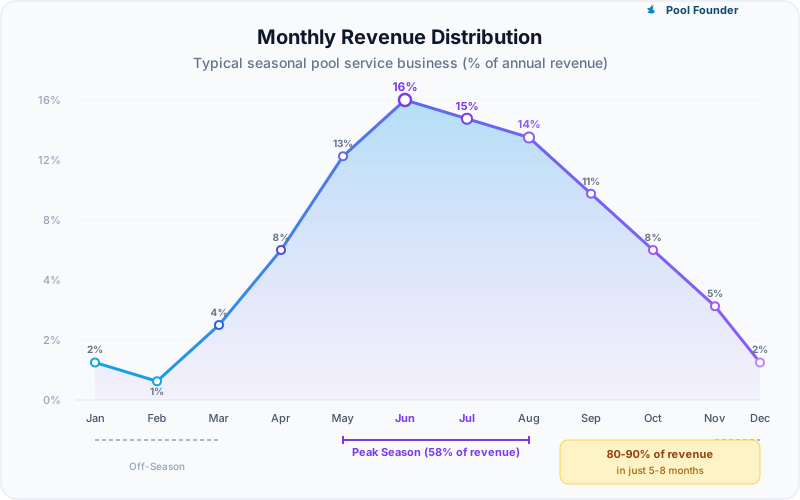
Pool service revenue in seasonal markets follows a bell curve that concentrates 85-90% of annual income between April and October, varies by as much as six weeks between northern and southern regions, and drops to near-zero recurring income from December through March. A pool company in Connecticut operates on a fundamentally different calendar than one in North Carolina, and using the wrong curve creates cash flow problems.
What Does the Standard Seasonal Revenue Curve Look Like?
For most seasonal pool markets — the Northeast, Midwest, and parts of the Mid-Atlantic and Pacific Northwest — the revenue distribution follows a roughly predictable pattern. Pool openings start in April or early May. Weekly service runs from May through September or early October. Closings and winterization cluster in late September through November. December through March generates little to no recurring service revenue.
| Month | Revenue Activity | % of Annual Revenue (Typical) |
|---|---|---|
| January | Off-season — planning, marketing, equipment prep | 1-2% |
| February | Off-season — early bookings begin, pre-season marketing | 1-2% |
| March | Pre-season — opening schedule fills, chemical orders | 3-5% |
| April | Pool openings begin, early weekly service starts | 8-10% |
| May | Full opening rush, weekly service ramp-up | 12-15% |
| June | Peak weekly service, repair calls increase | 14-16% |
| July | Peak season — highest weekly service revenue | 14-16% |
| August | Peak season continues, early closing inquiries | 13-15% |
| September | Closings begin, weekly service winds down | 10-12% |
| October | Heavy closing and winterization month | 8-10% |
| November | Final closings, equipment winterization | 3-5% |
| December | Off-season — year-end accounting, planning | 1-2% |
Those numbers shift depending on your geography. A pool company outside Chicago might compress even further — openings don't really start until late May, and closings are done by mid-October. A company in Virginia or Tennessee gets a longer shoulder season and can stretch weekly service from April through October without much difficulty.
How Do Regional Variations Affect the Seasonal Curve?
Sun Belt markets like Phoenix and Miami maintain 80-90% of service volume year-round, while Northeast and Midwest companies compress 85-90% of revenue into a six-month window from April through October, with HOA requirements and school calendars creating micro-peaks that shift the exact timing by 2-4 weeks per region. In resort areas, the season might start two weeks earlier because vacation rentals need pools ready by Memorial Day weekend. In suburban markets, the real rush often comes right after school lets out.
| Market Type | Active Season | Off-Season Length | Revenue Concentration |
|---|---|---|---|
| Northern (NY, MA, CT, MN, WI) | May - September | 5-6 months | 85-90% in 5 months |
| Mid-Atlantic (VA, NC, MD, PA) | April - October | 3-4 months | 80-85% in 7 months |
| Southern Seasonal (TN, parts of GA, SC) | March - November | 2-3 months | 75-80% in 9 months |
| Year-Round (FL, AZ, TX, Southern CA) | All year | None (mild seasonal dip) | Relatively even distribution |
Your off-season length directly determines how aggressively you need to plan. A company with a five-month off-season needs a fundamentally different financial strategy than one with a two-month slowdown. Track your actual revenue patterns month over month in your service software — real numbers, not estimates — to build the baseline for proper planning.
Why Do Most Pool Companies Underestimate Off-Season Costs?
Seasonal pool businesses that budget based on monthly revenue averages overestimate winter income by 40-60%, creating a cash reserve shortfall that forces owners to cover overhead from personal savings or credit lines during the three to five slowest months. If you gross $360,000 a year, the average month is $30,000. But if 85% of that revenue comes in five months, your peak months are averaging $61,000 while your off-season months are averaging $7,700. That means your fixed costs need to be covered by a much smaller revenue base for nearly half the year.
$2,800-$4,500
Typical monthly fixed costs for a seasonal pool company (1-3 trucks) during off-season
Source: Pool industry operator surveys
Fixed costs that persist through winter typically include vehicle payments and insurance, general liability and workers' comp premiums (often paid monthly or quarterly regardless of activity), warehouse or storage rent, business phone and software subscriptions, and any year-round employee salaries. When you add those up, most small to mid-size seasonal pool companies are burning $2,800 to $4,500 per month even when revenue is near zero.
How Can Pool Companies Generate Revenue in the Off-Season?
Off-season revenue strategies for pool companies fall into three categories: complementary services that use existing equipment and customer relationships, pre-season sales that pull spring revenue into winter months, and renovation project management that turns closed pools into billable work. The specific mix depends on your market, skills, and available capital.
Which Off-Season Services Actually Work for Pool Companies?
Hot tub maintenance, holiday lighting installation, and equipment repair generate $75-$2,000 per job using the skills, trucks, and customer relationships pool companies already have — without requiring new licensing or major equipment investment.
- Hot tub and spa maintenance — Your existing chemistry knowledge transfers directly. Hot tubs run year-round in cold climates, and most homeowners hate maintaining them. Monthly service contracts at $75-$150/month are achievable in affluent markets.
- Holiday lighting installation and removal — This one sounds unrelated, but it's a natural fit. You already have ladders, trucks, and crews comfortable working on residential properties. Companies like Christmas Decor offer franchise models, but many pool companies run this independently. Revenue typically hits $15,000-$40,000 for the season depending on market size.
- Snow removal for existing customers — If you already service a neighborhood, offering snow removal to those same homeowners is a low-friction upsell. You know the properties. The logistics are similar to route-based pool service. The margin on residential snow removal is solid if you price it right.
- Equipment repair and refurbishment — Winter is the perfect time to bring heaters, pumps, and filters into the shop for overhaul. You're not competing with peak-season urgency, so you can batch the work efficiently. Plus, having refurbished equipment ready for spring means faster turnaround on emergency replacements.
- Pool renovation project management — Replasters, tile replacements, deck resurfacing, and equipment upgrades all happen best during the off-season when the pool is already closed. Positioning yourself as the project manager (even if subs do the actual work) keeps revenue flowing and strengthens customer relationships.
The best off-season services share three traits: they use your existing customer relationships, they don't require major new equipment investments, and they generate revenue during your weakest months. If a diversification strategy requires you to build an entirely new customer base from scratch, it's probably not worth the distraction.
How Can Pre-Season Sales Pull Revenue Into Winter?
Early-bird booking incentives, annual service bundles, and chemical pre-buy programs encourage customers to commit and pay deposits during winter months — smoothing cash flow and giving you visibility into your spring schedule before the first pool opens.
- Early-bird opening discounts — Offer 10-15% off pool opening service for customers who book and pay a deposit before March 1st. You sacrifice some margin but gain cash flow and scheduling predictability.
- Annual service packages — Sell a bundled annual contract (opening + weekly service + closing) at a modest discount. Collect the first payment in January or February. This locks in the customer and generates winter cash flow.
- Chemical pre-buy programs — Purchase chemicals in bulk during winter (when prices are often lower) and offer customers a "chemical package" add-on to their service contract. You buy at volume pricing, sell at a markup, and collect the money before the season starts.
- Equipment upgrade packages — Partner with equipment distributors to offer off-season installation deals on heaters, variable-speed pumps, salt systems, or automation. Winter installation means no disruption to their swim season, and you generate project revenue during the slowest months.
Tracking which pre-season packages your customers choose — and what they spend year over year — helps you refine these offers each winter. Your service management software should make it easy to pull reports on seasonal revenue by service type so you can see what's actually moving the needle.
How Do You Diversify Without Overextending?
Pick one or two complementary services and execute them well before adding more. A pool company that also does mediocre Christmas lights and half-hearted snow removal dilutes their brand and exhausts their team. A pool company that becomes the best hot tub service in their area builds a genuine second revenue stream.
For a deeper breakdown of specific off-season revenue strategies — including pricing models and startup costs for each — see our complete guide to pool service off-season revenue ideas.
How Much Should You Charge for Pool Openings and Closings?
Pool opening prices range from $175 to $525 depending on pool type and service tier, closing and winterization runs 15-25% higher across the board, and tiered packaging can increase average ticket revenue by 25-70% over a flat-rate model. Most pool companies underprice these services by treating them as loss leaders for weekly accounts.
What Should Pool Opening Service Cost?
A standard residential pool opening involves removing the cover, reinstalling ladders and accessories, reassembling the pump and filter system, priming and starting the equipment, performing an initial chemical treatment, and doing a basic inspection. The time investment is typically 45 minutes to 2 hours depending on pool complexity, condition, and how well the closing was done the previous fall.
| Pool Type | Base Opening Price | With Cover Cleaning | With Full Chemical Balance |
|---|---|---|---|
| Standard inground (up to 20K gal) | $175 - $275 | $225 - $325 | $250 - $375 |
| Large inground (20K-40K gal) | $225 - $350 | $275 - $400 | $325 - $475 |
| Above ground | $125 - $200 | $175 - $250 | $200 - $300 |
| Pool with spa/hot tub combo | $275 - $400 | $325 - $450 | $375 - $525 |
| Commercial / HOA | $400 - $800+ | Varies by scope | Varies by scope |
These ranges reflect pricing in seasonal markets across the Northeast and Midwest as of 2026. Your local market will vary. The important thing is understanding what drives the range: pool size, equipment complexity, cover condition, and whether chemicals are included or billed separately.
Pricing tip: Don't bundle chemicals into your base opening price. List the opening labor and chemical treatment as separate line items on the invoice. This makes your pricing transparent, lets you adjust chemical costs as prices fluctuate, and shows customers the full value of what they're getting.
What Should Pool Closing and Winterization Cost?
Closings typically take longer than openings and involve more steps: lowering the water level, blowing out plumbing lines, adding winterization chemicals, installing plugs and gizmos, and securing the cover. A properly winterized pool also saves you time and headaches at opening — which is worth communicating to customers who push back on closing prices.
| Pool Type | Standard Closing | With Cover Install | With Safety Cover Install |
|---|---|---|---|
| Standard inground (up to 20K gal) | $200 - $325 | $250 - $375 | $300 - $425 |
| Large inground (20K-40K gal) | $275 - $400 | $325 - $450 | $375 - $500 |
| Above ground | $150 - $225 | $200 - $275 | N/A |
| Pool with spa/hot tub combo | $325 - $475 | $375 - $525 | $425 - $575 |
| Commercial / HOA | $500 - $1,200+ | Varies by scope | Varies by scope |
Notice that closings are priced 15-25% higher than openings across the board. This reflects the additional labor, the winterization chemicals, and the liability component — a bad closing leads to freeze damage, cracked plumbing, and very expensive spring repairs. Your pricing should reflect that expertise and responsibility.
How Should You Structure Seasonal Pricing Tiers?
The most profitable seasonal pool companies don't just offer one opening and one closing package. They create tiers that let customers choose their level of service — and naturally upsell themselves.
- 1Basic tier — Core opening or closing service. Equipment startup/shutdown, basic chemical treatment, cover removal/installation. No extras, no inspection report. This is your entry-level price.
- 2Standard tier — Everything in basic, plus a written equipment inspection report, filter cleaning, and chemical balancing to ideal levels. Most customers land here. Price it 25-35% above basic.
- 3Premium tier — Everything in standard, plus cover cleaning and storage (openings) or cover conditioning and proper fold-and-store (closings), equipment lubrication, o-ring replacement, and a detailed written report with photos. Price it 50-70% above basic. You'll be surprised how many customers choose this when presented with clear options.
When you send opening or closing quotes through your service software, presenting these tiers side by side makes the decision easy for customers. Most people don't choose the cheapest option when they can see the value difference. Tracking which tier each customer selects also gives you data to refine pricing next season — if 80% of customers choose premium, your basic price is probably too low.
How Do You Handle Annual Price Increases?
Seasonal services give you a natural price increase window that monthly service companies don't have. Every spring, you're sending a fresh quote — not adjusting an ongoing bill. Use this. A 5-8% annual increase on opening and closing services is completely reasonable and rarely draws pushback if you communicate it properly.
Send your pre-season pricing in January or February with a brief note: "Our 2026 seasonal pricing reflects increased chemical costs and updated labor rates." That's it. No apology, no lengthy explanation. Customers who've been with you for years expect modest annual increases. The ones who leave over a $15 price bump weren't your best customers anyway.
How Do Seasonal Pool Companies Manage Cash Flow?
Cash flow failure — not annual unprofitability — is the primary reason seasonal pool businesses close, with most operators needing $12,000-$40,000 in reserves to cover off-season fixed costs and a 25-30% peak-season savings rate to build that buffer within two years. Running out of cash in February leads to debt accumulation, deferred maintenance, and employee loss.
How Much Cash Reserve Does a Seasonal Pool Company Need?
Start with your total monthly fixed costs — everything you pay regardless of whether you're servicing pools. Multiply by the number of off-season months in your market. Add a 20% buffer for unexpected expenses. That's your minimum cash reserve target.
| Fixed Cost Category | Monthly Estimate | 5-Month Off-Season Total |
|---|---|---|
| Vehicle payments and insurance | $800 - $2,000 | $4,000 - $10,000 |
| General liability insurance | $200 - $500 | $1,000 - $2,500 |
| Workers' comp (if maintaining coverage) | $300 - $800 | $1,500 - $4,000 |
| Warehouse/storage rent | $400 - $1,200 | $2,000 - $6,000 |
| Software and phone | $100 - $300 | $500 - $1,500 |
| Loan payments | $0 - $1,500 | $0 - $7,500 |
| Miscellaneous (licenses, accounting, etc.) | $200 - $500 | $1,000 - $2,500 |
| TOTAL RANGE | $2,000 - $6,800/mo | $10,000 - $34,000 |
| With 20% buffer | $12,000 - $40,800 |
If that number looks daunting, that's actually the point. Knowing the real number forces better planning. And for most pool companies in the $250K-$500K annual revenue range, building a $15,000-$25,000 cash reserve is achievable within one to two seasons if you start setting aside money intentionally during peak months.
How Much Should You Set Aside Each Month?
The simplest approach to building your seasonal cash reserve: open a separate business savings account and transfer a fixed percentage of revenue into it every month during peak season. Don't touch it until the off-season.
How much to set aside depends on your off-season length. For a five-month off-season, plan to save 25-30% of gross revenue during your peak months (May through September). That sounds aggressive, and it is — but the alternative is scrambling in January. Once your reserve is fully funded, you can drop that percentage to a maintenance level of 10-15%.
Track your monthly revenue against your seasonal targets in your service software. If June comes in 15% below projection, you'll know by July 1st — not in October when it's too late to adjust. The companies that get blindsided by cash flow problems are almost always the ones that don't look at the numbers until year-end.
When Should Seasonal Companies Time Major Expenses?
Vehicle purchases, equipment upgrades, and insurance renewals can be timed to align with peak cash flow months — reducing the strain on off-season reserves and improving tax positioning.
- Schedule vehicle purchases and equipment investments for your highest-revenue months (June-August). Avoid financing decisions in winter when cash is tight and you're more likely to accept unfavorable terms.
- Negotiate annual insurance premiums for mid-season renewal dates rather than January renewals. Paying a large premium in your highest-revenue month is much less painful than paying it during the dead of winter.
- Buy chemicals in bulk during fall or early winter when suppliers often offer off-season pricing. You'll need storage space, but the 10-20% savings on a full season of chemicals adds up fast.
- Defer non-essential equipment upgrades to late summer when you have the best cash position and can make rational purchasing decisions rather than panic buys.
- Pay estimated quarterly taxes from the months that generated the revenue. Don't let a June tax bill surprise you in January. Set aside 25-30% of profit for taxes in real time.
How Should Seasonal Pool Companies Manage Accounts Receivable?
Getting paid on time matters more in seasonal businesses because you have a shorter window to collect. A customer who owes you $500 from September service and doesn't pay until December just cost you cash during your most vulnerable months.
Best practices for seasonal AR management: require credit cards on file for all weekly service accounts. Invoice openings and closings at the time of service, not at the end of the month. For annual contracts, collect the full amount or at least a 50% deposit before the season starts. Send automatic payment reminders at 3, 7, and 14 days past due. And cut off service for accounts more than 30 days past due — being lenient in August means chasing money in November when you have no leverage.
Automated invoicing through your service management platform removes the awkwardness of chasing payments and ensures nothing slips through the cracks during your busiest months. When invoices go out the same day as service completion, collection rates improve dramatically.
How Should Seasonal Pool Businesses Handle Year-End Tax Planning?
Seasonal pool businesses often have a unique tax planning opportunity. If your fiscal year aligns with the calendar year, most of your revenue arrives in a concentrated period. This creates opportunities for strategic equipment purchases (Section 179 deductions), retirement contributions, and expense timing that can significantly reduce your tax burden. Work with an accountant who understands seasonal businesses — not every CPA does. The difference between a good seasonal tax strategy and a generic one can easily be five figures.
When Should a Pool Company Switch to Year-Round Service?
Year-round pool companies achieve more stable monthly cash flow, retain customers at higher rates due to continuous relationships, and command stronger business valuations at sale — but the transition only makes financial sense in markets where pools operate eight or more months per year or where complementary services fill the remaining gap.
In Which Markets Does Year-Round Pool Service Make Sense?
The viability of year-round service depends almost entirely on your market. If you're in Florida, Arizona, Texas, or Southern California, the question isn't whether to go year-round — it's how to maximize the slight seasonal dip. If you're in Minnesota or Massachusetts, true year-round pool service isn't realistic, but year-round revenue from complementary services absolutely is.
The sweet spot for transitioning is in markets where pools can be operated 8-10 months of the year with heated pools extending even further: the Mid-Atlantic, upper South, parts of the Pacific Northwest, and anywhere customers have pool heaters or indoor pools. In these markets, you can shift from a "seasonal with closings" model to a "year-round with reduced winter schedule" model.
What Does a Year-Round Transition Look Like Year by Year?
- 1Year one: Identify your year-round candidates. Look at customers with pool heaters, indoor pools, attached spas, or enclosed pools. Offer them monthly winter maintenance at a reduced rate — typically 40-60% of their summer monthly rate. Even converting 15-20% of your customer base to year-round service makes a meaningful difference in winter cash flow.
- 2Year two: Add complementary winter services. Hot tub maintenance, equipment repair and refurbishment, and pool renovation project management are natural extensions. Market these to your existing customer base first, then expand. Track revenue by service type so you can see what's gaining traction.
- 3Year three: Restructure your service packages. Instead of offering "weekly summer service + opening + closing," offer annual service plans with seasonal adjustments built in. Customers pay a consistent monthly rate (slightly higher than seasonal-only pricing) and you maintain the pool year-round with appropriate seasonal modifications. This is the model that truly eliminates the feast-or-famine cycle.
- 4Year four and beyond: Consider geographic expansion. If your home market is deeply seasonal, expanding into a nearby market with a longer season can balance your revenue curve. A pool company based in northern New Jersey that also services central New Jersey and the shore extends their season by 4-6 weeks on each end.
How Should You Price Year-Round Pool Service?
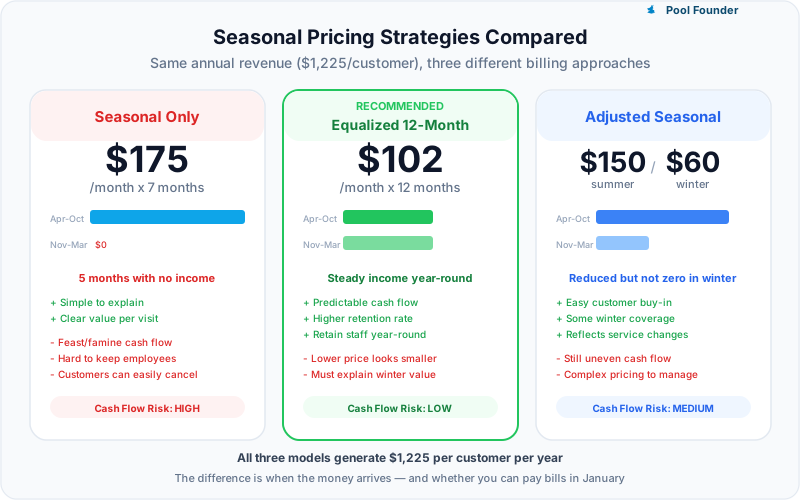
The equalized monthly payment model takes the customer's total annual service cost — weekly service, opening, closing, chemicals — and divides it by 12. The customer pays the same amount every month, which they love because it's predictable. You love it because January revenue looks a lot like July revenue. The key is calculating the annual cost accurately so you don't end up subsidizing the service.
The seasonal-adjusted model charges full rate during the active season, a reduced rate (typically 40-60%) during shoulder months, and a nominal "maintenance" rate during deep winter. This feels more intuitive to customers who know their pool isn't being serviced weekly in January, but it doesn't flatten the revenue curve as effectively.
| Model | Monthly Rate Example | Customer Appeal | Cash Flow Impact |
|---|---|---|---|
| Seasonal only | $150/mo (May-Sep) + $250 open + $300 close | Lowest cost perception | Extreme peaks and valleys |
| Seasonal-adjusted | $150/mo peak, $75/mo shoulder, $40/mo winter | Moderate — pays less in winter | Smoothed but still variable |
| Equalized annual | $120/mo x 12 months | Highest appeal — predictable budget | Nearly flat cash flow |
When you run equalized annual pricing, your service software needs to track the actual service delivered against the annual contract value. This ensures you're not over-servicing in summer or under-delivering on the annual commitment. Setting up recurring invoices with annual contract tracking eliminates the manual math.
What Can Seasonal Companies Learn From Year-Round Markets?
Pool companies in Florida, Arizona, and Texas don't deal with the same seasonal extremes, but they still have revenue patterns worth understanding. Florida pool service sees a dip from November through February — not because pools close, but because snowbirds leave, vacation rentals slow down, and some customers pause service. Arizona companies deal with extreme summer heat that actually reduces pool usage (and associated service calls) in July and August, while spring and fall are peak seasons.
No pool business has perfectly flat revenue. The operators who thrive understand their specific seasonal pattern and plan around it. A Florida company that knows January runs 15% below average can time marketing pushes and upsell campaigns accordingly.
How Does Going Year-Round Affect Staffing?
The biggest operational challenge of going year-round is staffing. Seasonal companies often rely on workers who expect winters off — landscapers picking up pool work in summer, college students, or seasonal laborers. Year-round service requires year-round employees, which means higher base labor costs but dramatically better retention and service quality.
The math usually works like this: a good seasonal technician costs you $20-$28/hour for six months. Training their replacement every spring costs you two to three weeks of reduced productivity plus the risk of losing customers to inconsistent service. A year-round technician at the same rate costs more in total salary, but you eliminate training costs, reduce customer complaints during transitions, and build the kind of institutional knowledge that makes your company more valuable.
During the slower winter months, year-round techs can handle equipment repairs, inventory management, vehicle maintenance, customer relationship follow-ups, and training. They're not sitting idle — they're building the infrastructure that makes your peak season more efficient.
How Do You Build a Seasonal Pool Business Plan?
A seasonal pool business plan requires quarterly revenue targets tied to your regional calendar, monthly tracking of six key metrics including cash reserves and retention rates, and a written action checklist for each phase from pre-season hiring through post-season financial review.
What Should Each Quarter Focus On?
| Quarter | Planning Focus | Key Actions |
|---|---|---|
| Q1 (Jan-Mar) | Pre-season preparation | Set seasonal pricing, send pre-season offers, hire and train seasonal staff, order chemicals, schedule openings, review and update service contracts |
| Q2 (Apr-Jun) | Ramp-up and peak operations | Execute openings, optimize routes for full schedule, monitor revenue against targets, begin setting aside cash reserves, address equipment repairs |
| Q3 (Jul-Sep) | Peak season and closing prep | Maintain service quality under full load, begin booking closings, evaluate off-season revenue plans, review mid-year financials, plan fall marketing |
| Q4 (Oct-Dec) | Wind-down and strategic planning | Execute closings, launch off-season services, conduct year-end financial review, plan next season pricing, invest in training and marketing |
Which Metrics Should Seasonal Pool Companies Track?
Revenue per pool, customer retention rate, and cash reserve runway are the three numbers that predict whether a seasonal pool company will survive its next off-season or struggle to make payroll.
- Revenue by service type (weekly service, openings, closings, repairs, off-season services) — broken out monthly so you can spot trends and compare year over year.
- Cash reserve balance — tracked against your target reserve amount. If you're behind by July, you need to adjust spending or push harder on collections.
- Customer retention rate season over season — what percentage of last year's customers rebooked? Anything below 85% signals a problem worth investigating.
- Average revenue per customer — including all services, not just weekly. A customer who gets weekly service, an opening, a closing, and a heater repair is worth far more than one who only gets summer service.
- Days to collect — how long it takes to get paid after invoicing. Seasonal businesses should target under 14 days during active season and under 7 days for opening/closing services.
- Off-season revenue as a percentage of total — track this year over year to see if your diversification strategy is actually working.
Pulling these reports from your service management platform at the end of each month takes maybe 20 minutes. That 20 minutes prevents the "I had no idea we were this far behind" conversation in October that every seasonal business owner dreads.
What Are the Most Common Seasonal Planning Mistakes?
Budgeting from annual averages instead of monthly actuals, waiting until November to plan for winter, and treating staff as disposable seasonal labor are the three mistakes that sink the most seasonal pool businesses.
- 1Treating peak-season revenue as normal revenue. When June deposits $60,000, it's tempting to spend like $60,000 is your new baseline. It's not. That money has to fund January through March. Budget based on annual numbers, not monthly peaks.
- 2Waiting until spring to hire. Good technicians get snapped up in February and March. If you're posting job ads in April, you're competing with every other pool company that also waited too long. Start recruiting in January.
- 3Underpricing openings and closings to "keep customers happy." Your seasonal services are specialized, time-sensitive, and require expertise. Price them accordingly. The customers who leave over a $20 price increase weren't loyal — they were just waiting for a reason.
- 4Not collecting deposits on pre-season bookings. A customer who books an opening in February and cancels in April cost you a scheduling slot you can't fill. Require a non-refundable deposit of at least 25-50% at booking.
- 5Ignoring off-season revenue opportunities because "that's not what we do." Every dollar of off-season revenue reduces your dependence on peak-season performance. Even $2,000-$3,000/month in winter income fundamentally changes your financial picture.
- 6Failing to track seasonal patterns in your service software. If you don't know that your revenue dropped 12% in September compared to last year, you can't react in time. Historical data is the foundation of good seasonal planning.
Ready to streamline your pool service business?
Pool Founder gives you route optimization, automated invoicing, chemical tracking, and everything else you need to run a more profitable pool business.
Frequently Asked Questions
How can pool companies use seasonal urgency to sell above ground swimming pools?
Pool service companies can leverage seasonal urgency to drive above ground pool sales by timing marketing pushes to the pre-season window (February through April in most markets) when homeowner demand peaks. The urgency comes from three factors: above ground pool inventory often sells out by late May, installation timelines extend as the season progresses, and customers want pools ready before school lets out. Effective approaches include offering bundled deals that pair above ground pool installation with a first-season weekly maintenance contract, sending targeted emails to leads in January and February emphasizing limited availability, and creating tiered packages (basic installation, full setup with deck, premium with automation) that let customers self-select. Pool companies already have the customer base, the chemistry knowledge, and the service infrastructure to capture this revenue. Marketing seasonal deadlines around Memorial Day and Fourth of July creates genuine urgency because the swim season is finite. Tracking pre-season bookings in your service software helps you forecast inventory needs and staff scheduling before the rush hits.
How much should a seasonal pool business keep in cash reserves?
A good target is your total monthly fixed costs multiplied by the number of off-season months, plus a 20% buffer. For most seasonal pool companies with 1-3 trucks, this works out to $12,000-$40,000 depending on your overhead and how long your off-season lasts. Build this reserve during peak months by setting aside 25-30% of gross revenue.
What is the best off-season revenue strategy for pool companies?
The most effective strategies leverage your existing customer relationships and skills. Hot tub and spa maintenance is a natural fit because your chemistry knowledge transfers directly. Holiday lighting installation works well because you already have trucks, ladders, and crews comfortable on residential properties. Pre-season booking incentives (early-bird discounts for paying deposits in winter) are the lowest-effort option because they pull existing revenue forward without requiring new services.
How much should I charge for pool opening service?
Standard residential pool opening prices range from $175-$375 depending on pool size, complexity, and whether chemicals are included. Large or complex pools with automation, spas, or water features command the higher end. Offer tiered packages (basic, standard, premium) to let customers self-select and naturally increase your average ticket. Always list chemical treatment as a separate line item.
How much should I charge for pool closing and winterization?
Pool closing and winterization typically runs 15-25% more than opening prices, ranging from $200-$500 for residential pools. The higher price reflects additional labor (blowing out lines, installing plugs, lowering water), winterization chemicals, and the liability of a proper winterization. If freeze damage occurs due to a poor closing, you could be on the hook for thousands in repairs.
Should I offer annual contracts or seasonal-only service?
Annual contracts with equalized monthly payments are better for both you and your customers in most cases. Customers get predictable monthly bills. You get consistent cash flow and higher retention rates. An annual contract customer who pays $120/month for 12 months is worth $1,440/year and almost never leaves. A seasonal customer who pays $150/month for 5 months plus opening and closing fees might generate similar revenue but is far more likely to shop around each spring.
How do I transition from seasonal to year-round pool service?
Start by identifying customers with heated pools, indoor pools, or attached spas — they're your natural year-round candidates. Offer reduced winter maintenance at 40-60% of summer rates. In year two, add complementary services like hot tub maintenance and equipment repair. By year three, restructure your packages into annual plans with seasonal adjustments. Most successful transitions take 2-3 years to fully implement.
When should I start booking pool openings for the season?
Start marketing opening services and accepting bookings in January. Offer early-bird pricing for customers who book and pay a deposit before March 1st. This gives you scheduling visibility, generates winter cash flow, and ensures your spring calendar fills predictably instead of all at once in April. Most well-run seasonal companies have 60-70% of their opening schedule booked before the season starts.
How do pool companies in Florida and Arizona handle seasonal fluctuations?
Year-round markets still have seasonal patterns — they're just less extreme. Florida pool companies see a 10-20% revenue dip from November through February as snowbirds leave and vacation rentals slow down. Arizona companies experience reduced service calls in extreme summer heat. Smart operators in these markets use the slower periods for upselling equipment upgrades, deep cleaning services, and renovation projects rather than simply accepting lower revenue.
What percentage of annual revenue should come from off-season services?
For a mature seasonal pool business with a solid diversification strategy, target 15-25% of annual revenue from off-season activities within 2-3 years. This includes both new services (hot tub maintenance, holiday lighting, snow removal) and pre-season revenue pulls (early-bird deposits, annual contract payments, chemical pre-buys). Even reaching 10% off-season revenue meaningfully reduces your financial stress during winter months.
Should I keep employees through the off-season or hire seasonally?
If you can afford it, keeping at least your core team year-round pays for itself through reduced training costs, better customer service continuity, and higher employee loyalty. The cost of replacing and retraining a technician every spring — typically 2-3 weeks of reduced productivity plus recruitment costs — often exceeds the cost of carrying them through winter at reduced hours. Use winter months for equipment maintenance, training, customer follow-ups, and off-season services to keep them productive.