How Much Has Pool Service Pricing Changed Since 2020?
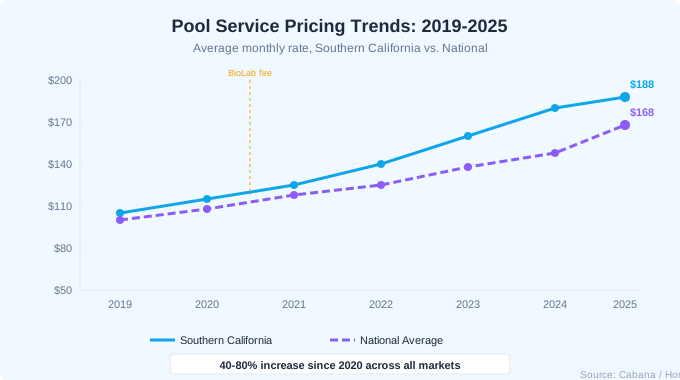
Pool service prices have increased 40-80% since 2020, depending on the market. In Southern California, the average monthly rate went from just over $100 in 2019 to $180 in 2024. Nationally, the average monthly cost for pool maintenance now ranges from $80 to $195, with premium markets like Los Angeles County and Orange County pushing past $230 per month. These are the largest sustained price increases the pool service industry has ever seen.
The increases were driven by three overlapping forces: the chlorine crisis triggered by the BioLab plant fire in 2020, the labor shortage caused by the pandemic and subsequent pool boom, and general inflation that raised the cost of fuel, insurance, and vehicle maintenance. Understanding these pricing trends matters whether you are setting rates for a new business, planning your next price increase, or evaluating whether your market will support higher pricing.
$140-$195
average monthly pool service rate nationally in 2025
Source: HomeGuide, Angi, Cabana Pool Service
40-80%
price increase for pool service since 2020 depending on market
Source: Service Industry News, Cabana 2025 Pricing Study
$960-$1,800
annual pool maintenance cost range for homeowners
Source: Angi, HomeGuide
What Are Current Pool Service Rates by Region?
Pool service pricing varies significantly by market, driven by local labor costs, chemical prices, competition density, and cost of living. California leads with the highest rates nationally, while Florida maintains surprisingly moderate pricing despite being the state with the most pools. Arizona and Texas fall between these two extremes.
| Market | Avg Monthly Rate (2025) | Premium Areas | Budget Areas |
|---|---|---|---|
| California (statewide) | $195 | LA/OC: $230 | Central Valley: $150 |
| Southern California | $180 | Beverly Hills: $250+ | Inland Empire: $155 |
| Texas (statewide) | $198 | Austin: $218 | El Paso: $168 |
| Dallas-Fort Worth | $208 | Plano/Frisco: $225 | Outer suburbs: $180 |
| Florida (statewide) | $143 | Naples: $157 | Central FL: $130 |
| Arizona (statewide) | $130 | Scottsdale: $140 | Tucson: $120 |
| Phoenix metro | $130 | Paradise Valley: $160 | Mesa/Gilbert: $120 |
| National average | $140 | Major metros: $175+ | Rural markets: $80-100 |
Florida has 1.59 million pools but maintains the lowest per-pool pricing among major markets. This is partly due to intense competition (more pool companies per capita) and partly because Florida pool service requires fewer chemicals in winter months, reducing year-round cost pressure.
How Did Pool Service Prices Change Year Over Year?
The pricing trajectory from 2019 to 2025 follows a clear pattern: steady pre-pandemic levels, sharp chemical-driven increases in 2021-2022, labor-driven increases in 2023-2024, and a moderation period beginning in 2025 as chemical prices stabilized while labor costs continued rising at a slower pace.
| Year | Southern CA Avg | National Avg Range | Primary Cost Driver |
|---|---|---|---|
| 2019 | ~$100-110 | $80-$120 | Stable pre-pandemic baseline |
| 2020 | ~$110-120 | $85-$130 | BioLab fire, early pandemic disruption |
| 2021 | ~$120-130 | $95-$140 | Chlorine prices doubled, labor tightening |
| 2022 | ~$140 | $100-$150 | Chemical costs peak, wage competition |
| 2023 | ~$160 | $110-$165 | Labor cost pass-through, fuel inflation |
| 2024 | ~$180 | $120-$175 | Continued labor increases, insurance costs |
| 2025 | ~$180-195 | $140-$195 | Chemical stabilization, labor still tight |
Southern California experienced the steepest increases because it started with the highest baseline and has the most expensive labor market. But every market saw significant increases. The average pool service customer in 2025 is paying 40-80% more than they were in 2019 for the same weekly service.
What Caused the Price Increases?
Three cost shocks hit the pool service industry in rapid succession, and each one drove a wave of price increases that compounded on the previous one. The result was a 5-year period of sustained cost inflation that forced operators to raise prices repeatedly.
The Chlorine Crisis (2020-2023)
Hurricane Laura destroyed the BioLab manufacturing plant in August 2020, wiping out 40% of the nation's chlorine tablet supply. Trichlor prices rose from $80 per 50-pound bucket to as high as $150. Chlorine tablets that cost $75-85 for two decades suddenly cost $130-190. The BioLab plant reopened gradually through 2023, but prices remained above pre-pandemic levels.
The Labor Shortage (2021-Present)
Pool technician wages increased 20-30% between 2020 and 2025, from $15-17/hour to $18-21/hour nationally. The pandemic tightened the labor market, the pool construction boom increased demand for technicians, and competing trades (plumbing at $28/hour, HVAC at $25/hour) pulled workers away. Labor is typically 40-50% of a pool service company's costs, so a 25% wage increase translates to a 10-12% cost increase on every route.
General Inflation (2022-Present)
Fuel costs, vehicle prices, insurance premiums, and equipment costs all increased 15-30% between 2020 and 2025. Commercial auto insurance, a major expense for pool service companies, increased 15-20% in 2023-2024 alone. These costs are less visible to customers than chemical and labor increases, but they are just as real and just as permanent.
How Did Price Increases Affect Customer Churn?
The conventional wisdom is that price increases cause churn. The data tells a different story. The pool service industry maintained 80-90% annual retention rates throughout the 2020-2025 pricing increases. Most customers accepted the increases because every pool company in their market was raising prices simultaneously. The companies that lost customers were not the ones that raised prices. They were the ones that raised prices without communicating why.
| Price Increase Approach | Typical Churn Impact | Notes |
|---|---|---|
| 5-10% with 30-day notice and explanation | 1-3% additional churn | Most customers accept when costs are explained |
| 10-15% with explanation of cost drivers | 3-5% additional churn | Some price-sensitive customers leave |
| 15-20% catch-up increase | 5-10% additional churn | Higher churn but revenue still increases net |
| Any increase with no communication | 8-15% additional churn | Customers feel blindsided, switch to competitors |
| No increase (absorb costs) | 0% price churn | But 5-10% margin erosion, unsustainable long-term |
The math typically works in favor of raising prices. If you raise rates 10% and lose 3% of customers, your net revenue still increases by about 7%. A 100-customer route at $150/month generates $15,000. After a 10% increase with 3% churn, you have 97 customers at $165/month generating $16,005. You are ahead even after the losses.
Companies that raised prices annually in small increments (5-8%) experienced less churn than companies that waited 2-3 years and hit customers with a 15-20% jump. Consistent, annual increases condition customers to expect gradual adjustments.
What Do Pool Service Rates Include?
The standard "weekly pool service" includes a technician visit once per week to skim the surface, vacuum or brush the pool, empty baskets, test and balance water chemistry, and add necessary chemicals. Beyond that, what is included varies significantly by company and market. Some companies include all chemicals in the monthly rate. Others charge chemicals separately. Equipment repair, filter cleaning, and salt cell maintenance are almost always separate charges.
| Service Component | Typically Included | Usually Extra |
|---|---|---|
| Weekly cleaning visit | Yes | |
| Surface skimming | Yes | |
| Water chemistry testing | Yes | |
| Basic chemicals (chlorine, acid) | Varies by market | Some markets charge separately |
| Filter cleaning | $75-$150 per cleaning | |
| Equipment repair | Billed hourly + parts | |
| Salt cell cleaning | $75-$125 per cleaning | |
| Pool opening/closing | $150-$350 per service | |
| Drain and refill | $250-$500 | |
| Acid wash | $350-$600 |
The trend is moving toward all-inclusive pricing. Companies that bundle chemicals, filter cleaning, and basic equipment checks into a higher monthly rate ($175-225/month) report higher customer satisfaction and lower churn than companies charging a lower base rate ($100-130) with frequent add-on charges. Customers prefer predictable billing.
Where Are Pool Service Prices Headed Next?
Chemical prices have stabilized near pre-pandemic levels, removing one of the three cost drivers. But labor costs continue rising 3-5% annually, and insurance and fuel costs show no signs of decreasing. The expected pricing trajectory for 2026-2028 is 3-6% annual increases in most markets, down from the 8-15% annual increases seen in 2021-2024.
| Cost Factor | 2026 Outlook | Impact on Pricing |
|---|---|---|
| Chemical costs | Stable to slight decrease | Neutral |
| Labor costs | Rising 3-5% annually | Primary upward pressure |
| Fuel | Moderate, dependent on oil markets | Minor upward pressure |
| Insurance | Rising 5-10% annually | Moderate upward pressure |
| Vehicle costs | Stable | Neutral |
| Technology/software | Stable to slight increase | Minor, offset by efficiency gains |
Pool companies should plan for 4-6% annual rate increases as the new normal. Any company that has not raised prices in the past 12 months is falling behind its own cost structure. The companies that will be most profitable are those that raise prices annually, communicate the reasons clearly, and invest in service quality that justifies the increases.
Corey Adams, Pool Founder co-founder and 15-year pool veteran: "In 2019, I was charging $110/month and felt like I was doing well. Today, $110 would not cover my costs. If you have not raised prices since the pandemic, you are working harder for less money. The market will support $150-175 in most areas. You just have to ask for it."
Ready to streamline your pool service business?
Pool Founder gives you route optimization, automated invoicing, chemical tracking, and everything else you need to run a more profitable pool business.
Frequently Asked Questions
How much does pool service cost per month in 2026?
The national average for monthly pool service is $140-195, with significant regional variation. California averages $195 (up to $230 in premium markets), Texas averages $198, Florida averages $143, and Arizona averages $130. Basic weekly cleaning service including chemicals typically falls in the $125-175 range in most markets.
Why did pool service prices increase so much since 2020?
Three factors drove increases: the 2020 BioLab plant fire destroyed 40% of chlorine tablet supply, causing chemical prices to double. Technician wages rose 20-30% due to labor shortages. General inflation increased fuel, insurance, and vehicle costs 15-30%. Together, these forces pushed pool service rates up 40-80% in most markets.
How much should you raise pool service prices each year?
Plan for 4-6% annual increases to keep pace with labor and operating cost inflation. Communicate increases 30 days in advance with a clear explanation of cost drivers. Companies that raise prices in small annual increments experience less churn than those that wait years and impose large catch-up increases.
Do price increases cause customers to cancel pool service?
Modest increases (5-10%) with clear communication typically cause only 1-3% additional churn. The net revenue impact is positive because 97% of customers paying higher rates more than offsets the 3% loss. Companies that raise prices without communication see 8-15% churn.
What is included in a monthly pool service rate?
Standard weekly service includes a cleaning visit, surface skimming, water chemistry testing, and basic chemicals. Filter cleaning ($75-150), equipment repair, salt cell cleaning, and seasonal services like opening/closing ($150-350) are typically extra. The trend is toward all-inclusive pricing at $175-225/month.
Which state has the most expensive pool service?
California has the highest pool service rates, averaging $195 statewide and reaching $230 in premium markets like Los Angeles, Orange County, and the Bay Area. Texas follows at $198 statewide. Florida, despite having the most pools, maintains moderate pricing at $143 statewide due to intense competition.
Sources & References
- Service Industry News: Survey Reveals Pool Service Prices Rising
- Cabana Pool Service: 2025 Pool Service Pricing Study
- Angi: How Much Does It Cost to Maintain a Pool (2026)
- HomeGuide: 2026 Pool Maintenance Costs
- Service Industry News: Chlorine Prices Update
- Pool Magazine: BioLab Plant Reopening Impact on Chlorine Prices