Key Takeaway
10 - 20%
Typical annual customer churn rate for pool service companies
Source: AQUA Magazine, industry broker data
80 - 90%
Annual customer retention rate for well-run pool service operations
Source: Sealey Business Brokers, DealStream
5 - 25x
How much more it costs to acquire a new customer vs. retaining one
Source: Bain & Company / Harvard Business Review
Customer churn is the single biggest threat to pool service profitability that most operators never measure. If you lose 20% of your customers every year, you are running on a treadmill, replacing accounts just to stay flat. The typical pool service company loses 10% to 20% of its customer base annually, which translates to roughly 1% to 2% monthly churn. That range comes from pool route broker data, AQUA Magazine benchmarks, and operator surveys across the industry.
This article breaks down what normal churn looks like for pool service businesses, the top reasons customers cancel, how to calculate your own churn rate, the real revenue cost of losing accounts, and specific strategies that move the needle on retention. Whether you are evaluating your route profitability or trying to figure out why customers keep leaving, these benchmarks will give you a clear target to measure against.
Churn rate and retention rate are two sides of the same coin. If your annual retention rate is 85%, your annual churn rate is 15%. This article uses both terms depending on context, but they always add up to 100%.
What Is a Normal Churn Rate for Pool Service Companies?
A normal annual churn rate for pool service companies is 10% to 20%, meaning you retain 80% to 90% of your customer base year over year. Well-run operations with strong communication and consistent service quality hold churn below 10%, while companies with poor follow-up, inconsistent techs, or no service reports often see churn above 20%. Pool route brokers consider a 90%+ retention rate "high value" and routes with less than 80% retention a red flag during due diligence.
These numbers come from multiple sources. Pool route brokers like Sealey Business Brokers and Tower Business Brokers report that pool routes typically maintain 80% to 90% annual retention rates, with premium routes exceeding 90%. AQUA Magazine analyzed a point-of-sale database of 88,000 pool and spa consumers and found the best-performing company achieved a 73% annual retention rate for retail customers, though recurring service accounts retain at significantly higher rates than one-time retail buyers.
| Performance Tier | Annual Churn | Annual Retention | What It Means |
|---|---|---|---|
| Excellent | Under 5% | 95%+ | Tight routes, strong relationships, consistent service |
| Good | 5 - 10% | 90 - 95% | Solid operation with room for minor improvement |
| Average | 10 - 15% | 85 - 90% | Typical for most pool service companies |
| Below average | 15 - 20% | 80 - 85% | Communication or quality issues need attention |
| Poor | 20%+ | Under 80% | Structural problems with service delivery or pricing |
How does pool service churn compare to other home service industries?
Pool service has lower churn than most home service verticals because pools require ongoing, non-optional maintenance. Pest control companies target 82% to 87% annual retention for residential accounts and 94%+ for commercial, according to Spring Green franchise benchmarks. Lawn care businesses typically plan for 10% annual cancellation rates. HVAC and plumbing companies have much higher churn because their revenue is project-based rather than recurring.
| Industry | Annual Retention | Annual Churn | Revenue Model |
|---|---|---|---|
| Pool service | 80 - 90% | 10 - 20% | Weekly/bi-weekly recurring |
| Pest control (residential) | 82 - 87% | 13 - 18% | Monthly/quarterly recurring |
| Lawn care | 85 - 90% | 10 - 15% | Weekly/bi-weekly seasonal |
| Commercial insurance | 86% | 14% | Annual contracts |
| IT managed services | 83% | 17% | Monthly retainer |
The recurring nature of pool maintenance is your biggest retention advantage. A pool owner cannot simply skip a month without consequences, unlike a pest control customer who might cancel because they "haven't seen any bugs lately." That built-in necessity gives pool service companies a structural edge, but only if the service quality matches the expectation.
Why Do Pool Service Customers Cancel?
The number one reason pool service customers cancel is the perception that the service is not being performed consistently or thoroughly. It is not price. In a 2023 survey of 1,200 pool owners, 82% said they would stay with a company that "communicates like a concierge," even if the monthly rate increased by up to 12%. The problem is visibility. When the pool looks fine, the customer starts wondering what they are actually paying for.
What are the top reasons pool customers leave?
Pool customers leave for six primary reasons, and most of them are preventable with the right systems in place. Here are the biggest drivers of churn, ranked by frequency based on industry data and operator surveys.
- 1Invisible service. The pool looks the same before and after the tech visits. No service reports, no photos, no communication. The customer forgets you were even there and starts questioning the bill.
- 2Inconsistent quality. Green water events, algae outbreaks, or equipment failures that should have been caught during routine visits. One bad experience can undo months of good service.
- 3Poor communication. Missed appointment notifications, no response to complaints, no heads-up about schedule changes. Customers want to feel informed, not ignored.
- 4Technician turnover. A new tech every few months destroys the personal relationship. Pool owners want "their pool guy," not a rotating cast of strangers.
- 5Price sensitivity triggered by lifestyle changes. The homeowner stops using the pool, a neighbor offers a cheaper price, or financial circumstances change. This type of churn is harder to prevent but can be reduced by demonstrating ongoing value.
- 6Seasonal cancellation. In markets with winter seasons, customers suspend or cancel during cold months. Many never restart because they find a different provider or decide to DIY.
Notice that "price is too high" is not at the top of this list. Pool owners who cancel over price alone were usually the wrong customers to begin with. Companies that compete primarily on price attract the most churn-prone customers.
How Do You Calculate Your Customer Churn Rate?
Customer churn rate is the percentage of customers who cancel during a specific period divided by the number of customers you had at the start of that period. Most pool service operators should calculate this monthly and annually. The monthly number catches problems early. The annual number shows the real trend.
What is the formula for customer churn rate?
The formula is straightforward: Churn Rate = (Customers Lost During Period / Customers at Start of Period) x 100. For example, if you started January with 100 customers and lost 2 by January 31, your monthly churn rate is 2%. If you started the year with 100 customers and lost 15 by December 31, your annual churn rate is 15%.
| Metric | Formula | Example |
|---|---|---|
| Monthly churn rate | (Customers lost in month / Customers at start of month) x 100 | 2 lost / 100 start = 2% |
| Annual churn rate | (Customers lost in year / Customers at start of year) x 100 | 15 lost / 100 start = 15% |
| Revenue churn rate | (MRR lost from cancellations / MRR at start of month) x 100 | $310 lost / $15,500 MRR = 2% |
Should you track customer churn or revenue churn?
Track both, but revenue churn is more important for understanding the financial impact. If you lose two customers paying $100/month and one customer paying $250/month, the customer churn is the same (one cancellation), but the revenue impact is very different. Revenue churn also captures downgrades, such as when a customer switches from weekly to bi-weekly service without fully canceling.
If you are using pool service software that tracks your customer count and monthly recurring revenue over time, you can pull these numbers in seconds. If you are running off spreadsheets, set a calendar reminder to count your active customers on the first of every month. Even that basic tracking will tell you more than most pool service owners know about their own business.
What Is the Revenue Impact of Different Churn Rates?
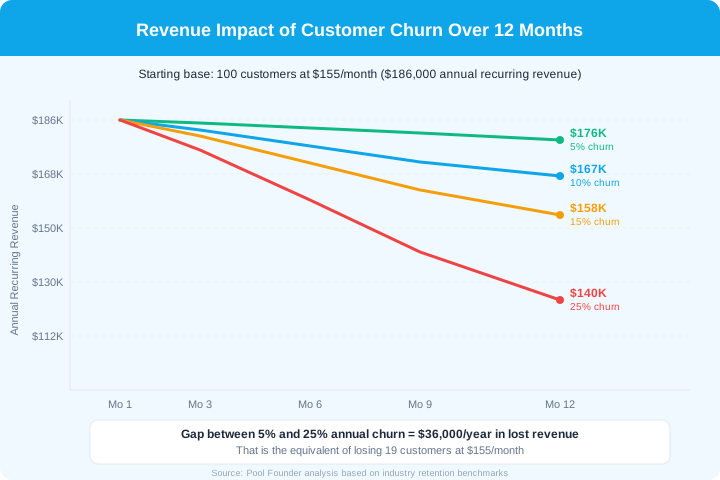
The revenue difference between a 5% and 25% annual churn rate is roughly $36,000 per year for a 100-customer pool service operation at $155/month. That gap is the equivalent of losing 19 customers and represents the difference between a growing business and one that is slowly shrinking. Churn compounds over time, which is what makes it so dangerous.
How does churn affect customer lifetime value?
Customer lifetime value (CLV) is calculated by dividing average revenue per customer by the churn rate. For a pool service customer paying $155/month with a 10% annual churn rate, the average customer lifespan is 10 years and the CLV is $18,600. At 20% annual churn, the lifespan drops to 5 years and CLV falls to $9,300. That is a $9,300 difference in lifetime revenue per customer, just from the churn rate.
| Annual Churn Rate | Avg. Customer Lifespan | CLV at $155/mo | Lost CLV vs. 5% Churn |
|---|---|---|---|
| 5% | 20 years | $37,200 | - |
| 10% | 10 years | $18,600 | -$18,600 |
| 15% | 6.7 years | $12,462 | -$24,738 |
| 20% | 5 years | $9,300 | -$27,900 |
| 25% | 4 years | $7,440 | -$29,760 |
How much does it cost to replace a lost pool customer?
Acquiring a new pool service customer costs $150 to $300 depending on the marketing channel, according to industry benchmarks. Google Ads for pool services run approximately $45 per lead, but not every lead converts, so the actual cost per acquired customer is higher. Referrals are the cheapest source at roughly $23 less per acquisition than paid channels. When you factor in the sales time, follow-up, and onboarding, the true cost of replacing a churned customer is $200 to $400.
According to research from Bain & Company, acquiring a new customer costs 5 to 25 times more than retaining an existing one. For pool service specifically, a retained customer also generates more revenue over time through equipment upsells, repair work, and referrals. The math is clear: investing in retention is dramatically cheaper than constantly backfilling lost accounts.
What Proven Strategies Reduce Pool Service Customer Churn?
The most effective churn reduction strategies for pool service companies center on one principle: make your service visible. When customers can see what you did, when you did it, and why it matters, they stop questioning the bill. Here are the specific tactics that move the needle, based on operator data and industry research.
1. Send service reports after every visit
Service reports with photos, chemical readings, and notes transform an invisible service into a tangible one. Pool customers who can see their service data are 15% to 20% less likely to cancel because transparency eliminates the uncertainty that drives churn. A branded email showing what the tech did, what the water chemistry looks like, and any issues spotted turns every visit into proof of value. Pool Founder sends these automatically after every stop, including timestamped photos and water chemistry readings.
2. Keep technician assignments consistent
A consistent tech becomes "their pool guy," and that identity is incredibly sticky. Customers build a relationship with the person servicing their pool, not the company logo on the truck. When you rotate techs constantly, you break that bond. Assign techs to fixed routes and only move them when absolutely necessary. If you do need to reassign, notify the customer in advance and introduce the new tech by name.
3. Communicate proactively, not reactively
The 2023 survey of 1,200 pool owners found that 82% would stay with a company that communicates proactively, even at a higher price. That means notifying customers before appointments, alerting them to schedule changes, and flagging potential issues before they become problems. Automated "on my way" texts, pre-season check-in emails, and proactive equipment age alerts all reduce the friction that leads to cancellations.
4. Give customers a portal to see their service history
A customer portal where pool owners can see upcoming visits, past service reports, water chemistry trends, and invoices eliminates the "what am I paying for?" question entirely. Self-service access reduces inbound calls, makes customers feel informed, and builds trust. When a customer can pull up three months of perfect water chemistry readings, the conversation about price becomes irrelevant.
5. Catch at-risk customers before they cancel
Most pool customers do not cancel out of the blue. There are warning signs: a complaint that went unresolved, a skipped payment, a request to switch to bi-weekly service. Tracking these signals lets you intervene before the cancellation call. A simple check-in call from the owner when a customer flags a complaint can save an account that was about to walk. The cost of that five-minute phone call is zero compared to the $200+ cost of acquiring a replacement.
6. Use autopay to reduce involuntary churn
Involuntary churn from failed payments and billing friction accounts for a meaningful share of total churn. Customers who are on autopay are less likely to cancel because the payment is frictionless and the "should I keep paying for this?" decision never comes up. Operations with autopay enabled see 99% on-time payment rates and dramatically lower billing-related cancellations. See our billing automation guide for implementation details.
Pool Founder automates service reports, customer notifications, autopay, and customer portals out of the box. Operators using the platform report saving 10+ hours per week on admin while giving customers the transparency that keeps them from canceling. Start a free trial to see how it works for your operation.
How Does Churn Rate Affect Pool Route Valuation?
Customer retention is one of the top factors pool route buyers evaluate during due diligence. Routes with 90%+ annual retention command a 10% to 20% premium on the maintenance contract value, while routes below 80% retention face valuation discounts to account for the expected cost of replacing lost accounts. If you ever plan to sell your route, your churn rate directly determines what a buyer will pay.
What retention rate do pool route buyers expect?
According to Sealey Business Brokers, the gold standard for pool route acquisitions in 2026 is routes where 80%+ of customers are on recurring autopay, combined with a 90%+ annual retention rate. Buyers verify customer retention by cross-referencing bank deposits against invoicing records. If your actual collected revenue does not match your reported customer list, the buyer will anchor the valuation to the lower number.
| Retention Rate | Valuation Impact | Buyer Perception |
|---|---|---|
| 95%+ | Premium (10-20% above standard) | Low risk, willing to pay top dollar |
| 90 - 95% | Standard valuation | Healthy operation, normal risk |
| 80 - 90% | Slight discount | Acceptable but needs improvement |
| Under 80% | Significant discount (15-30%) | High risk, expects account losses post-sale |
Pool routes typically sell for 10 to 12 times monthly recurring revenue for standard routes, with premium routes reaching 13 to 18 times. The difference between a 10x and 15x multiple often comes down to customer retention rate, autopay adoption, and route density. For a deeper look at what drives route value, see our pool route valuation guide.
Ready to streamline your pool service business?
Pool Founder gives you route optimization, automated invoicing, chemical tracking, and everything else you need to run a more profitable pool business.
Frequently Asked Questions
What is a good churn rate for a pool service company?
A good annual churn rate for a pool service company is 5% to 10%, which means retaining 90% to 95% of customers year over year. The industry average is 10% to 15% annual churn. Anything above 20% signals structural problems with service quality, communication, or pricing that need immediate attention.
How do you calculate monthly churn rate for a pool service business?
Divide the number of customers who cancelled during the month by the number of customers you had at the start of the month, then multiply by 100. For example, if you started with 80 customers and lost 2, your monthly churn rate is 2.5%. For pool service, a monthly churn rate under 1% is excellent and 1% to 2% is average.
What is the number one reason pool customers cancel?
The number one reason pool customers cancel is the perception that the service is not being performed consistently or thoroughly. This is an visibility problem, not a quality problem. When the pool looks fine and the customer never hears from you, they start questioning the value. Service reports, photos, and proactive communication solve this by making every visit visible.
How much revenue does a pool service company lose from churn?
A 100-customer pool service company at $155/month losing customers at a 15% annual churn rate loses approximately $28,000 in annual recurring revenue. At 25% churn, that loss climbs to $46,000. The gap between excellent retention (5% churn) and poor retention (25% churn) is roughly $36,000 per year for the same starting customer base.
Does customer churn rate affect pool route valuation?
Yes, significantly. Pool route buyers evaluate retention rate during due diligence. Routes with 90%+ annual retention earn a 10% to 20% premium, while routes below 80% retention face 15% to 30% valuation discounts. Buyers verify retention by cross-referencing bank statements against the customer list.
How much does it cost to replace a lost pool service customer?
Replacing a lost pool service customer costs $150 to $400 when you factor in marketing spend, lead conversion rates, sales time, and onboarding. Google Ads for pool services cost approximately $45 per lead, but conversion rates mean the actual cost per acquired customer is significantly higher. Research from Bain & Company shows acquiring a new customer costs 5 to 25 times more than retaining an existing one.
Sources & References
- AQUA Magazine - A Benchmark for Customer Retention in the Pool and Spa Industry
- Sealey Business Brokers - Pool Route Valuation Secrets Revealed
- DealStream - Pool Service Business Rules of Thumb Guide
- Harvard Business Review - The Value of Keeping the Right Customers
- Bain & Company - Loyalty Rules (Customer Retention Economics)
- First Page Sage - Customer Retention Rates by Industry: 2026 Report
- Spring Green Franchise - Evaluating Your Pest Control Business (Retention Benchmarks)
- Tower Business Brokers - The Economics of Pool Route Ownership
- Superior Pool Routes - Customer Experience: What Homeowners Expect Today
- Financial Models Lab - Pool Maintenance KPIs: $168 AMR, 80% Margin, 9-Month Breakeven