The Pricing Model You Choose Shapes Everything Else
Monthly vs. per-visit pool service pricing is not just a billing preference. It determines how predictable your cash flow is, how sticky your customers are, and how much your business is worth when you decide to sell. Most pool companies end up using both models, but the ratio matters more than most owners realize.
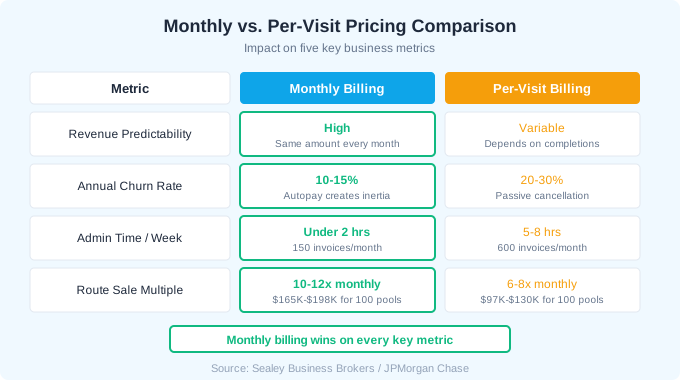
Corey Adams spent 15 years running pool routes before co-founding Pool Founder, and his take is blunt: "The guys who stay mostly per-visit are always chasing money. The guys who shift to monthly recurring build businesses they can actually sell." The data backs him up. Pool routes with monthly autopay billing sell for 8 to 12 times monthly revenue, while per-visit books of business trade at 6 to 8 times.
8-12x
monthly revenue is the typical sale price for pool routes with recurring monthly billing
Source: Sealey Business Brokers, 2026
This analysis compares both pricing models across five dimensions that matter to pool service operators: cash flow predictability, customer retention, chemical cost risk, administrative burden, and route valuation.
How Does Monthly Pricing Affect Cash Flow?
Monthly pricing creates predictable, recurring revenue that arrives on a set date each billing cycle. When paired with autopay and bill-ahead invoicing, you collect before or right when you perform the work, eliminating the 30 to 40 day float that kills small pool companies. This is the single biggest advantage of the monthly model.
The average small business can survive only 27 days without cash inflows, according to JPMorgan Chase research. Pool companies running per-visit billing are especially exposed because a rainy week or a holiday means fewer completions and less revenue. Monthly billing smooths all of that out.
| Factor | Monthly Billing | Per-Visit Billing |
|---|---|---|
| Revenue predictability | High. Same amount each month. | Variable. Depends on completions. |
| Payment timing | Bill-ahead collects before work. | Invoice after each visit or batch. |
| Weather impact | None. Revenue is flat. | Direct. Fewer visits = less income. |
| Cash flow forecasting | Easy. Multiply customers by rate. | Requires historical averages. |
| Late payment risk | Low with autopay. | Higher. More invoices = more chasing. |
If you run 150 pools at $165/month on autopay, you know $24,750 is hitting your account on the 1st. That certainty lets you plan hires, equipment purchases, and marketing spend without guessing.
Which Model Has Better Customer Retention?
Monthly billing wins on retention, and it is not close. When a customer is on a flat monthly plan with autopay, canceling requires an active decision. They have to call, email, or log into a portal to stop service. With per-visit billing, stopping is passive. They just stop calling you back.
Pool service customer churn typically runs 10 to 15% annually for monthly accounts and 20 to 30% for per-visit arrangements. The difference comes down to psychology: monthly customers see pool service as a fixed household expense, like landscaping or pest control. Per-visit customers see it as a discretionary purchase they evaluate each time.
10-15%
annual churn rate for monthly pool customers vs. 20-30% for per-visit customers
There is a second retention effect that is easy to miss. Monthly customers get service even when they are not home and not thinking about their pool. The pool stays clean. They never have a reason to question the value. Per-visit customers sometimes skip a week to save money, their pool turns, and they blame the service company when it takes two visits to recover.
How Do Chemical Costs Play Into Each Model?
Chemical cost risk is where per-visit billing has a structural advantage. When you bill per visit, you can either include chemicals at a marked-up rate or charge them as a separate line item. Either way, you recover your actual cost for that specific pool on that specific day. Monthly billing means you are absorbing chemical fluctuations across your entire route.
The average chemical cost per residential pool visit runs $8 to $15 for a standard 10,000 to 15,000 gallon pool in normal condition. But that average hides enormous variation. A green pool recovery can burn through $40 to $60 in chemicals in a single visit. Liquid chlorine prices have risen over 60% since 2020, with prices ranging from $5.50 to $7.00 per gallon depending on market.
| Chemical | Typical Cost | Per-Pool Usage/Visit |
|---|---|---|
| Liquid chlorine (12.5%) | $5.50-$7.00/gal | 0.5-1.5 gallons |
| Muriatic acid | $8-$12/gal | 8-16 oz |
| Stabilizer (CYA) | $4-$6/lb | Occasional, 1-2 lbs |
| Calcium hypochlorite (shock) | $4-$6/lb | As needed, 1-2 lbs |
| Diatomaceous earth | $25-$35/bag (25 lb) | Filter cleans only |
The smart move for monthly billing is an overage model. Include a standard chemical allowance per visit (say, 1 gallon of chlorine and 12 oz of acid) and charge separately for anything above that. This gives your customers cost predictability for normal maintenance while protecting your margins on problem pools.
What Is the Administrative Burden of Each Model?
Per-visit billing generates more invoices, more line items, and more opportunities for disputes. If you service 150 pools weekly, that is 600 invoices per month under per-visit billing versus 150 under monthly billing. Four times the invoices means four times the customer questions, four times the payment processing, and four times the reconciliation work.
Monthly billing with autopay is nearly hands-free. Set the rate, set the billing date, enable autopay, and the system handles everything. You only touch billing when a customer changes service frequency, a card declines, or you need to add a one-time charge for a repair or extra chemicals.
The average pool professional spends 7.5 hours per week on paperwork. Switching from per-visit to monthly billing with autopay can cut that to under 2 hours by eliminating per-stop invoice generation and payment chasing.
The exception is commercial accounts. HOAs, property managers, and multi-property owners often require per-visit invoices with detailed chemical breakdowns for their accounting. Fighting that requirement loses you the account. Build it into your pricing by adding $5 to $10 per visit for the administrative overhead of itemized billing.
How Does Pricing Model Affect Route Valuation?
If you ever plan to sell your pool business, this is the section that matters most. Pool routes are valued primarily on recurring service revenue, and buyers pay a premium for predictability. Routes with monthly billing, high autopay enrollment, and low churn consistently trade at the top of the 6 to 12 times monthly revenue range.
A route with 100 pools at $165/month ($16,500 monthly revenue) on monthly autopay might sell for $165,000 to $198,000. The same 100 pools billed per visit at $45/stop, averaging $16,200/month, might only fetch $97,000 to $130,000. Same revenue, very different valuation.
| Valuation Factor | Monthly Billing Impact | Per-Visit Impact |
|---|---|---|
| Revenue certainty | High. Buyer can project income. | Moderate. Varies with completions. |
| Customer stickiness | Strong. Autopay creates inertia. | Weaker. Easier to cancel. |
| Transition risk | Low. Billing continues automatically. | Higher. Customers may not stick. |
| Typical multiple | 10-12x monthly revenue | 6-8x monthly revenue |
Buyers also look at the percentage of customers on autopay. A route where 90% of customers have a card on file is worth more than one where 50% pay by check. Every manual payment introduces friction, delay, and churn risk that a buyer has to factor into their offer.
When Does Per-Visit Billing Actually Make Sense?
Per-visit billing is not inherently bad. There are legitimate scenarios where it is the right choice. Seasonal markets where pools are open fewer than 8 months per year make monthly billing harder to justify for customers. Snowbird accounts that want service only when they are in town are natural per-visit customers. And one-time or infrequent services like green pool cleanups, acid washes, or filter cleans should always be billed per visit.
- Seasonal pools (under 8 months): Customers resist paying monthly for months they do not use the pool. Per-visit keeps them as customers instead of losing them entirely.
- Commercial accounts requiring documentation: Property managers and HOAs often need per-visit invoices with itemized chemical and labor breakdowns for board reporting.
- Variable-frequency accounts: Customers who only want biweekly or on-call service do not fit neatly into a monthly plan.
- New customers on a trial basis: Some operators start new customers on per-visit and transition them to monthly after 60 to 90 days once trust is established.
- One-time and add-on services: Acid washes ($450-$750), filter cleans ($100-$175), and equipment repairs should be invoiced individually.
The goal is not to eliminate per-visit billing. It is to minimize it. Corey Adams recommends targeting 80% of revenue from monthly recurring and 20% from per-visit and one-time work. That ratio gives you a stable base with upside from service calls and upsells.
How to Transition Existing Customers to Monthly Billing
If you are running mostly per-visit today, transitioning to monthly billing takes 60 to 90 days and a straightforward communication plan. Do not spring it on customers. Frame it as a benefit: "We are moving to a flat monthly rate so your cost stays the same every month. No surprises, no fluctuations."
- 1Calculate the monthly equivalent for each customer. Take their average annual spend and divide by 12 (for year-round) or by the number of active months (for seasonal).
- 2Send a letter or email explaining the change 30 days in advance. Emphasize consistency and no price increase.
- 3Offer autopay enrollment with a small incentive. Even $5 off the first month gets most customers to save a card.
- 4Set a cutover date and switch billing in your software. Process the first monthly invoice and follow up on any declines within 48 hours.
- 5Keep per-visit as an option for the handful of customers who push back. Do not lose an account over a billing format.
Most operators who make this switch see autopay enrollment above 70% within three months and a measurable drop in late payments within the first billing cycle. The hardest part is deciding to do it.
Ready to streamline your pool service business?
Pool Founder gives you route optimization, automated invoicing, chemical tracking, and everything else you need to run a more profitable pool business.
Frequently Asked Questions
What is the average monthly cost for residential pool service?
Monthly residential pool service typically costs $100 to $300 per month for weekly maintenance, with most markets averaging $150 to $200. The price depends on pool size, service frequency, whether chemicals are included, and your local market. Per-visit rates run $45 to $80 per stop for the same service.
Should I include chemicals in my monthly pool service rate?
Most successful pool companies use an overage model: include a standard chemical allowance (like 1 gallon of chlorine and 12 oz of acid per visit) in the monthly rate and charge separately for usage above that. This keeps pricing simple for the customer while protecting your margins on pools that need extra treatment.
How much more are monthly pool routes worth than per-visit?
Pool routes with monthly billing and high autopay enrollment typically sell for 10 to 12 times monthly revenue, while per-visit books of business trade at 6 to 8 times monthly revenue. The premium reflects the predictability and stickiness of recurring billing.
What percentage of pool customers should be on monthly billing?
Aim for 80% or more of your revenue coming from monthly recurring billing. Keep per-visit for seasonal accounts, commercial clients requiring itemized invoices, and one-time services. This ratio maximizes cash flow predictability while accommodating customers who genuinely need per-visit arrangements.
How do I switch pool customers from per-visit to monthly?
Give customers 30 days notice, frame it as a benefit (consistent pricing, no surprises), and offer a small incentive for autopay enrollment. Calculate each customer monthly rate from their trailing 12-month average. Most operators see 70%+ autopay adoption within three months of switching.
Does per-visit billing cause higher customer churn?
Yes. Per-visit pool customers churn at 20 to 30% annually compared to 10 to 15% for monthly billing customers. Monthly billing with autopay creates inertia, since canceling requires an active decision rather than simply not scheduling the next visit.