Pool Service Pricing Varies Wildly by Market. Here Are the Real Numbers.
What you charge for pool service depends more on your ZIP code than almost any other factor. A full-service weekly maintenance account that goes for $130/month in Tucson commands $275/month in Los Angeles. Same work, same chemicals, same time per stop. The difference is market rate, cost of living, and what customers in that area expect to pay.
The problem is that most pricing advice ignores geography. "Charge $150/month" works in some markets and leaves money on the table in others. To price correctly, you need to know what your specific market bears, what your costs actually are in that market, and where to position yourself between discount and premium.
$80-$275
range of full-service monthly pool maintenance rates across major U.S. markets
Source: Cabana 2025 Pool Service Pricing Study
Corey Adams, Pool Founder co-founder and 15-year pool service veteran, has priced routes in multiple states. "The worst thing you can do is copy the cheapest guy in your market. He is probably losing money and does not know it. Price based on your costs, not someone else's ignorance."
What Are Average Pool Service Rates by State?
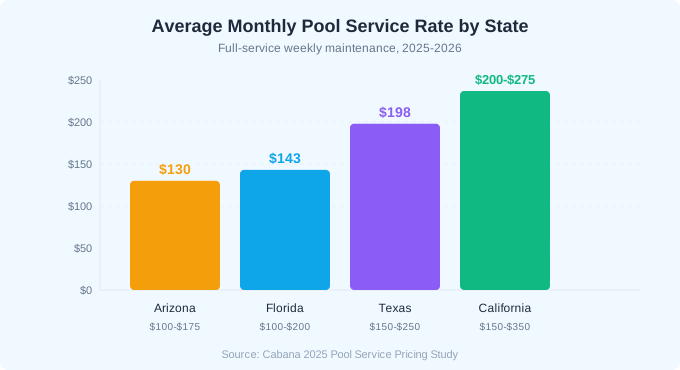
Here are the average monthly rates for full-service weekly pool maintenance in the four largest pool service markets. These rates include basic chemicals for most operators, though billing models vary by company.
| State / Metro | Avg Monthly Rate | Range | Key Factor |
|---|---|---|---|
| Florida (statewide) | $143 | $100-$200 | Highest competition, year-round service |
| Florida (Naples/Ft Myers) | $157 | $120-$220 | Premium market, seasonal residents |
| Texas (statewide) | $198 | $150-$250 | Wide metro variation |
| Texas (Austin) | $218 | $170-$280 | High growth, rising labor costs |
| Texas (El Paso) | $168 | $130-$210 | Lower cost of living |
| Arizona (statewide) | $130 | $100-$175 | Year-round, lower cost of living |
| Arizona (Scottsdale) | $140 | $110-$190 | Premium neighborhoods |
| California (Southern) | $200-$275 | $150-$350 | 20-30% premium over Sun Belt |
These are averages. Your rate should be based on your specific service area, the services included, and your cost structure. An average is not a target. It is a data point to help you understand where you sit relative to your market.
Florida has the highest pool density in the nation and the most competition. That pushes rates lower than other states despite year-round service. Texas and California have higher rates but also higher operating costs (fuel, labor, insurance).
Why Do Pool Service Prices Differ So Much by Region?
Four factors drive regional price differences: labor costs, competition density, cost of living, and seasonality. Understanding which factors dominate your market helps you price correctly instead of just matching the guy down the street.
Labor Costs
Pool technician wages range from $15-$17/hour in lower-cost markets to $20-$25/hour in California. When your labor cost per stop is 30-40% higher, your service rate has to reflect that. California and Northeast markets command 20-30% more than Texas or Florida partly because of technician wages alone.
Competition Density
Florida has the most pool service companies per capita of any state. High competition pushes rates down, especially in saturated metros like Tampa, Orlando, and Jacksonville. In contrast, newer pool markets in the Carolinas and Tennessee have less competition and more pricing flexibility.
Cost of Living
Homeowners in Scottsdale expect to pay more than homeowners in Tucson because their overall cost of living is higher. Your pricing should reflect the economic reality of the neighborhoods you serve. A $130/month rate in a $250K neighborhood makes sense. The same rate in a $750K neighborhood leaves money on the table.
Seasonality
Year-round markets (Florida, Arizona, Southern California) can price lower per month because you collect 12 months of revenue. Seasonal markets (Mid-Atlantic, Midwest) need to compress 12 months of income into 7-8 months of billing, which means higher monthly rates or annual contracts with winter billing.
How Do You Set Prices That Work in Your Specific Market?
Start with your costs, not your competitor's price. Your monthly rate needs to cover four things: chemical costs per pool, your share of vehicle and overhead costs per pool, labor cost per stop, and profit margin. Everything else is positioning.
- 1Calculate your cost per stop. Add chemical costs ($15-$25/pool/month), vehicle costs ($5-$10/pool/month based on mileage and route density), and overhead allocation ($3-$8/pool/month for insurance, software, phone). Your cost per stop is typically $23-$43/pool/month before labor.
- 2Add your labor cost. If you are solo, divide your target annual income by the number of pools you run. If you pay techs, calculate the per-pool labor cost from their hourly wage and time per stop.
- 3Add your margin. Target 15-25% net profit on top of all costs. This margin funds growth, equipment replacement, and emergency reserves.
- 4Compare to local market rates. If your calculated rate is above market average, you need to either position as a premium service (and back it up) or find ways to reduce costs. If your rate is below market, you have room to raise prices.
If your cost-based price comes out significantly below the market average, you are leaving money on the table. Set your rate at or slightly above average and let the margin fund better service, faster growth, and a stronger business.
Should You Price at the Top, Middle, or Bottom of Your Market?
Where you position on the pricing spectrum depends on the service you deliver, the customers you target, and your growth strategy. There is no universally "right" price point, but the bottom is almost always wrong.
| Position | Typical Rate | Customer Type | Trade-offs |
|---|---|---|---|
| Budget (bottom 25%) | $80-$110 | Price-sensitive, high churn | High volume needed, thin margins, hard to hire quality techs |
| Mid-market (middle 50%) | $120-$180 | Standard residential | Balanced volume and margin, most sustainable long-term |
| Premium (top 25%) | $180-$275+ | High-end homes, demanding service | Lower volume, higher margin, must deliver exceptional service |
Mid-market pricing is the sweet spot for most growing pool businesses. You attract reasonable customers who value good service, maintain margins that support employees and growth, and do not need to be the cheapest to win business.
The bottom of the market is a trap. At $80-$100/month, you need 70+ pools just to make a modest living. Your margins are so thin that one chemical price spike or equipment repair wipes out a month of profit. And your customers are the most likely to cancel over a $10 rate increase.
How Do You Raise Prices in a Competitive Market?
In competitive markets like Florida, raising prices feels risky because you assume customers will switch to the cheaper option. In reality, most customers do not leave over a modest price increase. They leave over poor service. A 5-10% annual increase loses fewer customers than most owners expect.
- Frame it around costs, not profit. "Chemical costs have increased 15% this year, and fuel prices continue to rise. To maintain the service quality you expect, I am adjusting rates by $10/month effective next month."
- Give 30 days notice. Surprises create complaints. Advance notice shows respect and gives customers time to adjust their budget.
- Raise everyone at once. Do not selectively raise some customers and not others. A single annual increase for all accounts is simpler to manage and prevents resentment if customers compare notes.
- Lead with value. Before raising prices, make sure your service reports, communication, and reliability are strong. Customers who feel well-served absorb price increases without complaint.
- Expect 2-5% churn. Some customers will leave. That is okay. The increased revenue from the 95-98% who stay more than offsets the lost accounts, and the customers you lose are usually the lowest-value, highest-maintenance ones.
2-5%
expected customer churn from a reasonable annual price increase of 5-10%
Source: Service Autopilot Pool Service Pricing Guide
What Add-On Services Should You Price Separately?
Your monthly rate covers standard weekly maintenance. Everything else should be priced as an add-on. This keeps your base rate competitive while generating additional revenue from services that require extra time or expertise.
| Add-On Service | Typical Price Range | Frequency |
|---|---|---|
| Filter clean (cartridge) | $75-$150 | Every 3-6 months |
| Filter clean (DE) | $125-$200 | Every 6-12 months |
| Green pool recovery | $200-$500 | As needed |
| Salt cell cleaning | $50-$100 | Every 3-6 months |
| Tile cleaning/acid wash | $200-$600 | Annual |
| Equipment repair (per hour) | $75-$125 | As needed |
Add-on services can increase your average revenue per customer by 20-30% annually. A customer paying $150/month for maintenance who also gets two filter cleans ($150 each) and a green pool recovery ($300) generates $2,400 per year instead of $1,800. That extra $600 per customer compounds across your entire route.
Price add-ons at or slightly above market rate. These are services where the customer has already chosen you and trusts your work. You do not need to compete on price for add-ons the way you do for the initial monthly contract.
Ready to streamline your pool service business?
Pool Founder gives you route optimization, automated invoicing, chemical tracking, and everything else you need to run a more profitable pool business.
Frequently Asked Questions
What is the average price for pool service per month?
The national average for full-service weekly pool maintenance ranges from $100-$250/month depending on your market. Florida averages $143, Texas averages $198, Arizona averages $130, and California runs $200-$275. These rates typically include basic chemicals for standard residential pools.
Why is pool service cheaper in Florida than other states?
Florida has the highest pool density and most pool service companies per capita, which creates intense competition that pushes rates down. Despite year-round service (12 months of billing), the average rate is $143/month compared to $198 in Texas and $200+ in California. The trade-off is higher volume potential.
How do I know if I am underpricing my pool service?
If your net profit margin is below 15% after paying yourself a reasonable salary, you are underpriced. Other signs: you cannot afford to hire help, equipment replacement comes out of your personal savings, or you are working 50+ hours per week to make ends meet. Calculate your true cost per stop and add a 15-25% margin.
Should I include chemicals in my monthly pool service rate?
Most residential pool service businesses include basic chemicals (chlorine and acid) in their monthly rate for simplicity. This works when pools have predictable chemical needs. For pools with higher chemical demands (salt conversions, large commercial accounts), bill chemicals separately or use an overage billing model.
How much more can you charge for pool service in California?
California pool service rates run 20-30% higher than comparable Sun Belt markets due to higher labor costs, insurance premiums, and cost of living. A pool that costs $143/month to service in Florida commands $200-$275/month in Southern California. The higher rate reflects real operating cost differences.