Why Are Water Quality Claims the Biggest Legal Risk for Pool Service Companies?
Pool service liability for water quality issues is the most misunderstood risk in this industry. Every week your techs adjust chlorine, balance pH, and dose stabilizer on dozens of pools. If a customer develops a chemical burn, a child gets sick from contaminated water, or an improperly treated pool damages a plaster surface, the claim lands on your desk. A 2020 case involving a Myrtle Beach hotel pool with illegally high chlorine levels resulted in a $26 million settlement after a three-year-old suffered chemical burns, according to AQUA Magazine. That case involved a property owner, but the legal theories apply to any party responsible for water chemistry.
The critical problem is that most pool service owners assume their general liability policy covers water quality claims. It often does not. Standard GL policies contain pollution exclusions that apply to chemical releases, and courts have upheld these exclusions in cases involving pool chemicals. Understanding the legal framework, your coverage gaps, and how to build a defensible paper trail is not optional. It is the difference between surviving a claim and losing your business.
Corey Adams, Pool Founder co-founder and 15-year pool service veteran, has been named in two water quality complaints over his career. Both were resolved without payout because his chemical logs documented exactly what was applied, when, and at what dosage. This guide covers the legal theory, insurance reality, and documentation practices that protect pool service companies from water quality claims.
What Legal Theory Applies to Water Quality Claims Against Pool Companies?
Water quality claims against pool service companies typically fall under negligence theory. The plaintiff must prove four elements: you owed a duty of care, you breached that duty, the breach caused the injury, and the plaintiff suffered actual damages. For pool service companies, the duty of care is established by your service contract, industry standards such as those published by the Pool and Hot Tub Alliance (PHTA), and in some cases state health department regulations for commercial pools.
Negligence Claims
The most common water quality negligence claims involve over-chlorination causing skin or eye irritation, under-chlorination allowing bacterial growth, improper acid application damaging pool surfaces, and failure to maintain adequate sanitizer levels between visits. The standard of care is what a reasonably competent pool service professional would do under the same circumstances. If your tech skipped a chlorine reading and dosed by eyeball instead of testing, that is a breach.
Strict Liability and Product Liability
In some jurisdictions, handling and applying pool chemicals can trigger strict liability theories, particularly if a chemical was misapplied or mixed improperly. If your tech adds muriatic acid to a pool with a running chlorinator and creates chlorine gas, the resulting injury claim may not require the plaintiff to prove negligence at all. Product liability theories can also attach if you supplied or recommended a chemical that caused damage.
Breach of Contract
If your service agreement promises to maintain water within specific chemical ranges and you fail to do so, the customer can pursue a breach of contract claim for resulting damages. This is why vague contract language like "maintain proper chemistry" is actually better than specific promises like "maintain free chlorine between 2.0 and 4.0 ppm at all times," which creates a measurable standard you may not meet between weekly visits.
A pool service company is typically not liable for water quality issues that occur between service visits if the company maintained proper levels during its scheduled service. Document your readings at arrival and departure to establish this defense.
What Does General Liability Actually Cover for Water Quality Claims?
General liability insurance covers third-party bodily injury and property damage claims. For pool service companies, GL would cover a customer who develops a rash from water your tech treated, damage to a pool surface caused by improper chemical application, and medical expenses for someone injured by a chemical reaction in a pool you service. The standard GL policy provides $1 million per occurrence and $2 million aggregate coverage.
The Pollution Exclusion Problem
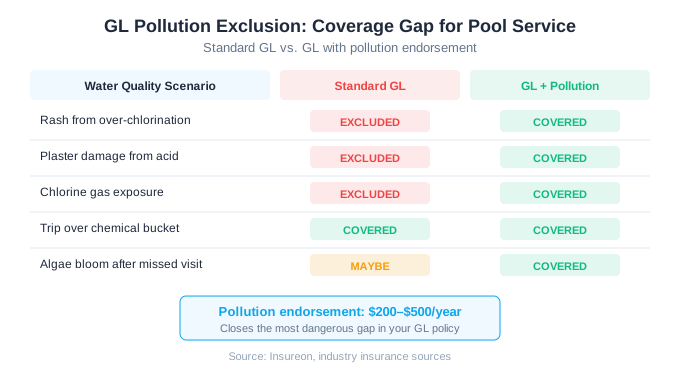
Here is where most pool service owners get burned. Standard general liability policies contain an "absolute pollution exclusion" that excludes coverage for bodily injury or property damage arising from the discharge, dispersal, release, or escape of pollutants. Courts in multiple states have ruled that pool chemicals, including chlorine, muriatic acid, and algaecides, qualify as pollutants under this exclusion. If your GL carrier invokes this exclusion, you have no coverage for your most common risk.
| Scenario | Standard GL Coverage | With Pollution Endorsement |
|---|---|---|
| Customer rash from over-chlorination | Likely excluded (pollution) | Covered |
| Plaster damage from acid application | Likely excluded (pollution) | Covered |
| Chlorine gas exposure from mixing error | Excluded (pollution) | Covered |
| Customer trips over chemical bucket | Covered | Covered |
| Green pool causes property value dispute | Not covered (no bodily injury/property damage) | Not covered |
| Algae bloom after missed service visit | May be covered as negligence | Covered |
How to Close the Gap
You need a pollution liability endorsement or a standalone pollution policy. A pollution endorsement added to your GL policy typically costs $200 to $500 per year according to industry insurance sources. A standalone pollution policy runs $1,000 to $3,000 annually depending on your revenue and number of employees. Every pool service company handles chemicals. Every pool service company needs pollution coverage.
Ask your insurance agent specifically: "Does my GL policy exclude claims arising from the application of pool chemicals?" If the answer is yes or they are unsure, you need a pollution endorsement. Do not assume you are covered.
How Do Chemical Logs Serve as Legal Evidence?
Chemical service logs are your single most important legal defense in a water quality claim. A timestamped record showing what chemicals were applied, at what dosage, with before-and-after test readings, creates a contemporaneous business record that courts treat as highly reliable evidence. Without logs, it is your word against the plaintiff, and juries tend to side with the injured party when documentation is absent.
What Your Chemical Logs Must Include
- Date, time, and tech name for every service visit
- Arrival readings: free chlorine, combined chlorine, pH, alkalinity, CYA, and calcium hardness
- Every chemical added: product name, exact quantity, and application method
- Departure readings: free chlorine and pH at minimum
- Any unusual conditions noted: cloudy water, algae presence, equipment malfunctions, or customer complaints
- Photos of the pool at arrival and departure when conditions are abnormal
Digital Logs vs. Paper Logs
Digital chemical logs with GPS timestamps and automatic date/time stamps are stronger evidence than handwritten logs because they are harder to fabricate after the fact. Paper logs can be questioned on authenticity. A digital system that records the reading at the time of service, with a GPS pin confirming the tech was actually at the property, is very difficult for a plaintiff to challenge. This is one of the reasons Corey Adams built chemical tracking into Pool Founder from day one.
Retain chemical logs for at least 5 years. Many states have statutes of limitations for personal injury claims of 2 to 4 years, but commercial contract claims can extend longer. Storage is cheap. Lawsuits are not.
What Are the Most Common Water Quality Claims Against Pool Services?
The five most common water quality claims against pool service companies follow predictable patterns. Understanding these patterns helps you implement targeted prevention rather than generic risk management.
Over-Chlorination Injuries
A tech adds too much chlorine or shock, the customer swims before levels drop to safe ranges, and they develop skin irritation, eye burns, or respiratory symptoms. Prevention: always test and record free chlorine at departure and advise customers not to swim until levels are below 5.0 ppm. Leave a written or digital note after every shock treatment.
Surface Damage from Acid Application
Muriatic acid poured directly into a plaster pool without dilution or with the pump off can etch or discolor the surface. Replastering costs $5,000 to $15,000 depending on pool size. Prevention: always dilute acid before adding, always add with the pump running, and never pour acid directly onto plaster surfaces.
Bacterial Illness from Inadequate Sanitizer
If a customer or their family contracts a waterborne illness like cryptosporidium, giardia, or pseudomonas and can show your service failed to maintain adequate sanitizer levels, you face a bodily injury claim. The CDC reports that cryptosporidium is resistant to normal chlorine levels, making proper CYA management and shock protocols essential defenses.
Staining and Discoloration
Metal staining from improper sequestrant use, calcium scaling from unbalanced LSI, and algae staining from delayed treatment are property damage claims. While less severe than bodily injury claims, these commonly result in demands for surface refinishing that run $3,000 to $15,000.
Chloramine and Chemical Gas Exposure
Mixing incompatible chemicals, particularly adding trichlor to a chlorinator still containing cal-hypo residue, or adding acid to a container with chlorine, creates toxic gas. Indoor pools are especially dangerous because poor ventilation concentrates fumes. These claims often involve emergency room visits and can produce six-figure settlements.
How Should You Handle a Water Quality Complaint?
When a customer contacts you with a water quality complaint, your response in the first 24 hours determines whether it becomes a resolved service issue or a lawsuit. The goal is to document everything, preserve evidence, and avoid admissions of fault while demonstrating that you take the concern seriously.
- 1Acknowledge the complaint immediately and schedule a same-day or next-day site visit. Do not ignore it or delay.
- 2Test the water at the visit and document all readings with photos. Compare against your last service log.
- 3Do not admit fault verbally or in writing. Saying "we must have added too much chlorine" is an admission. Say "we are investigating the situation and will determine what happened."
- 4Notify your insurance carrier within 48 hours if there is any bodily injury claim, property damage exceeding $1,000, or a threat of legal action.
- 5Preserve all records: chemical logs, service notes, text messages, emails, and photos from the last 90 days of service on that property.
- 6If the customer has medical bills, do not offer to pay them directly. That is what your insurance is for, and direct payment can be interpreted as an admission of liability.
Never discuss fault, liability, or insurance coverage details with the customer. Your insurance carrier has adjusters and attorneys for that. Your job is to document, preserve evidence, and report the claim.
What Risk Management Practices Reduce Water Quality Liability?
Risk management for water quality liability is about creating systems that prevent incidents and building a documentation trail that protects you when incidents occur despite your best efforts. The companies that rarely face claims are not lucky. They are disciplined about these practices.
- Test before you treat: Every visit starts with a water test. Never dose chemicals based on visual inspection alone. Record every reading.
- Follow manufacturer dosing guidelines: More is not better. Over-dosing creates liability. Use the product label rate and document compliance.
- Maintain proper CYA levels: Cyanuric acid between 30 and 50 ppm protects chlorine from UV degradation and ensures consistent sanitizer levels between visits. Over 80 ppm and chlorine effectiveness drops significantly.
- Communicate after shock treatments: Send a text or in-app notification telling the customer not to swim until chlorine drops below 5.0 ppm. Document that you sent the communication.
- Use a service agreement with a liability limitation clause: Your contract should state that you are responsible for water quality during and immediately following your scheduled service, not for conditions that develop between visits.
- Carry pollution liability coverage: A $200-$500 per year endorsement is the cheapest protection you can buy against your most common claim type.
- Train techs on chemical handling and documentation: An undertrained tech who skips readings or eyeballs dosages is a liability event waiting to happen.
The common thread across all of these practices is documentation. Test, record, treat, record, communicate, record. If it is not documented, it did not happen, at least not in court.
Run a pool route?
The business side of what you just read.
Pricing, chemical costs, and the tools owners use to keep the numbers straight.
- Commercial pool service pricing2026 rate tables and the cost-plus formula
- Chemical cost per poolWhat chemicals actually cost per stop
- Chemical tracking softwareLog readings and dosing from the pool deck
- Pool service softwareRoutes, invoicing, and service reports in one app
- Free profit & rate calculatorsProfit per pool, minimum rate, break-even
Frequently Asked Questions
Can a pool service company be sued for a customer getting sick from pool water?
Yes. If a customer contracts a waterborne illness and can demonstrate that your service failed to maintain adequate sanitizer levels, you face a negligence claim for bodily injury. Your chemical logs showing proper treatment at each visit are your primary defense.
Does general liability insurance cover chemical-related pool damage?
Standard GL policies often exclude chemical-related claims under the pollution exclusion. You need a pollution liability endorsement, which costs $200 to $500 per year, or a standalone pollution policy to cover claims from chlorine, acid, and other chemical applications.
How long should pool service companies keep chemical logs?
Keep chemical logs for at least 5 years. Personal injury statutes of limitations range from 2 to 4 years in most states, and commercial contract claims can extend longer. Digital logs with timestamps are preferred over paper records.
Am I liable for water quality problems between service visits?
Generally no, if you can document that water chemistry was within acceptable ranges when you left the property. Your service agreement should clarify that you are responsible for conditions at the time of service, not between visits. Departure readings prove your case.
What is the biggest legal mistake pool service companies make with water quality?
Not documenting chemical applications. When a claim arises and you have no records of what was tested, what was applied, and what readings you left behind, you have no defense. The second biggest mistake is assuming your GL policy covers chemical claims without verifying pollution coverage.
Can I be held liable if a customer adds their own chemicals after my service?
Customer tampering is a valid defense if you can prove water was properly balanced when you left. Document departure readings and include a contract clause stating the customer is responsible for any chemicals added between service visits.
Sources & References
- AQUA Magazine: Chlorine Burn Victim Receives $26 Million Settlement
- Insureon: Pool and Spa Cleaning Services Insurance Costs
- Pool Service Library: Pool Service Liability and Insurance Coverage Considerations
- Central Insurance: Pool Contractor Insurance Policies
- NIP Group: Pool Contractor Insurance Guide
- CDC: Recreational Water Illness Prevention