Certificates of Insurance Are Table Stakes for Commercial Work
The moment you sign your first commercial pool contract, you will be asked for a Certificate of Insurance (COI). Hotels, HOAs, apartment complexes, property management companies, and municipalities all require proof of insurance before you set foot on their property. A COI is a one-page document issued by your insurance company that summarizes your coverage types, limits, and effective dates. But there is more to COI management than handing over a document. Additional insured endorsements, blanket requirements, and certificate renewal tracking are where most pool service companies stumble.
Corey Adams, Pool Founder co-founder and 15-year pool service veteran, learned this the hard way. "I almost lost a 40-unit HOA contract because my COI was 3 months expired and the property manager caught it during an audit. The HOA board was ready to terminate and hire someone else. I got the updated cert the same day, but it was a wake-up call. Now I track every COI expiration date the same way I track route schedules."
$2M
Per-occurrence limit commonly required by commercial pool clients
Source: SPPA, The Hartford
What Is a Certificate of Insurance?
A Certificate of Insurance (COI) is a summary document produced by your insurance company or agent. It confirms that specific insurance policies are in force as of a certain date. The standard format in the U.S. is the ACORD 25 Certificate of Liability Insurance, which is a standardized one-page form used across all industries.
What a COI Includes
- Policy holder name: Your business name exactly as it appears on the policy
- Insurance company name and NAIC number: Identifies the carrier
- Policy number: The specific policy that provides the coverage
- Effective dates: The start and end dates of coverage
- Coverage types: General liability, commercial auto, workers compensation, umbrella/excess
- Limits: Per-occurrence, aggregate, and any sublimits
- Certificate holder: The entity requesting the COI (your client)
- Additional insured status: Whether the certificate holder is named as an additional insured
- Description of operations: A brief description of the work being performed
A COI is not proof of coverage. The ACORD 25 form explicitly states that it "is issued as a matter of information only and confers no rights upon the certificate holder." It confirms that a policy existed at the time the certificate was issued, but it does not guarantee the policy has not been canceled or modified since. This is why some clients also request copies of declarations pages and endorsements.
Additional Insured: What It Means and Why Clients Require It
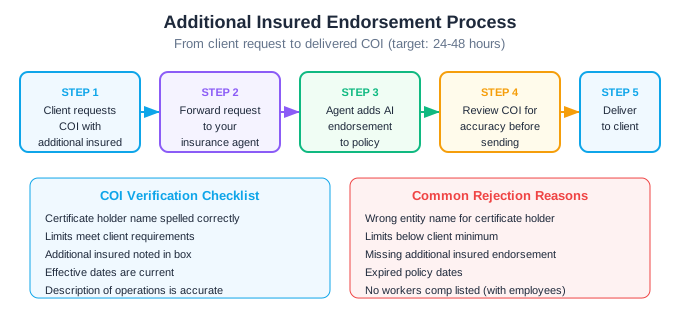
Being listed as an "additional insured" on your policy gives the client coverage under your GL policy for claims arising from your work at their property. If a bather slips on a chemical residue you left on the deck, the property owner can claim under your policy as an additional insured rather than filing against their own insurance. This is why commercial clients require it. It transfers risk from their policy to yours.
How Additional Insured Works
| Aspect | Without Additional Insured | With Additional Insured |
|---|---|---|
| Client protection | Client must use their own policy if sued for your work | Client can claim under your GL policy for incidents caused by your work |
| Your premium cost | No additional cost | May add $50-$200/year or included in blanket endorsement |
| Your liability | Same | Same (your policy limits still apply) |
| Commercial contract requirement | Some clients accept a basic COI | Most commercial clients require additional insured status |
Blanket Additional Insured Endorsement
If you service multiple commercial accounts, ask your agent about a blanket additional insured endorsement. This automatically extends additional insured status to any entity you are contractually required to name, without needing a separate endorsement for each client. This saves time and ensures you are never delayed waiting for your carrier to process a specific endorsement.
Coverage Limits Commercial Clients Expect
Commercial clients do not just want to see a COI. They want to see specific limits. If your limits fall short of their requirements, you will need to increase coverage or obtain an umbrella policy before signing the contract.
| Client Type | Typical GL Limit Required | Workers Comp Required? | Auto Liability Required? |
|---|---|---|---|
| Residential customers | $1M/$2M (or none specified) | Varies by state | Rarely requested |
| HOA communities | $1M/$2M per occurrence | Yes, if you have employees | Sometimes |
| Hotels and resorts | $2M/$4M or higher | Yes | Yes, $1M combined single limit |
| Municipalities | $2M/$4M or higher | Yes | Yes |
| Property management companies | $1M/$2M minimum | Yes, if you have employees | Sometimes |
| Apartment complexes | $1M/$2M minimum | Yes, if you have employees | Sometimes |
If a commercial client requires $2M/$4M limits and your GL policy is $1M/$2M, you do not necessarily need to upgrade your base policy. A commercial umbrella policy provides excess limits above your GL, auto, and workers comp for $500-$1,500 per year. This is almost always cheaper than increasing your base GL limits.
COI Request Workflow: From Request to Delivery
When a commercial client requests a COI, speed matters. Delays signal disorganization and can cost you the contract. Have a repeatable process that gets the certificate delivered within 24-48 hours.
- 1Receive the request and read it carefully. Clients often include specific requirements: minimum limits, additional insured language, waiver of subrogation, specific description of operations, and certificate holder address format. Miss any of these and the COI will be rejected.
- 2Forward the request to your insurance agent. Include the exact certificate holder name, address, required limits, additional insured status, waiver of subrogation (if requested), and any specific language the client requires in the description of operations.
- 3Review the COI before sending to the client. Verify the certificate holder name is spelled correctly, limits match the requirement, additional insured is noted, effective dates are current, and the description of operations is accurate.
- 4Deliver the COI to the client. Email a PDF copy. Many property management companies and HOAs use automated COI tracking systems that will flag expired certificates and notify you before they lapse.
- 5Set a renewal reminder. Track the COI expiration date. Send the updated certificate before it expires. Do not wait for the client to ask. Proactive renewal demonstrates professionalism and prevents service interruptions.
Common COI Mistakes That Cost Pool Companies Contracts
COI mistakes are surprisingly common in the pool service industry, and they have real business consequences. Each of these mistakes has cost a pool service company a commercial contract.
- Expired certificates: The most common mistake. Your policy renews annually, but the COI does not update automatically. You must request a new COI from your agent after every renewal.
- Wrong certificate holder name: If the property is owned by "XYZ Property Holdings LLC" and your COI lists "XYZ Properties," it may be rejected. Use the exact legal entity name provided in the request.
- Missing additional insured endorsement: The COI says "additional insured" in the description, but the actual endorsement was never added to the policy. The COI is informational only. Without the endorsement on the policy, the client has no actual coverage.
- Insufficient limits: Sending a $1M/$2M COI when the client requires $2M/$4M. Know the requirement before requesting the certificate.
- No workers compensation: Many states require workers comp for any business with employees. If your COI shows no workers comp and you have technicians, the client may assume you are uninsured or misclassifying employees.
- Waiting too long to respond: COI requests should be fulfilled within 24-48 hours. A week-long delay tells the client you are disorganized. Property managers have backup vendors ready to go.
Tracking COIs Across Multiple Commercial Accounts
Once you have 5 or more commercial accounts, manual COI tracking becomes unreliable. Each account may have different renewal dates, limit requirements, and additional insured specifications. A systematic approach prevents lapses.
COI Tracking System
- Maintain a spreadsheet or CRM record for every commercial account with: client name, certificate holder name, required limits, additional insured (yes/no), COI expiration date, and renewal reminder date (30 days before expiration)
- Set automated reminders 30 days before each COI expires
- After every insurance policy renewal, request updated COIs for all active commercial accounts in a single batch
- Store copies of all issued COIs in a centralized location (cloud folder, CRM, or service management platform)
- When a client requests a COI mid-contract, record the specific requirements for future renewals
Ask your insurance agent if they offer automated COI management. Many agencies now provide digital COI platforms that automatically issue renewal certificates and notify certificate holders. This eliminates the manual tracking burden and ensures zero lapses.
Ready to streamline your pool service business?
Pool Founder gives you route optimization, automated invoicing, chemical tracking, and everything else you need to run a more profitable pool business.
Frequently Asked Questions
What is a Certificate of Insurance (COI)?
A COI is a one-page summary document (typically ACORD 25 format) issued by your insurance company that confirms your policy types, limits, and effective dates. It is not proof of coverage but rather a snapshot of your insurance at the time of issuance. Commercial clients require COIs before allowing you to perform work on their property.
What does "additional insured" mean on a COI?
Additional insured means the client is covered under your GL policy for claims arising from your work at their property. It transfers some risk from the client insurance to yours. Most commercial accounts require additional insured status as a contract condition. A blanket additional insured endorsement automatically covers all clients who contractually require it.
How much does a COI cost?
The COI document itself is free. Your insurance agent issues it at no charge. However, if the client requires an additional insured endorsement, there may be a small charge ($50-$200/year) unless you have a blanket additional insured endorsement on your policy, which is often included at no extra cost in commercial GL packages.
How quickly should I respond to a COI request?
Within 24-48 hours. Property managers and commercial clients expect fast turnaround. A delay of more than a few days suggests disorganization and may cause the client to consider alternative service providers. Have your insurance agent contact information readily available so you can forward requests immediately.
What limits do commercial pool clients typically require?
Most HOAs and property management companies require $1M per occurrence / $2M aggregate minimum. Hotels, resorts, and municipalities often require $2M per occurrence / $4M aggregate or higher. If your base GL limits are lower, a commercial umbrella policy ($500-$1,500/year) provides the excess coverage needed.
Sources & References
- Progressive Commercial: Certificate of Insurance for Contractors
- Insureon: Contractor Certificate of Insurance (COI)
- TrustLayer: The Contractor Guide to Certificates of Insurance Management
- SPPA: General Liability Insurance for Pool Professionals
- Kohnen & Patton: Certificates of Insurance Do Not Guarantee Additional Insured Coverage