Which Contract Clauses Actually Protect Your Pool Service Business?
A pool service contract is only as strong as its clauses. A vague agreement with no liability limitation, no cancellation policy, and no dispute resolution mechanism is barely better than a handshake. When a disagreement escalates to a demand letter or a small claims filing, the specific language in your contract determines whether you are protected or exposed. Most pool service contracts that business owners write themselves or copy from a generic template are missing clauses that a court would look for.
Corey Adams, Pool Founder co-founder and 15-year pool service veteran, has refined his contract over years of real disputes. "My first contract was one page. It said I would clean the pool weekly for a monthly fee. That was it. When a customer disputed a chemical damage claim, I had nothing in writing about what I was and was not responsible for. I paid $3,500 out of pocket because I had no liability limitation, no indemnification clause, and no defined scope of work. Every clause in my contract now exists because something went wrong without it."
This guide covers the essential legal clauses every pool service contract needs with explanations of what each clause does and why it matters. It is not legal advice. Have an attorney licensed in your state review your final contract before using it.
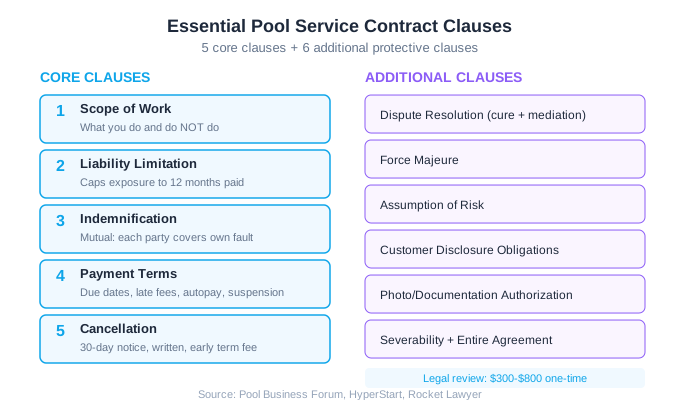
Overview: The 11 Clauses Your Contract Needs
Why Is the Scope of Work Clause the Most Important Part of Your Contract?
The scope of work clause defines exactly what you are responsible for and, equally important, what you are not responsible for. Without a clear scope, every issue with the pool becomes your problem. A crack in the deck, a stain on the plaster, a heater that fails. If your contract does not explicitly state what is included and excluded, the customer can argue that you should have caught it, fixed it, or prevented it.
What to Include in the Scope of Work
- Services included: List every service you perform. "Weekly pool maintenance including: skim surface debris, vacuum pool floor, brush walls, clean skimmer and pump baskets, test and adjust water chemistry (free chlorine, pH, alkalinity), backwash filter as needed, inspect equipment for visible issues."
- Frequency: Specify how often each service is performed. Weekly, bi-weekly, monthly. Do not leave frequency ambiguous.
- Services excluded: Explicitly list what is NOT included. "This agreement does not include: equipment repair or replacement, drain and refill, acid wash, tile cleaning, screen repair, plumbing repair, electrical work, or any service not listed above."
- Chemical responsibility: State who provides chemicals. If you provide them, note that chemical costs are included in the monthly fee (or billed separately). If the customer provides chemicals, state that you are not responsible for product quality or availability.
- Access requirements: Specify that the customer must provide unobstructed access to the pool, equipment pad, and water supply during service visits. Note that service cannot be performed if access is blocked by locked gates, aggressive animals, or construction.
The most common scope dispute in pool service is "I thought you were watching the equipment." If equipment monitoring is not in your scope, say so. "Routine equipment inspection for visible leaks and abnormal operation is included. Comprehensive equipment diagnostics, preventive maintenance, and equipment repair are available as separate services."
How Does a Liability Limitation Clause Protect You?
A liability limitation clause caps your financial exposure to a defined amount. Without it, your liability for any claim is theoretically unlimited. With it, you establish a ceiling that courts will generally enforce as long as it is reasonable and does not attempt to waive liability for gross negligence or willful misconduct.
Standard Liability Limitation Language
The most common approach limits your total liability to the amount the customer has paid you under the contract in the preceding 12 months. If the customer pays $200 per month, your maximum liability is $2,400. This is widely considered reasonable and enforceable.
What a Liability Limitation Can and Cannot Do
- Can limit: Consequential damages, indirect damages, lost income claims, and general compensatory damages up to the cap.
- Cannot limit: Liability for gross negligence, willful misconduct, fraud, or actions against public policy. Courts will not enforce caps that attempt to shield you from intentional harm.
- Cannot limit: Claims covered by insurance. Your GL policy responds to claims regardless of your contractual liability cap. The cap protects your personal and business assets beyond insurance.
Excluding consequential damages is as important as capping direct liability. A chemical error that damages a pool surface is direct damage. The customer claiming they lost rental income because they could not rent their vacation home due to the pool being unusable is consequential damage. Excluding consequential damages removes the open-ended financial exposure.
What Should Your Indemnification Clause Say?
Indemnification clauses define which party is responsible for paying claims that arise from each party's actions. In a pool service context, you agree to indemnify the customer for claims arising from your negligence, and the customer agrees to indemnify you for claims arising from their negligence, existing property conditions, and third-party use of the pool.
Mutual Indemnification Structure
A mutual indemnification clause is fair and more likely to be enforced than a one-sided clause. Each party indemnifies the other for claims resulting from their own negligence, actions, or omissions. If fault is shared, indemnification is proportional to each party's contribution to the claim.
Key Indemnification Elements
- Your indemnification of the customer: You agree to defend, indemnify, and hold harmless the customer from claims arising from your services, your employees' actions, and your negligence while performing work under the agreement.
- Customer's indemnification of you: The customer agrees to indemnify you from claims arising from pre-existing conditions, undisclosed hazards, third-party pool use, and the customer's own negligence.
- Insurance requirement: Tie indemnification to insurance. State that your indemnification obligation is backed by your GL policy and that the customer is responsible for their own homeowner insurance for their property.
- Notice requirement: Require the indemnified party to provide prompt written notice of any claim to allow the indemnifying party time to respond and participate in the defense.
If your contract includes chemical procurement, meaning you buy and apply all chemicals rather than the customer buying them, your indemnification exposure increases. Specify that chemical treatment follows manufacturer guidelines and industry standards, and that you are not liable for product defects or customer-provided chemicals.
What Payment Terms Protect Your Cash Flow?
Payment terms that are vague or not enforced create cash flow problems that compound over time. Every pool service contract should specify exactly when payment is due, how payment is made, what happens when payment is late, and when you can stop service for non-payment.
Essential Payment Terms
- Payment timing: "Payment is due on the 1st of each month for services to be performed during that month." Pre-payment eliminates collections risk. If you bill in arrears, specify "due upon receipt, payable within 15 days."
- Accepted payment methods: Specify credit card, ACH, check, or online payment. Require a card on file for autopay to eliminate manual collection.
- Late fees: "Payments received after the 15th of the month are subject to a late fee of $25 or 1.5% of the outstanding balance, whichever is greater." Check your state's usury laws for maximum allowable late fees.
- Service suspension: "Service will be suspended if payment is 30 days past due. A $50 reactivation fee applies to resume service after suspension for non-payment."
- Collection costs: "Customer agrees to pay all reasonable collection costs, including attorney fees, incurred in collecting past-due amounts."
- Rate adjustment: "Service rates may be adjusted with 30 days written notice. Continued use of services after the adjustment effective date constitutes acceptance of the new rate."
Autopay with a card on file is the single most effective payment protection. Customers who agree to autopay during onboarding have near-zero delinquency rates. Making autopay the default (with opt-out rather than opt-in) dramatically reduces collections work.
How Should You Structure the Cancellation Clause?
The cancellation clause balances your need for revenue stability against the customer's right to end the relationship. A clause that is too restrictive will not hold up in court. A clause that is too loose leaves you vulnerable to seasonal customers who sign up in April and cancel in September.
Standard Cancellation Terms
The industry standard for pool service contracts is 30 days written notice to cancel. This is widely considered fair and enforceable. Some companies use 60-day notice periods, which courts will generally uphold for commercial contracts but may scrutinize more closely for residential consumer contracts.
Cancellation Clause Elements
- Notice period: "Either party may cancel this agreement with 30 days written notice to the other party."
- Written notice requirement: "Cancellation must be submitted in writing via email, mail, or the customer portal. Verbal cancellation requests are not valid."
- Early termination fee (term contracts only): If your contract has a defined term (6 or 12 months), an early termination fee is appropriate. "Cancellation before the end of the initial term is subject to an early termination fee equal to one month's service charge." Courts generally uphold one month as reasonable. Fees exceeding two months may be considered punitive.
- Final payment: "Customer is responsible for payment through the end of the 30-day notice period, including any services performed."
- Return of access devices: "Customer shall return any gate keys, access codes, or other access devices provided by the service provider within 10 days of cancellation."
Keep early termination fees reasonable. A fair fee is no more than one month of service. Anything beyond that risks being deemed a penalty rather than liquidated damages, which courts may refuse to enforce. A reasonable fee is more likely to be paid voluntarily and upheld if challenged.
What Dispute Resolution Clause Should You Use?
A dispute resolution clause establishes how disagreements are handled before they reach a courtroom. The goal is to create a structured process that resolves disputes faster and cheaper than litigation for both parties.
Recommended Dispute Resolution Structure
- 1Cure period (10-15 days): The aggrieved party must provide written notice describing the issue and allow the other party 10-15 days to cure the breach before escalating. Many disputes resolve here.
- 2Negotiation (15-30 days): If the cure period fails, both parties agree to attempt good-faith negotiation for 15-30 days before pursuing formal resolution.
- 3Mediation (mandatory before litigation): If negotiation fails, require mediation before either party can file a lawsuit. Mediation is faster, cheaper, and more private than court. Cost is split between the parties.
- 4Binding arbitration or litigation: If mediation fails, specify whether disputes go to binding arbitration or court. For small pool service disputes, small claims court is often the most practical venue.
Additional Dispute Clause Elements
- Governing law: "This agreement is governed by the laws of the State of [your state]." This prevents disputes over which state's laws apply.
- Venue: "Any legal action shall be filed in [your county] County, [your state]." This prevents customers from filing suit in a distant jurisdiction.
- Attorney fees: "The prevailing party in any dispute shall be entitled to recover reasonable attorney fees from the non-prevailing party." This discourages frivolous claims.
- Limitation on claims: "Any claim related to this agreement must be filed within one year of the event giving rise to the claim." This prevents stale claims years after the fact.
What Other Clauses Should Every Pool Service Contract Include?
Beyond the five core clauses above, several additional provisions strengthen your contract and address common pool service scenarios.
Additional Protective Clauses
- Force majeure: Excuses performance when events outside your control (weather, natural disasters, supply chain disruptions, pandemic restrictions) prevent you from performing services. Specify that service credits are not issued for force majeure delays.
- Assumption of risk: "Customer acknowledges that pool ownership involves inherent risks including but not limited to drowning, chemical exposure, and slip-and-fall injuries. Customer assumes all risk associated with pool use by customer, family members, guests, and tenants."
- Customer disclosure obligations: Customer must disclose known hazards (aggressive dogs, broken gates, underground utilities, electrical issues) before service begins. Failure to disclose shifts liability for resulting incidents to the customer.
- Photo and documentation authorization: "Customer authorizes service provider to photograph the pool, equipment, and surrounding areas for documentation, service records, and quality assurance purposes."
- Severability: "If any provision of this agreement is found unenforceable, the remaining provisions remain in full force." Prevents one bad clause from invalidating the entire contract.
- Entire agreement: "This agreement constitutes the entire agreement between the parties. No verbal promises, representations, or prior agreements modify or supplement this agreement."
Have a local attorney review your contract once. A one-time legal review costs $300-$800 and ensures your clauses comply with your state laws. Contract language that is enforceable in Florida may not be enforceable in California. State-specific review is worth the investment.
Ready to streamline your pool service business?
Pool Founder gives you route optimization, automated invoicing, chemical tracking, and everything else you need to run a more profitable pool business.
Frequently Asked Questions
What is the most important clause in a pool service contract?
The scope of work clause is the most important because it defines what you are and are not responsible for. Without a clear scope, every pool issue becomes your liability. Liability limitation is the second most important because it caps your financial exposure. Together, these two clauses address the biggest risks in pool service agreements.
Is a 30-day cancellation notice enforceable?
Yes. A 30-day written notice requirement for cancellation is widely considered fair and enforceable by courts. This is the industry standard for pool service contracts. Longer notice periods (60 days) may be enforceable for commercial contracts but could face scrutiny for residential consumer contracts depending on your state.
Can I include an early termination fee in my pool service contract?
Yes, if the fee is reasonable. Courts distinguish between legitimate liquidated damages and penalties. An early termination fee equal to one month of service is generally considered reasonable and enforceable. Fees exceeding two months of service risk being deemed punitive, especially for residential consumer contracts.
Should my pool service contract require arbitration?
It depends on your preference. Binding arbitration is faster and more private than court but limits the customer's ability to appeal. For small pool service disputes, small claims court may be more practical and less expensive than arbitration. A mandatory mediation step before either arbitration or litigation is a good compromise that resolves many disputes without formal proceedings.
Does my contract need to be reviewed by a lawyer?
Yes. A one-time legal review costs $300-$800 and ensures your contract complies with your state laws. Contract clauses that are enforceable in one state may not be in another. An attorney can also identify gaps you may not have considered. The review cost is trivial compared to the cost of a contract dispute where your agreement does not hold up.
How does a liability limitation clause work in a pool service contract?
A liability limitation clause caps your total financial exposure, typically to the amount the customer has paid you in the preceding 12 months. If the customer pays $200/month, your cap is $2,400. Courts generally enforce this cap for ordinary negligence but not for gross negligence, willful misconduct, or fraud. Excluding consequential damages (lost income, lost use) further limits your exposure.
Sources & References
- Pool Business Forum: Pool Service Contracts and Agreements
- HyperStart: The Ultimate Guide to Limitation of Liability Clauses
- Lannan Legal: Indemnification and Limitation of Liability in Service Contracts
- HyperStart: Cancellation Clause Definition and Examples
- Rocket Lawyer: Pool Service Contract Template and FAQs
- Contract Nerds: Five Key Limitation of Liability Negotiation Points