Equipment Damage Claims Will Happen. Be Ready.
A customer calls and says their pool pump died the day after your technician serviced the pool. They want you to pay for the replacement. Another client says your tech cracked the filter housing during a clean. A property manager claims your chemical treatment damaged the pool surface. Equipment damage claims are among the most common disputes pool service companies face. The question is never whether you will receive one. The question is whether you have the documentation and insurance to handle it correctly.
Corey Adams, Pool Founder co-founder and 15-year pool service veteran, has handled dozens of equipment damage claims. "The first time a customer blamed us for a pump failure, I had no photos, no notes, and no way to prove the pump was already on its last legs. I paid for the replacement out of pocket because I could not prove otherwise. That was the last time. Now every piece of equipment gets documented on the first visit. Every single one."
$500-$1,500/yr
Average general liability insurance cost for pool service companies
Source: The Hartford, Tivly
When You Are Legally Liable for Equipment Damage
Liability for equipment damage comes down to causation and negligence. You are liable when your actions or your employee actions directly caused the damage, or when you failed to exercise reasonable care and that failure led to the damage. You are not liable for equipment that was already failing, defective products you did not manufacture, or damage caused by factors outside your control.
| Scenario | Liable? | Why |
|---|---|---|
| Tech drops a wrench into a pool pump during service | Yes | Direct physical damage caused by your employee during service |
| Tech runs pump dry during service, burns out the motor | Yes | Negligent operation of equipment during a service visit |
| Pump fails 2 days after routine chemical service | Likely no | Chemical service does not cause pump motor failure. Correlation is not causation. |
| Filter housing cracks during a cartridge change | Maybe | Depends on whether the crack was caused by excessive force or was pre-existing |
| Heater fails after you recommended it be replaced months ago | No | You identified the issue and advised the customer. Their decision to delay is not your liability. |
| Chemical treatment damages pool surface | Maybe | Depends on whether chemicals were applied correctly per manufacturer guidelines |
| Customer claims you broke equipment you never touched | No | Your service records and documentation should show what was and was not serviced |
The burden of proof in civil liability cases is "preponderance of evidence," meaning more likely than not. If a customer claims you damaged their equipment and you have zero documentation of its pre-existing condition, the claim becomes much harder to defend even if you did nothing wrong.
How General Liability Insurance Covers Equipment Damage
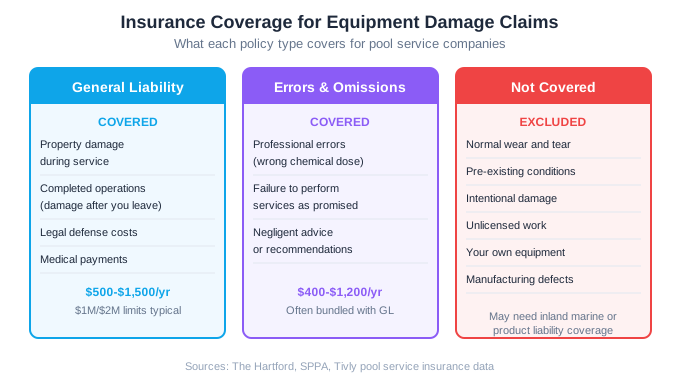
General liability (GL) insurance is the primary coverage for equipment damage claims. A standard GL policy covers third-party property damage caused by your business operations. For pool service companies, this means damage to customer equipment, pool surfaces, decking, and surrounding property that results from your work.
What GL Covers
- Property damage during service: If your tech drops a tool and cracks a filter housing, GL covers the repair or replacement cost.
- Products and completed operations: If a chemical you applied causes damage after you leave, GL covers the resulting damage. This is critical for pool service companies because many chemical-related issues do not become apparent until hours or days after application.
- Legal defense costs: If a customer sues you over equipment damage, GL covers your legal defense regardless of whether the claim has merit.
- Medical payments: If a customer is injured as a result of equipment you damaged (e.g., electrical shock from a damaged pump), GL covers their medical costs up to the policy sublimit.
What GL Does Not Cover
- Your own equipment and tools: Damage to your tools, vehicle, and supplies requires inland marine or commercial property coverage.
- Normal wear and tear: A pump that fails from age and use is not a GL claim, even if the customer tries to attribute it to your service.
- Intentional damage: Deliberate destruction of customer property is excluded.
- Work you were not licensed to perform: If you install equipment without the required contractor license, your GL policy may deny the claim. This is a common exclusion that catches unlicensed operators.
Standard GL policy limits for pool service companies are $1,000,000 per occurrence and $2,000,000 aggregate. The average cost ranges from $500 to $1,500 per year depending on your revenue, number of employees, and claims history. Commercial accounts often require $2,000,000 per occurrence limits.
Documenting Pre-Existing Equipment Condition
The single most effective way to defend against false or inflated equipment damage claims is a documented equipment baseline. This means photographing and recording the condition of all equipment on the first service visit and updating it whenever you observe changes. This is not optional. It is the foundation of your liability defense.
First-Visit Equipment Baseline
- 1Photograph every piece of equipment: Pump, filter, heater, salt system, automation controller, chemical feeder, timer, and any other equipment at the pool. Include close-ups of model numbers, serial numbers, and any visible damage, corrosion, or wear.
- 2Record make, model, and approximate age: This establishes the equipment life expectancy. A 12-year-old pump that fails during service was already well past its expected lifespan.
- 3Note pre-existing issues: Corrosion, leaks, unusual noises, missing covers, exposed wiring, cracked housings, or any condition that could worsen or fail. Write it down and photograph it.
- 4Share the baseline with the customer: Send the customer a copy of the equipment condition report after the first visit. This creates a shared record that both parties have acknowledged. If a dispute arises later, you can reference the baseline that the customer received and did not dispute.
Ongoing Documentation
- Photograph equipment condition changes at every service visit where you notice deterioration
- Log equipment recommendations (e.g., "pump seal showing wear, recommend replacement within 60 days") in your service notes
- Record when equipment recommendations are declined by the customer
- Timestamp all photos and notes with GPS location data when possible
Pool Founder makes equipment documentation automatic. Technicians photograph equipment with timestamped, GPS-tagged photos that attach to the service record. When a customer disputes a damage claim, you pull up the complete photo history of that piece of equipment going back to the first service visit.
How to Handle an Equipment Damage Claim
When a customer claims you damaged their equipment, your response in the first 24 hours sets the tone for the entire dispute. Follow this process to protect your business and maintain the customer relationship when possible.
- 1Acknowledge the claim immediately. Do not ignore it or delay. A prompt response shows professionalism regardless of whether you agree with the claim.
- 2Gather the facts before responding. Review the service notes and photos from the most recent visit. Review the equipment baseline documentation. Talk to the technician who performed the service. Do not admit fault or make promises until you have the full picture.
- 3Inspect the damage in person. Go to the site, photograph the damage, and assess whether your service could have caused it. Look for evidence that supports or contradicts the claim.
- 4Decide: legitimate claim or dispute. If your technician clearly caused the damage, own it. Notify your insurance company and file a claim. Covering a legitimate $500 repair before it becomes a $5,000 lawsuit is smart business. If the damage was pre-existing or unrelated to your service, share your documentation with the customer and explain your position professionally.
- 5Involve your insurance company early. Even if you believe the claim is unfounded, notify your GL carrier. They will advise you on how to respond and will handle defense if the customer escalates to a legal claim. That is what you pay premiums for.
- 6Document everything. Every conversation, email, photo, and service record related to the claim should be preserved. Create a claim file and keep it organized.
Contract Clauses That Limit Equipment Damage Liability
Your service contract is your first line of defense against unreasonable equipment damage claims. Including specific clauses about equipment liability sets clear expectations before a dispute ever arises.
Essential Contract Clauses
- Pre-existing condition acknowledgment: "Equipment condition is documented at the start of service. [Company] is not responsible for pre-existing damage, wear, corrosion, or defects identified in the initial equipment assessment."
- Limitation of liability: "Liability for equipment damage shall not exceed the replacement cost of the damaged equipment or the annual service contract value, whichever is less."
- Maintenance recommendation disclaimer: "When [Company] recommends equipment repair or replacement and the customer declines, [Company] is not liable for subsequent failure of that equipment."
- Notice requirement: "Customer must notify [Company] of any claimed equipment damage within 48 hours of discovery. Late notification may limit the ability to investigate and verify the claim."
- Insurance requirement: "Customer acknowledges that pool equipment is subject to wear, corrosion, and failure. Homeowner insurance or equipment warranty coverage is recommended for all pool equipment."
Have an attorney licensed in your state review your service contract. Contract clause enforceability varies by state. A limitation of liability clause that is enforceable in Texas may not be enforceable in California. State-specific legal review is worth the one-time cost.
Run a pool route?
The business side of what you just read.
Pricing, chemical costs, and the tools owners use to keep the numbers straight.
- Commercial pool service pricing2026 rate tables and the cost-plus formula
- Chemical cost per poolWhat chemicals actually cost per stop
- Chemical tracking softwareLog readings and dosing from the pool deck
- Pool service softwareRoutes, invoicing, and service reports in one app
- Free profit & rate calculatorsProfit per pool, minimum rate, break-even
Frequently Asked Questions
Am I liable if a pool pump fails after my service visit?
Only if your service directly caused the failure. If a pump fails from age, wear, or pre-existing mechanical issues, that is not your liability. Documentation of the equipment condition before and during your service is the key to proving the failure was unrelated to your work. Correlation (pump failed after your visit) is not causation.
Does general liability insurance cover equipment damage I cause?
Yes. A standard GL policy covers third-party property damage caused by your business operations, including damage to customer pool equipment. It also covers legal defense costs if the customer sues. Average GL costs for pool service companies range from $500 to $1,500 per year for $1M/$2M limits.
How do I prove equipment damage was pre-existing?
Document equipment condition on the first service visit with timestamped, GPS-tagged photos, including model numbers, serial numbers, visible wear, corrosion, and damage. Share this baseline with the customer. Update documentation whenever you observe condition changes. This photo history is your primary evidence in a dispute.
Should I pay for a damaged piece of equipment out of pocket or file an insurance claim?
For small claims (under $500-$1,000), consider whether the repair cost is less than your deductible. If so, paying out of pocket avoids an insurance claim on your record. For larger claims, always file with your GL carrier. Multiple small out-of-pocket payments add up, and an uninsured large claim could be devastating.
What should I do if a customer threatens to sue over equipment damage?
Notify your GL insurance carrier immediately. They will assign a claims adjuster and, if necessary, provide legal defense. Do not admit fault, do not argue with the customer, and do not make offers to settle without consulting your insurer. Your policy includes defense costs, so let the professionals handle it.
Sources & References
- The Hartford: Pool & Spa Contractor Business Insurance
- SPPA: General Liability Insurance for Pool Professionals
- Tivly: Swimming Pool Service Insurance
- Insureon: Contractor Certificate of Insurance
- Skimmer: What Pool Cleaner Insurance Your Business Needs