What Does General Liability Insurance Actually Cover for Pool Service?
General liability insurance is the foundation of every pool service insurance program. It is the first policy you buy, the one every commercial customer and HOA requires before they sign a contract with you, and the coverage that protects you when a third party, your customer, their family, or a bystander, suffers bodily injury or property damage because of your work. For pool service companies, the median cost is $67 per month or roughly $800 per year according to Insureon data.
Corey Adams, Pool Founder co-founder and 15-year pool service veteran, learned the importance of GL coverage early. "I had a customer trip over my vacuum hose in the first year of my business. She fell and broke her wrist. Without GL insurance, I would have been paying that medical claim out of pocket. With it, my insurer handled the claim, paid the settlement, and I did not miss a single day of work. That $67 a month was the best money I ever spent."
$67/month
Median general liability premium for pool and spa cleaning businesses
Source: Insureon, 2025
What Does General Liability Insurance Cover for Pool Service?
General liability insurance covers two main categories of risk: third-party bodily injury and third-party property damage that arise from your business operations. It also covers certain advertising and personal injury claims. Understanding exactly what is covered, and equally important what is excluded, prevents dangerous assumptions that leave you unprotected.
Covered Claims
- Customer bodily injury: A homeowner trips over your equipment hose and breaks an ankle. A child slips on a wet deck area where you were working. A customer has a skin reaction to improperly balanced chemicals.
- Third-party property damage: You crack a pool deck tile while moving equipment. Your truck leaks oil on a customer driveway. You accidentally damage a screen enclosure while carrying a filter.
- Completed operations: A repair you performed fails and causes subsequent damage. A filter you installed leaks and floods the equipment room. This coverage applies after you leave the property.
- Personal and advertising injury: A competitor sues claiming you made defamatory statements. A former employee claims you damaged their reputation.
- Legal defense costs: GL pays your legal defense even if the claim is frivolous. Defense costs are typically paid in addition to policy limits, not subtracted from them.
What GL Does NOT Cover
- Pollution and chemical spills: Standard GL policies contain a pollution exclusion. If you spill muriatic acid on a pool deck or chlorine damages landscaping, your GL will likely deny the claim. You need a separate pollution liability endorsement.
- Your own vehicles: GL does not cover vehicle accidents. You need commercial auto insurance.
- Employee injuries: GL does not cover your employees. Workers compensation handles on-the-job injuries to your team.
- Your own property and tools: GL covers damage you cause to others. Your own equipment, tools, and trucks require separate coverage (inland marine, commercial property).
- Professional errors: If you recommend the wrong chemical treatment and it damages a pool surface, that is a professional liability (E&O) claim, not a GL claim.
- Intentional acts: Any damage you cause deliberately is excluded.
The pollution exclusion is the most dangerous gap in a standard GL policy for pool service companies. You handle chlorine, muriatic acid, and other chemicals every day. A standard GL policy will deny claims related to chemical releases. Add a pollution liability endorsement to your GL policy or buy a separate pollution policy.
How Much Does General Liability Insurance Cost for Pool Service?
Pool and spa cleaning businesses pay a median of $67 per month, or $800 per year, for general liability insurance with standard $1 million per occurrence and $2 million aggregate limits according to Insureon. Premiums range from approximately $29 to $110 per month depending on your state, annual revenue, number of employees, claims history, and coverage limits.
| Factor | Lower Premium | Higher Premium |
|---|---|---|
| Annual revenue | Under $100,000 | Over $500,000 |
| Number of employees | Solo operator | 5+ employees |
| State | Midwest, low-litigation states | CA, FL, NY, TX |
| Claims history | Zero claims in 5 years | One or more claims in 3 years |
| Coverage limits | $1M/$2M standard | $2M/$4M higher limits |
| Deductible | $1,000-$2,500 | $0-$500 |
Cost as a Percentage of Revenue
GL premiums typically represent 1.0-1.9% of annual revenue for small pool service companies and 0.5-0.9% for larger operations. As your revenue grows, the premium increases in absolute dollars but decreases as a percentage of revenue because the base risk does not scale linearly with revenue.
Moving from $1M/$2M to $2M/$4M limits typically adds 15-30% to the premium. For most solo operators and small companies, $1M/$2M is adequate. If you service commercial accounts, HOA communities, or high-value properties, consider the higher limits or add an umbrella policy instead.
What Policy Limits Do You Need?
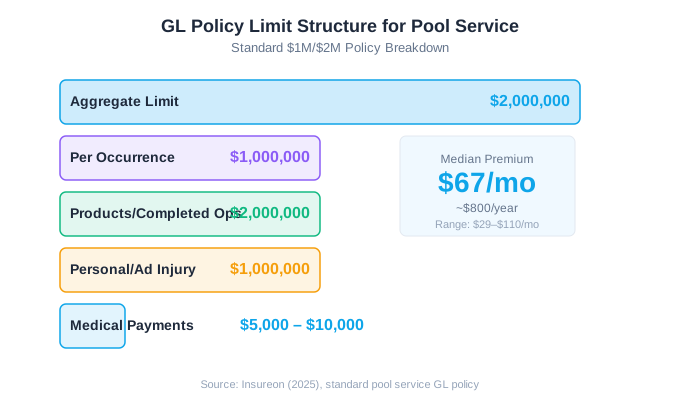
GL policies have two primary limits: per occurrence and aggregate. The per occurrence limit is the maximum the insurer will pay for a single incident. The aggregate is the total maximum payout for all claims during the policy period (usually one year). The industry standard for pool service is $1 million per occurrence and $2 million aggregate.
Understanding the Limit Structure
- Per occurrence ($1M standard): If a single incident generates a claim, the insurer pays up to $1 million for that incident. This covers the bodily injury or property damage claim plus your legal defense.
- Aggregate ($2M standard): If you have multiple claims in one policy year, the insurer pays up to $2 million total. After the aggregate is exhausted, you are self-insured for the rest of the year.
- Products/completed operations ($2M): A sub-limit within the aggregate that applies to claims arising from work you have already completed.
- Personal/advertising injury ($1M): A sub-limit for defamation, copyright infringement, and similar non-physical claims.
- Medical payments ($5K-$10K): Small medical payments made without a liability determination. Covers minor injuries to avoid a full claim process.
- Damage to rented premises ($100K-$300K): Covers damage to premises you rent or occupy temporarily.
When to Increase Limits
Increase your limits or add an umbrella policy when you service commercial accounts (many require $2M per occurrence in their contracts), work on properties valued over $1 million, have more than three employees in the field, or gross over $500,000 annually. An umbrella policy is often more cost-effective than increasing base GL limits.
How Do You Buy GL Insurance Without Overpaying?
The difference between the cheapest and most expensive GL policy for the same coverage can be 40-60%. Insurance is one of the few business expenses where shopping around consistently saves real money. Here is how to get the best rate without sacrificing coverage.
Shopping Strategies
- 1Get at least three quotes. Use a marketplace like Insureon, CoverWallet, or Simply Business to compare multiple carriers at once. Also get a direct quote from at least one carrier (Progressive, The Hartford, or biBERK) to compare.
- 2Classify your business correctly. Pool cleaning and maintenance has a different risk classification than pool construction or repair. Make sure your application reflects maintenance/cleaning, not construction. The wrong classification inflates your premium significantly.
- 3Bundle with a BOP. A Business Owner's Policy bundles GL with commercial property insurance at a 15-20% discount over buying separately. If you have an office, storage unit, or significant equipment, a BOP saves money.
- 4Increase your deductible. Moving from a $500 deductible to a $1,000 or $2,500 deductible can reduce your premium by 10-20%. Only do this if you can comfortably cover the deductible out of pocket.
- 5Maintain a clean claims history. Every GL claim increases your premium at renewal. Handle small issues out of pocket when the cost is below your deductible plus the expected premium increase.
- 6Review annually. Do not auto-renew without reviewing your policy. Your revenue, employee count, and risk profile change year to year. Shopping at renewal keeps your premium competitive.
Ask about a pollution liability endorsement when shopping for GL. Some carriers offer it as an add-on for $200-$400 per year. Others require a separate standalone policy. Given that pool service involves daily chemical handling, this endorsement is essential, not optional.
What Documents Do You Need from Your GL Policy?
Having a GL policy is only half the equation. You also need the right documentation to prove coverage to customers, commercial accounts, and property managers. Missing documentation loses you contracts.
Essential GL Documents
- Certificate of Insurance (COI): A one-page summary of your coverage, limits, and carrier that you provide to customers. Most carriers let you generate COIs online instantly. Have a general COI ready and be prepared to issue customized COIs that name specific customers as "additional insured" parties.
- Additional insured endorsement: Many commercial customers and HOAs require you to add them as an "additional insured" on your policy. This extends your GL coverage to protect them from claims arising from your work on their property. Most carriers charge $25-$50 per additional insured or include a blanket additional insured endorsement.
- Waiver of subrogation: Some commercial contracts require you to waive your insurer's right to subrogate (recover claim payments from the customer). Your carrier adds this as an endorsement, usually at no additional cost.
- Policy declarations page: The full summary of your policy showing all coverages, limits, deductibles, and endorsements. Keep a digital copy accessible at all times.
Set up your insurance account so you can generate COIs instantly online. Many pool service companies lose time and contracts because they cannot produce a COI fast enough when a new customer requests one.
What Happens When You File a GL Claim?
Understanding the claims process before you need it prevents mistakes that can delay or jeopardize your claim. GL claims for pool service typically involve property damage (cracked tiles, damaged equipment, chemical stains) or bodily injury (slip-and-fall, chemical contact, trip hazard).
Claims Process Steps
- 1Document everything immediately. Take photos of the incident scene, the damage or injury, and surrounding conditions. Get witness contact information if anyone saw what happened. Write down exactly what occurred while details are fresh.
- 2Report to your carrier within 24 hours. Most GL policies require prompt notification. Delayed reporting can give your insurer grounds to dispute the claim.
- 3Do not admit fault. Be helpful and cooperative with the injured party, but do not make statements acknowledging liability. Let your insurer and their legal team make that determination.
- 4Cooperate with the adjuster. Your insurer will assign an adjuster who will investigate the claim. Provide all documentation, answer questions honestly, and follow their guidance.
- 5Track the claim. Keep records of all communication with your insurer, the claimant, and any legal representatives. Note dates, names, and outcomes of every interaction.
Filing a GL claim will likely increase your premium at renewal, typically by 10-25% depending on the claim amount. For very small incidents under $500, consider whether handling it out of pocket is more cost-effective than filing a claim that raises your rates for 3-5 years.
Free starter kit
Start a pool service business with the numbers already run.
A short email series from an owner who started with $1,200 and a used truck. No software pitch, just the four things that decide whether year one works.
- Startup cost breakdownEvery line item from $2K bootstrap to fully equipped
- Pricing calculatorThe minimum you can charge per visit and still profit
- First-10-customers playbookDoor hangers, referrals, and the phone script that closes
- Licensing & insurance checklistWhat your state requires and which insurers pay claims
Already running routes? Try Pool Founder free
Frequently Asked Questions
How much does general liability insurance cost for a pool service company?
The median general liability premium for pool and spa cleaning businesses is $67 per month or $800 per year according to Insureon data. Premiums range from $29 to $110 per month depending on your state, revenue, employees, and claims history. States with higher litigation rates like California and Florida tend to be at the higher end.
Does general liability cover chemical spills for pool companies?
No. Standard general liability policies contain a pollution exclusion that typically applies to chemical releases, including chlorine spills and muriatic acid damage. Pool service companies need a pollution liability endorsement (approximately $200-$400 per year) added to their GL policy or a standalone pollution liability policy to cover chemical-related claims.
What GL limits do pool service companies need?
The industry standard is $1 million per occurrence and $2 million aggregate. This is adequate for most solo operators and small companies. If you service commercial accounts, HOA communities, or high-value residential properties, consider $2M/$4M limits or add a commercial umbrella policy for additional protection.
Is general liability insurance required for pool service companies?
General liability is not legally required in most states for pool service businesses. However, it is effectively mandatory because most commercial customers, HOA communities, and property managers require proof of GL coverage before they will sign a contract. Operating without GL also exposes you to unlimited personal liability for claims.
What is the difference between GL and a BOP for pool service?
General liability covers third-party bodily injury and property damage claims. A Business Owner's Policy (BOP) bundles GL with commercial property insurance (covering your office, storage, and business personal property) at a 15-20% discount over buying separately. If you have a physical location or significant equipment inventory, a BOP saves money.
How do I get a Certificate of Insurance for my pool service company?
Contact your insurance carrier or agent to request a Certificate of Insurance (COI). Most carriers allow you to generate COIs online through their policyholder portal. You can create general COIs for your records and customized COIs that name specific customers as additional insured parties. Set up online access so you can issue COIs immediately when customers request them.