1099 Contractors in Pool Service: The Legal Trap
Using 1099 independent contractors instead of W-2 employees saves pool service companies roughly 20-30% per worker in payroll taxes, workers comp premiums, and benefits costs. It is tempting. It is common. And for most pool service companies, it is illegal. The IRS, Department of Labor, and state agencies have been increasing enforcement of worker misclassification, and field service industries like pool service, lawn care, and pest control are prime targets. The penalties are not theoretical. They include back taxes, interest, fines up to $25,000 per violation in some states, and criminal charges for willful misclassification.
Corey Adams, Pool Founder co-founder and 15-year pool service veteran, has seen the consequences firsthand. "I know three pool company owners in my area who got hit with misclassification audits in the last two years. One guy had 8 techs on 1099s. The state reclassified all of them as employees and sent him a bill for $47,000 in back taxes, interest, and penalties. He thought he was saving money. It nearly put him out of business."
$25,000
Maximum per-violation penalty for willful worker misclassification (California)
Source: California Labor Code Section 226.8
Why Pool Service Companies Get It Wrong
The pool service industry has a long history of using 1099 contractors. Many owners learned from other owners who did it, so it feels normal. But "everyone does it" is not a legal defense. The core issue is that most pool service workers who are classified as 1099 contractors actually meet the legal definition of employees under federal and state law.
Red Flags That Signal Misclassification
- You set the technician route, schedule, and service order
- You provide the truck, chemicals, tools, or equipment
- You tell the technician how to perform the service (specific procedures, chemical protocols)
- The technician works exclusively or primarily for your company
- You set the pay rate rather than the technician negotiating a project fee
- You require the technician to wear your company uniform or branding
- Customers believe the technician is your employee
- You provide training on how to perform the work
If three or more of those statements are true, you almost certainly have an employee, not an independent contractor. The more control you exercise over how, when, and where the work is performed, the more likely the worker is an employee under federal and state tests.
The Three Tests: IRS, DOL, and State
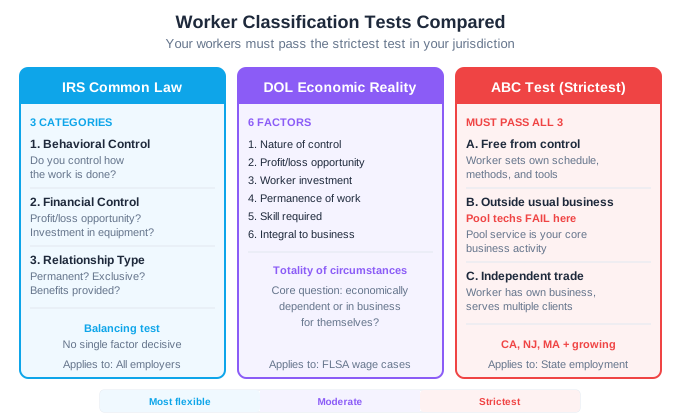
There is no single test for worker classification. The IRS, Department of Labor, and individual states each apply their own tests. A worker who qualifies as a contractor under one test may be classified as an employee under another. You need to pass all applicable tests, not just one.
IRS Common Law Test (20-Factor / 3-Category)
The IRS evaluates 20 factors grouped into three categories: behavioral control (do you control how the work is done?), financial control (does the worker have a profit or loss opportunity?), and relationship type (is the relationship permanent and exclusive?). No single factor is decisive. The IRS weighs all factors together.
DOL Economic Reality Test
The Department of Labor uses a 6-factor economic reality test to determine whether a worker is economically dependent on the employer (employee) or in business for themselves (contractor). Factors include the nature and degree of control, the worker opportunity for profit or loss, the worker investment in equipment, the permanence of the relationship, the skill required, and whether the work is integral to the business.
State ABC Test (California, New Jersey, Massachusetts, and Others)
The ABC test is the strictest classification test and is used by a growing number of states. Under the ABC test, a worker is presumed to be an employee unless the hiring entity proves all three conditions: (A) the worker is free from control and direction, (B) the worker performs work outside the usual course of the business, and (C) the worker has an independent trade or business. For pool service companies, prong B is nearly impossible to satisfy because pool technicians are performing the core service your business exists to provide.
In ABC-test states, pool service technicians are almost always employees, period. A pool tech performing pool service for a pool service company fails prong B because the work is within the usual course of your business. The only pool workers who might pass the ABC test are specialists like a licensed plumber you subcontract for a one-time equipment install.
Penalties for Worker Misclassification
Misclassification penalties come from multiple agencies simultaneously. An audit from one agency often triggers referrals to others. Here is what you face at each level.
| Agency | Penalty Type | Amount |
|---|---|---|
| IRS | Employer share of FICA (Social Security + Medicare) | Back payment of 7.65% of wages for all misclassified workers, all open tax years |
| IRS | Failure to withhold income tax | 1.5% of wages paid to the worker |
| IRS | Failure to file correct information returns (1099 vs W-2) | $60-$310 per incorrect form depending on correction timeline |
| IRS | Willful misclassification penalty | 100% of the tax that should have been withheld |
| State tax agency | Back state income tax withholding | Varies by state, plus interest and penalties |
| State labor agency | Civil penalty per violation | $5,000-$25,000 per worker in states with strict enforcement (CA, NJ, NY) |
| Workers compensation carrier | Back premiums plus penalties | Audit can result in retroactive premium charges for all misclassified workers |
| State unemployment agency | Back unemployment insurance taxes | Full UI tax liability for all misclassified workers, plus interest and penalties |
The combined liability from a misclassification audit can be devastating. For a pool service company with 5 misclassified workers earning $45,000 each, the total exposure across all agencies can exceed $100,000 for a single audit year.
How Misclassification Audits Get Triggered
Misclassification audits do not happen randomly. They are triggered by specific events. Understanding the triggers helps you assess your risk exposure.
- Worker files for unemployment: When a 1099 worker you let go files for unemployment, the state unemployment agency investigates because 1099 workers should not be eligible. This is the most common trigger.
- Worker files a workers comp claim: An injured 1099 worker who cannot get workers comp benefits may file a complaint with the state labor agency, triggering an investigation.
- IRS cross-match: The IRS cross-references 1099 filings against other indicators. A company filing many 1099s for workers performing the same job that similar companies pay W-2 employees for can trigger an audit.
- State labor department complaint: A current or former worker can file a misclassification complaint at any time. These complaints are often confidential, so you may not know who filed.
- Workers comp audit: Your workers comp insurer conducts annual premium audits. If they discover workers not reported on your payroll, they will investigate and may refer the finding to state agencies.
- Competitor or industry tip: Competitors who properly classify their workers and bear the higher cost sometimes report companies they know are misclassifying workers.
The IRS issued Revenue Procedure 2025-10 in January 2025, the first comprehensive update to Section 530 relief guidance in 40 years. This update makes it harder for companies to qualify for Section 530 safe harbor protection, which previously shielded some employers from back taxes on misclassified workers. The enforcement environment is getting stricter, not looser.
Section 530 Relief: The Safe Harbor That Is Getting Harder to Reach
Section 530 of the Revenue Act of 1978 provides limited relief from back employment taxes when an employer misclassified workers but had a "reasonable basis" for the classification. If you qualify, you avoid the back FICA and withholding tax, though other penalties may still apply.
Three Requirements for Section 530 Relief
- 1Reasonable basis: You must demonstrate a reasonable basis for treating the worker as a contractor. Acceptable bases include: a prior IRS audit that did not reclassify similar workers, a judicial precedent or published ruling supporting contractor classification, or a recognized industry practice of treating similar workers as contractors.
- 2Substantive consistency: You must have treated all similar workers consistently. If you classify some pool techs as employees and others as contractors doing the same work, you fail this test.
- 3Reporting consistency: You must have filed all required 1099 forms for the workers in question. Missing or late 1099 filings disqualify you from Section 530 relief.
The 2025 IRS guidance (Rev. Proc. 2025-10) narrows what constitutes a "reasonable basis" and requires more detailed documentation to support the claim. The days of claiming "everyone in the pool industry does it" as a reasonable basis are numbered. Proactively reclassifying your workers before an audit is far cheaper than fighting a reclassification after one.
How to Transition from 1099 to W-2 Without Disrupting Operations
If your pool technicians are currently on 1099s and they should be W-2 employees, the best time to reclassify is now. Waiting increases your exposure for every payroll period that passes. Here is how to make the transition with minimal disruption.
- 1Consult a CPA and employment attorney. Before making any changes, get professional advice specific to your state. The transition has tax implications and potential liability considerations that require expert guidance.
- 2Set up payroll. Register for state and federal employer tax accounts if you have not already. Choose a payroll provider. Most payroll services cost $40-$100/month plus $4-$10 per employee per pay period.
- 3Calculate the true cost increase. The cost of W-2 employment is roughly 20-30% higher than 1099 due to employer FICA (7.65%), workers comp premiums (varies by state), unemployment insurance, and any benefits you offer. Budget for this increase before making the switch.
- 4Communicate with your workers. Explain that they will now receive W-2s, have taxes withheld, and be eligible for workers comp coverage. Many workers prefer W-2 status because they no longer need to pay self-employment tax (15.3%) or make quarterly estimated payments.
- 5Adjust your pricing if necessary. If the increased labor cost compresses your margins, this may be the right time to raise service rates. The cost of compliance is a legitimate business expense, and operating legally is a competitive advantage when competitors get audited.
The IRS Voluntary Classification Settlement Program (VCSP) allows eligible employers to voluntarily reclassify workers with limited liability for past misclassification. You pay approximately 10% of the employment tax liability for the most recent tax year. This is significantly less than the penalties in a full audit. Talk to your CPA about whether VCSP is right for your situation.
Ready to streamline your pool service business?
Pool Founder gives you route optimization, automated invoicing, chemical tracking, and everything else you need to run a more profitable pool business.
Frequently Asked Questions
Can I use 1099 contractors as pool technicians?
In most cases, no. If you control the technician schedule, route, service procedures, and provide equipment, the worker is an employee under federal and state tests. The only scenario where a 1099 pool tech may be legitimate is a truly independent operator who sets their own schedule, uses their own equipment, serves multiple clients, and controls how the work is performed.
What is the penalty for misclassifying a pool technician as a 1099 contractor?
Penalties are layered across multiple agencies. IRS penalties include back FICA (7.65% of wages), failure-to-withhold penalties (1.5% of wages), and incorrect form penalties ($60-$310 each). State penalties can add $5,000-$25,000 per worker in strict-enforcement states like California. Workers comp audit findings add retroactive premiums. Total exposure can exceed $100,000 for a company with 5 misclassified workers.
What is the ABC test and does it apply to pool service?
The ABC test is the strictest worker classification test, used by California, New Jersey, Massachusetts, and a growing number of states. A worker is presumed to be an employee unless you prove: (A) they are free from your control, (B) they perform work outside your usual business, and (C) they have an independent trade. Pool techs fail prong B because pool service is your core business.
What triggers a misclassification audit?
The most common triggers are: a worker filing for unemployment benefits (1099 workers should not be eligible), a workers comp claim by an uninsured worker, IRS cross-matching of 1099 filings, a state labor department complaint from a current or former worker, a workers comp premium audit, or a competitor tip. Any of these can start an investigation that snowballs across agencies.
How do I transition my 1099 pool techs to W-2 employees?
Consult a CPA and employment attorney first. Set up payroll through a payroll provider ($40-$100/month). Budget for the 20-30% cost increase (employer FICA, workers comp, UI). Communicate the change to workers. Consider the IRS Voluntary Classification Settlement Program (VCSP) to limit liability for past misclassification. Adjust service pricing if necessary to maintain margins.
What is Section 530 relief?
Section 530 of the Revenue Act of 1978 provides limited relief from back employment taxes when an employer had a "reasonable basis" for misclassifying workers. To qualify, you need: a reasonable basis for the classification, consistent treatment of all similar workers, and timely filing of all 1099 forms. The IRS tightened eligibility requirements in January 2025 (Rev. Proc. 2025-10).
Sources & References
- IRS: Worker Reclassification and Section 530 Relief
- IRS: Revenue Procedure 2025-10 (Section 530 Update)
- ADP: 9 Consequences of Misclassifying 1099 Contractors
- Deel: 1099 Contractor Misclassification Penalties and Prevention
- California DIR: Independent Contractor versus Employee
- USA Employment Lawyers: Misclassified Pool Cleaner in Florida