Why Does Post-Hurricane Pool Recovery Require a Specific Protocol?
After a hurricane, every pool on your route is a different kind of problem than normal service. Pools are filled with contaminated floodwater, tree branches, construction debris, and potentially hazardous materials including sewage, fertilizer, gasoline, and pesticides. Equipment pads may be submerged, electrical systems compromised, and pool structures stressed by hydrostatic pressure from saturated ground. You cannot approach post-hurricane pools the same way you approach a routine green pool recovery. The risks are higher, the work is harder, and the pricing must reflect the reality of storm recovery.
The single most important rule of post-hurricane pool recovery: never drain the pool. An empty pool in saturated ground can "pop" out of the ground due to hydrostatic lift pressure, causing catastrophic structural damage that costs $15,000 to $50,000 or more to repair. This guide covers the safe, sequential approach to hurricane pool recovery that protects both the pool and your service team.
Corey Adams, Pool Founder co-founder and 15-year pool service veteran, has worked through multiple hurricane seasons in the Southeast. His first rule: "Slow down. A hurricane pool is not a green pool. Test before you touch anything electrical, and never drain water until you know the ground conditions."
What Safety Assessment Should You Perform Before Starting?
Before touching anything at a post-hurricane pool, perform a full safety assessment. Hurricane damage creates hazards that do not exist in normal service conditions, including downed power lines, broken glass, exposed nails from debris, standing water with potential electrical current, and contaminated floodwater. Rushing into recovery work without an assessment puts your team at risk.
Pre-Work Safety Checklist
- 1Check for downed power lines: Do not enter the pool area if there are any power lines on or near the property. Call the utility company and wait for clearance.
- 2Turn off all pool equipment breakers: Go to the main electrical panel and shut off the pool equipment breaker before approaching the equipment pad. If the panel is submerged or damaged, do not touch it. Call an electrician.
- 3Inspect for structural damage: Look for cracks in the pool shell, shifted coping, displaced deck sections, and damaged retaining walls. Document everything with photos before starting any work.
- 4Check the equipment pad: If the equipment pad was submerged, all electrical components (pump motors, timers, salt cells, automation controllers) should be inspected by a qualified technician before being energized.
- 5Assess water contamination level: Assume floodwater is contaminated with bacteria, sewage, chemicals, and petroleum products. If floodwater entered the pool, the water will need heavy shock treatment and possibly partial replacement.
- 6Look for hazardous debris: Broken glass, nails, sharp metal, and animal carcasses may be in or around the pool. Use gloves and appropriate footwear.
If the pool area shows signs of significant structural damage, stop and refer the customer to their insurance company and a structural engineer before attempting any recovery work. Pool service companies should not assess structural integrity beyond obvious visible damage.
Why Should You Never Drain a Pool After a Hurricane?
This point cannot be overstated: never drain a pool after a hurricane unless you have confirmed that groundwater levels have returned to normal. Hurricane rainfall saturates the soil surrounding the pool, creating enormous hydrostatic pressure against the outside of the pool shell. The weight of the water inside the pool counterbalances this pressure. Remove the water and the pool can literally float out of the ground, a phenomenon called "pool pop" that causes catastrophic, often irreparable damage.
What Happens During a Pool Pop
- The pool shell lifts out of the ground, breaking all underground plumbing connections
- The deck surrounding the pool cracks, separates, and collapses into the void
- The pool shell itself cracks from uneven pressure as it lifts
- Repair costs range from $15,000 for minor pops to $50,000 or more for full reconstruction
- Many insurance policies exclude pool pop damage or limit coverage significantly
Even if the pool water is heavily contaminated, it is safer to treat it in place than to drain it. Shock the water aggressively, run the filter continuously to remove particulates, and only consider a partial drain (no more than 1/3 of the pool volume at a time) after the ground has dried, typically 2 to 4 weeks after the storm.
Inform your customers about this risk immediately after the storm. Homeowners who do not know better may drain their own pool trying to "get rid of the dirty water" and cause a pop. A quick text or email to all customers in the affected area could prevent a disaster.
How Do You Remove Debris from a Post-Hurricane Pool?
Debris removal is the first physical step after the safety assessment. Hurricane debris ranges from leaves and small branches to entire trees, patio furniture, fence sections, roofing materials, and other large objects. The approach depends on the type and volume of debris.
Debris Removal Sequence
- 1Remove large debris by hand first: Use a leaf net, pool pole, and your hands (with gloves) to remove branches, furniture, and large objects. Do not use the pool filtration system to handle large debris.
- 2Skim floating debris: After large items are out, use a leaf rake and skimmer net to remove floating debris, leaves, and small items.
- 3Clean skimmer baskets and pump baskets: These will be packed with debris. Clear them before attempting to run the pump.
- 4Remove settled debris from the bottom: Once the water clears enough to see the bottom, use a leaf vacuum or pool vacuum connected to the waste port (not through the filter) to remove settled debris and sediment.
- 5Brush all surfaces: Hurricane floodwater deposits a film of sediment, algae, and contaminants on every pool surface. Brush walls, floor, steps, and tile thoroughly.
For pools with heavy tree debris, the removal process alone can take 2 to 4 hours. Pools with damaged screens or enclosures may also require coordination with a screen repair contractor before debris removal is practical. Document the debris condition with photos before starting, as customers may need this for insurance claims.
How Do You Restore Water Chemistry After a Hurricane?
Post-hurricane pool water is not just unbalanced. It is contaminated. Floodwater introduces bacteria, sewage, petroleum products, fertilizer, soil, and organic matter that normal chemical treatment is not designed to handle. The chemistry restoration process is more aggressive than a standard green pool recovery and requires multiple rounds of treatment.
Chemistry Restoration Protocol
- 1Test the water first: Before adding anything, test pH, chlorine, alkalinity, and CYA. Post-hurricane water often has extreme readings that determine your dosing strategy.
- 2Adjust pH to 7.2 to 7.4 before shocking: Chlorine is most effective at lower pH. If pH is above 7.6, add muriatic acid to bring it down before the shock treatment.
- 3Triple shock the pool: Add 3 lbs of calcium hypochlorite per 10,000 gallons, targeting free chlorine above 10 ppm. For pools with visible floodwater contamination, some professionals recommend quadruple shock to 20 to 30 ppm.
- 4Run the filter continuously: Run the pump 24/7 until the water clears. Backwash sand and DE filters every 12 to 24 hours. Clean cartridge filters daily.
- 5Re-test and re-shock after 24 hours: If free chlorine has dropped below 5 ppm after 24 hours, shock again. The organic load from hurricane debris consumes chlorine rapidly.
- 6Add a clarifier after the second shock holds: Once chlorine holds above 5 ppm for 24 hours, add a clarifier to help the filter remove remaining fine particles.
- 7Balance remaining chemistry: After the water is clear and chlorine is stable, adjust alkalinity, calcium hardness, and CYA to normal ranges.
If floodwater was in contact with sewage, animal carcasses, or petroleum products, the CDC recommends treating the pool to at least 10 ppm free chlorine for a minimum of 30 minutes with a pH at 7.5 or below before the pool is safe for use. Test twice before clearing the pool for swimming.
How Do You Handle Submerged Pool Equipment?
Equipment pads that were submerged in floodwater require careful evaluation before any equipment is powered on. Floodwater introduces salt, sediment, and contaminants into motor windings, electrical connections, and sensitive electronics. Powering on a submerged pump motor can cause electrical shorts, motor failure, or fire.
Equipment Recovery Protocol
- Pump motor: If the motor was submerged, do not power it on. Have the motor inspected by a qualified technician or motor shop. Many single-speed motors can be dried out, cleaned, and returned to service. Variable-speed motors with electronic controls usually require replacement if submerged.
- Filter: Sand and DE filters are generally resilient to flooding. Drain, backwash thoroughly, and inspect the multiport valve for sediment contamination. Cartridge filters should have cartridges replaced if submerged in contaminated water.
- Heater: Gas and electric heaters that were submerged need a professional inspection before being fired. Gas heaters may have water in the gas valve or burner tray. Heat exchangers should be flushed.
- Salt cell: Remove, clean with diluted acid, and inspect the cell plates. If floodwater deposited sediment inside the cell, it may need professional cleaning or replacement.
- Automation controller: Electronic controllers (Pentair IntelliCenter, Jandy iAqualink, Hayward OmniLogic) are usually not designed to survive submersion. Expect replacement if the control board was submerged.
- Electrical panel and GFCIs: Have an electrician inspect the pool sub-panel, GFCI outlets, and all wiring connections before restoring power to any pool equipment.
Document the condition of all equipment with photos and provide the customer with a written assessment of what needs repair versus replacement. This documentation is essential for their insurance claim.
How Should You Price Hurricane Recovery Work?
Hurricane recovery is not regular pool service and should not be priced as regular pool service. The work is harder, takes longer, uses significantly more chemicals, and carries higher risk. You also face higher demand, limited chemical supply availability, and potentially hazardous working conditions. Price accordingly while remaining fair to customers who are dealing with broader storm damage.
Recovery Pricing Framework
| Service Level | Typical Scope | Price Range | Visits Included |
|---|---|---|---|
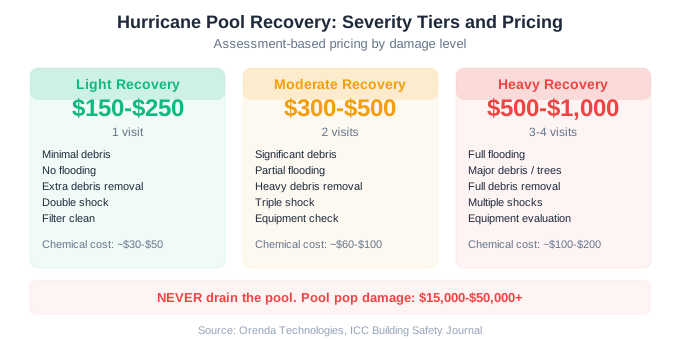
| Light recovery (minimal debris, no flooding) | Extra debris removal, double shock, filter clean | $150 - $250 | 1 visit |
| Moderate recovery (significant debris, partial flooding) | Heavy debris removal, triple shock, equipment check, 2 visits | $300 - $500 | 2 visits |
| Heavy recovery (full flooding, major debris) | Full debris removal, multiple shock treatments, equipment evaluation | $500 - $1,000 | 3-4 visits |
| Equipment pad assessment | Inspection of all submerged equipment, written report | $100 - $200 | 1 visit |
| Equipment replacement coordination | Ordering, installation, and startup of replacement equipment | Cost + labor | Varies |
Pricing Principles
- Charge separately from regular service: Hurricane recovery is a one-time service, not part of the regular maintenance contract. Invoice it separately.
- Require payment before or at service: Collections are difficult after storms. Collect payment at the time of service or require a deposit for multi-visit recoveries.
- Include chemicals in the price: Estimate your chemical cost and build it into the flat rate. Do not nickel-and-dime customers on chemical line items during a stressful time.
- Document for insurance: Provide an itemized invoice that the customer can submit to their homeowner insurance. Include before-and-after photos, a list of services performed, and a breakdown of materials used.
- Do not price gouge: Customers remember how you treated them during a crisis. Charge fairly for the work, and they will be loyal for years. Charge $1,500 for a moderate recovery that should cost $400, and they will tell everyone they know.
Send a pre-storm communication to all customers explaining that post-hurricane recovery is a separate service with separate pricing, and outline your approximate rates. This sets expectations before the storm and eliminates billing surprises after.
How Do You Prioritize Recovery Across Your Route?
After a major hurricane, every customer on your route needs attention at the same time. You cannot service everyone on day one. Triage your route by damage severity, customer type, and business priority.
Prioritization Framework
- 1Commercial and HOA accounts first: These have contractual obligations, higher liability exposure, and often need to be operational for residents. They also represent your largest revenue per stop.
- 2Customers with known flooding or structural risk second: Pools in flood zones or low-lying areas are most likely to have hydrostatic pressure issues. Check these before homeowners attempt DIY draining.
- 3Regular maintenance customers by route order third: Work through your regular route, performing an initial assessment and basic debris removal at each stop. Full recovery visits can be scheduled as follow-ups.
- 4Non-contract customers last: If you receive calls from new customers seeking post-hurricane help, serve them after your existing customers are stabilized.
Communicate your triage plan to customers immediately after the storm. A text message saying "We are working through storm recovery and will be at your pool by [date]. Please do not drain your pool. We will assess the situation and provide a recovery plan." prevents customer anxiety and DIY disasters.
Ready to streamline your pool service business?
Pool Founder gives you route optimization, automated invoicing, chemical tracking, and everything else you need to run a more profitable pool business.
Frequently Asked Questions
Can I drain my pool after a hurricane?
No. Never drain a pool when the ground is saturated from hurricane rainfall. The hydrostatic pressure can cause the pool to "pop" out of the ground, causing $15,000 to $50,000 or more in damage. Wait at least 2 to 4 weeks for the ground to dry, and then only drain 1/3 of the volume at a time.
How do I treat a pool contaminated with floodwater?
Triple shock the pool with 3 lbs of calcium hypochlorite per 10,000 gallons, targeting free chlorine above 10 ppm. Run the filter 24/7, backwash or clean daily, and re-shock every 24 hours until chlorine holds above 5 ppm for a full day. Do not allow swimming until water tests clear.
How much should I charge for hurricane pool recovery?
Light recovery (minimal debris) runs $150 to $250. Moderate recovery (significant debris, partial flooding) runs $300 to $500. Heavy recovery (full flooding, major debris) runs $500 to $1,000 over 3 to 4 visits. Equipment assessment is an additional $100 to $200.
Can submerged pool equipment be saved?
It depends on the equipment type. Single-speed pump motors can often be dried and returned to service. Variable-speed motors and electronic controllers usually require replacement. Filters are generally resilient. All submerged equipment should be inspected by a qualified technician before being powered on.
Should I service pools during the hurricane if there is no active storm?
Yes. Before the storm hits, help customers prepare by lowering water level 6 to 12 inches, removing loose equipment and furniture from the pool area, and super-chlorinating. After the storm, wait until local authorities give the all-clear before entering service areas.
Will homeowner insurance cover hurricane pool damage?
Most homeowner policies cover wind damage to pool structures and equipment but may exclude flood damage unless the customer has a separate flood policy. Provide detailed documentation including before-and-after photos and itemized invoices to support insurance claims.
Sources & References
- Orenda Technologies: Swimming Pool Recovery After a Hurricane
- ICC Building Safety Journal: Treating Flooded Pools and Spas
- Leslie's Pool: Cleaning Your Pool After a Hurricane
- University of Florida: Swimming Pools and Hurricanes
- Amenity Pool Services: Post-Hurricane Pool Care Essential Steps
- Gettle Pools: Dealing with Pool Damage After a Hurricane