Why Does Florida Rainy Season Require a Completely Different Service Protocol?
Florida receives an average of 53.7 inches of rainfall annually, and the majority falls between June and September during the rainy season. For pool service companies, this means daily late-afternoon thunderstorms that dump inches of rain into every pool on your route, diluting chlorine, crashing pH, introducing phosphates and nitrates, and creating the perfect conditions for algae blooms within 24 to 48 hours. A pool that tests perfectly balanced on Monday morning can be green by Wednesday afternoon after two days of afternoon storms.
The financial impact is real. Chemical costs during Florida rainy season increase 30 to 50% compared to dry months. Algae recovery calls pull techs off their regular routes. Customer complaints spike because homeowners see green water and assume their pool company is not doing the job. Companies that do not adjust their protocols, pricing, and communication for rainy season lose customers every summer. This guide covers the specific chemistry adjustments, scheduling strategies, and customer communication that Florida pool service companies need from June through September.
Florida has more residential swimming pools than any other state, with over 1.7 million. Rainy season service quality is the single biggest differentiator between pool companies that retain customers year after year and companies that churn through them.
How Does Rain Affect Pool Water Chemistry?
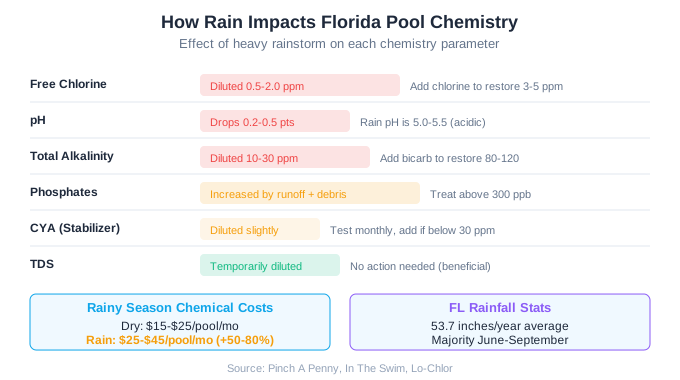
Rainwater is not clean water as far as pool chemistry is concerned. It has a pH of approximately 5.0 to 5.5 (acidic), contains zero alkalinity, carries dissolved nitrogen and phosphorus from the atmosphere and runoff, and introduces organic matter including algae spores from surrounding vegetation. Every rainstorm simultaneously lowers pH, dilutes chlorine, reduces alkalinity, and feeds algae. The combined effect is more damaging than any single factor alone.
| Chemistry Parameter | Effect of Heavy Rain | Recovery Action |
|---|---|---|
| Free chlorine | Diluted by 0.5 - 2.0 ppm depending on rainfall | Add liquid chlorine to restore 3.0 - 5.0 ppm |
| pH | Drops 0.2 - 0.5 points (rain is acidic) | Add sodium bicarbonate to restore 7.4 - 7.6 |
| Total alkalinity | Diluted, may drop 10 - 30 ppm | Add sodium bicarbonate to restore 80 - 120 ppm |
| CYA (stabilizer) | Diluted slightly, gradual effect | Test monthly, add stabilizer if below 30 ppm |
| Phosphates | Increased by runoff and organic debris | Apply phosphate remover if above 300 ppb |
| Total dissolved solids | Temporarily diluted | No action needed (beneficial dilution) |
The critical point is that rain does not just affect one parameter. It creates a cascade: chlorine drops, pH drops, phosphates increase, and organic debris provides nutrients. If any one of these is not addressed at the next service visit, the pool has favorable conditions for algae growth. This is why testing every parameter at every summer visit matters in Florida, not just chlorine and pH.
How Should You Adjust Chemical Treatment During Rainy Season?
Standard weekly chemical dosing that works from October through May does not hold during Florida rainy season. You need to increase chlorine dosing, buffer alkalinity higher to absorb rain-driven pH drops, and add phosphate management to your routine. The adjustments are straightforward, but they must be consistent at every visit.
Rainy Season Chemical Protocol
- Increase chlorine dosage 25-40%: If you normally add 1 gallon of liquid chlorine per visit to a 15,000-gallon pool, increase to 1.25 to 1.5 gallons during rainy season to compensate for rain dilution.
- Maintain alkalinity at 90 to 120 ppm: Target the higher end of the acceptable range. Higher alkalinity buffers against rain-driven pH drops and reduces the frequency of pH corrections.
- Shock after heavy rain events: If a customer reports multiple inches of rain since your last visit, add a shock dose (1 lb cal-hypo per 10,000 gallons) at the beginning of service to immediately boost sanitizer.
- Add phosphate remover monthly: Rain introduces phosphates through runoff, fertilizer residue, and organic debris. Test phosphates monthly and treat with a lanthanum-based phosphate remover when levels exceed 300 ppb.
- Increase algaecide frequency: Use a maintenance dose of copper-based or polyquat algaecide every two weeks during rainy season instead of monthly.
- Check CYA monthly: Rain dilutes CYA gradually. If CYA drops below 30 ppm, chlorine will not hold between visits regardless of how much you add.
Phosphates do not directly harm swimmers, but they are the primary food source for algae. A pool with high phosphates and marginal chlorine will grow algae. A pool with high phosphates and strong chlorine will resist algae but consume chlorine faster. Either way, removing phosphates reduces your chemical cost and algae risk.
How Do You Schedule Service Around Florida Storms?
Florida afternoon thunderstorms follow a predictable pattern: building from late morning, arriving between 2 PM and 5 PM, and clearing by evening. This pattern holds across most of the state during June through September. Smart scheduling works with this pattern rather than against it.
Scheduling Strategy
- Front-load routes to morning hours: Schedule chemistry-critical pools (salt pools, pools with persistent algae history, commercial accounts) before noon. Chemical treatments have more time to work before afternoon rain hits.
- Save maintenance-heavy pools for early morning: Pools that need more brushing, vacuuming, or filter cleaning work best as first stops when temps are cooler and storms have not started.
- Accept that afternoon service is weather-dependent: From June through September, any pool scheduled after 2 PM may get rained on during or immediately after service. Build buffer time into afternoon routes.
- Do not reschedule for rain: Unless there is lightning, service the pool. Rain does not prevent chemical treatment, and the customer needs the chemical boost more after rain, not less. Skipping a visit because of rain is the fastest path to a green pool.
- Add a "storm check" stop midweek: For problem pools, offer a 5 to 10 minute midweek chemical check at $30 to $50 per stop. Test chlorine, add chlorine if needed, remove large debris. This prevents the Thursday green pool call.
Lightning is the exception. Florida leads the nation in lightning strikes. If there is active lightning within 10 miles, get away from the pool immediately. A wet pool deck next to a large body of water during a thunderstorm is exactly where you do not want to be. Wait in your truck or move to the next stop and come back.
How Do You Handle Persistent Algae During Rainy Season?
Even with adjusted protocols, some pools will develop algae during Florida rainy season. The combination of daily rain, heavy organic load from surrounding vegetation, high phosphates from lawn runoff, and warm water temperatures creates conditions where algae can establish between weekly visits. A full green pool recovery costs $150 to $300 in chemicals and 2 to 3 extra service visits, so prevention is always cheaper than cure.
Algae Prevention Hierarchy
- 1Maintain chlorine above 2.0 ppm at all times: Algae cannot establish when chlorine is adequate. This is your first and most important defense.
- 2Keep phosphates below 300 ppb: Remove the food source and algae struggles to grow even when other conditions are favorable.
- 3Maintain proper CYA levels: CYA between 30 and 50 ppm protects chlorine from UV so it persists between visits.
- 4Use a maintenance algaecide: Polyquat 60 or copper-based algaecide every two weeks acts as a secondary barrier when chlorine dips.
- 5Brush weekly: Algae begins on surfaces before it is visible in the water. Weekly brushing disrupts early-stage growth.
- 6Clean filters regularly: A dirty filter cannot circulate water effectively, creating dead spots where algae establishes first.
When Algae Appears Despite Prevention
When a pool goes green, act immediately. Do not wait for the next scheduled visit. The longer algae grows, the more chemicals and time the recovery requires. Triple shock the pool (3 lbs cal-hypo per 10,000 gallons), brush all surfaces, clean the filter, and return in 24 to 48 hours to re-test and re-shock if needed. Charge the customer for the recovery as a separate service, not as part of their regular maintenance.
How Does Rainy Season Affect Service Revenue and Costs?
Florida rainy season increases your chemical costs 30 to 50% while also generating more customer service calls, more callbacks, and more recovery work. If your pricing does not account for this seasonal cost increase, you are subsidizing summer service with winter and spring profits.
| Cost Category | Dry Season (Oct-May) | Rainy Season (Jun-Sep) | Increase |
|---|---|---|---|
| Liquid chlorine per pool/visit | $3 - $5 | $5 - $8 | 40-60% |
| Shock treatments per pool/month | $5 - $8 | $10 - $15 | 50-100% |
| Algaecide per pool/month | $3 - $5 | $5 - $8 | 40-60% |
| Phosphate remover per pool/month | $0 | $5 - $10 | New cost |
| Total chemical cost per pool/month | $15 - $25 | $25 - $45 | 50-80% |
Pricing Strategies for Rainy Season
- Flat annual rate: Average chemical costs across 12 months and charge a consistent rate. Simpler for customers, but requires accurate cost forecasting.
- Seasonal chemical surcharge: Add $15 to $30 per month from June through September. Transparent and easy to explain.
- Chemical pass-through: Bill actual chemical costs separately from service labor. Most transparent but creates variable bills customers dislike.
- Tiered summer packages: Offer a standard weekly service and a premium twice-weekly service during rainy season at different price points.
Whichever pricing model you use, communicate it before rainy season starts. A May email explaining summer chemistry challenges and any cost adjustments prevents the July phone call from a customer surprised by a higher bill.
What Equipment Adjustments Are Needed During Rainy Season?
Beyond chemistry, Florida rainy season puts additional strain on pool equipment. Higher debris loads, increased pump run times for chemical circulation, and frequent water level fluctuations from heavy rain all affect equipment performance and longevity.
Equipment Maintenance Adjustments
- Clean skimmer baskets at every visit: Rainstorms blow leaves, pollen, and debris into pools. A full skimmer basket reduces flow and starves the pump.
- Backwash or clean filters more frequently: Every 2 to 3 weeks during rainy season instead of monthly. Heavy organic loads clog filters faster.
- Check pump basket every visit: Debris bypasses full skimmer baskets and accumulates in the pump strainer, reducing flow and increasing pump strain.
- Verify water level after heavy rain: Pools can overflow during heavy storms, flooding equipment pads. If the pool has an autofill, ensure it is not still running when the pool is already full.
- Inspect equipment electrical connections: Heavy rain and flooding can corrode electrical connections on pump motors, timers, and salt cells. Check for tripped GFCIs after every major storm.
- Run pump longer during rainy season: Increase run time by 1 to 2 hours per day to improve chemical circulation and filtration of rain-introduced debris.
Document equipment condition at every visit. If a pump fails in August and the customer claims it was working fine before rainy season, your service logs showing consistent operation through June and July demonstrate the failure was not caused by your service.
Ready to streamline your pool service business?
Pool Founder gives you route optimization, automated invoicing, chemical tracking, and everything else you need to run a more profitable pool business.
Frequently Asked Questions
How much does rain affect pool chlorine levels?
Heavy rain can dilute free chlorine by 0.5 to 2.0 ppm depending on the amount of rainfall. Rain also lowers pH, reduces alkalinity, and introduces phosphates and organic matter that increase chlorine demand. The combined effect can leave a pool under-sanitized within 24 to 48 hours.
Should I skip pool service when it is raining in Florida?
No. Unless there is active lightning, service the pool. Rain does not prevent chemical treatment, and the pool needs the chemical boost more after rain, not less. Skipping a visit during rainy season significantly increases the risk of algae.
How much more do chemicals cost during Florida rainy season?
Chemical costs increase 30 to 50% during rainy season (June through September). Total chemical cost per pool per month rises from approximately $15 to $25 in dry months to $25 to $45 during rainy season, driven by higher chlorine consumption, more frequent shock treatments, and phosphate removal.
What causes persistent algae in Florida pools during summer?
The combination of daily rain diluting chlorine, warm water temperatures above 85 degrees F, phosphates introduced by runoff, and organic debris from storms creates ideal conditions for algae. Maintaining chlorine above 2.0 ppm and keeping phosphates below 300 ppb are the two most important preventive measures.
Should I charge more for pool service during Florida rainy season?
Yes. Options include a flat annual rate that averages seasonal costs, a $15 to $30 monthly summer surcharge, or a chemical pass-through billing model. Communicate any pricing changes before rainy season begins.
Sources & References
- JTS Pool Services: How Florida Weather Affects Your Pool
- Pinch A Penny: Pool Care During Rainy Season
- In The Swim: Heavy Rains and Pool Water Chemistry
- Lo-Chlor: How Does Rainy Weather Affect My Pool Water?
- PhosLocker: The Link Between Phosphates and Algae Growth in Pools
- Swim Incorporated: Saltwater Pool Mistakes Florida Owners Must Avoid