One Freeze Event Can Destroy $10,000 in Pool Equipment
When water freezes inside pool plumbing, it expands roughly 9% by volume. That expansion cracks PVC pipes, splits pump housings, warps filter tanks, and destroys heater heat exchangers. A single hard freeze without circulation can generate $3,000 to $15,000 in equipment and plumbing damage. Freeze protection systems exist to prevent this by automatically running the circulation pump when air temperatures drop near freezing, keeping water moving so it cannot freeze inside the plumbing.
Corey Adams, Pool Founder co-founder and 15-year pool service veteran, has responded to freeze damage calls that wiped out entire equipment pads. "I got a call from a customer in north Texas after a February cold snap. Their freeze guard failed because the sensor wire had corroded. Every pipe on the equipment pad was cracked. The pump housing split in half. The heater heat exchanger was destroyed. Total repair was $11,400. A $200 freeze guard and a 10-minute annual test would have prevented all of it."
$3K-$15K
Typical repair cost for freeze damage to pool plumbing and equipment
Source: HomeAdvisor, Angi, Pool industry data
How Pool Freeze Protection Works
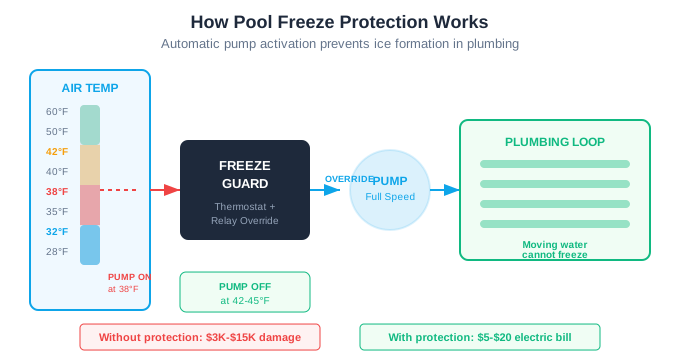
Pool freeze protection relies on a simple principle: moving water is far harder to freeze than still water. A freeze guard monitors the ambient air temperature using a thermostat sensor. When the temperature drops to a preset threshold, typically 36-40 degrees Fahrenheit, the freeze guard overrides the normal pump timer and turns on the circulation pump. The pump runs continuously until the air temperature rises above the threshold. Water circulating through the plumbing prevents ice formation.
Types of Freeze Protection Systems
| Type | How It Works | Cost Installed | Best For |
|---|---|---|---|
| Standalone freeze guard (Intermatic PF1102T or similar) | Add-on thermostat that wires into the pump timer and overrides it when temperature drops below threshold | $150-$300 | Pools with basic timer controls and no automation |
| Automation system freeze protection | Built-in feature in Pentair IntelliCenter, Hayward OmniLogic, Jandy iAqualink, and similar controllers. Uses an integrated temperature sensor. | Included with automation ($1,500-$4,000 for the system) | Pools with modern automation systems |
| Inline pipe heater or heat tape | Electric heating element wrapped around exposed pipes to prevent localized freezing | $50-$200 per section | Supplemental protection for exposed above-ground pipe runs |
| Pool pump with freeze protection mode | Variable speed pumps (Pentair IntelliFlo, Hayward MaxFlo VS) with built-in freeze protection that activates the pump automatically | Included with pump ($800-$1,500) | Modern VS pump installations |
Thermostat Settings and Calibration
The thermostat is the brain of the freeze protection system. If it is set wrong or miscalibrated, the system either activates too late (freeze damage) or too early (wasted energy). Getting the settings right is critical.
Recommended Thermostat Settings
| Setting | Recommended | Why |
|---|---|---|
| Activation temperature | 38 degrees F (factory default on most units) | Provides a safety buffer above 32 degrees F to account for sensor lag and microclimates |
| Deactivation temperature | 42-45 degrees F | Prevents short-cycling when temps hover near the threshold |
| Pump speed (VS pumps) | Maximum RPM during freeze protection | Full flow ensures all plumbing lines have circulation. Low speed may not reach elevated features or distant return lines. |
Do not lower the activation temperature below 36 degrees F to save on electricity. The sensor measures air temperature, not water temperature, and it may be mounted in a location that reads warmer than the actual air at the plumbing. A 38 degree F setting with a sensor reading 2-3 degrees warm means the pump activates around 35-36 degrees F actual. Lowering to 34 degrees F could mean the pump does not activate until actual temps hit 31-32 degrees F, which is too late.
Sensor Placement and Calibration
- Mount the sensor in open air, away from heat sources (pump motors, heater exhaust, equipment enclosures that trap heat)
- The sensor should be shaded from direct sunlight, which causes false warm readings
- Position the sensor at the same height as the plumbing you are protecting, not 6 feet up on a wall where air is warmer
- Calibrate annually by comparing the sensor reading to a known-accurate thermometer placed next to the sensor during cool weather
Pre-Season Testing: The 10-Minute Test That Prevents $10,000 in Damage
Every pool service company in a freeze-risk area should test freeze protection systems before the first cold snap of the season. This is a 10-minute procedure that costs nothing and prevents catastrophic damage.
Freeze Guard Test Procedure
- 1Visual inspection: Check the freeze guard unit for physical damage, corrosion, loose wiring, and insect nests (wasps love control boxes). Verify the sensor wire is intact and the sensor is properly mounted.
- 2Simulate a freeze event: Most standalone freeze guards have an adjustable thermostat dial. Turn the dial up past the current air temperature to trigger the freeze protection. The pump should start within 30-60 seconds. If using automation, use the manual freeze protection test function in the controller menu.
- 3Verify pump operation: Confirm the pump is running and that water is circulating through all lines. Check for adequate flow at the return jets. If the pool has elevated water features, spillovers, or raised spas, verify that water is flowing through those lines as well.
- 4Check all valves: All valves should be in a position that allows water to circulate through every plumbing line. Closed valves isolate sections of plumbing, and isolated sections will freeze. Some pool owners close off features during winter. Open them for freeze protection testing and instruct the owner to leave them open.
- 5Reset the thermostat: After confirming the system works, return the thermostat to the normal activation setting (38 degrees F). Verify the pump shuts off when the temperature reading drops below the activation threshold.
- 6Document the test: Record the test date, test result (pass/fail), thermostat setting, and any issues found. Add this to the service record for the pool.
Test freeze protection in early fall, before the first freeze threat. Do not wait until a cold front is 48 hours away. If the test reveals a failed sensor, corroded wiring, or a dead unit, you need time to order parts and make repairs.
Common Freeze Protection Failures and How to Prevent Them
Freeze protection systems fail for predictable, preventable reasons. Understanding the common failure modes lets you catch them during routine service before they cause damage.
| Failure Mode | What Happens | How to Prevent It |
|---|---|---|
| Corroded sensor wire | Sensor stops reading temperature, freeze guard never activates | Inspect sensor wire annually. Replace corroded wires. Use weatherproof connectors. |
| Sensor mounted near heat source | Sensor reads warm, freeze guard activates too late or not at all | Relocate sensor away from motors, heater exhaust, and enclosed equipment rooms |
| Power outage during freeze event | No power = no pump = frozen pipes | Install a battery backup or generator for the pump. Some VS pumps have battery backup options. |
| Closed valve isolates plumbing section | Water in the isolated section freezes while the rest of the system circulates | Open all valves before freeze season. Mark valves that must stay open with tags or paint. |
| Pump fails during freeze event | Freeze guard activates but the pump does not start | Test pump operation during pre-season freeze test. Address any pump issues before winter. |
| VS pump runs at low speed during freeze | Insufficient flow to reach all plumbing lines | Configure freeze protection to run pump at maximum speed, not at the normal service speed |
| Freeze guard unit failure | Thermostat or relay fails, pump does not activate | Replace freeze guard units older than 10 years. Test annually. |
What to Do When Freeze Protection Fails
Despite best efforts, freeze events happen. Power goes out, equipment fails, or a freeze hits a region that rarely sees freezing temperatures. When a customer calls after a freeze, your response determines how much damage occurs and how quickly the pool is back in service.
Immediate Response Protocol
- 1Do NOT turn on the pump. If you suspect frozen pipes, running the pump can worsen damage by forcing water against ice blockages, rupturing connections.
- 2Wait for temperatures to rise above 40 degrees F. Let the ice thaw naturally. Do not use open flame, heat guns, or boiling water on PVC pipes. Rapid heating can crack PVC that has been weakened by expansion.
- 3Visually inspect all plumbing for cracks. Once thawed, walk the entire plumbing run. Check every fitting, union, valve, and straight section. Look for wet spots on the ground (indicating hidden cracks). Check the pump housing, filter tank, heater connections, and chemical feeder plumbing.
- 4Check the pump housing and volute. The pump volute is the most common point of freeze failure because it holds a pool of water when the pump is off. A cracked volute must be replaced before the pump can operate.
- 5Check the filter tank and multiport valve. Freeze expansion can crack filter tanks and warp multiport valve internals. Operate the multiport through all positions and check for leaks.
- 6Run the pump with the equipment pad visible. Turn on the pump while watching the entire equipment pad. Pressurize the system slowly and watch for leaks at every connection. A small drip now becomes a major failure under full pressure later.
Document all freeze damage with photos before making any repairs. If the customer has homeowner insurance, freeze damage to pool equipment is often covered under the dwelling policy. Your documentation helps their claim. If the freeze resulted from a system you maintain, your own documentation protects you by showing the system was tested and operational before the freeze event.
Freeze Protection by Region: Who Needs What
Not every pool needs the same level of freeze protection. The investment should match the risk. Here is a regional breakdown to help you advise customers appropriately.
| Region | Freeze Risk | Recommended Protection | Notes |
|---|---|---|---|
| Sun Belt (AZ, South FL, SoCal) | Very low (rare freezes) | Automation system freeze mode or VS pump built-in protection | Freeze events are rare but devastating when they occur because most equipment is not winterized |
| Mild freeze zones (N. TX, N. FL, GA, Carolinas) | Moderate (5-15 freeze events/year) | Dedicated freeze guard + all valves open during winter | Most freeze damage in the pool industry occurs in this zone because protection is often inadequate |
| Hard freeze zones (TN, VA, MO, OK) | High (20+ freeze events/year) | Freeze guard + winterization blowout for pools that close seasonally | Pools that stay open year-round need robust freeze protection. Seasonal pools should be winterized. |
| Northern states (OH, PA, NY, NE) | Very high | Full winterization with compressed air blowout and antifreeze in lines | Freeze protection alone is not sufficient. Winterize all pools that will not operate through winter. |
Ready to streamline your pool service business?
Pool Founder gives you route optimization, automated invoicing, chemical tracking, and everything else you need to run a more profitable pool business.
Frequently Asked Questions
What temperature should a pool freeze guard be set to?
The recommended activation temperature is 38 degrees F, which is the factory default on most units. This provides a safety buffer above 32 degrees F to account for sensor lag, sensor placement, and temperature variations across the equipment pad. Do not lower the setting below 36 degrees F to save on electricity.
Can a variable speed pump provide freeze protection?
Yes. Most modern variable speed pumps (Pentair IntelliFlo, Hayward MaxFlo VS, etc.) have built-in freeze protection that activates the pump automatically when the integrated temperature sensor detects cold air. Configure the freeze protection mode to run at maximum speed, not at a low service speed, to ensure adequate flow through all plumbing lines.
How much does freeze damage to a pool cost to repair?
Typical freeze damage repair costs range from $3,000 to $15,000 depending on the extent of damage. A cracked pump housing is $300-$800. Replumbing a section of PVC is $200-$500. A destroyed heater heat exchanger can be $1,000-$3,000. Multiple simultaneous failures from a single freeze event can total $10,000 or more.
Should I turn on the pool pump immediately after a freeze?
No. If you suspect frozen pipes, wait for temperatures to rise above 40 degrees F and let the ice thaw naturally. Running the pump against ice blockages can worsen damage by forcing water against frozen sections, rupturing connections and fittings.
Does homeowner insurance cover pool freeze damage?
Often yes. Many homeowner insurance policies cover sudden and accidental damage from freezing under the dwelling coverage section. However, coverage may be denied if the homeowner failed to take reasonable steps to prevent freeze damage (such as maintaining a functioning freeze protection system). Document all freeze damage with photos to support the insurance claim.