Why Do Equipment Inspections Generate More Revenue Than Any Other Service Add-On?
High-performing pool service companies generate repair and equipment revenue equal to 20-35% of total maintenance revenue. The companies that hit those numbers are not doing it with aggressive sales tactics. They are doing it with systematic equipment inspections that surface legitimate repair and replacement needs before equipment fails. An inspection report turns a conversation from "you should buy this" into "here is what I found and here is what it means for your pool."
Corey Adams, Pool Founder co-founder and 15-year pool service veteran, built his inspection process over years of trial and error. "When I started, I would just mention things verbally. The customer would nod and forget. When I started writing it down with photos and sending it in a report, close rates on repairs went from maybe 20% to over 60%. The report is not a sales tool. It is documentation. But documentation sells because it builds trust."
20-35%
Repair and equipment revenue as a percentage of maintenance revenue for high-performing pool service companies
Source: Industry surveys, Pool Business Forum, 2025
What Should a Pool Equipment Inspection Report Include?
A professional equipment inspection report covers every major component on the equipment pad and in the pool. It documents current condition, identifies issues, rates urgency, and provides actionable recommendations. The report should be clear enough that a homeowner with zero pool knowledge understands what is happening and what they need to do.
Equipment Pad Inspection Checklist
- Pump: Check for leaks at seal plate, listen for bearing noise, note vibration, check basket condition, verify flow rate and pressure, record amp draw if possible.
- Filter: Record pressure (clean vs. dirty), check multiport valve operation, inspect tank for cracks or corrosion, note media age (sand, DE, cartridge).
- Heater: Test ignition sequence, check for error codes, inspect heat exchanger for scale or corrosion, verify thermostat accuracy, check gas connections for corrosion.
- Salt cell: Inspect cell plates for calcium buildup, record cell voltage and salt level, check flow sensor, note cell age relative to warranty period.
- Automation system: Test all relays, verify sensor readings match manual readings, check for firmware updates, test remote connectivity.
- Plumbing: Check all visible joints for leaks, inspect valve operation (multiport, check valves, actuators), look for UV degradation on exposed PVC.
In-Pool Inspection Checklist
- Returns and suction fittings: Check for proper flow, verify VGBA-compliant drain covers, inspect for cracks around fittings.
- Lights: Test operation, check lens gasket condition, note any water inside the fixture.
- Tile and coping: Document cracked, loose, or missing tiles. Note calcium line buildup.
- Surface condition: Note staining, roughness, delamination, or exposed aggregate that indicates surface age.
- Water features: Test all features, check for leaks at connection points, verify timer or automation control.
How Should You Rate and Prioritize Inspection Findings?
Not every finding is urgent. Dumping 15 issues on a customer with no prioritization overwhelms them and they do nothing. A good inspection report categorizes findings by urgency so the customer knows what to address now versus what to plan for. Use a simple three-tier system that any homeowner can understand.
| Priority | Definition | Examples | Timeline |
|---|---|---|---|
| Critical | Safety risk or imminent failure | Electrical hazard, non-compliant drain cover, leaking gas connection | Immediate |
| Recommended | Will fail within 3-12 months or causing inefficiency | Worn pump seal, scaled salt cell, high filter pressure | Within 30-90 days |
| Monitor | Normal wear, no immediate action needed | Aging equipment nearing end of life, minor cosmetic issues, slow valve actuator | Next inspection |
The critical tier gets addressed immediately and often closes on the spot. The recommended tier is where most of your additional revenue comes from. The monitor tier builds the pipeline for future work and demonstrates that you are not trying to sell unnecessary repairs.
Including a "monitor" category is what separates a trusted advisor from a pushy salesperson. When a customer sees that you looked at something and said "this is fine for now, we will keep an eye on it," they trust the items you flagged as recommended. That trust closes more work than any sales technique.
How Do You Present Inspection Reports to Customers?
The format and delivery of the report matters as much as the content. A verbal mention gets forgotten. A text message with "your pump is leaking" creates anxiety without context. A professional report with photos, explanations, and pricing options gets read, shared with spouses, and acted on.
Report Format Best Practices
- Photos for every finding. A photo of a corroded heater header is worth more than any description. Take before photos of every issue and annotate them if possible.
- Plain language descriptions. Write "the rubber seal that keeps water from leaking out of the pump is worn and dripping" instead of "shaft seal failure at the seal plate interface." The customer is not a technician.
- Cost ranges, not exact quotes. Include approximate repair costs so the customer can make a decision without needing a separate estimate call. Present a range, not a single number.
- Repair vs. replace options. For equipment nearing end of life, show both the repair cost and the replacement cost. Let the customer see the math. A $300 repair on a 12-year-old heater versus a $3,000 replacement is a different decision than a $300 repair on a 3-year-old heater.
- Digital delivery. Email or portal delivery with PDF attachment. The customer can forward it to their spouse, property manager, or HOA board. Paper reports get lost.
Send the report within 24 hours of the inspection. Same-day is better. The longer you wait, the less urgency the customer feels and the lower your close rate on recommended repairs.
How Often Should You Perform Equipment Inspections?
The frequency depends on the account type and equipment age. Over-inspecting wastes your time. Under-inspecting means you miss revenue opportunities and equipment fails without warning, which damages your reputation.
| Account Type | Inspection Frequency | Rationale |
|---|---|---|
| Residential, equipment < 5 years | Annual (season open) | Equipment is relatively new. Annual baseline catches early issues. |
| Residential, equipment 5-10 years | Semi-annual (open + mid-season) | Equipment is in the replacement window. More frequent monitoring catches issues before failure. |
| Residential, equipment > 10 years | Quarterly | End-of-life equipment needs close monitoring. Failures are more frequent and more costly. |
| Commercial | Monthly (equipment pad) + quarterly (full) | Higher liability, higher usage, regulatory requirements. Monthly pad checks are quick. |
Charge for inspections. A comprehensive equipment inspection is a professional service worth $75-$150 for residential and $150-$300 for commercial. Giving it away devalues the work. Frame it as a "pool health assessment" that saves the customer money by catching small problems before they become big ones.
How Do Equipment Inspections Impact Revenue Per Account?
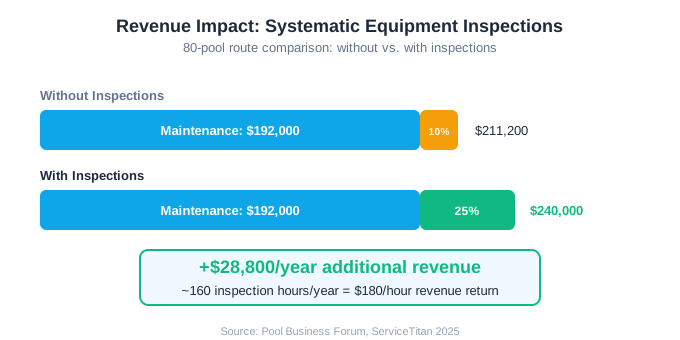
The math is straightforward. On a well-managed pool service operation, maintenance contributes 70-80% of revenue and repairs and equipment contribute 20-30%. If your average residential maintenance account generates $2,400 per year, the repair and equipment opportunity is $600-$1,000 per account annually. Without systematic inspections, most of that revenue goes uncaptured or goes to competitors who inspect proactively.
Revenue Impact Example: 80-Pool Route
| Metric | Without Inspections | With Inspections |
|---|---|---|
| Maintenance revenue | $192,000 | $192,000 |
| Repair/equipment revenue | $19,200 (10%) | $48,000 (25%) |
| Total revenue | $211,200 | $240,000 |
| Additional revenue | Baseline | +$28,800/yr |
| Inspection time investment | None | ~160 hrs/yr (2 hrs/pool) |
| Revenue per inspection hour | N/A | $180/hr |
That $28,800 in additional annual revenue comes from work that needs to be done regardless. Equipment ages, parts wear out, and things break. The only question is whether you find it first or the customer calls someone else when it fails. Proactive inspections keep that revenue in your shop.
What Tools Do You Need for Professional Equipment Inspections?
You do not need expensive diagnostic equipment for most residential inspections. A few key tools and your experience as a technician cover 90% of what you need to assess.
- Clamp meter (amp meter): $40-$100. Measures motor amperage to detect overloaded or failing motors. Compare reading to nameplate FLA.
- Infrared thermometer: $25-$50. Checks heater output temperature, motor housing temperature, and bearing temperature without contact.
- Pressure gauge (calibrated): $15-$30. Verifies filter pressure readings against the tank gauge. Tank gauges are often inaccurate after a few years.
- Phone camera: Already have it. Take photos of every finding. Use a photo annotation app to circle or arrow issues.
- Multimeter: $30-$80. Tests voltage at motor terminals, checks for ground faults, verifies control system outputs.
- Flow meter or flow calculator: $0-$200. Either a portable flow meter or a calculation based on pump curve, RPM, and system head to verify adequate turnover.
Total investment for a complete inspection toolkit is $110-$460 on top of what you already carry. At $180 per hour in revenue generated from inspection findings, the tools pay for themselves on the first inspection.
Run a pool route?
The business side of what you just read.
Pricing, chemical costs, and the tools owners use to keep the numbers straight.
- Commercial pool service pricing2026 rate tables and the cost-plus formula
- Chemical cost per poolWhat chemicals actually cost per stop
- Chemical tracking softwareLog readings and dosing from the pool deck
- Pool service softwareRoutes, invoicing, and service reports in one app
- Free profit & rate calculatorsProfit per pool, minimum rate, break-even
Frequently Asked Questions
How much additional revenue do equipment inspections generate?
High-performing pool service companies report that repair and equipment revenue equals 20-35% of maintenance revenue when systematic inspections are in place. On an 80-pool route with $192,000 in maintenance revenue, that translates to $38,400-$67,200 in additional annual revenue from equipment work surfaced by inspections.
How long does a pool equipment inspection take?
A thorough residential equipment inspection takes 20-30 minutes for the on-site assessment and another 15-30 minutes for report writing. Commercial inspections take 45-90 minutes on site. Most techs build inspection time into their regular service visit rather than scheduling a separate appointment.
Should I charge for pool equipment inspections?
Yes. A comprehensive equipment inspection is a professional service worth $75-$150 for residential and $150-$300 for commercial. Charging for the inspection signals that it has value. Some companies include one annual inspection in their service agreement and charge for additional inspections.
What is the best format for an equipment inspection report?
A digital PDF sent via email within 24 hours of the inspection, with photos of every finding, plain language descriptions, a three-tier priority rating (critical, recommended, monitor), and approximate cost ranges for each repair or replacement option. Digital reports can be forwarded to spouses, property managers, or HOA boards.
How often should pool equipment be inspected?
Annual inspections for newer equipment (under 5 years), semi-annual for equipment in the 5-10 year range, and quarterly for equipment over 10 years old. Commercial pools should have monthly equipment pad checks and quarterly full inspections due to higher usage and regulatory requirements.