Why Equipment Failure Data Matters for Service Companies
3-7 Years
average salt cell lifespan before replacement is needed
Source: Pool Research, Leslie's Pool
8-12 Years
typical pool pump lifespan for single-speed models with proper maintenance
Source: In The Swim, Shasta Pool Supply
50%
of warranty service calls find no actual product defect, just operator error or bad water chemistry
Source: Payan Pool Service, manufacturer data
Equipment failures are the number one source of emergency service calls, customer frustration, and upsell revenue for pool service companies. Knowing when each piece of equipment is likely to fail lets you move from reactive repairs to proactive replacements. That shift improves customer trust, reduces callbacks, and creates a predictable revenue stream from equipment sales.
This article compiles failure rate data by equipment type, breaks down lifespan ranges by technology (single-speed vs. variable-speed pumps, gas vs. heat pump heaters), and provides a timeline for when service companies should start monitoring for end-of-life symptoms. The data comes from manufacturer warranty specifications, pool supply retailers, and 15 years of Corey Adams' field experience replacing equipment across thousands of pools.
Pool Pump Failure Rates and Lifespan
Pool pumps are the workhorse of every pool system and the most common piece of equipment that service companies replace. <b>Single-speed pumps last 7-12 years</b> on average, while <b>variable-speed pumps last 10-15 years</b>. The extended lifespan of VS pumps comes from lower operating stress, since they run at reduced RPM for most of their daily cycle instead of full speed constantly.
| Pump Type | Expected Lifespan | Common Failure Points | Warranty Period |
|---|---|---|---|
| Single-Speed | 7-12 years | Shaft seal, motor bearings, capacitor | 1-2 years |
| Variable-Speed | 10-15 years | Drive board, shaft seal, display | 2-3 years |
| Two-Speed | 8-12 years | Motor windings, shaft seal | 1-2 years |
| Booster (cleaner) | 5-8 years | Impeller wear, seal failure | 1 year |
What Causes Premature Pump Failure?
Most premature pump failures come from preventable stress rather than manufacturing defects. The shaft seal is the most common failure point, typically caused by excessive heat from restricted water flow, unbalanced water chemistry (particularly low pH corroding the seal), or running the pump dry. Service companies that monitor for these conditions and address them early can extend pump life by 2-3 years.
- <b>Shaft seal leak:</b> Most common issue. Caused by heat, bad chemistry, or salt corrosion. Replace the seal ($15-40 part) before it damages the motor ($200-400).
- <b>Motor bearing failure:</b> Grinding noise progressing to seizure. Usually occurs after 8+ years. Motor replacement is typically the right call at this point.
- <b>Capacitor failure:</b> Pump hums but does not start. A $15-25 part that takes 15 minutes to replace. Common on pumps 5+ years old.
- <b>Drive board failure (VS pumps):</b> Display errors, erratic speed changes, or complete shutdown. Board replacement runs $200-500.
Salt Cell Failure Rates and Lifespan
Salt chlorine generator cells have the shortest lifespan of any major pool component at <b>3-7 years</b>, with most cells rated for approximately 10,000 hours of runtime. At typical Florida usage of 8-10 hours per day year-round, that translates to roughly 3-4 years. In seasonal markets running 6 months per year, cells can last 5-7 years because total runtime accumulates slower.
Salt cells are also the most predictable replacement item. Unlike pumps and heaters where failure can be sudden, salt cells degrade gradually. Chlorine output drops steadily as the coating wears off the cell plates. Service companies can track declining output through water chemistry trends. When a pool that used to hold 3-4 ppm free chlorine starts consistently running at 1-2 ppm despite the cell running at higher output percentages, the cell is nearing end of life.
| Factor | Impact on Cell Life | Preventive Measure |
|---|---|---|
| Calcium buildup | Reduces output, accelerates coating wear | Clean cell every 3-6 months with muriatic acid |
| Low salt level | Overworks remaining output capacity | Maintain 3,200-3,400 ppm salt |
| High CYA | Requires higher chlorine demand, more cell runtime | Keep CYA under 80 ppm |
| Improper pH | Accelerates plate degradation below 7.2 or above 7.8 | Maintain pH 7.4-7.6 |
| Oversized pool | Cell runs at 100% continuously | Recommend cell upgrade for pools above rated capacity |
Salt cells cost $300-800 to replace depending on brand and model. At a 3-5 year replacement cycle, that is $60-267 per year in equipment cost per salt pool. Service companies that proactively recommend replacement before complete failure avoid the angry phone call about a green pool and instead get a grateful customer thanking them for catching it early.
Pool Heater Failure Rates and Lifespan
<b>Gas heaters (natural gas or propane) last 5-12 years</b>, with most failures occurring between years 7 and 10. <b>Heat pump heaters last 10-20 years</b>, with a typical functional life of 12-15 years. The significant lifespan difference comes from the fundamental technology. Gas heaters use combustion, which corrodes heat exchangers over time. Heat pumps use a refrigerant cycle similar to an air conditioner, with less chemical stress on components.
| Heater Type | Expected Lifespan | Avg. Replacement Cost | Common Failures |
|---|---|---|---|
| Natural Gas | 7-12 years | $2,500-4,500 installed | Heat exchanger, ignition, gas valve |
| Propane | 5-10 years | $2,500-4,500 installed | Same as natural gas, slightly shorter life |
| Electric Heat Pump | 10-15 years | $3,500-6,000 installed | Compressor, heat exchanger, fan motor |
| Solar | 15-25 years | $3,000-7,000 installed | Panel degradation, valve failure |
Heat Exchanger: The Expensive Failure Point
The heat exchanger is the most expensive component to fail in any pool heater. In gas heaters, low pH water corrodes the copper heat exchanger from the inside while combustion byproducts attack from the outside. In heat pumps, the titanium or cupronickel heat exchanger is more durable but still susceptible to aggressive water chemistry. A heat exchanger replacement typically costs $800-1,500 for parts alone, often making full heater replacement the better financial decision on units over 8 years old.
California's 2025 Title 24 update effectively ended gas heaters as the primary heat source for new pool construction. Service companies in California should prepare for a shift toward heat pump installations and the different maintenance requirements they bring.
Pool Filter Failure Rates and Media Replacement
Pool filters rarely "fail" in the dramatic way that pumps and heaters do. Instead, they gradually lose effectiveness as filter media degrades. The filter tank itself lasts 15-20+ years for most quality brands. The media inside is what needs periodic replacement.
| Filter Type | Media Life | Tank Life | Replacement Cost (Media) |
|---|---|---|---|
| Cartridge | 2-3 years per cartridge | 15-20 years | $50-200 per cartridge |
| Sand | 5-7 years (sand media) | 20+ years | $50-100 for sand refill |
| DE (Diatomaceous Earth) | 5-7 years (grids) | 15-20 years | $150-400 for grid set |
Cartridge filters require the most frequent replacement. In high-debris environments (lots of trees, heavy pollen, construction dust), cartridges may need replacement annually. Sand filters are the lowest maintenance option with 5-7 year sand replacement intervals. DE filters provide the best filtration quality but require more hands-on management with powder recharging after each backwash.
The revenue opportunity for service companies is not in the media cost itself (relatively inexpensive) but in the labor and the upsell. A cartridge replacement visit is an opportunity to inspect the entire equipment pad, check o-rings, assess pump condition, and recommend any other maintenance. Filter replacement visits average $150-300 including parts and labor.
Automation and Control System Lifespan
Pool automation systems (Pentair IntelliCenter, Hayward OmniLogic, Jandy iAqualink) have been installed in volume only for the past 10-15 years, so long-term failure data is limited. Early data suggests control panels last <b>8-15 years</b> before requiring board replacement or full system upgrades. Wireless modules, relay boards, and touchscreen interfaces are the most common failure points.
Chemical automation controllers like Pentair IntelliChem have a shorter expected life of 5-10 years, primarily because the pH and ORP probes require regular replacement (every 1-2 years at $50-100 each) and the chemical feed pumps wear out after 3-5 years.
- <b>Control panel:</b> 8-15 years. Board-level failures are common after 10 years. Replacement boards cost $300-800.
- <b>Wireless/WiFi module:</b> 5-8 years. Most common complaint is connectivity loss. Module replacement is $100-200.
- <b>Relay boards:</b> 7-12 years. Relay failures cause individual equipment to stop responding to automation commands.
- <b>pH/ORP probes:</b> 1-2 years. Consumable items that require regular replacement for accurate chemical control.
- <b>Chemical feed pumps:</b> 3-5 years. Peristaltic pump tubing wears out and needs replacement.
Equipment Failure Timeline for Service Companies
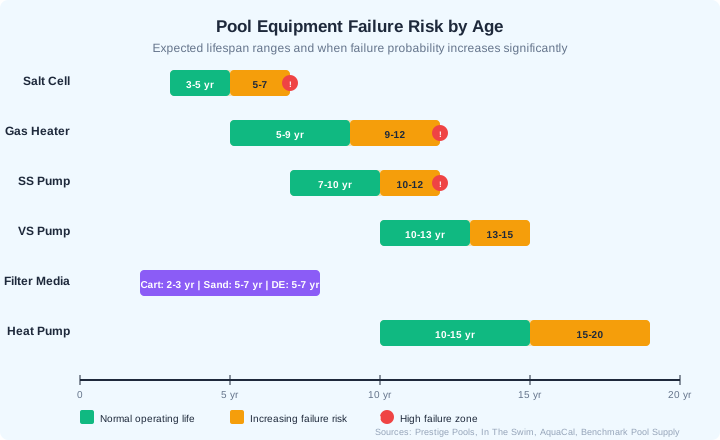
Service companies that track equipment installation dates can predict replacement needs 6-12 months before failure occurs. Here is a practical monitoring schedule:
- 1<b>Year 2-3:</b> Start monitoring salt cell output. Check chlorine production efficiency at each visit.
- 2<b>Year 5-7:</b> Inspect gas heater heat exchangers for signs of corrosion. Check pump shaft seals for early leaking.
- 3<b>Year 7-10:</b> Proactively discuss pump replacement timeline with customers. Recommend variable-speed upgrades for energy savings.
- 4<b>Year 10+:</b> Full equipment pad assessment annually. Budget planning with customers for major replacements.
- 5<b>Ongoing:</b> Replace cartridge filters every 2-3 years. Replace pH/ORP probes annually on chemical automation systems.
Pool Founder's equipment tracking logs installation dates, manufacturer, and model for every piece of equipment on each customer's pool. When items approach their expected end of life, you can flag them for inspection and have the replacement conversation before the emergency call.
Run a pool route?
The business side of what you just read.
Pricing, chemical costs, and the tools owners use to keep the numbers straight.
- Commercial pool service pricing2026 rate tables and the cost-plus formula
- Chemical cost per poolWhat chemicals actually cost per stop
- Chemical tracking softwareLog readings and dosing from the pool deck
- Pool service softwareRoutes, invoicing, and service reports in one app
- Free profit & rate calculatorsProfit per pool, minimum rate, break-even
Frequently Asked Questions
How long does a pool pump last?
Single-speed pool pumps last 7-12 years on average, while variable-speed pumps last 10-15 years. The most common failure points are the shaft seal, motor bearings, and capacitor. Proper water chemistry and adequate water flow are the two biggest factors in pump longevity. Running a pump dry or with restricted flow significantly shortens its life.
How long does a salt cell last?
Salt chlorine generator cells last 3-7 years, with most rated for approximately 10,000 hours of runtime. In year-round climates like Florida running 8-10 hours daily, expect 3-4 years. In seasonal markets running 6 months per year, cells can last 5-7 years. Regular cleaning and proper water chemistry extend cell life.
What is the most common pool equipment failure?
Pump shaft seal failure is the single most common pool equipment repair. It is caused by heat from restricted water flow, aggressive water chemistry, or running the pump without adequate water. Seal replacement is a $15-40 part and should be done before the leak damages the motor, which costs $200-400 to replace.
How long does a pool heater last?
Gas pool heaters (natural gas or propane) last 5-12 years, with most failures between years 7 and 10. Electric heat pump heaters last 10-20 years. Solar heating systems last 15-25 years. The heat exchanger is the most expensive component to fail, often making full heater replacement more cost-effective than repair on units over 8 years old.
How often should pool filter media be replaced?
Cartridge filters need new cartridges every 2-3 years. Sand filter media should be replaced every 5-7 years. DE filter grids last 5-7 years before replacement. The filter tanks themselves last 15-20+ years. In high-debris environments, cartridge replacement may be needed annually.
What percentage of pool equipment warranty claims find no defect?
Approximately 50% of warranty service calls find that the product is functioning correctly and the issue is caused by operator error, poor water chemistry, or improper installation. This statistic from manufacturer service data highlights the importance of proper maintenance and water chemistry management in preventing perceived equipment failures.
Sources & References
- Prestige Pools - Life Expectancy of Pool Equipment
- In The Swim - How Long Does a Pool Pump Last
- AquaCal - Average Lifespan of a Swimming Pool Heat Pump
- Pool Research - How to Tell if a Salt Cell Needs Replacing
- Benchmark Pool Supply - Average Lifespan of Pool Filters Explained
- Shasta Pool Supply - Truth About Pool Pump Lifespan