Key Takeaway
$45
Average cost per lead for pool and spa companies through Google Ads, the lowest in all home services
Source: Google Ads Benchmarks, 2025
20 - 40%
Lower customer acquisition cost for referral-acquired customers vs. paid channels
Source: Bain & Company / industry surveys
$36
Return for every $1 spent on email marketing to existing customers
Source: Litmus Email Marketing ROI Report
Customer acquisition is the growth engine of every pool service business, but most operators have no idea what each new customer actually costs them or which channels deliver the best return. The data shows a clear pattern: referrals are the cheapest and highest-converting source, local SEO is the best long-term investment, and paid ads work but cost two to three times more per acquired customer than organic channels.
This report breaks down acquisition channel performance for pool service companies using cost-per-lead data, conversion benchmarks, and real operator spending patterns. Whether you are a solo operator growing from 30 pools to 100 or a company with five trucks trying to fill new routes, understanding where your next customer comes from and what they cost determines whether growth is profitable or just expensive.
Customer acquisition cost (CAC) is the total marketing and sales spend divided by the number of new customers acquired. A pool company spending $2,000/month on marketing that signs 10 new accounts has a CAC of $200. This report uses CAC and cost-per-lead (CPL) interchangeably where conversion rates are factored in.
What Does It Cost to Acquire a Pool Service Customer?
The average cost to acquire a new pool service customer ranges from $50 for referrals to $350 or more for paid advertising, depending on the channel, your market, and your conversion rate. Pool and spa companies pay an average of $45.15 per lead through Google Ads, which is the lowest cost per lead of any home services category. Compare that to plumbing at $129 per lead, HVAC at $128, and roofing at $228. The pool industry has a structural advantage in paid search because competition is lower and intent is high.
| Channel | Avg. Cost Per Lead | Avg. Cost Per Customer | Conversion Rate |
|---|---|---|---|
| Referrals | $0 - $50 | $50 - $100 | 30 - 50% |
| Google Business Profile / Local SEO | $0 - $20 | $75 - $150 | 15 - 25% |
| Google Ads (Search) | $45 | $150 - $250 | 15 - 20% |
| Google Local Services Ads | $25 - $50 | $100 - $200 | 20 - 30% |
| Facebook / Instagram Ads | $20 - $40 | $150 - $300 | 5 - 12% |
| Direct Mail | $54 | $200 - $350 | 1 - 3% |
| Door-to-Door | $0 (labor only) | $75 - $150 | 5 - 15% |
| Nextdoor / Community Apps | $0 - $15 | $50 - $125 | 10 - 20% |
These ranges reflect national averages. Markets like Phoenix, Dallas, and South Florida with high pool density will have higher ad costs due to competition, while smaller markets with fewer pool service companies will see lower CPL. The key takeaway is that no single channel is universally cheapest. Your optimal mix depends on your market saturation and growth stage.
Referral-acquired customers have 20-40% lower acquisition costs and higher lifetime value than customers acquired through paid channels. They also churn at lower rates because the trust is pre-established through the referring customer.
Which Acquisition Channels Work Best by Company Size?
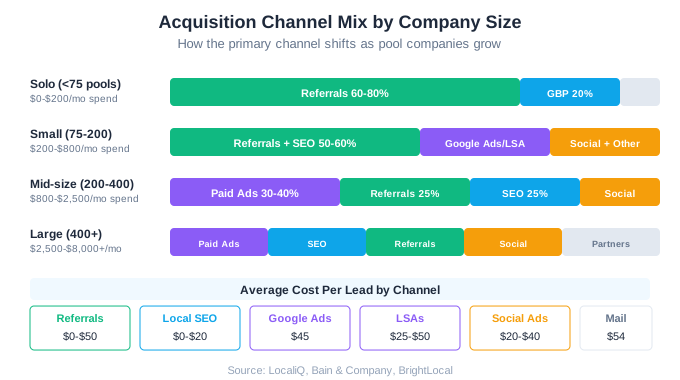
The most effective customer acquisition channel shifts as a pool company grows. Solo operators with under 75 pools rely almost entirely on referrals and word-of-mouth because they have no marketing budget and limited time. Mid-size companies with 150 to 400 pools typically add Google Ads and local SEO to sustain growth beyond their referral network. Larger operations with 400+ pools diversify across five or more channels and hire marketing help to manage the complexity.
| Company Size | Primary Channel | Secondary Channel | Typical Monthly Marketing Spend |
|---|---|---|---|
| Solo (under 75 pools) | Referrals (60-80% of new customers) | Google Business Profile | $0 - $200 |
| Small (75-200 pools) | Referrals + Local SEO (50-60%) | Google Ads / LSAs | $200 - $800 |
| Mid-size (200-400 pools) | Google Ads / LSAs (30-40%) | Referrals + SEO + Social | $800 - $2,500 |
| Large (400+ pools) | Multi-channel (even split) | Paid ads + SEO + referral programs + partnerships | $2,500 - $8,000+ |
Why do referrals dominate at small scale?
Small pool companies get 60% to 80% of their new customers from referrals because the math favors it. A referral costs nothing or close to it, converts at 30% to 50% (compared to 5-15% for cold channels), and produces customers who stay longer. When Corey Adams was building his first pool route, every new customer came from a neighbor watching him work or a happy customer mentioning his name at a barbecue. That pattern holds across the industry. The limitation is that referrals do not scale linearly. You cannot double your referral volume by spending more money.
When should you start investing in paid acquisition?
The inflection point is when referral growth flattens and you need to add more than five new customers per month to hit your route density targets. For most pool companies, that happens between 75 and 150 pools. At that point, Google Local Services Ads deliver the best ROI because you pay per lead (not per click), your listing appears at the top of search results with a "Google Guaranteed" badge, and the leads are high intent. Start with $500 to $1,000 per month and track your cost per acquired customer weekly.
How Does Local SEO Compare to Paid Ads for Pool Companies?
Local SEO is the highest-ROI long-term acquisition channel for pool service companies because the leads are free after the initial investment. A fully optimized Google Business Profile appears 80% more often in search results and generates four times more website visits than an incomplete profile. The tradeoff is time. SEO takes three to six months to produce consistent leads, while paid ads generate leads on day one.
| Factor | Local SEO | Google Ads | Google LSAs |
|---|---|---|---|
| Time to first lead | 1 - 6 months | Same day | Same week |
| Monthly cost | $0 - $500 (DIY or agency) | $500 - $3,000+ | $300 - $2,000+ |
| Cost per lead (ongoing) | $0 - $20 | $45 avg. | $25 - $50 |
| Lead quality | High (intent-based) | High (intent-based) | Very high (Google Guaranteed) |
| Scalability | Limited by search volume | Limited by budget | Limited by budget + availability |
| Long-term ROI | Excellent (compounds) | Stops when spend stops | Stops when spend stops |
The smart play is to run both simultaneously. Use paid ads to fill immediate capacity gaps while building your local SEO presence for long-term lead generation. Pool companies that rank in the Google Maps 3-pack for "pool service near me" in their market report receiving 15 to 30 organic leads per month at zero marginal cost. That organic pipeline eventually reduces your reliance on paid channels and drops your blended CAC significantly.
What local SEO actions matter most for pool companies?
- 1Google Business Profile optimization. Complete every field, add service area, upload 20+ photos, and post weekly updates. This single action has the highest impact on local visibility.
- 2Review generation. Pool companies with 50+ Google reviews at 4.5+ stars dominate local search. Ask every happy customer for a review within 24 hours of service.
- 3Website with location pages. A service page targeting "[city] pool service" with local content, schema markup, and customer testimonials helps Google connect your business to local searches.
- 4Citation consistency. Your business name, address, and phone number must be identical across Google, Yelp, Facebook, BBB, and industry directories.
- 5Content marketing. Blog posts answering common pool questions ("how often should I shock my pool") build topical authority and attract organic traffic.
What Role Does Door-to-Door Play in Pool Service Growth?
Door-to-door canvassing remains one of the most effective acquisition channels for pool service companies despite being the least discussed in marketing guides. The reason is simple: pool service is hyperlocal and visual. When you are already servicing a pool on a street, knocking on the neighbor's door with a clean truck in the driveway and a branded shirt is the highest-trust cold outreach possible. Conversion rates for door-to-door in pool service run 5% to 15%, which is significantly higher than direct mail (1-3%) or cold social media ads (2-5%).
When is door-to-door most effective?
Door-to-door works best when you are building route density in a specific neighborhood. If you have three pools on a street and want to add two more to eliminate drive time, walking those doors between stops costs nothing and takes five minutes per house. The economics are compelling: adding a neighboring pool eliminates three to five minutes of drive time per day, which compounds to hours saved per month. Corey Adams built some of his densest routes this way, turning two-pool streets into five-pool streets one knock at a time.
- Best window: 30 minutes before or after servicing a nearby pool (your truck is visible proof)
- Best pitch: "I service your neighbor's pool at [address]. I had an opening on my [day] route and wanted to see if you need pool service."
- Best leave-behind: Door hanger with your name, phone, and a "neighbor discount" offer
- Best season: Spring (March-May) when pool owners are thinking about opening
- Worst approach: Aggressive sales tactics or visiting after dark
Door-to-door is a route density strategy, not a scale strategy. It works for adding five to ten accounts per month in targeted neighborhoods but cannot replace paid channels when you need to fill 50+ accounts on a new route.
How Should Pool Companies Track Acquisition Channel Performance?
Most pool service companies cannot tell you what percentage of their customers came from referrals vs. Google vs. door-to-door, which means they are making marketing decisions blind. Tracking acquisition channels does not require complex analytics. It requires asking one question at the point of sale: "How did you hear about us?" and recording the answer consistently.
What metrics should you track per channel?
Three numbers per channel tell you everything: cost per lead, cost per acquired customer, and customer lifetime value by source. If your Google Ads leads cost $45 each but only 15% convert, your cost per acquired customer is $300. If your referral customers stay an average of seven years vs. four years for ad-acquired customers, the referral is worth 75% more in lifetime revenue despite costing $250 less to acquire.
| Metric | What It Tells You | How to Calculate |
|---|---|---|
| Cost per lead (CPL) | Channel efficiency at generating interest | Channel spend / number of leads from that channel |
| Cost per acquisition (CAC) | True cost of a paying customer | Channel spend / number of customers signed from that channel |
| Conversion rate | Lead quality from each channel | Customers signed / leads received x 100 |
| Customer lifetime value by source | Long-term ROI of each channel | Avg. monthly revenue x avg. months retained per source |
| Payback period | How fast you recoup acquisition cost | CAC / monthly revenue per customer |
What tools help track acquisition sources?
Pool service software that includes a "lead source" field on customer records is the simplest tracking method. When you create a new customer in Pool Founder, you can tag their acquisition source and run reports showing which channels produce the most revenue, not just the most leads. For paid channels, Google Ads and Facebook Ads have built-in conversion tracking. For referrals, a simple referral reward program with tracking codes lets you attribute new signups to existing customers.
Review your channel mix quarterly. If more than 70% of your new customers come from a single source, you are vulnerable. A Google algorithm change, a referral slowdown, or an ad cost spike can cut your growth overnight. Diversify to at least three active channels.
What Does a Healthy Acquisition Channel Mix Look Like?
A healthy channel mix for a growing pool service company allocates roughly 40% of new customers from referrals and word-of-mouth, 25% from local SEO and Google Business Profile, 20% from paid advertising (Google Ads, LSAs, social), and 15% from direct outreach (door-to-door, partnerships, community involvement). This mix provides both low-cost organic growth and predictable paid volume that you can dial up or down based on capacity.
| Channel | Target % of New Customers | Monthly Budget Allocation | Best For |
|---|---|---|---|
| Referrals / word-of-mouth | 35 - 45% | $0 - $200 (rewards) | Highest quality, lowest cost |
| Local SEO / Google Maps | 20 - 30% | $0 - $500 | Long-term pipeline |
| Google Ads / LSAs | 15 - 25% | $500 - $2,000 | Immediate capacity fill |
| Social media / community | 5 - 15% | $100 - $500 | Brand awareness, seasonal push |
| Direct outreach | 5 - 10% | $0 (labor only) | Route density building |
The exact percentages depend on your market. A pool company in a new subdivision with hundreds of new pools might lean heavier on door-to-door and direct mail. A company in a mature market with saturated competition might need to spend more on Google Ads to stand out. The principle is the same: diversify your sources so no single channel failure can stall your growth.
Email marketing to your existing customer base deserves special mention. It is not an acquisition channel in the traditional sense, but it generates referrals at scale. A monthly email to current customers with a "refer a neighbor, get $50 off" offer can produce three to five new signups per month at almost zero cost. Email marketing returns $36 for every $1 spent according to Litmus, making it the highest-ROI marketing activity for service businesses with an existing customer list.
Pool Founder tracks lead sources automatically and lets you run reports showing revenue by acquisition channel. Instead of guessing which marketing is working, you see exactly which channels produce the most valuable customers over time.
Ready to streamline your pool service business?
Pool Founder gives you route optimization, automated invoicing, chemical tracking, and everything else you need to run a more profitable pool business.
Frequently Asked Questions
What is the average customer acquisition cost for a pool service company?
The average customer acquisition cost for a pool service company ranges from $50 to $300 depending on the channel. Referrals cost $50 to $100 per acquired customer. Google Ads average $150 to $250 per acquired customer after accounting for conversion rates. Direct mail runs $200 to $350. The blended average across all channels is typically $125 to $200 for a company using a healthy mix of referral, organic, and paid sources.
What is the best marketing channel for a small pool service company?
Referrals are the best marketing channel for small pool service companies with under 100 pools. They cost almost nothing, convert at 30-50% (vs. 5-15% for paid channels), and produce customers who stay longer and refer others. Supplement referrals with a fully optimized Google Business Profile to capture local search traffic at zero ongoing cost.
How much should a pool service company spend on marketing?
Pool service companies should budget 5% to 10% of gross revenue for marketing. A company generating $300,000 in annual revenue should spend $15,000 to $30,000 per year ($1,250 to $2,500 per month) across all channels. Solo operators under $150,000 in revenue can start with $200 to $500 per month focused on Google Business Profile optimization and a small Google Ads budget.
Are Google Local Services Ads worth it for pool companies?
Yes. Google Local Services Ads are one of the highest-ROI paid channels for pool companies because you pay per lead (not per click), your listing appears at the top of Google with a "Google Guaranteed" badge, and the leads are high intent. Pool and spa companies pay an average of $25 to $50 per lead through LSAs, with conversion rates of 20-30%.
How do I get more referrals for my pool service business?
The three most effective referral tactics are: (1) Ask every happy customer directly after a positive interaction, (2) Create a structured referral program with a clear reward like $50 off their next month for each referral that signs up, and (3) Send a quarterly email to your customer list reminding them of the referral offer. Service reports with your branding also generate passive referrals when customers share them with neighbors.
Is door-to-door still effective for pool service companies?
Yes, particularly for building route density. Door-to-door converts at 5-15% for pool service, which is higher than direct mail and cold social ads. The key is timing: knock on doors when you are already servicing a nearby pool so your branded truck is visible. It works best as a targeted neighborhood strategy, not a mass outreach approach.
Sources & References
- Google Ads Benchmarks for Home Services (Pool & Spa CPL Data)
- Litmus - Email Marketing ROI Report
- Bain & Company - Customer Retention and Acquisition Economics
- First Page Sage - Customer Acquisition Cost by Industry (B2B Edition)
- BrightLocal - Local Consumer Review Survey (Google Business Profile Impact)
- Superior Pool Routes - How Homeowners Find Pool Service Providers