Key Takeaway
$180K - $350K
Median annual revenue for a typical small pool service company
Source: IBISWorld, industry surveys
$8.8 Billion
Total U.S. swimming pool cleaning services industry revenue in 2025
Source: IBISWorld
78,817
Registered pool service businesses operating in the U.S. in 2025
Source: IBISWorld
The average pool service company revenue depends almost entirely on how big the operation is and where it operates. A solo tech running 70 pools out of one truck takes home a very different number than an owner managing five crews across 400 accounts. The U.S. swimming pool cleaning services industry hit **$8.8 billion in total revenue in 2025**, according to IBISWorld, spread across nearly 79,000 registered businesses. That works out to a mean of roughly $112,000 per company, but the median tells a more useful story for most operators.
This article breaks down real revenue benchmarks by company size (solo through 10-tech), revenue per pool by region, profit margins at each tier, and the specific levers that separate a $100K operation from a $1M+ company. Whether you are evaluating [how to start a pool service business](/how-to-start-pool-service-business) or benchmarking an existing operation against the industry, these numbers come from IBISWorld, the Pool & Hot Tub Alliance (PHTA), Pool & Spa News, and operator-level surveys.
Revenue figures in this article represent gross revenue before expenses. Owner take-home pay is a separate calculation that depends on profit margins, business structure, and reinvestment strategy. For owner income data specifically, see our pool company owner salary breakdown.
How Much Revenue Does the Average Pool Service Company Generate?
The average pool service company in the U.S. generates between $180,000 and $350,000 in annual revenue based on aggregated industry data. The mean revenue per company is higher, around $350,000 to $560,000, but that figure is heavily skewed by large multi-crew operations and consolidators that pull in millions. More than 70% of pool service businesses generate less than $500,000 in annual revenue, and the typical company employs between 2 and 5 people including the owner.
The gap between mean and median matters. According to Pool & Spa News, the 2024 Top 50 Service Companies alone generated $412.6 million in combined service revenue. The largest, SPS PoolCare, reported $87 million. These outliers pull the average way up, making the mean misleading for a typical owner running two or three trucks.
| Metric | Value | Source |
|---|---|---|
| U.S. industry total revenue | $8.8 billion (2025) | IBISWorld |
| Number of registered businesses | 78,817 (2025) | IBISWorld |
| Mean revenue per company | ~$350K - $560K | IBISWorld, industry surveys |
| Median revenue (typical company) | $180K - $300K | Aggregated operator data |
| Companies under $500K revenue | 70%+ | Industry surveys |
The 4.4% year-over-year growth in the number of registered pool service businesses (IBISWorld, 2024-2025) signals strong entry into the market, which means more competition but also more demand. The industry has grown at roughly 2.9% annually over the past five years in terms of new business formation.
Revenue Benchmarks by Company Size: Solo to 10-Tech
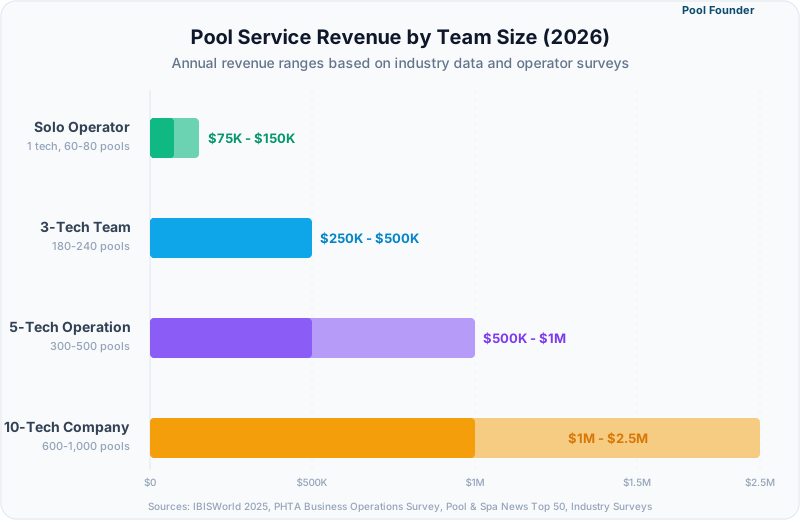
Company size is the single biggest driver of pool service revenue. A solo operator is capped by how many pools one person can physically service in a day. A 10-tech operation can service 600 to 1,000+ pools, but carries overhead that a solo tech never has to think about. Here is how annual revenue typically breaks down across four common tiers based on industry data and operator surveys.
How much does a solo pool operator make in revenue?
A solo pool service operator running 60 to 80 residential pools typically generates $75,000 to $150,000 in annual gross revenue. At current market rates of $125 to $175 per pool per month for recurring maintenance, a full route of 80 pools at $150/month produces $144,000 annually. Add repair and equipment revenue, and the total often reaches $150,000 to $192,000. Net profit margins for solo operators tend to be the highest in the industry at 25% to 45%, because there is no labor cost beyond the owner.
What revenue does a 3-tech pool service company generate?
A 3-technician pool service company typically generates $250,000 to $500,000 in annual revenue, servicing 180 to 240 pools. At this stage, the owner is usually still on a route but also handling sales, scheduling, and customer management. Labor costs take a bigger bite, with technician wages averaging $38,000 to $45,000 annually (BLS data). Net margins compress to 15% to 25%, but total owner compensation often exceeds what a solo operator earns because the business generates revenue from multiple trucks.
How much revenue does a 5-tech pool company produce?
A 5-tech operation servicing 300 to 500 pools typically brings in $500,000 to $1 million in annual revenue. This is the tier where the owner usually comes off the route entirely and focuses on management, sales, and business development. The company may have a dedicated office manager or admin. Overhead climbs, but the operation reaches a scale where repair and equipment upsells can add 20% to 40% on top of recurring maintenance revenue.
What does a 10-tech pool service company earn?
A 10-technician pool service company servicing 600 to 1,000+ pools typically generates $1 million to $2.5 million in annual revenue. Only about 6% of pool service businesses reach this scale, according to industry surveys. At this level, the owner is a CEO managing route supervisors, office staff, and potentially multiple service vehicles. Net margins often settle between 10% and 18%, but the dollar amount of profit on $1.5M in revenue can still be $150,000 to $270,000.
| Company Tier | Pool Count | Annual Revenue | Net Margin | Est. Owner Profit |
|---|---|---|---|---|
| Solo (1 tech) | 60 - 80 | $75K - $150K | 25 - 45% | $30K - $68K |
| Small (3 techs) | 180 - 240 | $250K - $500K | 15 - 25% | $50K - $125K |
| Mid (5 techs) | 300 - 500 | $500K - $1M | 12 - 20% | $80K - $200K |
| Scaled (10 techs) | 600 - 1,000+ | $1M - $2.5M | 10 - 18% | $150K - $375K |
These revenue ranges assume recurring residential maintenance as the core service. Companies that add commercial accounts, equipment repair, renovation, and chemical supply can push well beyond the high end of each range.
How Much Revenue Does Each Pool Generate Per Month?
Recurring pool maintenance generates $125 to $200 per pool per month nationally, translating to $1,500 to $2,400 per pool annually. The exact number depends on service frequency, whether chemicals are included, pool size, and geography. When you factor in repair work, equipment replacement, and seasonal add-ons, total revenue per pool climbs to $2,500 to $5,000+ per year.
What is the average revenue per pool per month?
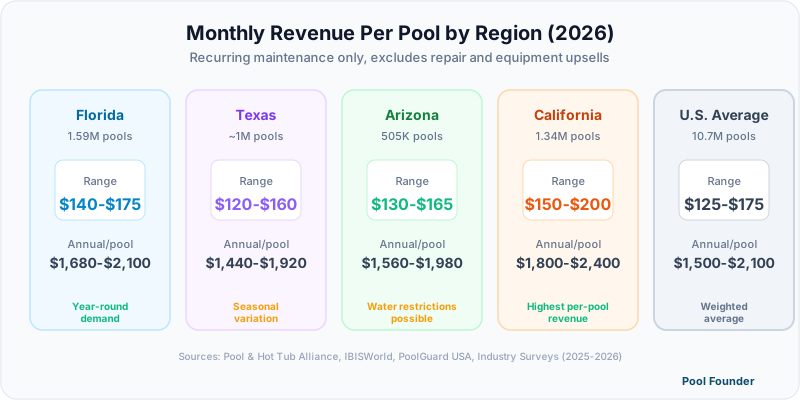
The national average for recurring pool maintenance revenue is $125 to $175 per pool per month. In Florida-style markets, many residential routes price between $140 and $175 per pool per month as of 2026. California commands the highest per-pool rates at $150 to $200 monthly due to higher cost of living and labor costs. Texas and Arizona fall in the middle at $120 to $165.
Residential pool owners spend an average of about $1,700 per year on maintenance according to industry data, which aligns with the $140/month midpoint. Commercial pools generate higher per-account revenue, often exceeding $2,000 per year due to stricter compliance requirements and larger water volume. For a deeper look at pricing strategies, see our [pool service pricing guide](/pool-service-pricing-guide).
How does revenue per pool scale with volume?
Revenue per pool tends to stay flat or even increase slightly as companies grow, because larger operations can negotiate better chemical purchasing rates and upsell more effectively. A 100-pool operation at $150/month in recurring maintenance produces $180,000 in annual recurring revenue. Add repair and equipment work, and that same 100 pools can produce $250,000 to $350,000 in total revenue, according to industry benchmarks.
| Revenue Component | Per Pool/Month | Per Pool/Year | % of Total Revenue |
|---|---|---|---|
| Recurring maintenance | $125 - $175 | $1,500 - $2,100 | 55 - 70% |
| Repairs & equipment | $40 - $80 | $480 - $960 | 20 - 30% |
| Seasonal add-ons (openings, closings) | $15 - $40 | $180 - $480 | 5 - 15% |
| Chemical supply markup | $10 - $25 | $120 - $300 | 5 - 10% |
How Does Geography Affect Pool Service Revenue?
Geography is the second biggest revenue factor after company size. Florida, California, Texas, and Arizona account for over half of all U.S. pool service revenue, driven by the concentration of residential pools in warm-weather states. Florida alone has 1.59 million residential pools, California has 1.34 million, and Arizona has 505,000, according to PoolGuard USA and industry census data.
Which states generate the most pool service revenue?
Florida and California combined account for roughly 65% of the U.S. residential pool service market. Florida has the highest density of pool service providers per capita in the country, driven by year-round pool weather and 1.59 million pools. California commands the highest per-pool rates but faces periodic headwinds from water restrictions during drought years.
| State | Residential Pools | Monthly Rate Range | Season Length | Revenue Environment |
|---|---|---|---|---|
| Florida | 1.59 million | $140 - $175 | 12 months | Year-round demand, highest pool density |
| California | 1.34 million | $150 - $200 | 10-12 months | Highest rates, occasional water restrictions |
| Texas | ~1 million | $120 - $160 | 8-10 months | Fast-growing market, seasonal variation |
| Arizona | 505,000 | $130 - $165 | 10-12 months | High per-capita pool ownership, drought risk |
How much more do year-round markets earn than seasonal ones?
A pool service company in Florida operating 12 months per year on 80 pools at $155/month generates about $148,800 in recurring annual revenue. The same pool count at the same rate in a northern state with a 6-month season produces roughly $74,400, a 50% revenue gap just from seasonality. This is why the fastest-growing pool service markets are all in the Sun Belt: Florida, Texas, Arizona, and the Carolinas, according to PHTA data.
For strategies to maintain revenue during slow months, see our [seasonal business planning guide](/seasonal-pool-business-planning) and [off-season revenue ideas](/pool-service-off-season-revenue).
What Profit Margins Should Pool Service Companies Expect?
Pool service net profit margins typically range from 15% to 25% for well-run operations, with solo operators often exceeding 30% and some route-dense solos reaching 45%. The industry average net profit margin is 12% to 15% according to industry benchmarking data, with larger companies achieving 18% to 20% through scale efficiencies. The PHTA Q3 2025 survey showed the service, maintenance, and repair segment was the only pool industry sector to report increased bottom-line profits (+1% to +5%).
What are the biggest expense categories?
Labor, fuel, and chemicals are the three largest expenses for any pool service operation. For companies with employees, labor typically consumes 35% to 50% of revenue. A solo operator eliminates that line item entirely, which is why solo margins can reach 45%. Chemical costs run 8% to 15% of revenue depending on purchasing volume. Vehicle and fuel costs add another 8% to 12%.
| Expense Category | Solo Operator | 3-5 Tech Company | 10+ Tech Company |
|---|---|---|---|
| Labor (excl. owner) | 0% | 35 - 45% | 40 - 50% |
| Chemicals & supplies | 10 - 15% | 8 - 12% | 6 - 10% |
| Vehicle & fuel | 10 - 15% | 8 - 12% | 8 - 10% |
| Insurance | 3 - 5% | 3 - 5% | 4 - 6% |
| Software & admin | 1 - 3% | 2 - 4% | 3 - 5% |
| Net margin (after owner comp) | 25 - 45% | 15 - 25% | 10 - 18% |
Route density is the hidden margin lever. A tech servicing 12 pools per day with 5 minutes between stops will have dramatically better margins than one servicing 8 pools with 15-minute drives. Tightening routes is often the fastest path to better profitability. See our route optimization guide for specifics.
How Does Pool Service Revenue Compare to Other Home Services?
Pool service companies operate in the broader field service management market, which reached $5.5 billion in the U.S. in 2025 according to Grand View Research. Compared to other home service verticals, pool service offers strong recurring revenue and relatively low startup costs, but operates at a smaller per-job ticket size than HVAC, plumbing, or electrical contractors.
| Industry | Avg. Small Company Revenue | Recurring Revenue % | Startup Costs |
|---|---|---|---|
| Pool service | $180K - $350K | 60 - 80% | $15K - $30K |
| Lawn care / landscaping | $200K - $500K | 50 - 70% | $10K - $25K |
| HVAC | $500K - $1.5M | 20 - 40% | $50K - $100K+ |
| Plumbing | $400K - $1M | 10 - 20% | $30K - $75K |
The recurring revenue model is what makes pool service uniquely attractive. While HVAC and plumbing companies chase one-time jobs, pool service companies collect monthly checks from the same customers year after year. That predictability translates directly to business value: pool routes typically sell for 10 to 12 times monthly recurring revenue, with premium routes reaching 13 to 18 times monthly revenue according to industry brokers. For a deeper look at what your route is worth, see our [pool route valuation guide](/pool-route-valuation).
What Separates a $100K Pool Company from a $1M+ Operation?
The difference between a $100,000 solo route and a $1 million+ operation comes down to five specific factors. None of them require luck. All of them require systems.
1. Revenue per pool through upsells
Companies that only offer recurring maintenance leave 30% to 40% of potential revenue on the table. Adding repair services, equipment installation, and chemical supply can push per-pool annual revenue from $1,800 to $3,500+. The owner who says yes to filter replacements, pump repairs, and salt cell installations turns every maintenance stop into a potential upsell.
2. Route density and technician productivity
A well-run technician can handle 70 to 100 pools depending on route density and drive time. At $150/month per pool, one tech at full capacity generates $126,000 to $180,000 in recurring revenue annually. The difference between a company with tight, dense routes and one with scattered stops is tens of thousands of dollars per year in fuel savings and additional stops per day.
3. Commercial accounts
Commercial pools, including HOAs, hotels, and municipal facilities, generate higher per-account revenue, often $2,000+ annually per account. They also tend to be more consistent and less price-sensitive than residential customers. See our [commercial pool service pricing guide](/commercial-pool-service-pricing) for rate benchmarks.
4. Billing automation and collections
Companies that still invoice manually and chase payments leave revenue on the table and waste hours every week. Operations with autopay see 99% on-time payment rates and eliminate the admin overhead of collections. That time goes directly back into revenue-generating activity: selling new accounts, handling upsells, or tightening routes.
5. Systems that remove the owner as the bottleneck
A $100K solo operation has the owner doing everything: scheduling, routing, invoicing, customer communication, and field work. A $1M+ company has systems handling the admin so the owner can focus on growth. Pool service software that handles [scheduling](/pool-service-scheduling-software), [billing](/pool-service-invoicing-software), and [route optimization](/pool-route-optimization-software) is what makes the jump from one truck to five trucks possible without hiring office staff.
Industry Outlook: Where Is Pool Service Revenue Headed?
The pool service industry is projected to grow at a CAGR of roughly 4% through 2029, with total U.S. industry revenue expected to reach $10.3 billion by 2029 according to market research projections. The growth is being driven by three factors: population migration to Sun Belt states (more pools), aging existing pool stock (more repairs), and rising homeowner expectations for professional maintenance.
According to industry sentiment surveys, 64% of pool service operators expected to bring in more revenue in 2026 than in 2025, while only 8% expected a decrease. The PHTA reported that the service, maintenance, and repair segment saw both revenue and profit increases in Q3 2025, making it the strongest-performing sector in the broader pool and hot tub industry.
The trend in 2026 is toward higher revenue per stop rather than just adding more stops. Operators are focusing on execution quality, upselling from existing accounts, and running tighter routes. The companies that will outperform are the ones investing in systems that improve per-tech productivity and per-pool revenue rather than just chasing volume.
Pool Founder helps pool service companies increase revenue per tech by automating scheduling, billing, and route optimization. Operators using the platform report saving 10+ hours per week on admin and adding 2-3 additional pools per day per technician. Start a free trial to see where your operation stacks up.
Free starter kit
Start a pool service business with the numbers already run.
A short email series from an owner who started with $1,200 and a used truck. No software pitch, just the four things that decide whether year one works.
- Startup cost breakdownEvery line item from $2K bootstrap to fully equipped
- Pricing calculatorThe minimum you can charge per visit and still profit
- First-10-customers playbookDoor hangers, referrals, and the phone script that closes
- Licensing & insurance checklistWhat your state requires and which insurers pay claims
Already running routes? Try Pool Founder free
Frequently Asked Questions
How much does the average pool service company make per year?
The median pool service company generates $180,000 to $300,000 in annual revenue. The mean is higher at $350,000 to $560,000, but that is skewed by large multi-crew operations. More than 70% of pool service businesses generate less than $500,000 in annual revenue according to industry data.
How much revenue does a single pool generate per month?
Recurring residential pool maintenance generates $125 to $200 per pool per month, or $1,500 to $2,400 annually. When you include repairs, equipment, and seasonal services, total per-pool revenue reaches $2,500 to $5,000+ per year depending on region and service scope.
What profit margin should a pool service company expect?
Net profit margins typically range from 15% to 25% for pool service companies with employees. Solo operators often achieve 25% to 45% margins because they have no labor costs beyond their own time. The industry average net margin is 12% to 15%, with well-run companies reaching 20%+.
How many pools can one technician service?
A well-trained pool service technician can handle 70 to 100 pools depending on route density and drive time. With tight routes and minimal drive time between stops, some techs reach 12 to 15 pools per day. At $150/month per pool, one tech at full capacity generates $126,000 to $180,000 in annual recurring revenue.
Is pool service a good business to start?
Pool service is one of the most accessible home service businesses to start, with startup costs of $15,000 to $30,000 for a solo operation. The industry generates $8.8 billion annually, offers strong recurring revenue (60-80% of total revenue), and is projected to grow 4% annually through 2029. The U.S. has 10.7 million residential pools that need regular maintenance.
How much can a pool service company owner take home?
Pool company owner income ranges from $50,000 for a small solo route to $300,000+ for a multi-crew operation. A solo operator running 60-80 pools typically takes home $50,000 to $80,000. An owner managing 5-10 techs can earn $120,000 to $250,000+. For detailed income data, see our pool company owner salary breakdown.
Sources & References
- IBISWorld - Swimming Pool Cleaning Services in the US (2025)
- IBISWorld - Number of Swimming Pool Cleaning Services Businesses (2025)
- Pool & Spa News - 2025 PSN/Jandy Top 50 Service Companies
- PHTA - Pool & Hot Tub Industry Revenue Holds Steady Despite Margin Pressure (2025)
- PHTA - 2024 Business Operations Survey Report
- PoolGuard USA - Swimming Pool Statistics 2026 (State Pool Counts)
- Grand View Research - Field Service Management Market Size 2025
- Pool Magazine - The State of Pool Service in 2026