Why Does Your Pool Business Need a Clear Cancellation Policy?
Every pool service business loses customers. Whether they are moving, switching to DIY maintenance, or simply unhappy with your service, cancellations are an unavoidable part of the business. What separates well-run operations from chaotic ones is how they handle those cancellations. A clear, written pool service cancellation policy eliminates billing disputes, protects your route density, and gives both you and your customers a fair, predictable process for ending the relationship.
Without a formal cancellation policy, you are exposed to customers ghosting without notice, leaving you with empty route stops and lost revenue. You also risk awkward conversations about final invoices, equipment returns, and whether the customer owes anything for the current billing cycle. Industry data shows that pool service companies with contracts and clear cancellation terms retain 80-90% of customers annually, compared to just 75-85% retention for companies operating on informal handshake agreements.
This guide walks through every element of a professional pool service cancellation policy, from notice periods and fee structures to handling common scenarios like seasonal pauses and customer relocations. All recommendations reflect 2026 industry standards from pool service operators, legal templates, and trade publications.
What Should Your Cancellation Policy Include?
A complete pool service cancellation policy covers five core elements: the required notice period, the method of notice, any applicable fees, how the final bill is prorated, and what happens during the notice period. Each element needs to be specific enough to hold up in a billing dispute while remaining easy for a homeowner to understand. Vague language like "reasonable notice" invites arguments. Precise language like "30 days written notice via email or letter" does not.
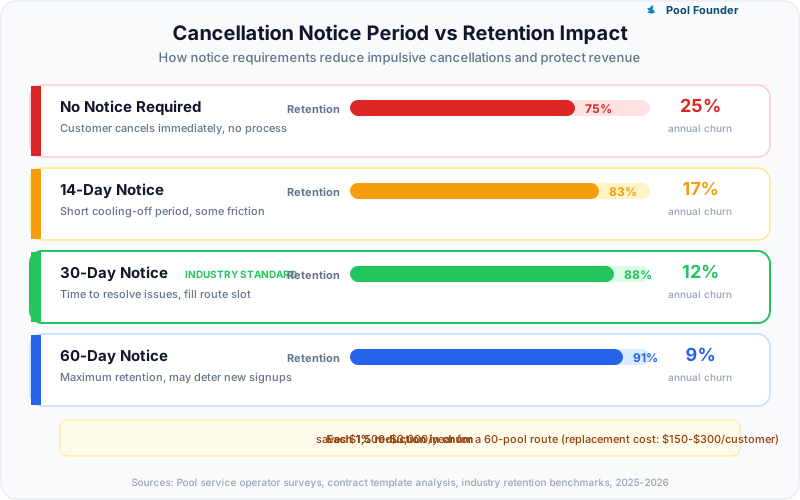
Notice Period
The notice period is the number of days a customer must give before cancellation takes effect. This window protects your revenue by allowing you to fill the route slot and prevents customers from canceling the day before a scheduled service and disputing the charge. Thirty days written notice is the industry standard for pool service contracts and the most commonly recommended period across legal templates and trade publications.
Written Notice Requirement
Always require cancellation in writing. Email is the most practical format for both parties because it creates a timestamped record. Specify accepted methods in your contract: email to a designated address, a cancellation form on your website, or a physical letter. Do not accept verbal cancellations over the phone or in person, as these create he-said-she-said disputes about when notice was given and what was agreed.
Fee Structure
Your cancellation policy should clearly state whether any fees apply. Month-to-month agreements typically carry no cancellation fee beyond the notice period. Annual or multi-year contracts usually include an early termination fee to recover the discount the customer received for committing to a longer term. Define the exact fee amount or formula in the contract so there are no surprises.
Proration of the Final Bill
State that the monthly fee will be prorated as of the termination date. If a customer pays $200 per month and their cancellation takes effect on the 15th of a 30-day month, they owe $100 for that final period. Proration is fair to both sides and prevents disputes about paying for services not rendered. Include language that any outstanding balance is due within 30 days of the final service date.
Final Service Terms
Clarify what happens during the notice period. Most companies continue providing normal service through the end of the notice window. Specify that the customer remains responsible for payment during this time and that you will perform a final service visit on or before the termination date. Some operators include a final pool condition assessment to document the state of the pool at handoff, which protects against liability claims after you stop servicing.
- Required notice period (typically 30 days)
- Accepted notice methods (email, written letter, online form)
- Early termination fees, if any, with exact amounts
- Proration formula for the final billing period
- Service continuation during the notice window
- Final balance due date and payment method
- Provider right to cancel without notice for non-payment
What Are Common Cancellation Notice Periods?
Notice periods in pool service contracts range from one week to 60 days, with 30 days being the most widely used standard. The right notice period for your business depends on how quickly you can fill a cancelled route stop and how much flexibility your customers expect. Shorter notice periods are more customer-friendly but give you less time to adjust, while longer periods protect your revenue but may discourage customers from signing contracts in the first place.
| Notice Period | Best For | Pros | Cons |
|---|---|---|---|
| 1 week | Month-to-month, competitive markets | Very customer-friendly, low commitment feel | Almost no time to fill the route slot, revenue gap likely |
| 2 weeks | Month-to-month, smaller operations | Reasonable for customers, some buffer to adjust | Still tight for finding a replacement customer |
| 30 days | Most pool service businesses (industry standard) | Enough time to fill route, matches billing cycles, widely accepted | Some customers may feel locked in during the final month |
| 60 days | Annual contracts, premium service tiers | Maximum route protection, time to upsell or resolve issues | May deter price-sensitive customers from signing |
30 days
Industry standard cancellation notice period for pool service contracts
Source: Skimmer, ContractsCounsel, PandaDoc
If you use month-to-month agreements, 30 days notice is the sweet spot. It aligns with billing cycles, gives you time to market the open route slot, and is short enough that customers do not feel trapped. For annual contracts, consider 30-60 days to protect the longer commitment.
Should You Charge Cancellation or Early Termination Fees?
Cancellation fees are one of the most debated topics in pool service business management. Charging a fee can protect your revenue when a customer breaks a long-term commitment, but overcharging or applying fees unfairly can damage your reputation and even expose you to legal risk. The key distinction is between a true early termination fee on an annual contract versus a penalty for canceling a month-to-month agreement. The former is generally enforceable and expected; the latter is almost always a bad idea.
When Early Termination Fees Are Appropriate
Early termination fees are appropriate when the customer signed an annual or multi-year contract that included a discount for the longer commitment. The fee compensates you for the revenue shortfall when the customer leaves before the term expires. Without this protection, customers could sign an annual contract to get a lower rate and then cancel after two months, leaving you with a discounted rate and no long-term revenue to offset it.
Common Fee Structures
| Fee Structure | Example | When to Use |
|---|---|---|
| One month of service | $175 flat fee (equal to one monthly payment) | Simple, easy to explain, works for most annual contracts |
| Percentage of remaining term | 50% of remaining months owed | Longer contracts (2+ years) where flat fee undervalues the commitment |
| Sliding scale | 100% of one month if cancelled in months 1-6, 50% if months 7-12 | Rewards customers who stay longer before canceling |
| No fee (month-to-month) | $0 with 30 days notice | Month-to-month agreements where flexibility is the selling point |
Many states have auto-renewal disclosure laws that require you to send written notice before a contract automatically renews. If you fail to send this notice and the contract renews, a court may void the early termination fee for the renewal period. Check your state regulations and build renewal reminders into your billing workflow.
Legal Considerations
For a cancellation or early termination fee to be enforceable, it must be clearly stated in the signed contract, reasonable in proportion to the actual harm caused by the early cancellation, and not structured as a penalty. Courts in most states will enforce a fee that reflects lost revenue (such as one month of service) but may strike down fees that are punitive or grossly disproportionate to the remaining contract value. Have an attorney review your fee language if you operate in multiple states, as consumer protection laws vary significantly.
How to Handle Common Cancellation Scenarios
Cancellation policies are only useful if they account for real-world situations. Pool service companies encounter the same handful of cancellation scenarios repeatedly, and having a documented process for each one saves time, reduces conflict, and makes your team more consistent. Here are the most common situations and how to handle them professionally.
Customer Is Moving
Relocation is the most common non-discretionary cancellation reason. When a customer notifies you they are selling their home, offer to transfer the service agreement to the new homeowner. This is the single best opportunity to retain a route stop without any marketing cost. Provide the customer with a referral card for the buyer, and if possible, coordinate a brief introduction with the new owner during the home sale process. If the transfer does not happen, apply standard notice period and proration terms. Waiving early termination fees for relocating customers is common practice and generates goodwill that leads to referrals.
Customer Requests a Seasonal Pause
Some customers want to pause service during winter months or extended travel rather than cancel entirely. Offering a seasonal pause option with a reduced monthly fee (typically 25-50% of the regular rate for basic chemical checks or winterization visits) retains the customer relationship and guarantees the route stop when full service resumes. Define the maximum pause duration (commonly three to four months), any hold fee, and the process for reactivating. This is far better than a full cancellation and re-signup cycle.
Customer Is Dissatisfied
When a customer cancels due to dissatisfaction, the 30-day notice period becomes your recovery window. Train your team to escalate dissatisfaction cancellations immediately. Call the customer within 24 hours, acknowledge the issue, and offer a concrete resolution such as a service credit, a free deep clean, or a temporary upgrade. Companies that respond quickly to dissatisfaction cancellations recover 20-40% of those customers. Even if you cannot save the account, the conversation provides valuable feedback for improving your service.
Customer Stops Paying (Non-Payment)
Most well-written pool service contracts allow the provider to cancel without notice for non-payment. Your policy should specify how many missed payments trigger a cancellation (typically two consecutive missed payments or 30 days past due), that a written notice of cancellation will be sent, and that any outstanding balance remains due. Never continue servicing a pool after two missed payments without a documented payment plan. Stop service, send a final invoice with the outstanding balance, and if necessary, escalate to collections.
Customer Sells Home to a New Owner
This differs from the customer moving scenario when you learn about the sale after it has already happened. If the new homeowner contacts you, treat it as a warm lead and offer them the same terms or a first-month discount to continue service. If the original customer left without notice, apply your standard cancellation terms and send a final invoice to their last known address. Including an assignment clause in all new contracts allows the agreement to transfer with the property, which simplifies this situation significantly.
How to Reduce Customer Cancellations
The best cancellation policy is one you rarely have to use. Pool service companies that invest in retention consistently outperform those that rely on new customer acquisition to replace churn. Industry data shows that annual customer churn ranges from 15-25% for companies without contracts and drops to 10-20% for companies with service agreements. The strategies below target the most common churn drivers and can reduce your cancellation rate significantly.
80-90%
Annual customer retention rate for pool service companies using service agreements
Source: BusinessDojo, Industry Surveys
Deliver Consistent, High-Quality Service
This sounds obvious but it is underexecuted across the industry. The top reason customers cancel outside of moving is perceived inconsistency in service quality. Use service checklists, photo documentation after each visit, and automated service reports sent to the customer. When the homeowner can see timestamped photos of their clean pool every week, they have tangible proof of your value. This is especially important for customers who are rarely home and might otherwise feel like they are paying for invisible work.
Communicate Proactively
Send monthly or quarterly service summaries that show what was done, any chemistry trends, and recommendations for equipment maintenance. Proactive communication about upcoming weather events, seasonal service changes, or chemical price adjustments builds trust and prevents surprises. Customers who feel informed and cared for are far less likely to cancel than those who only hear from you when there is a problem or a price increase.
Offer Annual Agreements with Real Benefits
Annual contracts reduce churn dramatically, but only if the customer gets real value from committing. Offer a meaningful discount of 5-10% off monthly rates, priority scheduling for repairs, or a free seasonal service like a spring opening or fall closing. The discount pays for itself through reduced churn: retaining just two additional customers per year at $175 per month saves $4,200 in annual revenue that would otherwise require new customer acquisition to replace.
Implement Loyalty Incentives
Reward long-term customers with benefits that increase over time. Examples include a free filter clean after 12 months of service, a small annual rate lock guarantee, or priority scheduling for repair calls. These incremental benefits create switching costs that make it harder for a competitor to poach your customer with a slightly lower price. The goal is to make your long-term customers feel valued and make leaving feel like giving up accumulated benefits.
- Send photo documentation and service reports after every visit
- Provide monthly or quarterly service summaries with chemistry trends
- Offer 5-10% discounts for annual service agreements
- Include a free seasonal service (spring opening or fall closing) with annual contracts
- Reward loyalty with escalating benefits at 12, 24, and 36 months
- Respond to cancellation requests within 24 hours with a personal call
- Track cancellation reasons to identify and fix recurring issues
Ready to streamline your pool service business?
Pool Founder gives you route optimization, automated invoicing, chemical tracking, and everything else you need to run a more profitable pool business.
Frequently Asked Questions
Can I legally enforce early termination fees on pool service contracts?
Yes, early termination fees are enforceable in most states as long as the fee is clearly stated in the signed contract, the customer acknowledged the term before signing, and the fee amount is reasonable in proportion to the actual harm caused by early cancellation. Courts generally uphold fees equal to one month of service or a reasonable percentage of the remaining contract value. However, fees that appear punitive or grossly disproportionate to your actual loss may be struck down. Some states also have specific consumer protection laws around auto-renewal contracts that can affect enforceability. Have an attorney licensed in your state review your contract language to ensure compliance with local regulations.
Should I offer a seasonal pause option instead of allowing cancellation?
Offering a seasonal pause is one of the most effective retention tools available to pool service companies. A pause option with a reduced monthly fee, typically 25-50% of the regular rate for basic maintenance like chemical checks or winterization, keeps the customer relationship active and guarantees the route stop when full service resumes. Define clear terms including a maximum pause duration of three to four months, a specific hold fee amount, and the reactivation process. Customers who pause are far more likely to return than customers who fully cancel and have to go through the signup process again with a new provider.
What should I do if a customer just stops paying without formally canceling?
Stop servicing the pool after two consecutive missed payments or 30 days past due, whichever comes first. Send a written notice stating that service is suspended due to non-payment, that the outstanding balance is due immediately, and that the account will be formally cancelled if payment is not received within 14 days. Most pool service contracts include a clause allowing the provider to cancel without notice for non-payment, so verify your contract includes this language. After cancellation, send a final invoice with the full outstanding balance. If the amount is significant and the customer does not respond, escalate to a collections agency. Never continue servicing a non-paying customer hoping they will catch up, as this compounds your losses every week.
How can I keep the door open for a cancelled customer to return in the future?
End every cancellation on a professional and positive note regardless of the reason. Send a brief email thanking the customer for their business, confirming the final service date and any outstanding balance, and letting them know they are welcome to restart service at any time. Add cancelled customers to a low-frequency re-engagement email list with seasonal tips or check-in messages every two to three months. Many customers who cancel for DIY or cost reasons return within six to twelve months after discovering that maintaining a pool themselves is more work and expense than they anticipated. A friendly, no-pressure follow-up six months after cancellation converts a surprising number of former customers back into active accounts.