The Six Years That Changed Pool Chemical Pricing Forever
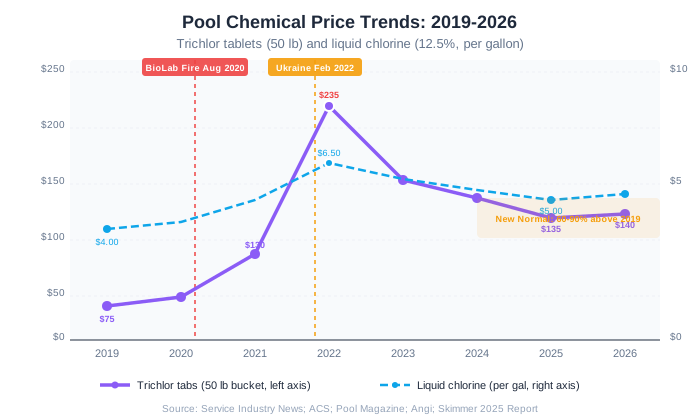
Between 2020 and 2023, pool chemical prices experienced the most volatile period in the industry's history. A 50-pound bucket of trichlor tablets that sold for $75 for over a decade spiked to $220 to $250, a 200%+ increase that forced every pool service company in the country to rethink their pricing, chemical sourcing, and service models. The causes were a perfect storm: a catastrophic factory fire, a pandemic-driven pool construction boom, global supply chain disruption, and raw material shortages that cascaded through every chemical category.
By 2025, prices had moderated from their peaks but had not returned to pre-2020 levels. According to Service Industry News and the American Chemistry Society (ACS), structural changes in manufacturing capacity, raw material costs, and demand mean that the $75 bucket of trichlor is unlikely to return. The new baseline is 40 to 60% higher than 2019 levels, and pool service companies that have not adjusted their rates accordingly are operating on margins that were thin even before the spike.
This article tracks pool chemical prices from 2020 through 2026, explains the supply and demand factors behind the changes, and provides an outlook for the next two to three years. All prices are based on industry wholesale/distributor pricing unless noted otherwise.
200%+
Peak trichlor tablet price increase vs. 2019 baseline
Source: Service Industry News, Pool Magazine
40-60%
Current chemical costs above pre-2020 levels
Source: Industry analysis, distributor pricing data
What Happened to Chlorine Prices in 2020-2021?
The crisis began in August 2020 when Hurricane Laura struck the Gulf Coast and triggered a fire at the BioLab manufacturing plant in Westlake, Louisiana. This single facility produced approximately 40% of the trichlor tablets sold in the United States according to Service Industry News and the American Chemical Society. The fire destroyed the plant and removed that 40% of domestic production capacity overnight.
40%
Share of U.S. trichlor production lost in the BioLab fire
Source: Service Industry News, ACS Chemical & Engineering News
Simultaneously, the COVID-19 pandemic triggered a surge in residential pool construction. Homeowners stuck at home invested in backyard upgrades, with pool installations spiking over 500% according to CAPE Analytics. Every new pool needed chemicals. Demand surged while 40% of supply vanished. By spring 2021, the price of a 50-pound bucket of trichlor tablets had risen from the decade-long norm of $70 to $80 to $110 to $150 in many markets.
| Chemical | 2019 Price | Spring 2021 Price | Change |
|---|---|---|---|
| Trichlor tabs (50 lb bucket) | $70-80 | $110-150 | +57% to +88% |
| Liquid chlorine (12.5%, per gal) | $3.50-4.50 | $4.50-6.00 | +29% to +33% |
| Muriatic acid (per gal) | $4.00-5.00 | $5.00-6.50 | +25% to +30% |
| Calcium hypochlorite (per lb) | $2.50-3.50 | $3.50-5.00 | +40% to +43% |
| CYA/stabilizer (per lb) | $3.00-4.00 | $4.50-6.00 | +50% |
The 2021 season caught most pool service companies off guard. Chemical costs rose 30 to 50% but most companies had already quoted annual rates and were locked into 2020 pricing with their customers. According to Orenda Technologies, this mismatch between cost increases and rate adjustments was the single largest margin hit pool service companies had experienced in decades.
How Bad Did It Get in 2022?
Prices continued climbing through 2022 as the BioLab plant remained offline and additional supply chain pressures mounted. Russia's invasion of Ukraine in February 2022 quadrupled the price of urea, one of the three primary raw materials in trichlor production (chlorine, caustic soda, and urea). Service Industry News reported that pool service techs nationwide were paying an average of $220 for a 50-pound bucket of trichlor tabs, with some markets seeing prices of $250 or higher.
$220-250
Average price per 50-lb bucket of trichlor tabs in 2022
Source: Service Industry News
| Chemical | 2019 Price | Peak 2022 Price | Peak Increase |
|---|---|---|---|
| Trichlor tabs (50 lb) | $70-80 | $220-250 | +183% to +213% |
| Liquid chlorine (12.5%, gal) | $3.50-4.50 | $5.50-7.50 | +57% to +67% |
| Muriatic acid (gal) | $4.00-5.00 | $6.00-8.00 | +50% to +60% |
| Cal-hypo (per lb) | $2.50-3.50 | $5.00-7.00 | +100% |
| CYA/stabilizer (per lb) | $3.00-4.00 | $6.00-8.50 | +100% to +113% |
The response from pool service companies was widespread price increases. According to the Skimmer 2023 State of Pool Service Report, over 70% of pool service professionals raised their rates in 2022, with the most common increase being $10 to $25 per month. Even with these increases, many companies saw their per-pool profit margin decline because chemical costs had risen faster than rates.
The Shift Away from Trichlor
The price spike accelerated an existing trend away from trichlor tablets toward liquid chlorine (sodium hypochlorite). Liquid chlorine was less affected by the supply disruption because it is produced domestically by multiple manufacturers and does not rely on the same raw material chain. Pool service companies that switched to liquid chlorine in 2021 and 2022 saved 20 to 40% on sanitizer costs compared to those that continued buying trichlor at peak prices. The added benefit of avoiding CYA accumulation (liquid chlorine adds no CYA) made the switch even more attractive.
Where Did Prices Settle in 2023-2025?
Chemical prices began moderating in late 2023 as BioLab partially resumed production, competing manufacturers increased output, and the post-pandemic pool construction boom slowed. By 2025, trichlor tab prices had declined from their $220+ peak but settled at $120 to $150 per 50-pound bucket, still 60 to 90% above 2019 levels. Angi reported chlorine tablet costs of $60 to $70 per 25-pound bag (equivalent to $120 to $140 per 50 pounds) as of 2025.
| Chemical | 2019 Baseline | 2025 Settled Price | Net Increase vs 2019 |
|---|---|---|---|
| Trichlor tabs (50 lb) | $70-80 | $120-150 | +57% to +88% |
| Liquid chlorine (12.5%, gal) | $3.50-4.50 | $4.50-5.50 | +22% to +29% |
| Muriatic acid (gal) | $4.00-5.00 | $5.00-6.50 | +25% to +30% |
| Cal-hypo (per lb) | $2.50-3.50 | $4.00-5.50 | +57% to +60% |
| CYA/stabilizer (per lb) | $3.00-4.00 | $4.50-5.50 | +38% to +50% |
| Sodium bicarbonate (per lb) | $0.80-1.20 | $1.10-1.60 | +33% to +38% |
The 2025 price level represents a "new normal" that is unlikely to decline significantly. The factors that drove prices higher, including reduced domestic manufacturing capacity, higher raw material costs, increased demand from a larger installed pool base, and general inflation, are structural rather than cyclical. Pool service companies that set their rates during the 2019 pricing environment and have not fully adjusted are operating on margins that are 8 to 15 percentage points lower than they were six years ago.
60-90%
Trichlor tab prices above 2019 levels as of 2025
Source: Angi, Service Industry News, distributor data
What Is the Chemical Cost Outlook for 2026 and Beyond?
Industry analysts and chemical suppliers project modest price increases of 3 to 5% per year through 2028, roughly tracking general inflation. The BioLab plant has resumed partial production, new capacity is being brought online by competitors, and the post-pandemic demand surge has normalized. However, several structural factors prevent a return to 2019 pricing.
Factors Keeping Prices Elevated
- Reduced domestic chlorine production capacity. The U.S. chlorine supply is shrinking as older plants close and new capacity investment lags demand.
- Higher raw material costs. Urea, caustic soda, and chlorine feedstocks remain 30 to 50% above 2019 levels due to energy costs and supply constraints.
- Larger installed pool base. The 120,000+ pools built annually during 2020-2022 all require ongoing chemical supply, permanently increasing demand.
- Transportation and logistics costs remain elevated. Fuel surcharges and driver shortages add 10 to 15% to delivered chemical costs versus 2019.
- Regulatory compliance costs for chemical manufacturing continue to increase, with EPA requirements adding production expenses that are passed to end users.
Projected Price Ranges for 2026-2028
| Chemical | 2026 Projected | 2028 Projected | Trend |
|---|---|---|---|
| Trichlor tabs (50 lb) | $125-160 | $135-175 | Gradual increase, 3-5%/yr |
| Liquid chlorine (12.5%, gal) | $4.75-5.75 | $5.00-6.25 | Stable to slight increase |
| Muriatic acid (gal) | $5.25-6.75 | $5.50-7.25 | Tracking inflation |
| Cal-hypo (per lb) | $4.25-5.75 | $4.50-6.25 | Moderate increase |
| CYA/stabilizer (per lb) | $4.75-5.75 | $5.00-6.25 | Stable |
Build a 5% annual chemical cost increase into your service pricing model. If you are raising rates 3 to 5% per year anyway (which you should be), your chemical cost increase should be absorbed without margin compression. If you are not raising rates annually, you are losing ground every year.
How Should Pool Companies Adapt Their Pricing to Chemical Costs?
The chemical cost surge from 2020 to 2023 exposed a fundamental weakness in how most pool companies price their services: they set a monthly rate and rarely revisit it even as their input costs change dramatically. Companies that survived the spike without hemorrhaging profit share three common practices.
Three Pricing Adaptations That Work
- 1Annual rate reviews tied to chemical cost indices. Review your chemical spend per pool every December and adjust January rates accordingly. The Skimmer 2025 report found that 76% of pool professionals planned price increases, indicating that annual increases have become an industry norm rather than an exception.
- 2Separate chemical billing. Twenty percent of companies now bill chemicals separately from the service rate. This approach passes chemical cost fluctuations directly to the customer and protects your service margin. It is particularly effective for customers with large pools, salt systems, or water features that consume above-average chemicals.
- 3Bulk purchasing and supplier diversification. Companies that buy chemicals quarterly at distributor pricing save 15 to 25% versus weekly retail purchases. Diversifying across two or three suppliers prevents being locked into one vendor's price increases and provides leverage for negotiation.
76%
Pool service professionals who planned price increases in 2025
Source: Skimmer 2025 State of Pool Service Report
The bottom line: chemical costs are not going back to 2019 levels. Every rate you quote today should be built on current chemical costs with a 5% annual escalation assumption. If you are still operating on rates set when trichlor was $75 a bucket, your margins are 8 to 15 percentage points lower than they should be, and that gap widens every year you delay a rate adjustment.
Run a pool route?
The business side of what you just read.
Pricing, chemical costs, and the tools owners use to keep the numbers straight.
- Commercial pool service pricing2026 rate tables and the cost-plus formula
- Chemical cost per poolWhat chemicals actually cost per stop
- Chemical tracking softwareLog readings and dosing from the pool deck
- Pool service softwareRoutes, invoicing, and service reports in one app
- Free profit & rate calculatorsProfit per pool, minimum rate, break-even
Frequently Asked Questions
Why did pool chemical prices spike in 2021-2022?
Three factors converged: the BioLab factory fire in August 2020 destroyed approximately 40% of U.S. trichlor tablet production capacity, the COVID-19 pandemic triggered a surge in pool construction that increased chemical demand, and the Ukraine-Russia conflict quadrupled urea prices (a key trichlor raw material). Together, these drove trichlor tablet prices from $70-80 per 50-pound bucket to $220-250 at peak.
Are pool chemical prices going back to normal?
Prices have moderated from their 2022 peaks but will not return to 2019 levels. Trichlor tablets have settled at $120-150 per 50-pound bucket, 60-90% above the old baseline. Structural factors including reduced manufacturing capacity, higher raw material costs, and a larger installed pool base keep prices elevated. Industry projections show 3-5% annual increases through 2028.
How much have pool chemicals increased since 2019?
As of 2025, trichlor tablets are 60-90% above 2019 prices. Liquid chlorine is 22-29% higher. Muriatic acid is 25-30% higher. Cal-hypo is 57-60% higher. CYA/stabilizer is 38-50% higher. Overall, the weighted average chemical cost per pool has increased approximately 40-60% versus pre-2020 levels.
Should pool companies switch from trichlor to liquid chlorine?
Many companies made this switch during the 2021-2022 shortage and have not switched back. Liquid chlorine costs 22-29% above 2019 levels versus 60-90% for trichlor, making it relatively cheaper. It also avoids CYA accumulation, which is a significant chemistry benefit. The trade-offs are shorter shelf life (liquid chlorine degrades), heavier transport (gallons vs. tabs), and the need for proper handling (12.5% sodium hypochlorite is a strong oxidizer).
How much should I increase my rates to cover chemical costs?
If you have not raised rates since 2019, you need a 15-25% increase to restore your pre-2020 margins. If you raised rates incrementally, calculate your current chemical cost per pool per month and compare it to your 2019 cost. The difference, plus a 5% buffer for future increases, is your minimum rate adjustment. For most companies, this translates to $15-35 per month per pool depending on pool size and chemical demand.
Sources & References
- Service Industry News: Trichlor Prices Rise from Supply Shortage (2020)
- ACS Chemical & Engineering News: Trichlor Shortages Threaten Summer Fun
- Service Industry News: No End in Sight for Soaring Chlorine Prices (2022)
- Pool Magazine: Why Are Chlorine Prices Still So High?
- Orenda Technologies: Pool Service Price Increase (2021)
- Skimmer: 2025 State of Pool Service Report
- Angi: Chlorine Shortage 2025 and Current Costs