Why Does the Contract Question Matter for Pool Service Businesses?
Few decisions shape a pool service business as fundamentally as how you structure your customer agreements. The choice between requiring service contracts and operating on a no-contract, pay-as-you-go basis affects everything from monthly cash flow to long-term business valuation, and the right answer depends on your market, your size, and where you want to be in five years.
The pool service industry, valued at $7.2 billion to $8.8 billion in 2026, has historically leaned toward informal arrangements. Most pool companies operate on month-to-month agreements with 30-day cancellation notice rather than rigid annual contracts. But the data tells a nuanced story: businesses that implement structured service agreements, even flexible ones, consistently outperform on retention, revenue stability, and exit valuation compared to those running purely on handshake relationships.
This analysis uses industry data from DealStream, KMF Business Advisors, Skimmer, and BusinessDojo to compare both models across five dimensions: retention, revenue, valuation, operational overhead, and scalability. The goal is not to declare a winner but to help you make an informed decision for your specific situation.
What Is the Difference Between Contract and No-Contract Pool Service?
Before comparing the two models, it is worth defining what each actually looks like in practice. The terms "contract" and "no-contract" mean different things to different operators, and the pool service industry uses several hybrid structures that blur the line.
The Contract Model
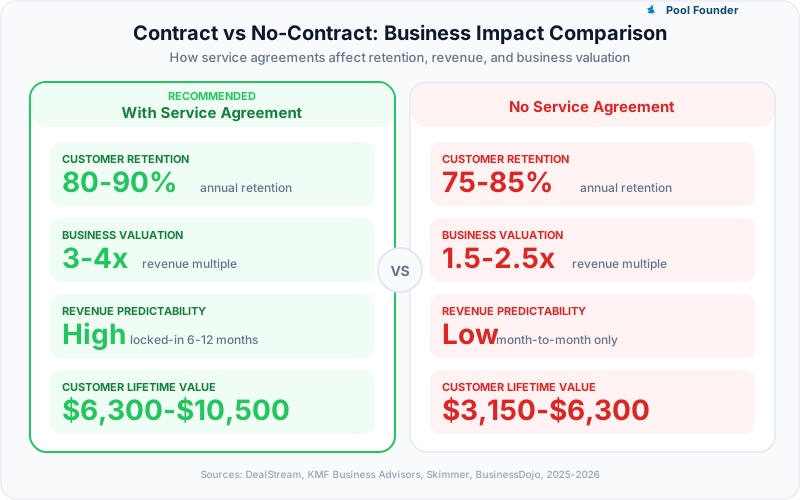
A contract model requires customers to commit to a defined service period, typically 6 or 12 months, with specific terms governing service frequency, included tasks, pricing, cancellation procedures, and liability. The agreement is a signed document that creates mutual obligations: the company guarantees consistent service at a locked-in rate, and the customer commits to paying for the full term. Early termination usually involves a cancellation fee, often one to two months of service charges.
Within the contract model, there is significant variation. Some companies use rigid annual contracts with steep early termination penalties. Others use annual service agreements that auto-renew but allow cancellation with 30 to 60 days written notice. The latter approach, sometimes called an "evergreen agreement," has become the most common contract structure in the pool service industry because it provides stability without creating the adversarial dynamic that strict contracts can produce.
The No-Contract Model
A no-contract model allows customers to start and stop service at will, with little or no formal commitment beyond the current billing cycle. Some operators in this camp have no written agreement at all, relying on verbal arrangements and goodwill. Others use a simple service authorization form that outlines what is included but makes no commitment to a service duration. The customer can cancel at any time, often with as little as a phone call or text message.
The no-contract approach is popular among solo operators and smaller companies for good reason: it removes a perceived barrier to customer acquisition. Homeowners who are hesitant about committing to an annual agreement are more likely to try a service that feels risk-free. This lower barrier to entry can accelerate growth, especially in competitive markets where customers have many options.
| Factor | Contract Model | No-Contract Model |
|---|---|---|
| Revenue predictability | High; locked-in revenue for 6-12 months | Low; month-to-month with no guarantees |
| Customer retention | 80-90% annual retention typical | 75-85% retention; 15-25% annual churn |
| Administrative overhead | Higher; requires contract management and renewals | Lower; minimal paperwork and tracking |
| Customer flexibility | Limited; early termination fees apply | High; customers can cancel anytime |
| Business valuation | 3-4x multiples with 85%+ retention | Lower multiples; less predictable revenue |
| Seasonal stability | Strong; 12-month agreements smooth cash flow | Weak; seasonal drop-offs in cooler months |
| Legal protection | Clear terms for disputes, liability, and scope | Minimal; verbal agreements are hard to enforce |
How Do Contracts Affect Customer Retention and Churn?
Customer retention is the single most important metric for long-term pool service profitability, and this is where the contract question has its most measurable impact. The data is clear: businesses using formal service agreements retain customers at significantly higher rates than those without them.
80-90%
Annual customer retention rate for pool companies using service agreements
Source: DealStream, KMF Business Advisors
Pool service companies with annual service agreements typically achieve 80% to 90% customer retention per year. Without formal agreements, annual churn rates climb to 15% to 25%, meaning a company loses roughly one in five customers every year. Over a five-year period, that difference compounds dramatically. A 100-customer base with 85% retention still has roughly 44 of those original customers after five years. At 75% retention, only 24 remain.
Why Contracts Improve Retention
Contracts improve retention through three mechanisms, and only one of them is the cancellation penalty. First, the act of signing an agreement creates psychological commitment. Behavioral research consistently shows that people who make explicit commitments are more likely to follow through, even when the commitment is non-binding. Second, contracts typically include clearly defined service scope, which reduces the mismatched expectations that cause many cancellations. When a customer knows exactly what they are getting each visit, they are less likely to feel disappointed or overcharged. Third, the cancellation friction, even a simple 30-day notice requirement, prevents impulsive cancellations driven by a single bad experience or a competitor flyer left on the door.
Customer Lifetime Value Comparison
The retention difference translates directly into customer lifetime value. At $175 per month average service rate, a customer retained for four years generates $8,400 in gross revenue. A customer who churns after 14 months, the average for no-contract arrangements in seasonal markets, generates only $2,450. Even accounting for the slightly lower acquisition cost of no-contract customers, the lifetime value gap is substantial.
| Metric | With Agreement | Without Agreement |
|---|---|---|
| Annual retention rate | 80-90% | 75-85% |
| Average customer lifespan | 3-5 years | 1.5-3 years |
| Lifetime revenue (at $175/mo) | $6,300-$10,500 | $3,150-$6,300 |
| Cost to replace churned customer | $150-$300 (marketing + onboarding) | $150-$300 (marketing + onboarding) |
| Net lifetime value advantage | Baseline | 30-50% lower |
Retention is not just a revenue metric. Every customer you lose costs $150 to $300 to replace through marketing, sales time, and onboarding. A company with 15% annual churn on a 100-pool route spends $2,250 to $4,500 per year just replacing lost customers before it can grow.
What Is the Revenue Impact of Contract vs No-Contract Models?
Beyond retention, the contract structure directly affects revenue predictability, seasonal cash flow, and the ability to make confident business decisions about hiring, equipment purchases, and expansion. This is where the operational advantages of service agreements become most apparent.
Cash Flow Predictability
Annual service agreements create 12 months of predictable, contracted revenue. A company with 80 pools under annual agreements at $175 per month can confidently project $168,000 in recurring revenue for the year. That predictability enables better decisions about hiring timelines, equipment financing, and marketing budgets. Without agreements, the same company might see reliable revenue for only 7 to 9 months in seasonal markets, with significant uncertainty about which customers will return after winter.
12 vs 7 months
Predictable revenue window: annual agreements vs no-contract seasonal model
Source: KMF Business Advisors
Seasonal Revenue Smoothing
In markets with seasonal variation, contracts provide a critical buffer against winter revenue drops. A pool service company in Phoenix might see minimal seasonal impact, but a company in Dallas, Atlanta, or Charlotte can lose 20% to 40% of no-contract customers during the cooler months. Those customers may or may not return in spring, and even those who do return create a gap of two to four months of lost revenue that cannot be recovered.
Annual agreements that include year-round service, even at a reduced winter frequency such as monthly instead of weekly, smooth this curve significantly. The customer continues paying a consistent monthly rate, the company maintains the relationship, and spring does not become a frantic scramble to rebuild the route. Some operators offer a slight discount on the annual rate to incentivize year-round commitment, trading a small margin reduction for the substantial benefit of cash flow continuity.
Pricing Power and Rate Increases
Service agreements also provide a structured mechanism for implementing annual rate increases. A contract renewal notice is a natural opportunity to communicate a 3% to 5% price adjustment with advance notice, positioning it as a standard business practice rather than an arbitrary decision. No-contract operators often struggle with rate increases because every price change feels like a reason for the customer to shop around. The result is that many no-contract businesses undercharge for years, eroding margins as their costs rise while their prices remain flat.
The math on rate increases compounds quickly. A 4% annual increase on a $175 monthly service grows to $204 per month over four years. Without structured increases, that same service likely stays at $175 or $180, representing a cumulative revenue loss of over $700 per customer across the same period.
How Does Each Model Affect Business Valuation?
If you ever plan to sell your pool service business, and most owners eventually do, the contract structure may be the single largest factor in what a buyer is willing to pay. Business brokers and acquisition specialists consistently report that documented recurring revenue under formal agreements commands a significant premium over informal, undocumented customer relationships.
3-4x
Valuation multiple for pool businesses with 85%+ customer retention under agreements
Source: DealStream
Why Buyers Pay More for Contracted Revenue
Buyers evaluate pool service businesses primarily on the reliability of their revenue stream. A buyer purchasing a company with 100 customers under annual service agreements can reasonably expect 80 to 90 of those customers to remain after the ownership transition. A buyer purchasing a company with 100 customers on informal, no-contract arrangements faces much greater uncertainty. Without agreements, customer relationships are often tied to the personal rapport with the previous owner, and the churn rate during ownership transitions can spike to 30% or more.
Pool service businesses with customer retention above 85% under formal agreements typically command valuation multiples of 3 to 4 times annual revenue or seller discretionary earnings. Businesses with lower retention or informal arrangements often sell at 1.5 to 2.5 times, representing a 10% to 20% or greater discount on the total sale price. For a company generating $300,000 in annual revenue, that difference can mean $150,000 to $450,000 in lost sale value.
| Valuation Factor | With Agreements | Without Agreements |
|---|---|---|
| Typical valuation multiple | 3-4x SDE | 1.5-2.5x SDE |
| Buyer confidence in revenue continuity | High; documented and transferable | Low; dependent on owner relationships |
| Expected post-sale churn | 10-20% | 25-40% |
| Due diligence complexity | Straightforward; contracts available | Complex; must verify verbal arrangements |
| Financing availability | SBA loans more readily approved | Harder to finance; higher perceived risk |
Documenting Value for a Future Sale
Even if you are not planning to sell anytime soon, implementing service agreements now builds documented value that compounds over time. Every year of retention data under formal agreements strengthens your business profile. Brokers advise that three or more years of documented retention above 80% is the threshold where premium valuations become achievable. Starting agreements today means you reach that threshold years before a potential exit.
Business brokers specializing in pool service acquisitions report that the most common reason deals fall through or sell at a discount is the lack of documented customer agreements. Even a simple month-to-month agreement with clear terms is dramatically better than a verbal arrangement when it comes time to sell.
Which Model Works Best for Different Business Sizes?
The ideal agreement structure often depends on where you are in the business lifecycle. What works for a solo operator building their first route is different from what a multi-crew company needs to protect its investment. Here is how the calculus changes at each stage.
Solo Operators (1-50 Pools)
Solo operators building their initial customer base often benefit from starting with a lighter agreement structure. A simple service authorization form that outlines scope, pricing, and a 30-day cancellation notice is usually sufficient. The priority at this stage is filling the route, and a rigid annual contract can slow down customer acquisition when you are competing against established companies. That said, even a one-page agreement is vastly better than a handshake. It sets professional expectations, documents the service scope, and creates a paper trail that will matter when you eventually want to sell the route or bring on employees.
Small Teams (50-150 Pools)
Once you have employees, the economics shift decisively toward formal agreements. You are now carrying fixed costs, including payroll, workers compensation insurance, and vehicle payments, that do not disappear when a customer cancels. A sudden loss of five or ten customers can turn a profitable month into a losing one. At this stage, transitioning to annual service agreements with auto-renewal and 30 to 60 day cancellation notice provides the stability needed to manage payroll and overhead with confidence. Most customers who are already satisfied with your service will sign without hesitation.
Growing Companies (150+ Pools)
Companies operating multiple routes with dedicated office staff should have every customer under a formal service agreement. At this scale, the administrative overhead of managing contracts is easily absorbed, and the benefits in retention, valuation, and cash flow predictability are too significant to leave on the table. Larger companies also have the leverage to enforce contract terms more consistently, and the professional infrastructure, such as automated billing and CRM systems, to manage renewals and rate increases systematically.
| Business Size | Recommended Approach | Key Benefit | Key Risk |
|---|---|---|---|
| Solo (1-50 pools) | Simple service authorization with 30-day notice | Low barrier to customer acquisition | Vulnerable to seasonal churn |
| Small team (50-150 pools) | Annual agreement with auto-renewal | Payroll and overhead stability | Some customers may resist transition |
| Growing (150+ pools) | Full service contracts with defined terms | Valuation premium and financing access | Higher administrative overhead |
The Hybrid Approach
Many successful pool service companies use a hybrid model that offers customers a choice. The contract option comes with a slightly discounted rate, perhaps 5% to 10% off the standard monthly price, in exchange for an annual commitment. The no-contract option is available at full price with a 30-day cancellation policy. This approach lets price-sensitive customers self-select into the stability tier while preserving flexibility for customers who value it. The discount is easily offset by the higher retention and reduced acquisition costs of contracted customers.
Operators who implement this hybrid model typically see 60% to 70% of customers voluntarily choose the annual agreement when the savings are presented clearly. The remaining 30% to 40% who prefer month-to-month still have a written service authorization that documents the relationship, which is better for both parties than an informal arrangement.
Regardless of which model you choose, put something in writing. A one-page service agreement that covers scope, pricing, billing terms, cancellation policy, and liability takes 30 minutes to draft and protects both you and your customer. The difference between "no contract" and "no documentation" is the difference between flexibility and chaos.
Ready to streamline your pool service business?
Pool Founder gives you route optimization, automated invoicing, chemical tracking, and everything else you need to run a more profitable pool business.
Frequently Asked Questions
Can I use a hybrid contract model that gives customers a choice?
Yes, and many of the most successful pool service companies do exactly this. Offer an annual agreement at a 5% to 10% discount alongside a month-to-month option at standard pricing. This lets customers self-select based on their preference while incentivizing the commitment you need for stability. Typically 60% to 70% of customers will choose the annual option when the savings are presented clearly at signup.
How do I transition existing no-contract customers to service agreements?
The most effective approach is to introduce agreements at a natural renewal point, such as the start of a new service season or during an annual rate adjustment. Frame the agreement as a benefit to the customer: locked-in pricing, guaranteed service priority, and clearly documented scope. Avoid presenting it as a restriction. Many operators roll out agreements over 6 to 12 months, starting with new customers and gradually transitioning existing ones as opportunities arise. Forcing the change all at once risks unnecessary cancellations.
What should I do when customers push back on signing a contract?
Customer resistance usually stems from a fear of being locked into bad service. Address this directly by explaining your cancellation policy, emphasizing the benefits they receive such as price protection and service guarantees, and offering the month-to-month alternative at a slightly higher rate. If a customer still refuses any written agreement, consider whether the relationship is sustainable. Customers who will not agree to basic documented terms, including scope, pricing, and a cancellation process, are often the same ones who create disputes over billing and service expectations.
Are pool service contracts legally enforceable?
Service agreements are generally enforceable as long as they meet basic contract law requirements: offer, acceptance, consideration, and mutual agreement to terms. However, enforceability varies by state, and pursuing a residential customer for an early termination fee through legal channels rarely makes financial sense. The practical value of a contract is not in its legal enforceability but in the commitment structure it creates and the documentation it provides. Courts in most states will enforce reasonable cancellation fees, typically one to two months of service, but the real protection is the 30 to 60 day notice requirement that gives you time to fill the gap.
Should I switch from no-contract to contract mid-year?
You can, but timing matters. The worst time to introduce contracts is during your busiest season when customers feel they have maximum leverage. The best time is during the off-season or at the start of a new calendar year when customers are accustomed to changes and renewals. If you must transition mid-year, consider grandfathering existing customers at their current rate for the remainder of the year and introducing the formal agreement at the next renewal point. New customers should go on agreements immediately regardless of timing.