Why Your Pool Service Business Needs a Bulletproof Contract Template
A pool service contract is the single document that defines the relationship between your business and every customer you serve. It determines what you are responsible for, what the customer can expect, how you get paid, and what happens when something goes wrong. Yet most pool service operators either use a generic one-page agreement they found online, copy a competitor's contract without understanding the clauses, or worst of all, operate on a handshake with no written agreement at all.
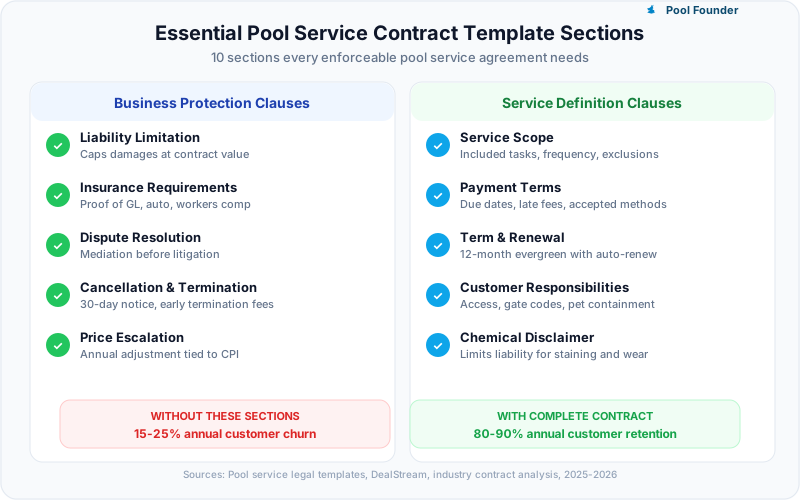
The difference between a strong contract and a weak one shows up in three measurable ways. Businesses with well-structured contracts retain 80-90% of customers annually compared to 15-25% churn rates without contracts. They collect payment faster because terms are clearly documented. And when they eventually sell, their customer base commands a higher valuation multiple because buyers can verify that every account is under a signed, transferable agreement.
This guide walks through every section of a professional pool service contract template, explaining not just what to include but why each clause matters and how to customize it for your specific situation. Whether you are starting from scratch or improving an existing agreement, you will finish with a contract that protects your business, sets clear customer expectations, and stands up in court if it ever needs to.
This article is an educational guide that explains each contract section in detail so you can build or customize your own agreement. It is not legal advice. Have a licensed attorney in your state review your final contract before putting it into use, particularly if you operate in states like Florida or California that have specific consumer contract disclosure requirements.
What Makes a Good Pool Service Contract Template?
Before diving into specific sections, it helps to understand the four principles that separate a contract that actually protects your business from one that just looks professional. Every clause you add should serve at least one of these purposes, and the best clauses serve multiple purposes simultaneously.
Clarity: Both Parties Understand the Deal
The number one cause of customer disputes in pool service is not bad work. It is mismatched expectations. A clear contract eliminates ambiguity by spelling out exactly which services are included, how often they are performed, and what falls outside the scope of the agreement. When a customer calls to complain that you did not clean their spa, your contract should answer definitively whether spa service was included. Write in plain language that a homeowner without legal training can understand. Avoid jargon, define technical terms when you must use them, and organize sections with descriptive headings so customers can quickly find the information they need.
Completeness: Every Scenario Is Addressed
A good contract anticipates problems before they happen. What if the customer's dog is in the backyard and you cannot access the pool? What if a freeze damages equipment between visits? What if the customer disputes an invoice? Every situation you have dealt with or heard about from other operators should have a corresponding clause in your contract. You will never cover every possible scenario, but the more common situations your contract addresses, the fewer disputes you will face and the stronger your legal position will be when one arises.
Enforceability: It Holds Up in Court
A contract is only as strong as its enforceability. This means using language that courts in your state recognize, including required disclosures for consumer contracts, and avoiding clauses that are so one-sided a judge would throw them out. For example, a cancellation clause that charges a customer their entire annual contract value for early termination is unlikely to be enforced because courts view it as a penalty rather than a reasonable estimate of damages. A clause that charges the remaining balance of the current billing period, or a flat early termination fee of one to two months of service, is far more defensible. Enforceability also requires proper execution: both parties must sign, the contract must clearly identify who the parties are, and any changes must be documented in writing.
Customizability: It Adapts to Your Business
No template works perfectly out of the box. Your contract needs to reflect your specific services, pricing model, service area, and state laws. A pool service operator in Phoenix who deals with dust storms and extreme heat needs different clauses than one in New Jersey who handles winterization and spring openings. A company that offers chemical-only service has different liability considerations than one that services equipment and performs repairs. Build your template with a modular structure, core sections that apply to every customer plus optional addenda for different service types, so you can customize each agreement without rewriting the whole document.
80-90%
Annual customer retention rate for pool businesses with signed contracts
Source: Industry surveys
Essential Sections Every Pool Service Contract Needs
A comprehensive pool service contract includes ten core sections. Each serves a distinct purpose, and skipping even one creates a gap that can lead to disputes, lost revenue, or legal exposure. The following table summarizes what each section covers and why it matters, followed by a detailed breakdown with example language for each.
| Contract Section | What It Covers | Why It Matters |
|---|---|---|
| Party Identification | Full legal names, addresses, and contact information for both the service provider and the customer | Establishes who is bound by the agreement and where legal notices should be sent |
| Service Description | Specific services included (skimming, brushing, vacuuming, chemical balancing, filter cleaning, equipment inspection) and services explicitly excluded | Prevents disputes over what was promised and protects against scope creep |
| Frequency and Schedule | How often service is performed (weekly, biweekly, monthly), expected day of the week, and how schedule changes are communicated | Sets clear expectations for when the customer can expect service and gives you scheduling flexibility |
| Pricing and Payment | Monthly or per-visit rate, what is included in the price, payment due dates, accepted payment methods, and late payment penalties | Ensures consistent cash flow and provides legal basis for collecting unpaid invoices |
| Term and Renewal | Start date, initial term length, whether the contract auto-renews, and how renewal terms differ from the initial term | Provides revenue predictability and increases business valuation through documented recurring revenue |
| Cancellation | Required notice period, acceptable methods of notice, any early termination fees, and final billing procedures | Protects against sudden revenue loss and gives you time to fill the route opening |
| Liability and Insurance | Limits of liability, insurance requirements, indemnification clauses, and waivers for pre-existing conditions | Protects your business from claims beyond the scope of your service and sets reasonable damage limits |
| Special Conditions | Pool-specific clauses for chemical responsibility, equipment condition, access requirements, pet policies, and weather | Addresses situations unique to pool service that generic templates miss entirely |
| Dispute Resolution | How disagreements are handled: direct negotiation, mediation, arbitration, or litigation, and which jurisdiction governs | Keeps disputes out of court when possible and ensures any legal proceedings happen in your local jurisdiction |
| Signatures | Signature lines for both parties with printed names, dates, and acknowledgment of terms | Makes the contract legally binding and provides evidence that both parties agreed to the terms |
Section 1: Party Identification
Every contract begins by identifying the parties. For the service provider, include your full legal business name (exactly as it appears on your LLC or corporation filing), your business address, phone number, email, and any relevant license numbers. For the customer, include their full legal name (not just "the homeowner"), the service address (which may differ from their mailing address), and their preferred contact method. If the pool is at a rental property, clarify whether the property owner or the tenant is the contracting party, because this determines who is responsible for payment and who can authorize service changes.
Always use the customer's legal name, not a nickname. If "Bob" signs the contract but his legal name is "Robert James Smith," use "Robert James Smith" on the agreement. This matters if you ever need to pursue collections or file a claim in small claims court.
Section 2: Service Description
The service description is the most important section for preventing disputes. List every service that is included in the base price, and equally important, state what is not included. A strong service description for a standard weekly maintenance plan might include: surface skimming and debris removal, brushing of walls, steps, and waterline tile, vacuuming as needed, testing and balancing water chemistry (pH, chlorine, alkalinity, stabilizer), emptying skimmer and pump baskets, backwashing or cleaning the filter as needed, and visual inspection of equipment. Explicitly exclude: equipment repairs, equipment replacement, drain and acid wash, phosphate or metal treatment, tile cleaning beyond normal brushing, and any work on spa or water features unless specified. This level of specificity protects you from customers who assume everything pool-related is included, and it creates clear upsell opportunities for services beyond the base plan.
Section 3: Frequency and Schedule
Define the service frequency (weekly, biweekly, or monthly) and the expected service day. Most operators specify a day of the week rather than a specific time, with language such as "Service will be performed on Thursdays, between 7:00 AM and 5:00 PM, weather permitting." Include provisions for schedule changes: how much notice you will give if the service day changes permanently, how holidays are handled (skipped, made up, or rescheduled), and your policy for weather-related delays. Avoid committing to a specific time window unless you charge a premium for it, because rigid time commitments are the fastest way to create customer complaints when your route runs long.
Section 4: Pricing and Payment
State the service price clearly: the monthly amount for recurring service, or the per-visit rate for non-recurring work. Specify what is included in the price (chemicals, travel, standard testing) and what triggers additional charges (green pool cleanup, extra chemical costs beyond a threshold, equipment repairs). Define payment terms including when invoices are issued, when payment is due (net 15 or net 30 are standard), accepted payment methods (credit card, ACH bank transfer, check), and consequences for late payment. Industry standard late payment penalties are 1.5% per month on the outstanding balance or a flat $25 late fee, whichever you prefer. Include a clause allowing price increases with 30 days written notice, typically tied to annual chemical cost adjustments or inflation. Finally, state that you reserve the right to suspend service for accounts more than 30 days past due.
1.5%/month
Industry standard late payment penalty on outstanding balance
Source: ContractsCounsel, Rocket Lawyer
Section 5: Term and Renewal
The term section defines how long the contract lasts and what happens when it expires. Common structures include month-to-month with 30-day cancellation notice, an initial 12-month term with automatic month-to-month renewal, or an annual term with automatic annual renewal. Auto-renewal clauses are valuable for revenue predictability, but many states (including California, New York, and Florida) require specific disclosures for automatic renewal provisions. At minimum, the auto-renewal clause should be clearly labeled, prominently displayed (not buried in fine print), state the renewal period and the price at renewal, and explain how the customer can opt out of renewal. Failing to meet these disclosure requirements can void the auto-renewal clause entirely and expose you to penalties in some states.
Section 6: Cancellation
A 30-day written cancellation notice is the industry standard for pool service agreements. Specify the acceptable methods of delivering cancellation notice (email to a specific address, certified mail, or through your customer portal) and what happens during the 30-day notice period (service continues and the customer is billed normally). If you charge an early termination fee for annual contracts, keep it reasonable: one to two months of the monthly service rate is defensible, while charging the remaining balance of the annual term is likely unenforceable. Include language about what happens to any prepaid amounts (prorated refund), the customer's responsibility for final payment of any outstanding balance, and your process for the final service visit.
A 30-day cancellation notice is not just about revenue protection. It gives you time to fill the open spot on your route, which maintains your route density and profitability. Include language that the cancellation notice period begins on the date you receive the written notice, not the date the customer verbally mentions they want to cancel.
Section 7: Liability and Insurance
The liability section limits your financial exposure while demonstrating that you carry professional coverage. Start by stating your general liability insurance coverage (the industry standard is $1,000,000 per occurrence and $2,000,000 aggregate), and offer to provide a certificate of insurance upon request. Include a limitation of liability clause capping your total liability at the amount paid by the customer in the 12 months preceding the claim, or the per-occurrence limit of your insurance, whichever is less. Add an indemnification clause where the customer agrees to hold you harmless for damage caused by pre-existing conditions, equipment failure that you did not cause, third-party actions, or customer negligence (such as adding chemicals to the pool between visits without telling you).
$1M / $2M
Standard general liability coverage (per occurrence / aggregate) for pool service
Source: Insureon, PHTA
Section 8: Special Conditions
This section contains clauses specific to your market, service model, and the individual customer's property. It might include provisions for access requirements (gate codes, key lockboxes, dog containment), special instructions for the property (avoid parking on the driveway, use the side gate, do not let the cat outside), seasonal service adjustments (reduced frequency during winter months, additional visits during monsoon season), and any customizations to the standard service package. These clauses are best handled as a separate addendum or notes section that can be updated without modifying the entire contract. Include language that allows you to update special conditions with 14 days written notice.
Section 9: Dispute Resolution
Define a clear escalation path for disputes. The typical structure is: first, the parties attempt to resolve the issue through direct communication within 14 days; second, if direct resolution fails, the parties submit to mediation in the county where the service provider is located; third, if mediation fails, the dispute is resolved through binding arbitration (or small claims court for amounts under the jurisdictional limit, typically $5,000-$10,000 depending on the state). Specify the governing law (your state) and the venue (your county). Including a mediation-first clause significantly reduces legal costs and often resolves disputes faster than going straight to arbitration or litigation. Some operators also include a prevailing party attorney fees clause, which discourages frivolous claims by making the losing party responsible for the winner's legal costs.
Section 10: Signatures
The signature section makes the contract legally binding. Include signature lines for both the service provider (or an authorized representative of your company) and the customer, with printed names and dates below each signature. Add a statement above the signatures confirming that both parties have read, understand, and agree to all terms and conditions in the agreement. If using digital signatures, include language acknowledging that electronic signatures are legally equivalent to handwritten signatures under the E-SIGN Act and the Uniform Electronic Transactions Act. Keep a copy of every signed contract, whether physical or digital, for at least three years after the service relationship ends.
How to Customize Your Contract for Different Service Types
A single contract template cannot serve every situation. The core sections remain the same, but the service description, pricing, term, and special conditions should vary based on the type of service you are providing. The most effective approach is to build a master template with your standard legal language and then create service-specific addenda that plug into the master. This gives you consistency across your legal terms while allowing flexibility in service details.
Residential Weekly Service
This is the bread and butter of most pool service businesses and the contract type you will use most often. The service description should list every task performed at each visit, the pricing section should specify a flat monthly rate (not a per-visit rate, which creates disputes when months have five service weeks), and the term should be month-to-month with a 30-day cancellation notice or an annual contract with auto-renewal. Include chemical costs in the monthly rate for simplicity, with a clause allowing a surcharge if chemical costs exceed a specified threshold (for example, if CYA is too high and requires a partial drain, or if phosphate treatment is needed). Residential weekly contracts are the most standardized and benefit from the clearest, simplest language.
Residential Biweekly or Monthly Service
Less-frequent service contracts require additional clauses around customer responsibility between visits. When you service a pool biweekly or monthly, the customer needs to understand that they are responsible for maintaining water level, running the pump on the agreed schedule, and not adding chemicals between visits unless coordinated with you. Include a clause stating that green pool cleanup resulting from customer neglect between visits is not covered under the standard rate and will be quoted separately. Your liability exposure is higher with less-frequent service because problems can develop between visits, so your liability limitation and pre-existing condition clauses should be especially thorough.
Commercial Pool Service
Commercial contracts are typically more detailed than residential ones and involve higher dollar amounts, longer terms, and more stringent requirements. Service descriptions should reference relevant health codes and specify testing frequencies that meet local health department requirements (often two to three times per week for public pools). Pricing is usually higher and may include separate line items for chemicals, emergency callouts, and health department inspection preparation. Terms are typically annual or multi-year with specific renewal negotiation windows. Insurance requirements may be higher ($2,000,000 per occurrence is common for commercial), and the contract should include provisions for providing regular water quality reports and maintaining health department compliance documentation. Add a clause addressing service during facility shutdowns or renovations.
One-Time Service Contracts
Green pool cleanups, drain and acid washes, equipment installations, and opening/closing services all need their own contract or work order. These are typically structured as project-based agreements with a fixed price, a specific scope of work, a timeline for completion, and payment terms (50% deposit, 50% on completion is standard for larger jobs). Include a detailed description of the starting condition and the expected end condition so there is no ambiguity about what "clean" means. For equipment installations, include warranty information and clearly state which warranties are from the manufacturer and which (if any) are from your company. One-time service contracts do not need term, renewal, or frequency sections, but they absolutely need clear scope, pricing, liability, and signature sections.
Seasonal Contracts (Opening and Closing)
In markets with cold winters, pool opening and closing services can be structured as standalone one-time contracts or bundled into the annual service agreement. If bundled, clearly state the pricing allocation (for example, whether the monthly rate covers opening/closing or whether those are billed separately) and the expected timing window for each seasonal service. Include clauses addressing what happens if weather delays the opening or forces an early closing, your process for winterization (including what chemicals and equipment protection you provide), and the customer's responsibility for any off-season maintenance or monitoring. Seasonal contracts should also address the condition inspection performed at opening and your right to quote additional repairs discovered during the inspection before proceeding.
Use a modular approach: keep your master template with sections 1, 4-10 (parties, pricing, term, cancellation, liability, special conditions, disputes, signatures) as the consistent legal foundation, and swap out sections 2-3 (service description and schedule) based on the service type. This lets you customize every contract without rewriting your legal protections each time.
Pool-Specific Clauses Other Templates Miss
Generic service contract templates cover the legal basics, but they miss clauses that are essential for pool service businesses. These pool-specific provisions address situations that every experienced operator has encountered and that create significant liability or financial exposure if left unaddressed. Adding these clauses to your contract demonstrates professionalism, protects your business, and sets expectations that prevent the most common customer disputes.
Chemical Responsibility Clause
Define exactly who is responsible for pool chemicals. If you supply chemicals as part of the service, state that you select and apply chemicals at your professional discretion and that the customer agrees not to add chemicals to the pool without prior coordination. If the customer supplies chemicals, state that you are not liable for water quality issues resulting from the quality, quantity, or type of customer-supplied chemicals. This clause prevents a common scenario where a customer dumps a bag of shock into the pool the day before your visit, the chlorine spikes to 20 ppm and bleaches the pool surface, and the customer blames you. Include language that your service rate is based on a pool maintained in normal operating condition, and that excessive chemical costs resulting from neglect, contamination, or customer-applied chemicals will be billed separately.
Equipment Pre-Condition Documentation
Before starting service on any new pool, document the existing condition of the pool surface, equipment, and surrounding area. Your contract should include a clause stating that you are not responsible for pre-existing damage, staining, deterioration, or equipment issues that were present before the start of service. Reference an attached pre-condition report (with photographs) that both parties sign. This is the most commonly skipped step in pool service onboarding and the one that creates the most expensive disputes. When a customer claims your chemicals stained their 15-year-old plaster surface, your pre-condition photos showing existing staining are your best defense. Make the pre-condition assessment a required part of your customer onboarding process, not an optional step.
Gate and Access Requirements
Pool service requires physical access to the customer's property, which creates unique situations. Your contract should require the customer to provide reliable, unobstructed access on the scheduled service day. Specify your policy for each common access scenario: gate code provided and kept current, lockbox key provided for locked gates, dog containment required during service hours, and what happens if you arrive and cannot access the pool. Most operators charge a trip fee (typically $25-$50) if they arrive for a scheduled visit and cannot access the pool due to a locked gate with no code, an unrestrained aggressive dog, or a gate blocked by construction or landscaping. State that repeated access failures (three or more in any 60-day period) constitute a breach of contract and may result in termination of service.
Pet Policy
Dogs and pool technicians interact multiple times per week, and animal bites are a real liability concern. Your contract should state that the customer is responsible for restraining or confining pets during the service window, that you are not liable for pets that escape through gates opened during service (include this specifically as it is a common complaint), and that you reserve the right to skip service and charge a trip fee if an unrestrained animal prevents safe access to the pool area. Some operators also include a clause about pool water not being safe for pet consumption and that they are not responsible for health effects on pets that drink treated pool water.
Freeze Damage Disclaimer
In markets that experience occasional freezes, a freeze damage disclaimer is essential. State that you are not responsible for damage caused by freezing temperatures unless the customer has purchased a specific freeze protection service. If you offer freeze protection (running equipment, monitoring temperatures, draining vulnerable lines), describe it as a separate service with a separate fee. Make clear that your standard service agreement does not include freeze protection and that the customer is responsible for their own equipment during freezing conditions unless they have contracted for this additional service. This clause alone can save you tens of thousands of dollars in a single freeze event when multiple customers experience cracked pipes, damaged pumps, or broken heaters.
After the February 2021 Texas freeze, pool service companies without freeze damage disclaimers faced an average of $15,000-$50,000 in disputed repair claims from customers who expected their pool service company to protect equipment during the freeze. A single clause in your contract can prevent this entire category of disputes.
Green Pool Surcharge
Include a clause defining what constitutes a "green pool" and your policy for handling it. A pool that turns green between scheduled visits due to customer actions (adding fill water without adjusting chemicals, turning off the pump, blocking the skimmer with debris) is not a warranty issue. Your contract should state that green pool recovery requires additional chemicals, labor, and potentially multiple visits, and that it is billed as a separate service at your posted green pool cleanup rate. Define a threshold (for example, "if the pool requires more than twice the normal chemical application or more than double the standard service time, a green pool surcharge will apply"). This prevents customers from expecting you to spend three hours recovering a neglected pool at the standard weekly service rate.
How to Get Your Contract Signed
A perfectly written contract is worthless if it sits unsigned in your truck or your email drafts folder. The signing process affects both your close rate (how many prospects actually sign) and your legal protection (whether the signature is valid and enforceable). Modern pool service businesses have multiple options for getting contracts signed, and the best approach depends on your sales process and customer demographics.
Electronic Signatures and the E-SIGN Act
Electronic signatures have been legally equivalent to handwritten signatures since the Electronic Signatures in Global and National Commerce (E-SIGN) Act was signed into federal law in 2000. The Uniform Electronic Transactions Act (UETA) provides additional state-level validation and has been adopted in 47 states plus the District of Columbia. This means a contract signed through DocuSign, PandaDoc, HelloSign, or even your pool service software's built-in signature feature carries the same legal weight as a contract signed with a pen on paper. In many cases, digital signatures are actually more defensible in court because they include a timestamped audit trail showing when the document was sent, when it was opened, the IP address where it was signed, and the exact time of signature. Paper contracts rarely have this level of documentation.
In-Person Signing During the Sales Visit
Many pool service operators present the contract during the initial pool assessment and get it signed on the spot. This approach has the highest close rate because you can walk the customer through each section, answer questions in real time, and capture the signature while the customer is most motivated. Use a tablet with a digital signature tool so you do not have to deal with paper copies. Walk the customer through the key sections: here is exactly what we will do each visit, here is the price, here is how to cancel if you are ever unhappy. Most customers do not need to read every clause if you proactively explain the important ones. Present the contract as standard and professional, not as something adversarial. "This is our standard service agreement that outlines everything we just discussed" is more effective than "you need to sign this contract."
Digital Delivery for Remote Signing
For customers who want time to review, or when you are closing sales over the phone or through your website, send the contract electronically for remote signing. Email the contract as a link (not a PDF attachment) through your e-signature platform so you can track when it is opened and send reminders if it is not signed within a few days. Include a brief cover note summarizing the key terms (service frequency, monthly price, start date) and a clear call-to-action to sign. Follow up with a phone call if the contract is not signed within 48 hours. The most common reason contracts go unsigned is not objection to the terms but simply that the customer forgot or got busy. A friendly reminder closes most of these gaps. Set up automatic reminders at 48 hours and 7 days through your e-signature platform.
Keep every signed contract for at least three years after the service relationship ends. Digital contracts stored in your e-signature platform or pool service software are automatically preserved. If you use paper contracts, scan them immediately and back up the digital copies. You will need these records for insurance claims, legal disputes, business valuation, and tax documentation.
Storing and Organizing Contract Records
A signed contract that you cannot find is almost as useless as one that was never signed. Establish a consistent storage system from day one. Cloud-based storage (your pool service software, Google Drive, Dropbox) is preferable to local storage because it survives hardware failures and is accessible from anywhere. Organize contracts by customer name and service address, and link each contract to the customer record in your pool service software. When a customer disputes a charge, claims a service was promised, or your insurance company requests documentation, you should be able to pull up the relevant contract in under 60 seconds. Periodically audit your contract files to ensure every active customer has a current, signed agreement on file. Any gaps represent unprotected revenue.
- Use a consistent file naming convention: LastName_FirstName_ServiceAddress_Date.pdf
- Link each contract to the customer record in your pool service software
- Back up contract files to at least two locations (cloud storage and a local backup)
- Review all contracts annually and update terms for the following year at renewal
- Keep contracts for at least three years after the service relationship ends
- Include the pre-condition assessment photos as an attachment to each contract
Ready to streamline your pool service business?
Pool Founder gives you route optimization, automated invoicing, chemical tracking, and everything else you need to run a more profitable pool business.
Frequently Asked Questions
Is a pool service contract template from the internet legally valid?
A template from a reputable source like Rocket Lawyer, PandaDoc, or ContractsCounsel provides a solid starting point, but it is not automatically valid in your state without customization. Contract enforceability depends on state-specific requirements for consumer contracts, proper identification of the parties, mutual agreement to the terms (demonstrated by signatures), and consideration (you provide service, they pay you). A template becomes legally valid when it includes all required elements for your state, both parties sign it, and the terms are not unconscionable (unreasonably one-sided). The risk with generic templates is not that they are invalid but that they may be missing state-specific disclosures or contain clauses that are unenforceable in your jurisdiction. Use a template as your foundation, customize it for your business and state, and invest in a one-time attorney review before deploying it to your entire customer base.
Are there state-specific requirements for pool service contracts?
Yes. Several states have specific requirements that affect pool service contracts. Florida requires certain consumer contract disclosures and has specific rules about automatic renewal provisions. California's Automatic Renewal Law requires clear and conspicuous disclosure of auto-renewal terms, an affirmative consent mechanism, and an acknowledgment sent to the consumer after signing. New York has similar auto-renewal disclosure requirements. Many states limit the enforceability of non-compete clauses, indemnification provisions, and limitation of liability clauses. Additionally, if you hold a contractor license in your state, there may be licensing-board-specific contract requirements such as including your license number, right-to-cancel disclosures, or required warranty language. The safest approach is to research your state's consumer contract laws, check with your state contractor licensing board for any contract-specific requirements, and have a local attorney review your final template.
Should I use annual contracts or per-job contracts for pool service?
For recurring maintenance service, annual or month-to-month contracts are superior to per-job contracts in every measurable way. Annual contracts provide predictable revenue, higher customer retention (80-90% versus 15-25% churn without contracts), stronger business valuation, and a documented service relationship that protects both parties. Per-job contracts or work orders are appropriate for one-time services like green pool cleanups, equipment installations, drain and acid washes, and seasonal opening/closing services. The ideal structure is an ongoing service agreement for recurring maintenance with separate work orders for additional services performed outside the scope of the maintenance agreement. This gives you the revenue stability of recurring contracts with the flexibility to quote and document individual projects as they arise.
Are electronic signatures on pool service contracts legally enforceable?
Yes. Electronic signatures are fully legally enforceable under the federal E-SIGN Act (Electronic Signatures in Global and National Commerce Act), signed into law in 2000, and the Uniform Electronic Transactions Act (UETA), which has been adopted in 47 states plus the District of Columbia. These laws establish that electronic signatures carry the same legal weight as handwritten signatures and that contracts cannot be denied legal effect solely because they are in electronic form. For pool service contracts, this means a customer signing through DocuSign, PandaDoc, HelloSign, your pool service software, or even a signature captured on a tablet screen is legally binding. Digital signatures often provide stronger evidence than paper signatures because they include an audit trail with timestamps, IP addresses, and email verification that proves when and by whom the document was signed.
How should I transition existing customers to a new contract template?
Transitioning existing customers to a new contract requires a thoughtful approach to avoid triggering cancellations. The best time to introduce a new contract is at a natural renewal point: the anniversary of their service start date or the beginning of a new calendar year. Send a personal message explaining that you are updating your service agreement to better protect both parties and to clearly document the services they already receive. Emphasize that the new contract does not change their current service or pricing, but rather formalizes the terms in writing. Offer to walk them through the document by phone or at their next service visit. For customers who resist, start with your most loyal, long-term customers first as positive testimonials help with the rest. Aim to transition your entire customer base within 6-12 months. Do not threaten to discontinue service for customers who have not signed, but do make the signed contract a requirement for any future price lock, discount, or priority scheduling.