What Are the Failure Rates for Pool Service Businesses?
Roughly 20% of all small businesses fail in their first year, and 49.4% fail within five years according to the U.S. Bureau of Labor Statistics. Service-based businesses have it worse: approximately 43% fail in their first year. Pool service sits in a favorable position within those statistics because of high demand, recurring revenue, and low startup costs, but the failure rate is still significant for underprepared operators.
The pool service businesses that fail almost always share the same characteristics: underpricing, undercapitalization, no systems, and an employee mindset instead of a business owner mindset. The businesses that survive and grow share different characteristics: competitive pricing that accounts for all costs, cash reserves for unexpected expenses, documented processes, and a plan to eventually step off the truck.
20.4%
of all small businesses fail in their first year
Source: U.S. Bureau of Labor Statistics (2024 data)
49.4%
of all small businesses fail within 5 years
Source: U.S. Bureau of Labor Statistics
43%
first-year failure rate for service-based businesses specifically
Source: Business Initiative, BLS data analysis
82%
of business failures caused by cash flow management problems
Source: U.S. Bank study
What Are the Failure Rates at Year 1, 3, and 5?
The SBA reports that 67.7% of new businesses survive their first two years, meaning 32.3% fail. By year five, only 48.9% survive. For service-based businesses, the first year is the most dangerous period, with a 43% failure rate. Pool service has structural advantages (recurring revenue, low overhead, high demand) that likely put it below the service industry average, but no pool-specific failure data exists at scale.
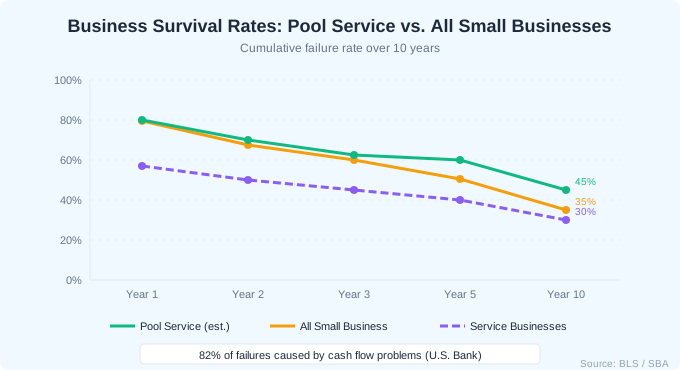
| Time Period | All Small Businesses | Service Businesses | Est. Pool Service |
|---|---|---|---|
| Year 1 | 20.4% fail | 43% fail | 15-25% fail |
| Year 2 | 32.3% fail (cumulative) | ~50% fail | 25-35% fail |
| Year 3 | ~40% fail (cumulative) | ~55% fail | 30-40% fail |
| Year 5 | 49.4% fail (cumulative) | ~60% fail | 35-45% fail |
| Year 10 | ~65% fail (cumulative) | ~70% fail | 50-60% fail |
The pool service estimates are informed by the industry's structural advantages: recurring monthly revenue (vs. one-time project revenue), low startup costs ($10,000-30,000 vs. $100,000+ for restaurants or retail), high demand in growing markets, and a fragmented competitive landscape with room for new entrants. These factors give pool service a survival advantage over service businesses generally.
Pool service failure is rarely about lack of demand. There are 10.7 million pools in the U.S. and most markets are underserved. The failures are almost always operational: bad pricing, poor cash management, or inability to retain customers and employees.
What Are the Most Common Reasons Pool Service Businesses Fail?
82% of business failures are caused by cash flow problems according to a U.S. Bank study. In pool service, the specific cash flow killers are underpricing, unexpected equipment failures, and seasonal revenue gaps. But the root cause is almost always the same: the owner priced services based on what competitors charge rather than what their actual costs require.
Top Failure Causes Ranked by Frequency
- 1Underpricing services: Charging $80-100/month when true costs (labor, chemicals, vehicle, insurance, overhead) require $130-150/month. The business looks busy but bleeds money on every stop.
- 2Undercapitalization: Starting with no cash reserves. A single truck transmission ($4,000-7,000), an insurance claim deductible ($2,500-5,000), or a slow season can kill an underfunded business.
- 3Employee mindset: Thinking like a technician instead of a business owner. Focusing on doing pool work instead of building systems, managing finances, and growing the customer base.
- 4No financial tracking: Not knowing actual profit per stop, cost per customer, or monthly breakeven point. Operating on gut feel instead of data.
- 5Poor customer communication: Missed follow-ups, no service reports, unreturned calls. This drives churn above 20% and forces constant customer replacement.
- 6Growing too fast without systems: Adding customers and technicians without route management, quality control, or training processes. Growth amplifies chaos.
- 7Wrong customer focus: Accepting every customer regardless of location or profitability. Driving 30 minutes for a $90 account loses money after vehicle and labor costs.
How Do Survivors Differ From Failures?
The pool service businesses that survive five years and beyond share a set of operational characteristics that failures lack. It is not about being a better pool technician. The best technical pool person can fail at business while someone with average pool knowledge but strong business practices builds a profitable company. The difference is systems, pricing discipline, and financial management.
| Business Area | Survivors | Failures |
|---|---|---|
| Pricing | Based on actual cost analysis + profit margin | Based on what competitors charge or what feels right |
| Cash reserves | 3-6 months of operating expenses in savings | Living paycheck to paycheck, no reserves |
| Financial tracking | Monthly P&L review, know profit per stop | Check bank account balance occasionally |
| Customer communication | Service reports, proactive updates, review requests | Only contact customers when there is a problem |
| Employee management | Documented training, competitive pay, career paths | Verbal training, below-market wages, high turnover |
| Growth planning | Capacity-based: hire then grow, or grow then hire deliberately | Reactive: say yes to everything, figure it out later |
| Technology | Route software, digital billing, service tracking | Paper route sheets, manual invoicing, memory-based routing |
| Owner role | Transitioning from technician to manager/owner | Permanently stuck on a truck doing daily service |
The single clearest indicator of a pool service business that will survive is whether the owner knows their cost per stop. If you can tell someone exactly what it costs you in labor, chemicals, vehicle expense, and overhead to service one pool, you are operating like a business. If you cannot, you are guessing.
What Is the Minimum Capital Needed to Start a Pool Service Business?
Pool service is one of the lowest-cost businesses to start, which is both an advantage and a trap. The low barrier to entry means anyone can start, but it also means many people start without enough capital to survive the first 6 months. The minimum startup cost is $5,000-10,000 if you already own a vehicle. A properly capitalized startup, including cash reserves for unexpected expenses, requires $15,000-30,000.
| Startup Expense | Minimum | Recommended | Notes |
|---|---|---|---|
| Equipment and chemicals | $2,000-3,000 | $3,000-5,000 | Test kits, poles, vacuum, chemicals, parts inventory |
| Vehicle setup | $500-1,000 | $2,000-3,000 | Rack system, chemical storage, organization |
| Insurance (first 6 months) | $1,500-2,500 | $2,000-3,500 | General liability, commercial auto, workers comp if employees |
| Business licensing | $200-500 | $200-500 | City/county business license, CPO certification optional |
| Marketing (first 3 months) | $500-1,000 | $1,500-3,000 | Website, business cards, initial advertising |
| Software/technology | $0-200 | $50-150/month | Pool service management software |
| Cash reserves | $0 | $5,000-15,000 | The difference between surviving and failing |
| Total | $5,000-8,000 | $15,000-30,000 | Including 3-6 month cash reserve |
The businesses that start at $5,000 with no reserves are the ones with the highest failure rates. One truck repair, one slow month, or one insurance claim can wipe them out. The $15,000-30,000 range provides enough buffer to survive the inevitable surprises of the first year.
What Financial Benchmarks Should Pool Companies Track?
Surviving pool service businesses track a core set of financial metrics that failing businesses ignore. The most important is profit per stop, because it reveals whether your pricing actually covers your costs. If you are making $3 per stop after all expenses, you are working for free. If you are making $25-35 per stop, you have a sustainable business.
| Metric | Healthy Range | Warning Zone | Critical |
|---|---|---|---|
| Gross profit margin | 55-70% | 40-55% | Below 40% |
| Net profit margin | 15-30% | 10-15% | Below 10% |
| Profit per stop | $25-45 | $15-25 | Below $15 |
| Customer acquisition cost | $100-250 | $250-400 | Above $400 or unknown |
| Annual churn rate | 5-15% | 15-20% | Above 20% |
| Months of cash reserves | 3-6 months | 1-3 months | Less than 1 month |
| Revenue per technician | $8,000-12,000/month | $6,000-8,000 | Below $6,000 |
| Owner on truck % | 0% (manages only) | 50% (partially) | 100% (full-time tech) |
If you are in the warning zone on multiple metrics, your business is at risk. If you are in the critical zone on even one metric, address it immediately. The businesses that track these numbers monthly catch problems early. The businesses that do not discover problems when it is too late.
How Do You Build a Pool Service Business That Survives?
The playbook for building a pool service business that survives 5+ years is not complicated, but it requires discipline that most first-time business owners lack. Price correctly from day one, keep cash reserves, build systems before you need them, and make the transition from technician to business owner as early as possible.
The Survival Playbook
- 1Price based on costs, not competitors. Calculate your true cost per stop (labor, chemicals, vehicle, insurance, overhead) and add a 25-35% profit margin. If the market will not support that price, find a market that will.
- 2Start with 3-6 months of cash reserves. Do not spend your last dollar on equipment. Keep enough cash to survive a bad month, a truck breakdown, and a slow season.
- 3Track your numbers monthly. Revenue, expenses, profit per stop, customer count, churn rate. If you only check your bank balance, you are flying blind.
- 4Communicate proactively with customers. Send service reports after every visit. Respond to messages within 4 hours. Follow up on every estimate within 24 hours.
- 5Build systems before you hire. Document your service process, training steps, quality standards, and route procedures. When you do hire, the system trains the person.
- 6Plan your exit from the truck. Every month you are on a truck full-time is a month you are not growing the business. Hire your first technician as soon as you can afford it, even if margins tighten temporarily.
Corey Adams, Pool Founder co-founder and 15-year pool veteran: "I have watched dozens of pool companies start and fail over 15 years. It is always the same story: good technician, bad business operator. The ones who survive figure out that running a pool business is 30% pool knowledge and 70% business management."
Free starter kit
Start a pool service business with the numbers already run.
A short email series from an owner who started with $1,200 and a used truck. No software pitch, just the four things that decide whether year one works.
- Startup cost breakdownEvery line item from $2K bootstrap to fully equipped
- Pricing calculatorThe minimum you can charge per visit and still profit
- First-10-customers playbookDoor hangers, referrals, and the phone script that closes
- Licensing & insurance checklistWhat your state requires and which insurers pay claims
Already running routes? Try Pool Founder free
Frequently Asked Questions
What percentage of pool service businesses fail?
While no pool-specific failure data exists at scale, service-based businesses have a 43% first-year failure rate. Pool service likely performs better (estimated 15-25% first-year failure) due to recurring revenue, low startup costs, and high demand. Approximately 35-45% are estimated to fail within 5 years.
Why do pool service businesses fail?
The top causes are underpricing services (charging less than true cost), undercapitalization (no cash reserves for emergencies), operating with an employee mindset instead of a business owner mindset, poor customer communication leading to high churn, and no financial tracking. 82% of all business failures trace back to cash flow problems.
How much money do you need to start a pool service business?
The minimum startup cost is $5,000-10,000 if you own a vehicle, but properly capitalized startups need $15,000-30,000 including 3-6 months of cash reserves. Businesses that start underfunded have the highest failure rates because one unexpected expense can be fatal.
What is a healthy profit margin for pool service?
Healthy pool service companies maintain 55-70% gross profit margins and 15-30% net profit margins. Profit per stop should be $25-45. If your net margin is below 10% or profit per stop is below $15, your pricing needs immediate attention.
How do successful pool service companies differ from failures?
Survivors price based on cost analysis rather than competitor pricing, maintain 3-6 months of cash reserves, track financial metrics monthly, communicate proactively with customers, document their processes, and work to transition the owner from daily technician work to business management.
Sources & References
- U.S. Bureau of Labor Statistics: Business Employment Dynamics (Survival Rates)
- Small Business Administration: Small Business Survival Rates
- Business Initiative: Small Business Survival and Failure Rate Statistics
- U.S. Bank Study: Cash Flow and Business Failure
- InvoiceOwl: Common Pool Service Business Mistakes to Avoid
- QuickScream: Reasons Why Pool Cleaning Businesses Fail
- Sealey Business Brokers: Pricing Mistakes and Pool Route Valuation