Why Does 110 Degree Heat Change Everything About Pool Service?
Pool service in Arizona during summer operates under conditions that break the rules used everywhere else. When ambient temperatures exceed 110 degrees F and pool water reaches 90 to 95 degrees F, chlorine degrades up to 90% in two hours of direct sunlight without adequate stabilizer according to Arizona pool chemistry data. Evaporation rates hit a quarter inch per day, concentrating minerals and pushing calcium hardness and TDS higher every week. The Langelier Saturation Index shifts positive as water temperature rises, accelerating calcium scaling on surfaces, heat exchangers, and salt cells. Chemical costs increase 40 to 60% compared to spring and fall months.
For pool service companies in the Phoenix metro, Tucson, and the desert corridor, June through September is not just the busiest season. It is the season where your chemical knowledge, service frequency, and customer communication determine whether you retain customers or lose them to complaints about green water, scaling, and high bills. This guide covers the specific protocol adjustments that separate Arizona pool service professionals from companies that treat summer like any other season.
Arizona pool service companies operate in the largest year-round pool market in the country. Maricopa County alone has over 400,000 residential swimming pools. Summer is when your expertise is most visible and most valuable to customers.
How Does Extreme Heat Affect Chlorine Levels?
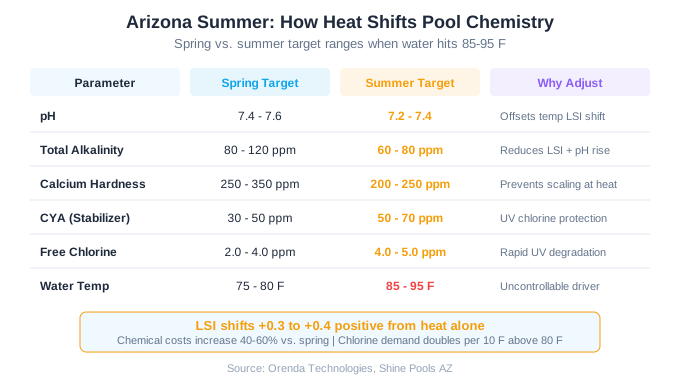
Chlorine degradation in Arizona summer is the single biggest service challenge. UV radiation at Arizona latitudes is intense, and combined with water temperatures in the 85 to 95 degree F range, a pool that tests at 3.0 ppm free chlorine in the morning can be at 0.5 ppm by late afternoon. Without adequate cyanuric acid (CYA) as a stabilizer, chlorine can degrade completely in under two hours on a sunny Arizona day. For every 10 degree F increase above 80 degrees F, chlorine demand roughly doubles.
Summer Chlorine Management Protocol
- Maintain CYA at 50 to 70 ppm: Higher than the standard 30 to 50 ppm recommendation for other climates. CYA is the only thing standing between your chlorine and the Arizona sun. Below 40 ppm in summer, chlorine loss is unmanageable.
- Target free chlorine at 4.0 to 5.0 ppm: Higher than normal to account for rapid degradation between visits. At arrival, 2.0 ppm or higher is acceptable. Below 1.0 ppm and algae has a foothold.
- Shock weekly: Cal-hypo or liquid chlorine shock once per week during peak summer, in addition to normal chlorine maintenance. Always shock at night when UV degradation is not a factor.
- Increase liquid chlorine dosage 30-50%: Summer weekly chlorine consumption for a 15,000-gallon pool jumps from approximately 1 gallon to 1.5 to 2 gallons of liquid chlorine per visit compared to spring.
- Test at every visit: Do not skip readings in summer. Chlorine demand changes rapidly and a single missed week can result in a green pool.
CYA above 80 ppm reduces chlorine effectiveness even though it slows UV degradation. The ratio of free chlorine to CYA matters. At 80 ppm CYA, you need a minimum 6.0 ppm free chlorine to maintain adequate sanitization. If CYA creeps above 80, partial drain and refill is the only practical solution.
How Does the LSI Shift in Arizona Summer Heat?
The Langelier Saturation Index (LSI) measures whether pool water is corrosive (negative LSI) or scale-forming (positive LSI). The acceptable range is negative 0.30 to positive 0.30. Temperature is one of the five variables in the LSI calculation, and it has a significant impact. When water temperature rises from 75 degrees F to 95 degrees F, the LSI shifts approximately 0.3 to 0.4 points positive even with no other changes. This means water that was perfectly balanced in March is aggressively scale-forming by July.
Summer LSI Adjustment Strategy
| LSI Variable | Spring Target | Summer Adjustment | Why |
|---|---|---|---|
| pH | 7.4 - 7.6 | 7.2 - 7.4 | Lower pH offsets temperature-driven LSI increase |
| Total alkalinity | 80 - 120 ppm | 60 - 80 ppm | Lower TA reduces LSI and slows pH rise |
| Calcium hardness | 250 - 350 ppm | 200 - 250 ppm | Lower CH prevents scaling at high temps |
| Water temperature | 75 - 80 F | 85 - 95 F (uncontrollable) | Drives LSI positive by 0.3 - 0.4 points |
| CYA | 30 - 50 ppm | 50 - 70 ppm | Slight LSI impact but chlorine protection is priority |
The practical adjustment is to run pH and alkalinity at the lower end of acceptable ranges during summer. This compensates for the temperature-driven LSI shift and reduces calcium scaling on surfaces, tile lines, and equipment. Pool service companies that do not adjust for seasonal LSI spend more time descaling and handle more customer complaints about rough surfaces and white deposits.
Use an LSI calculator at every summer visit. A quick calculation using pH, temperature, alkalinity, calcium hardness, and TDS takes 30 seconds and tells you whether you are headed toward scaling or corrosion. Orenda Technologies offers a free LSI calculator app.
How Should Salt Cell Output Be Adjusted for Summer?
Salt chlorine generators face a paradox in Arizona summer. Chlorine demand is at its peak, so the temptation is to run the salt cell at 100% output. But high output generates more heat at the cell plates, raises the local pH above 8.0 at the electrode surface, and dramatically accelerates calcium scaling. A salt cell running at 100% all summer can scale over in 2 to 4 weeks, reducing output and shortening cell life.
Salt Cell Summer Protocol
- Set output to 60-80%: Not 100%. Supplement with liquid chlorine when the cell cannot keep up rather than overdriving the cell.
- Extend run time instead of output: Running the pump and cell for 10 to 12 hours per day at 70% output produces more chlorine than 6 hours at 100% and causes less scaling.
- Inspect the cell monthly: In summer, monthly acid washing of the salt cell may be necessary. Spring and fall inspections every 3 months are not sufficient in Arizona heat.
- Program a cool-down period: If the controller allows it, set the cell to shut off 30 minutes before the pump stops. Water continues to flow through the cell, cooling the plates and flushing loose scale.
- Maintain salt at 3,200 to 3,400 ppm: Evaporation concentrates salt, so do not add salt by default in summer. Test before adding. Over-salting reduces cell efficiency.
- Keep alkalinity at 60-80 ppm: Lower alkalinity reduces the pH ceiling that the salt cell naturally creates through sodium hydroxide production, directly reducing scale formation.
A salt cell that scales over requires an acid wash that costs the customer $75 to $150 per cleaning. If the cell is damaged by repeated heavy scaling, replacement costs $400 to $1,200. Proactive output management extends cell life by 1 to 2 years.
How Do You Manage Evaporation and Water Loss?
Arizona pools lose approximately a quarter inch of water per day during summer, which translates to 1.5 to 2 inches per week for a typical residential pool. A standard 15,000-gallon pool can lose 300 to 500 gallons per week to evaporation alone. This creates three service challenges: maintaining water level for proper skimmer function, managing mineral concentration from constant fill water addition, and controlling TDS creep.
Evaporation Management
- Verify autofill function at every visit: Most Arizona pools have an autofill device. If it fails, the pool can lose several inches in a week, exposing the skimmer and potentially burning out the pump.
- Test calcium hardness monthly: Fill water in Phoenix averages 250 to 350 ppm calcium hardness. Constant refilling from evaporation adds calcium that never evaporates, steadily increasing pool calcium levels.
- Monitor TDS quarterly: Evaporation leaves dissolved solids behind while refill water adds more. TDS above 3,000 ppm (or 1,500 ppm above the fill water baseline for salt pools) reduces water clarity and chemical effectiveness.
- Recommend partial drains: When calcium hardness exceeds 400 ppm or TDS is unmanageable, a partial drain and refill is the only correction. In Arizona, most pools benefit from a 1/3 drain annually, typically in spring before summer evaporation compounds the issue.
Arizona water costs are a sensitive topic for customers. A partial drain and refill on a 15,000-gallon pool uses about 5,000 gallons, which costs roughly $15 to $25 in municipal water fees. Frame the conversation around protecting their pool surface and equipment, not about water chemistry abstractions.
How Should You Communicate Summer Chemical Costs to Customers?
Chemical costs in Arizona summer run 40 to 60% higher than spring and fall months. A customer who pays $135 per month for service may see chemical surcharges or price increases that push their monthly cost to $160 to $180 during June through September. If you do not proactively communicate why costs increase, customers assume you are overcharging or wasting chemicals.
Customer Communication Framework
- 1Send a pre-summer email in May: Explain that summer heat increases chlorine consumption by 40-60%, requires more frequent shock treatments, and may require chemical surcharges. Set expectations before the first hot month.
- 2Show the data: Share chemical test readings with customers through your service reports. When they see free chlorine dropping from 4.0 to 1.5 between weekly visits, they understand why more chlorine is needed.
- 3Offer tiered summer pricing: Some companies build chemical costs into a flat monthly rate year-round, absorbing the summer spike. Others charge a summer chemical surcharge of $20 to $40 per month from June through September. Either approach works if communicated clearly.
- 4Explain the alternative: A green pool recovery costs $150 to $300 in chemicals and 2 to 3 extra visits. Proactive summer chemistry costs less than reactive recovery.
Pool Founder service reports show customers their water chemistry readings at every visit. When a customer can see their chlorine levels, pH, and alkalinity trending over time, the conversation about chemical costs becomes objective rather than emotional.
What Is the Optimal Summer Service Schedule for Arizona?
The standard weekly service schedule that works in spring and fall is often insufficient during Arizona peak summer. Pools with high bather loads, heavy landscaping, or dust exposure may need service adjustments to maintain water quality between visits.
Summer Schedule Adjustments
| Pool Type | Spring/Fall Frequency | Summer Recommendation | Reason |
|---|---|---|---|
| Standard residential, low use | Weekly | Weekly (sufficient) | With proper CYA and chlorine dosing |
| Active family pool, high use | Weekly | Twice weekly or chemical-only midweek check | High bather load depletes chlorine faster |
| Pool with heavy landscaping/dust | Weekly | Weekly with extra filter cleaning | Debris loads increase phosphate introduction |
| Salt pool | Weekly | Weekly with monthly cell inspection | Scaling risk requires more frequent cell checks |
| Commercial / HOA | Twice weekly | Three times weekly | Regulatory requirements and high bather loads |
For residential pools where twice-weekly service is not cost-effective, a midweek chemical drop works well. The tech stops by for 5 to 10 minutes, tests chlorine and pH, adds chlorine if needed, and moves on. Charge $30 to $50 per midweek stop. This prevents the Friday green pool problem where chlorine depleted by Wednesday results in algae by Friday.
Schedule Arizona summer service visits before 11 AM or after 4 PM. Working on a pool deck at 2 PM in 115 degree heat is a heat illness risk for techs. OSHA recommends water breaks every 15 to 20 minutes when the heat index exceeds 103 degrees F.
Ready to streamline your pool service business?
Pool Founder gives you route optimization, automated invoicing, chemical tracking, and everything else you need to run a more profitable pool business.
Frequently Asked Questions
How much chlorine does an Arizona pool need in summer?
Arizona pools need 30 to 50% more chlorine in summer compared to spring. A 15,000-gallon pool that uses 1 gallon of liquid chlorine per week in March may need 1.5 to 2 gallons per week in July. Weekly shock treatments are also recommended during peak heat.
What CYA level should Arizona pools maintain in summer?
Target 50 to 70 ppm CYA in Arizona summer, higher than the standard 30 to 50 ppm for other climates. CYA is essential to protect chlorine from UV degradation. Keep CYA below 80 ppm or chlorine effectiveness drops significantly.
How often should salt cells be cleaned in Arizona?
Monthly during summer. High water temperatures accelerate calcium scaling on salt cell plates. Set cell output to 60 to 80% and extend pump run time rather than running at 100%, which causes faster scaling.
How much water does an Arizona pool lose to evaporation?
Approximately a quarter inch per day, or 1.5 to 2 inches per week during summer. A 15,000-gallon pool can lose 300 to 500 gallons per week. Verify autofill function at every visit and monitor calcium hardness from constant refilling.
Should I charge more for pool service in Arizona summer?
Yes. Chemical costs increase 40 to 60% in summer. Either build the increase into your annual rate (spread over 12 months) or add a summer chemical surcharge of $20 to $40 per month from June through September. Communicate the increase proactively in May.
Sources & References
- Shine Pools AZ: How Arizona Heat Impacts Pool Water Chemistry
- Orenda Technologies: Understanding LSI (Langelier Saturation Index)
- Orenda Technologies: How to Prevent Scale in Pool Heaters and Salt Chlorine Generators
- Leslie's Pool: How to Prevent and Remove Scale from Salt Cells
- Arizona Department of Water Resources: Pools and Spas