A Dripping Pump Seal Is a $15 Part and a $200 Repair. Know the Difference.
A shaft seal leak is one of the most common pool pump problems you will encounter on route. Water dripping from the bottom of the pump housing, rust stains on the equipment pad, or moisture around the motor vents all point to the same culprit: a worn mechanical shaft seal. Left alone, that drip becomes a stream, water reaches the motor bearings, and a $15 seal replacement turns into a $500-900 motor replacement. According to INYOPools, the shaft seal is the single most frequently replaced part on residential pool pumps.
"I keep three seal types on my truck at all times," says Corey Adams, Pool Founder co-founder and 15-year pool service veteran. "A PS-1000 for Pentair, an SPX1600Z2 for Hayward, and an R0479400 for Jandy. Those three cover about 85% of the pumps I see on route. If I spot a drip during a routine visit, I can have that seal replaced before I leave the property. The customer never even knew there was a problem, and I just earned a $150-250 repair."
Safety first. Always turn off the pump at the circuit breaker before starting any seal replacement. Pool pumps run on 115V or 230V. Disconnect power completely and verify it is off with a voltage tester before opening the pump.
How Do You Know a Pool Pump Shaft Seal Is Failing?
The shaft seal sits behind the impeller where the motor shaft passes through the seal plate into the wet end of the pump. Its job is to prevent water from traveling along the spinning shaft into the motor. The seal uses two polished faces, one that rotates with the shaft and one that stays stationary in the seal plate, pressed together by a spring and elastomer bellows. When either face wears, cracks, or loses its polish, water gets past.
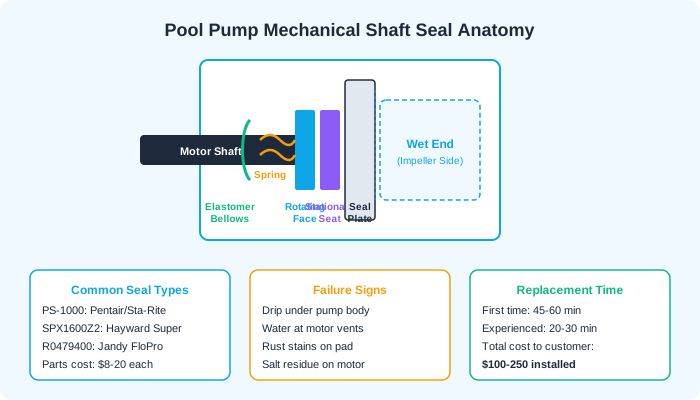
Signs of a Leaking Shaft Seal
- Water dripping from the bottom center of the pump body. This is the most obvious sign. The drip comes from between the seal plate and the volute, directly below the shaft.
- Rust stains on the equipment pad under or behind the pump, especially in a trail pattern from the pump base.
- Moisture or salt residue around the motor vent holes. Water that gets past the seal travels along the shaft toward the motor and exits at the vents.
- Noisy motor bearings. If water has been reaching the bearings for weeks, you will hear a grinding or squealing sound. At this point the bearings may also need replacement.
- Green or white mineral deposits on the seal plate area when you open the pump.
Do not confuse a seal leak with a lid O-ring leak. Lid O-ring leaks drip from the top of the pump housing and run down the outside. Seal leaks drip from the bottom center where the motor attaches to the wet end. Check both.
What Parts and Tools Do You Need for a Shaft Seal Replacement?
A shaft seal replacement requires minimal parts and tools, which is why it is one of the most profitable field repairs. The seal itself costs $8-20 wholesale, and the job takes 20-45 minutes depending on your experience and the pump model. Always order the correct seal for the specific pump. Using a generic seal on a pump that requires a specific face type will cause premature failure.
| Pump Brand | Common Models | Seal Part Number | Seal Cost |
|---|---|---|---|
| Pentair | WhisperFlo, IntelliFlo, SuperFlo | PS-1000 (or OEM 071734S) | $8-16 |
| Hayward | Super Pump, Super II, MaxFlo | SPX1600Z2 | $10-18 |
| Jandy | FloPro, PlusHP, Stealth | R0479400 | $12-20 |
| Sta-Rite | Max-E-Pro, IntelliPro | PS-1000 (same as Pentair) | $8-16 |
Tools Required
- 9/16" socket or wrench (for motor bolts on most pumps)
- Flat-head screwdriver (for prying the old seal components)
- Needle-nose pliers
- Silicone-based O-ring lubricant (never use petroleum jelly)
- Clean rag or shop towel
- Seal removal tool or seal puller (optional but speeds up the job)
- Multimeter (to verify power is off)
Stock Viton-grade seals (PS-3865 for Pentair) for saltwater pools. Standard elastomer seals degrade faster in salt systems. The Viton upgrade costs $2-4 more and lasts significantly longer.
Step-by-Step: How to Replace a Pool Pump Shaft Seal
This procedure covers the general process that applies to most residential pool pumps. Model-specific differences are noted where they matter. The entire job should take 20-45 minutes once you have done it a few times.
- 1Turn off the breaker. Verify power is off at the pump with a multimeter. Do not rely on timers or automation systems alone.
- 2Release system pressure. Open the air relief valve on the filter to release trapped pressure. Close the suction and return valves to isolate the pump if possible.
- 3Remove the pump housing bolts. Most pumps have four 9/16" bolts holding the motor and seal plate assembly to the volute (wet end housing). Remove all four and carefully pull the motor straight back.
- 4Remove the impeller. Hold the motor shaft from the back of the motor (some motors have a flat on the shaft for a wrench, others require removing the back motor cover to grip the shaft). Unscrew the impeller counterclockwise (it has standard right-hand threads on most pumps). On Hayward Super Pumps, the impeller may require a strap wrench.
- 5Remove the old seal components. The seal has two parts. The rotating portion (with the spring and rubber bellows) slides off the shaft after the impeller is removed. The stationary seat presses into the seal plate. Use a flat-head screwdriver to gently pry the stationary seat out of the seal plate recess. Be careful not to scratch the seal plate bore.
- 6Clean the seal plate bore and shaft. Remove all old rubber, corrosion, or mineral deposits from the seal plate recess and the motor shaft. A clean, smooth surface is critical for the new seal to seat properly.
- 7Install the new stationary seat. Press the new ceramic or carbon stationary face into the seal plate recess. Push it in straight and evenly. Do not touch the polished face with your fingers as oils can cause premature failure.
- 8Install the new rotating assembly. Slide the spring and bellows assembly onto the motor shaft with the polished face pointing toward the stationary seat. Push it down until the spring compresses and the two faces meet.
- 9Reassemble the pump. Slide the motor and seal plate back into the volute. Replace the four bolts and tighten in a cross pattern to ensure even pressure. Do not overtighten.
- 10Open valves, prime, and test. Open the suction and return valves, fill the pump housing with water, replace the lid, and turn on the breaker. Let the pump run for 10 minutes and check for any drips at the seal area.
"The number one reason new seals fail within a week is contamination. If you touch the polished seal faces with your bare fingers, the oils from your skin create a spot where the seal does not make full contact. Handle the seal faces by the edges only, or wear nitrile gloves." - Corey Adams
Model-Specific Notes: Pentair, Hayward, and Jandy Differences
While the general procedure is the same across brands, each manufacturer has design quirks that can trip you up if you are not expecting them. Knowing these differences before you open the pump saves time and prevents broken parts.
Pentair WhisperFlo and IntelliFlo
Pentair pumps use the PS-1000 seal (OEM part 071734S). The motor shaft has a flat spot that accepts a 7/16" wrench to hold the shaft while removing the impeller. The diffuser plate between the impeller and seal plate must be removed before accessing the seal. Reassemble the diffuser with the flow vanes facing the impeller.
Hayward Super Pump and Super II
Hayward uses the SPX1600Z2 seal. These pumps do not have a flat on the motor shaft, so you need to remove the rear motor cover and grip the shaft with pliers or use a strap wrench on the impeller. The seal plate on Hayward pumps uses a press-fit that can be tight. Apply gentle, even pressure when removing the stationary seat. According to Best Pool Adviser, forcing it can crack the seal plate, which costs $40-80 to replace.
Jandy FloPro and Stealth
Jandy pumps use the R0479400 seal. The volute on Jandy FloPro models uses a cam-and-ramp locking ring instead of bolts, which makes disassembly faster but can be confusing the first time. Rotate the ring counterclockwise to unlock. The Stealth series uses standard bolts. Both models have a flat on the motor shaft.
What Causes Pool Pump Seals to Fail Prematurely?
Understanding why seals fail helps you advise customers on prevention and set realistic expectations for seal lifespan. A properly installed seal in a well-maintained pool should last 3-5 years. If you are replacing the same seal every year, something else is going on.
- Running the pump dry. Even a few seconds of dry operation generates enough heat to crack or blister the seal faces. This is the number one cause of premature seal failure. According to Perry's Pool Pump, dry running causes heat damage that is often invisible until the seal starts leaking weeks later.
- Poor water chemistry. Low pH (below 7.2) or extremely high calcium hardness accelerates seal face erosion. Salt pools are particularly hard on standard seals, which is why Viton upgrades are recommended.
- Improper installation. Touching the polished faces, installing the seal crooked, or failing to clean the seal plate bore all lead to early failure.
- Overtightened housing bolts. Uneven bolt torque distorts the seal plate, preventing the seal faces from mating properly.
- Debris in the seal area. Sand, small pebbles, or broken basket fragments that reach the seal area score the faces.
3-5 years
Expected shaft seal lifespan with proper installation and water chemistry
Source: INYOPools
How Should You Price a Shaft Seal Replacement?
A shaft seal replacement is one of the highest-margin repairs in pool service because the parts cost is low and the labor time is short. The key is pricing it as a professional service, not discounting because the part only costs $15. Your customer is paying for the diagnosis, the knowledge, the truck stock, and the same-day resolution.
| Cost Component | Your Cost | Customer Price | Your Margin |
|---|---|---|---|
| Shaft seal (PS-1000 or equivalent) | $8-16 | $25-40 | 60-75% |
| O-ring lubricant (per use) | $1-2 | Included | 100% |
| Labor (20-45 min) | $15-30 (your time cost) | $75-150 | 70-80% |
| Service call / trip charge | Included in route | $0-50 | Variable |
| Total repair | $25-48 | $100-250 | 65-80% |
"I price a seal replacement at $175-225 depending on the pump model," Corey says. "That includes the seal, the O-ring lube, and the labor. If I catch it during a routine service visit, there is no trip charge. The customer gets same-day resolution, and my margin on that repair is 75% or better. Compare that to losing the customer because their pump motor burned out from a leak you could have caught."
Always check the motor bearings before quoting just a seal replacement. If the bearings are already growling, the water has been getting past the seal for a while. Replacing only the seal on a pump with damaged bearings means you will be back in a few weeks for the motor. Quote both so the customer can decide.
Run a pool route?
The business side of what you just read.
Pricing, chemical costs, and the tools owners use to keep the numbers straight.
- Commercial pool service pricing2026 rate tables and the cost-plus formula
- Chemical cost per poolWhat chemicals actually cost per stop
- Chemical tracking softwareLog readings and dosing from the pool deck
- Pool service softwareRoutes, invoicing, and service reports in one app
- Free profit & rate calculatorsProfit per pool, minimum rate, break-even
Frequently Asked Questions
How long does a pool pump shaft seal last?
A properly installed shaft seal on a pool with balanced water chemistry typically lasts 3-5 years. Saltwater pools and pools with low pH tend to wear seals faster. If your seal is failing within a year of replacement, check for dry-running events, poor chemistry, or installation issues.
Can you replace a pool pump seal without removing the motor?
No. The shaft seal sits between the motor and the wet end of the pump. You must separate the motor from the volute by removing the housing bolts, then remove the impeller to access both seal components. There is no shortcut for this repair.
What is the difference between a PS-1000 and PS-3865 shaft seal?
The PS-1000 is the standard shaft seal for Pentair and Sta-Rite pumps with a standard elastomer bellows. The PS-3865 is the Viton upgrade designed for salt pools and ozone systems. The Viton material resists chemical degradation better than standard rubber. It costs $2-4 more and is recommended for any saltwater pool.
Is a shaft seal leak an emergency?
Not immediately, but it should not be ignored. A small drip will not stop the pump from working, but the water is traveling toward the motor bearings. Left for weeks, a seal leak will damage the bearings and eventually burn out the motor. Fix it within a week of discovery to avoid a much more expensive repair.
How much should I charge for a pool pump seal replacement?
Most pool service professionals charge $100-250 for a shaft seal replacement, which includes the seal ($8-20), O-ring lubricant, and 20-45 minutes of labor. This is a high-margin repair because the parts cost is low relative to the value of the service. Price based on your market and the value of same-day resolution.
Why did my new pool pump seal start leaking after one week?
The most common causes of rapid seal failure after replacement are contamination of the polished seal faces during installation (fingerprint oils), a damaged or unclean seal plate bore, or a shaft that is grooved from the old seal. Check all three. If the shaft itself is scored, the seal will never seat properly and the motor may need replacement.