pH Drives Everything. Get It Wrong, and Nothing Else Works Right.
pH is the single most important water chemistry parameter on a pool service route. It determines how much of your free chlorine is active (at pH 7.2, about 65% is active HOCl; at pH 8.0, only 22% is active). It affects the Langelier Saturation Index. It determines whether the water is corrosive or scale-forming. And it is the number that drifts the most between service visits. Understanding why pH rises, how to calculate the correct acid dose, and the relationship between pH and total alkalinity will make you a better tech on every stop.
Corey Adams, Pool Founder co-founder and 15-year pool service veteran, calls pH "the number I check first on every pool." "If pH is right, chlorine works, the water is clear, and the equipment lasts. If pH is off, I am chasing problems all day. I have seen techs dump acid to fix cloudy water when the real issue was something else entirely. You have to understand what pH actually does before you start adjusting it."
This guide covers why pH rises naturally, the chemistry behind acid demand, muriatic acid vs dry acid tradeoffs, and the common mistake of chasing pH when alkalinity is the real problem.
Why Does Pool pH Rise Naturally?
Pool pH rises naturally for one primary reason: carbon dioxide (CO2) outgassing. Water in contact with the atmosphere is constantly exchanging gases. CO2 dissolved in pool water forms carbonic acid, which lowers pH. When that CO2 escapes into the air, the carbonic acid goes with it, and pH rises. Any factor that increases aeration, such as water features, jets, waterfalls, wind, heavy swimming, and pump returns, accelerates CO2 outgassing and pH rise.
What Are the Primary Causes of pH Rise?
| Cause | Mechanism | Severity |
|---|---|---|
| CO2 outgassing (aeration) | Carbonic acid leaves the water as CO2 gas | High, ongoing, universal |
| Salt chlorine generators | Electrolysis produces sodium hydroxide (pH 13+) | High on salt pools |
| Water features/fountains | Increased aeration accelerates CO2 loss | Moderate to high |
| High total alkalinity | Higher TA buffers pH upward more aggressively | Moderate |
| Calcium hypochlorite shock | Product pH is 10.8-11.8 | Temporary spike after shocking |
| Sodium carbonate (soda ash) | Used to raise pH, but overshooting is common | Temporary if overdosed |
The key insight is that CO2 outgassing raises pH without changing total alkalinity. This is important because acid lowers both pH and alkalinity. If you keep adding acid to fight a pH rise caused by aeration, you will eventually drive alkalinity too low while pH keeps bouncing back. This is the single most common pH management mistake on pool routes.
Aeration raises pH. Acid lowers both pH and TA. If you are fighting a constant pH rise but TA keeps dropping, you are in an acid-aeration cycle. The fix is to lower TA to 60-80 ppm so the water has less buffering capacity pushing pH up.
How Do You Calculate the Correct Acid Dose?
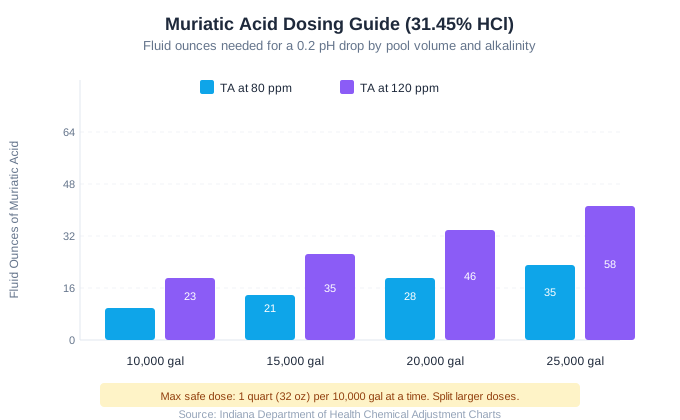
Acid dosing depends on the current pH, target pH, total alkalinity, and pool volume. Higher TA requires more acid because the alkalinity buffers against pH change. The Indiana Department of Health chemical adjustment charts provide standard dosing references that most service professionals use as a baseline.
Muriatic Acid Dosing Reference (31.45% HCl)
| Pool Volume | pH Drop of 0.2 (TA 80 ppm) | pH Drop of 0.2 (TA 120 ppm) | TA Drop of 10 ppm |
|---|---|---|---|
| 10,000 gal | 12-16 fl oz | 20-26 fl oz | 25.6 fl oz (1 qt) |
| 15,000 gal | 18-24 fl oz | 30-39 fl oz | 38.4 fl oz |
| 20,000 gal | 24-32 fl oz | 40-52 fl oz | 51.2 fl oz (1.5 qt) |
| 25,000 gal | 30-40 fl oz | 50-65 fl oz | 64 fl oz (2 qt) |
These are starting estimates. Always retest 4 to 6 hours after adding acid and before making a second adjustment. The maximum safe dose of muriatic acid is 1 quart per 10,000 gallons at a time. If you need a larger correction, split it into multiple doses at least 4 hours apart.
Never add more than 1 quart of muriatic acid per 10,000 gallons in a single dose. Adding too much acid at once creates a low-pH pocket around the addition point that can etch plaster, damage equipment, and harm swimmers. Split large corrections into multiple doses spaced 4-6 hours apart.
What Is the Difference Between Muriatic Acid and Dry Acid?
Both muriatic acid (hydrochloric acid, HCl) and dry acid (sodium bisulfate, NaHSO4) lower pH and total alkalinity. They have different handling characteristics, different costs, and one critical chemical difference that matters for long-term water quality.
| Property | Muriatic Acid (31.45% HCl) | Dry Acid (Sodium Bisulfate) |
|---|---|---|
| Form | Liquid | Granular powder |
| Handling | Produces fumes, requires ventilation | Easier to handle, low fume risk |
| Storage | Corrodes metal nearby, must isolate | Easier to store, less corrosive in dry form |
| Cost per pH point | Lower (approximately $0.15/gal treated) | Higher (approximately $0.25/gal treated) |
| Byproduct | None problematic (produces water + NaCl) | Adds sulfate to the water |
| Sulfate concern | No sulfate added | Sulfate above 300 ppm damages plaster via sulfate attack |
| Effectiveness | 1 qt per 10,000 gal lowers TA by 10 ppm | 1.5 lb per 10,000 gal lowers TA by 10 ppm |
Which Acid Should You Carry on the Truck?
For professional route service, muriatic acid is the better choice in almost every situation. It is cheaper per unit of pH correction, leaves no problematic byproducts, and is the industry standard. The fume and handling concerns are manageable with proper technique: pour slowly near the water surface, downwind, with the pump running. Dry acid makes sense for companies that service pools accessible only through homes (indoor pools, rooftop pools) where carrying liquid acid through living spaces is impractical.
Be aware of cumulative sulfate buildup if you or the homeowner regularly uses dry acid. Sulfate concentrations above 300 ppm can damage plaster and concrete through sulfate attack, creating a softening and deterioration of the pool surface. This is rarely an issue with occasional use but becomes a real problem with weekly dry acid additions over years.
What Is the Relationship Between pH and Total Alkalinity?
pH and total alkalinity are two different measurements, but they are chemically linked. Total alkalinity measures the water's ability to resist pH changes (buffering capacity). Higher TA means pH is more stable but also means it takes more acid to move pH down. Lower TA means pH moves easily but also means pH can swing wildly between visits. The relationship creates a common management mistake: adding acid to fix pH without understanding the TA impact.
The Most Common pH Management Mistake
Here is the scenario. You arrive at a pool with pH at 7.8 and TA at 120 ppm. You add acid to drop pH to 7.4. The acid also drops TA to 110. A week later, pH has drifted back to 7.8 (because high TA pushes it up), but TA is still at 110. You add more acid. pH drops, TA drops to 100. This cycle repeats until TA is at 60 ppm but pH still bounces to 7.6 every week because of aeration. Now you have low TA causing pH instability, and the acid corrections become more volatile.
The correct approach is to intentionally lower TA first using the acid-and-aerate method. Add acid to lower both pH and TA. Then aerate the pool (run water features, return jets angled up, or use an air compressor in the return line) to raise pH back without raising TA. Repeat until TA reaches the target range for that pool type, then manage pH from there.
| Pool Type | Target TA Range | Why |
|---|---|---|
| Traditional chlorine (plaster) | 80-120 ppm | Standard buffering range |
| Traditional chlorine (vinyl/fiberglass) | 80-100 ppm | Lower range preferred for softer surfaces |
| Salt chlorine generator | 60-80 ppm | Lower TA reduces pH rise from electrolysis |
| Pools with water features | 60-80 ppm | Lower TA reduces pH rise from aeration |
How Do You Add Acid Safely to a Pool?
Acid addition technique matters for both safety and effectiveness. The goal is to distribute the acid evenly throughout the pool without creating concentrated low-pH pockets that can etch surfaces or harm swimmers.
Acid Addition Best Practices
- 1Ensure the pump is running. Never add acid to a pool with the pump off.
- 2Pour acid slowly near a return jet to aid distribution. The jet disperses the acid as it enters the water.
- 3Walk the perimeter and pour in small amounts at multiple locations for pools needing large doses.
- 4Pour close to the water surface to minimize splashing and fumes. Do not dump from waist height.
- 5Stand upwind. Muriatic acid fumes blow downwind and irritate eyes and lungs.
- 6Never pour acid into the skimmer. Concentrated acid flowing through the equipment can damage the pump seal, heater heat exchanger, and filter internals.
- 7Wait at least 4 hours before retesting. Acid needs time to circulate and react.
- 8Never add acid and shock at the same time. Mixing chlorine and acid produces toxic chlorine gas.
The cardinal rule: never add acid and chlorine products at the same time or in the same location. Even adding acid through one skimmer and shock through another can create chlorine gas where the two meet in the plumbing. Add acid first, circulate for at least 30 minutes, then add chlorine.
How Do You Raise pH When It Is Too Low?
Low pH (below 7.0) is less common than high pH on pool routes, but it happens after acid overdose, heavy rain (rainwater is typically pH 5.0-5.6), or when using trichlor tabs exclusively (trichlor has a pH of 2.8-3.0). Low pH is corrosive to metal equipment, etches plaster, and irritates eyes and skin.
What Products Raise pH?
| Product | Effect on pH | Effect on TA | Best Use |
|---|---|---|---|
| Soda ash (sodium carbonate) | Raises pH significantly | Raises TA moderately | When pH is low and TA is also low |
| Sodium bicarbonate (baking soda) | Raises pH slightly | Raises TA significantly | When TA is low but pH only needs a small bump |
| Aeration | Raises pH | No effect on TA | When pH is low but TA is already at target |
The choice between soda ash, sodium bicarbonate, and aeration depends on where both pH and TA currently stand. If both are low, use soda ash. If TA is low but pH is close to target, use sodium bicarbonate. If pH is low but TA is already at the target, aerate the pool. Do not use soda ash when TA is already at or above target, because it will push TA too high and start the acid-chasing cycle all over again.
Sodium bicarbonate (baking soda) dose: approximately 1.5 pounds per 10,000 gallons raises TA by about 10 ppm. Broadcast it across the pool surface with the pump running. Wait 6 hours before retesting.
Ready to streamline your pool service business?
Pool Founder gives you route optimization, automated invoicing, chemical tracking, and everything else you need to run a more profitable pool business.
Frequently Asked Questions
What is the ideal pH for a swimming pool?
The ideal pH range for swimming pools is 7.2 to 7.6, with 7.4 as the optimal target for most pools. At pH 7.2, about 65% of free chlorine is in the active hypochlorous acid form. At pH 7.6, that drops to about 45%. At pH 8.0, only 22% is active. Keeping pH between 7.2 and 7.4 maximizes chlorine effectiveness and minimizes chemical costs.
Why does my pool pH keep going up every week?
Pool pH rises naturally due to CO2 outgassing from the water. Aeration from water features, jets, wind, and swimming accelerates this process. Salt chlorine generators also push pH up by producing sodium hydroxide during electrolysis. High total alkalinity makes the problem worse by buffering pH upward. Lower TA to 60-80 ppm on salt and water-feature pools to reduce pH rise.
How much muriatic acid do I need to lower pH?
As a starting estimate, 12-16 fl oz of 31.45% muriatic acid per 10,000 gallons lowers pH by approximately 0.2 units when total alkalinity is around 80 ppm. Higher TA requires more acid. Never add more than 1 quart per 10,000 gallons at a time. Retest after 4-6 hours before making additional adjustments.
Is dry acid better than muriatic acid for pools?
For most professional route service, muriatic acid is preferred. It is cheaper per unit of correction and leaves no problematic byproducts. Dry acid (sodium bisulfate) adds sulfate to the water, which can damage plaster at concentrations above 300 ppm with long-term use. Dry acid is useful when carrying liquid acid is impractical, such as servicing indoor or rooftop pools.
Should I adjust pH or alkalinity first?
Adjust total alkalinity first, then fine-tune pH. TA acts as a buffer for pH, so getting TA to the correct range stabilizes pH and makes subsequent adjustments more predictable. If TA is too high, use the acid-and-aerate method to lower it without crashing pH. Once TA is in range, pH corrections become smaller and more stable.
Can you add acid through the skimmer?
No. Never pour acid through the skimmer. Concentrated acid flowing through the plumbing damages pump seals, heater heat exchangers, and filter internals. Always pour acid directly into the pool near a return jet with the pump running. The jet helps distribute the acid evenly throughout the pool.