If You Cannot Control Alkalinity, You Cannot Control Anything Else
Total alkalinity (TA) is the water's ability to resist changes in pH. It acts as a buffer. When TA is in the correct range, pH stays stable between service visits and acid corrections are small and predictable. When TA is too high, pH drifts up relentlessly and you burn through acid trying to keep up. When TA is too low, pH swings wildly from one extreme to another, making every chemical adjustment a gamble.
Corey Adams, Pool Founder co-founder and 15-year pool service veteran, adjusts TA before touching pH on every new customer pool. "Alkalinity is the foundation. If I get alkalinity right first, pH behaves predictably on every visit after that. If I skip TA and just chase pH with acid, I end up in a cycle where the numbers never stabilize and the customer thinks I do not know what I am doing."
This guide covers the TA-pH relationship, how to raise TA with sodium bicarbonate, how to lower TA with the acid-and-aerate method, target ranges for different pool types, and common TA mistakes.
What Is Total Alkalinity and How Does It Affect pH?
Total alkalinity measures the concentration of alkaline substances in pool water, primarily bicarbonates, carbonates, and hydroxides, expressed in parts per million (ppm). These substances neutralize acids and resist pH changes. Think of TA as a shock absorber for pH. High TA means a stiff suspension that resists any pH change, requiring large amounts of acid to move pH down. Low TA means a loose suspension where even small chemical additions cause pH to swing dramatically.
How Does TA Interact with pH?
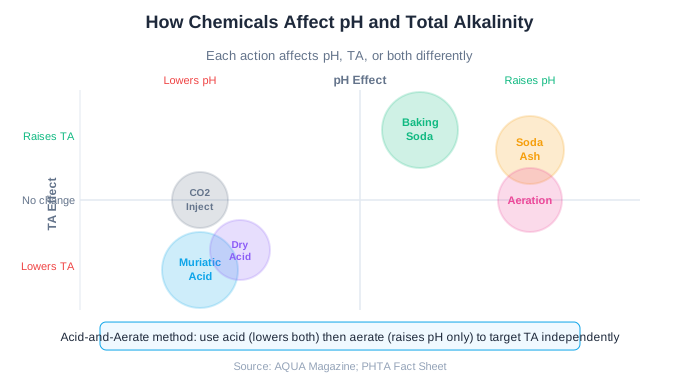
When you add acid to a pool, it lowers both pH and TA. When you add a base (like soda ash), it raises both pH and TA. When CO2 outgasses from the water through aeration, it raises pH but does not change TA. This asymmetry is the key to managing both parameters independently: you can lower TA with acid (which also drops pH), then raise pH back with aeration (which does not affect TA).
| Action | Effect on pH | Effect on TA |
|---|---|---|
| Add muriatic acid | Lowers | Lowers |
| Add sodium bisulfate (dry acid) | Lowers | Lowers |
| Add sodium bicarbonate (baking soda) | Raises slightly | Raises significantly |
| Add sodium carbonate (soda ash) | Raises significantly | Raises moderately |
| Aeration (CO2 outgassing) | Raises | No change |
| CO2 injection | Lowers | No change |
80-120 ppm
Standard total alkalinity target range for most swimming pools
What Should Total Alkalinity Be for Different Pool Types?
The optimal TA range depends on the pool surface, sanitizer system, and whether the pool has aeration features. Pools with persistent pH rise benefit from lower TA because reduced buffering capacity means pH rises more slowly and needs less acid to correct.
| Pool Type | Target TA | Why This Range |
|---|---|---|
| Plaster/gunite (traditional chlorine) | 80-120 ppm | Standard range. Provides stable pH buffering. |
| Vinyl liner | 80-100 ppm | Slightly lower to prevent pH creep and reduce chemical cost |
| Fiberglass | 80-100 ppm | Similar to vinyl. Gel coat is sensitive to chemistry extremes. |
| Salt chlorine generator | 60-80 ppm | Lower TA reduces the constant pH rise from electrolysis sodium hydroxide production |
| Pools with water features/spillover spas | 60-80 ppm | Lower TA reduces pH rise from heavy aeration |
| Commercial/public pools | 80-120 ppm | Health department compliance. Tighter monitoring is possible. |
Salt pools and water-feature pools are the most common candidates for intentionally low TA. If you service a salt pool at TA 120 ppm and fight pH every single week, dropping TA to 70 ppm will cut your acid use in half and stabilize the pool between visits.
How Do You Raise Total Alkalinity?
Sodium bicarbonate (baking soda) is the standard product for raising total alkalinity. It raises TA significantly while raising pH only slightly. This makes it the right choice when TA is low but pH is near target. The dosing rate is approximately 1.5 pounds per 10,000 gallons to raise TA by 10 ppm.
Sodium Bicarbonate Dosing Table
| Pool Volume | TA Increase of 10 ppm | TA Increase of 20 ppm | TA Increase of 30 ppm |
|---|---|---|---|
| 10,000 gal | 1.5 lbs | 3.0 lbs | 4.5 lbs |
| 15,000 gal | 2.25 lbs | 4.5 lbs | 6.75 lbs |
| 20,000 gal | 3.0 lbs | 6.0 lbs | 9.0 lbs |
| 25,000 gal | 3.75 lbs | 7.5 lbs | 11.25 lbs |
How to Add Sodium Bicarbonate Correctly
- 1Calculate the required amount based on pool volume and desired TA increase.
- 2With the pump running, broadcast the sodium bicarbonate across the pool surface in wide arcs.
- 3Do not dump it all in one spot. Spread it across the entire surface for even distribution.
- 4Let the water circulate for at least 6 hours before retesting.
- 5If the needed increase is more than 30 ppm, split into two doses at least 6 hours apart.
Do not use soda ash (sodium carbonate) to raise alkalinity. Soda ash raises pH dramatically while providing a smaller TA increase. It is the right product when both pH and TA are low, but if pH is near 7.4 and only TA needs to come up, sodium bicarbonate is the correct choice.
How Do You Lower Total Alkalinity?
Lowering TA requires the acid-and-aerate method. There is no product that lowers TA without also lowering pH. The technique exploits the asymmetry between acid (which lowers both) and aeration (which raises only pH). The process takes multiple cycles over several days but is the only reliable way to drop TA to target without crashing pH.
The Acid-and-Aerate Method
- 1Test current pH and TA.
- 2Add muriatic acid to lower pH to 7.0-7.2 and TA proportionally. Use approximately 1 quart of 31.45% muriatic acid per 10,000 gallons to lower TA by 10 ppm.
- 3After the acid circulates (30 minutes), turn on all aeration: water features, spillover, spa jets, return jets angled to break the surface.
- 4The aeration drives off CO2, which raises pH back toward 7.4-7.6 without raising TA.
- 5Once pH has risen back above 7.2, add another dose of acid to lower pH (and TA) again.
- 6Repeat the acid-then-aerate cycle until TA reaches the target range.
- 7Each cycle typically lowers TA by 5-10 ppm and takes 4-8 hours.
For a pool with TA at 150 ppm and a target of 80 ppm, expect 7-14 cycles over 3-5 days. This is a process, not a single-visit fix. On a service route, you can do one cycle per visit over consecutive weeks until TA reaches target.
Patience is critical with the acid-and-aerate method. Adding too much acid at once to speed up the process risks crashing pH below 6.8, which is corrosive to equipment and surfaces. Stick to 1 quart per 10,000 gallons maximum per dose, and let aeration do the work of raising pH back between cycles.
What Happens When Total Alkalinity Is Too High or Too Low?
Both extremes of TA cause distinct problems. High TA is more common on pool routes because fill water in many regions starts at 100-150+ ppm alkalinity. Low TA typically results from excessive acid use without proper TA management.
| Condition | TA Level | Symptoms | Fix |
|---|---|---|---|
| Too High | 140+ ppm | pH constantly drifts above 7.6. Requires excessive acid. Water may become cloudy from calcium carbonate precipitation. | Acid-and-aerate method to lower TA to target range. |
| Slightly High | 120-140 ppm | pH creep between visits. Higher than normal acid usage. Generally manageable. | Acid-and-aerate if persistent. May be acceptable for plaster pools. |
| Ideal Range | 80-120 ppm | Stable pH. Predictable acid demand. Clear water. | Maintain with routine monitoring. |
| Slightly Low | 60-80 ppm | pH may fluctuate more between visits. Acceptable for salt pools and water-feature pools. | May be intentional for salt pools. Raise with bicarb if unintentional. |
| Too Low | Below 60 ppm | pH swings wildly. Water becomes aggressive and corrosive. Difficult to maintain any stable chemistry. | Add sodium bicarbonate immediately. Retest and adjust. |
Can High TA Cause Cloudy Water?
Yes. When TA is above 120 ppm and pH drifts above 7.8, the water becomes supersaturated with calcium carbonate. The excess calcium carbonate precipitates out of solution as fine white particles, causing persistent cloudiness that will not respond to clarifiers or filtration alone. The fix is to lower pH with acid (which also lowers TA) and target TA in the 80-100 ppm range to prevent recurrence.
How Do You Manage Alkalinity Across Your Route?
Most techs check pH on every visit but only test TA when something seems off. This is backwards. Testing TA at least monthly, and adjusting it before fine-tuning pH, prevents the acid-chasing cycle that wastes product and time. Build TA checks into your service schedule.
Route TA Management Protocol
- 1Test TA on every new customer pool during the first visit. Record the baseline.
- 2Test TA monthly on all pools, biweekly on salt pools and pools with water features.
- 3If TA is above 120 ppm on a pool with persistent pH problems, begin the acid-and-aerate process.
- 4If TA is below 60 ppm, add sodium bicarbonate before adjusting anything else.
- 5Log TA alongside pH in your service software. TA trends reveal whether your acid usage is creating an alkalinity problem over time.
- 6When a pool "will not hold pH," check TA first. Nine times out of ten, TA is either too high (causing pH rise) or too low (causing pH instability).
Pool Founder logs TA alongside every other chemistry reading on each service report. When TA trends downward over several months, the system alerts you before it drops below the critical threshold. This prevents the crisis of a pool with 40 ppm TA that suddenly cannot hold stable chemistry.
Run a pool route?
The business side of what you just read.
Pricing, chemical costs, and the tools owners use to keep the numbers straight.
- Commercial pool service pricing2026 rate tables and the cost-plus formula
- Chemical cost per poolWhat chemicals actually cost per stop
- Chemical tracking softwareLog readings and dosing from the pool deck
- Pool service softwareRoutes, invoicing, and service reports in one app
- Free profit & rate calculatorsProfit per pool, minimum rate, break-even
Frequently Asked Questions
What is the ideal total alkalinity for a swimming pool?
The standard target range is 80 to 120 ppm for most pools. Salt chlorine generator pools and pools with water features do better at 60 to 80 ppm because lower TA reduces the constant pH rise caused by aeration and electrolysis. Always adjust TA before fine-tuning pH for the most stable results.
How do you raise total alkalinity in a pool?
Add sodium bicarbonate (baking soda) at a rate of approximately 1.5 pounds per 10,000 gallons to raise TA by 10 ppm. Broadcast it across the pool surface with the pump running and wait at least 6 hours before retesting. For increases over 30 ppm, split into two doses.
How do you lower total alkalinity without lowering pH?
Use the acid-and-aerate method. Add muriatic acid to lower both pH and TA, then aerate the pool to raise pH back up without affecting TA. Repeat the cycle until TA reaches the target range. Each cycle lowers TA by 5 to 10 ppm and takes 4 to 8 hours.
Does baking soda raise pH or alkalinity?
Sodium bicarbonate (baking soda) primarily raises total alkalinity with only a slight increase in pH. It is the correct product when TA is low but pH is near target. If both pH and TA are low, use soda ash (sodium carbonate), which raises pH significantly and TA moderately.
Why does my pool alkalinity keep dropping?
Repeated acid additions lower TA along with pH. If you add acid weekly to fight a constant pH rise without addressing the root cause, TA will steadily decline. The fix is to lower TA intentionally to the target range for your pool type (which reduces pH rise), then maintain TA by monitoring it monthly and adding sodium bicarbonate when it drops below target.
Should I adjust alkalinity or pH first?
Adjust total alkalinity first. TA acts as a buffer for pH, so getting TA to the correct range first stabilizes pH and makes all subsequent adjustments more predictable. If you adjust pH first without correcting TA, pH will drift right back to where it started.
Sources & References
- PHTA Fact Sheet: Total Alkalinity Management in Swimming Pools
- AQUA Magazine: Using Air and Acid to Get Perfect pH/Alkalinity
- Swim University: How to Raise and Lower Pool Alkalinity
- Pool Chemical Calculator: What Should Pool Alkalinity Be
- Indiana Department of Health: Chemical Adjustment in Swimming Pools