Pool Heater Calls Pay Well. Diagnosing Them Fast Pays Better.
Pool heater troubleshooting is one of the highest-value service calls you can take. Homeowners expect warm water and will pay a premium for fast resolution. The challenge is that pool heaters come in three fundamentally different technologies, each with its own failure modes, error codes, and diagnostic approach. A gas heater that will not ignite is a completely different problem than a heat pump throwing a low-pressure fault.
"Heater calls used to intimidate me because there are so many brands and error codes," says Corey Adams, Pool Founder co-founder and 15-year pool service veteran. "But once I realized that 80% of heater problems come down to flow, ignition, or sensors, I could walk up to any brand and start diagnosing. The error code just tells you which of those three categories to investigate." This guide covers the three heater types separately, with common failure points and brand-specific error codes.
What Should You Check Before Diagnosing Any Pool Heater?
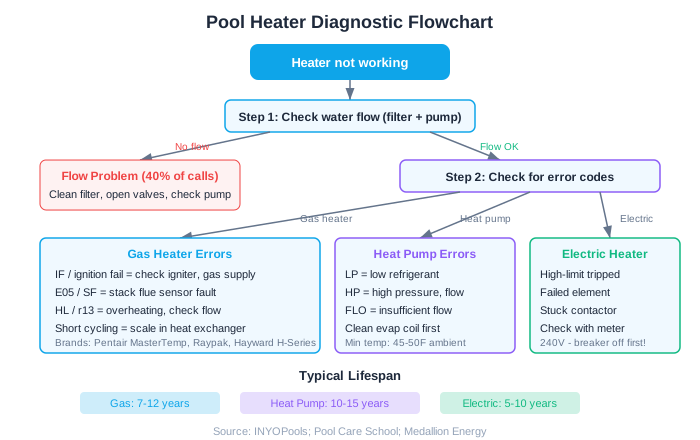
Regardless of heater type, run through these baseline checks before opening any panel or reading any error code. These five items resolve about 40% of heater service calls without any parts or technical diagnosis.
- 1Confirm the pump is running and the filter is clean. Every heater requires minimum water flow to operate. A dirty filter is the most common cause of heater shutdowns.
- 2Check the heater breaker at the sub-panel. Heat pumps and electric heaters draw significant amperage and can trip breakers.
- 3Verify the thermostat is set above the current water temperature. This sounds obvious, but automation systems and manual dials get bumped.
- 4Inspect all valves between the pump and heater. A partially closed valve restricts flow enough to trigger a flow switch fault.
- 5Check the heater for visible error codes on the display panel. Write down the exact code before clearing or resetting anything.
Always confirm adequate water flow before any other diagnosis. Low flow is the number one cause of heater shutdowns across all brands and heater types. According to INYOPools, flow-related issues account for the majority of residential pool heater service calls.
How Do You Troubleshoot Gas Pool Heater Problems?
Gas heaters (natural gas or propane) use a burner tray to heat water passing through a copper or cupro-nickel heat exchanger. They heat water fastest of any pool heater type, raising temperature 1-2 degrees per hour on a typical residential pool. The three most common failure categories are ignition failure, flame or sensor faults, and heat exchanger problems.
Ignition Failure: Heater Tries to Light But Does Not Fire
- No gas supply. Check the gas valve on the supply line. Confirm the gas meter is on. For propane heaters, check the tank level.
- Dirty or failed igniter. The hot surface igniter (HSI) or spark igniter wears out over time. Inspect for cracks or carbon buildup. Replace if damaged.
- Blocked burner orifices. Spider webs and insect nests inside burner tubes are extremely common, especially on heaters that sit idle for months. Inspect and clean all burner orifices with compressed air.
- Gas valve solenoid failure. The electronic gas valve may not be opening. Listen for a click when the ignition sequence starts. If no click, the valve may need replacement.
- Incorrect gas pressure. Natural gas should be 3.5-4.0 inches WC at the heater manifold. Propane should be 10-11 inches WC. Low pressure causes ignition failure.
Common Gas Heater Error Codes by Brand
| Brand/Model | Error Code | Meaning |
|---|---|---|
| Pentair MasterTemp | E05 (or PS) | Stack flue sensor open or shorted |
| Pentair MasterTemp | E01 | Water temp sensor open or shorted |
| Pentair MasterTemp | r13 | Stack flue limit exceeded (overheating) |
| Raypak Digital | IF | Ignition failure, no pilot sensed |
| Raypak Digital | SF | Stack flue sensor fault |
| Raypak Digital | HL | High limit tripped, overheating |
| Hayward H-Series | LO | Low water temperature sensor fault |
| Hayward H-Series | HI | High limit fault |
| Hayward H-Series | CE | Communication error (automation) |
Raypak heaters have a diagnostic history. Press the "Mode" button to scroll through the last 6 fault codes. This tells you if the heater has a recurring problem or if the current code is a one-time event.
What Are the Most Common Heat Pump Pool Heater Issues?
Heat pump pool heaters extract heat from ambient air using a refrigerant cycle, similar to an air conditioner running in reverse. They are 3-6 times more energy efficient than gas heaters but heat water more slowly, typically 1-3 degrees per day depending on ambient temperature. Heat pumps work best when air temperatures are above 50 degrees Fahrenheit and struggle in cold weather.
Low Refrigerant Pressure (LP Fault)
A low-pressure fault means the refrigerant is not absorbing enough heat from the air. Causes include refrigerant leak (requires licensed HVAC tech), dirty evaporator coil restricting airflow, low ambient temperature below the unit operating range, or a blocked or iced-up coil. Clean the evaporator coil with a garden hose and inspect for ice buildup. If the unit has a defrost cycle, make sure it is functioning. Recurring LP faults after cleaning usually indicate a refrigerant leak.
Flow Switch or Water Pressure Faults
Heat pumps have a flow switch or pressure switch that confirms adequate water flow before allowing the compressor to run. A dirty filter, closed valve, or pump running at too low a speed (common with variable speed pumps) triggers this fault. Increase pump speed to at least 2,000 RPM when the heater calls for heat, and verify the filter is clean.
Common Heat Pump Error Codes
| Brand | Error Code | Meaning |
|---|---|---|
| Pentair UltraTemp | LP | Low refrigerant pressure |
| Pentair UltraTemp | HP | High refrigerant pressure, check water flow |
| Pentair UltraTemp | FLO | Insufficient water flow |
| Hayward HeatPro | LP | Low pressure fault, check coil and airflow |
| Hayward HeatPro | HP | High pressure, check flow and filter |
| AquaCal | EVAP | Evaporator sensor malfunction |
| AquaCal | PS (flashing) | Pressure switch open, no flow |
Heat pumps must have 2-3 feet of clearance around the evaporator coil for proper airflow. Landscaping, fences, or pool equipment sheds built too close to the unit restrict airflow and cause low-pressure faults and ice buildup.
How Do You Diagnose Electric Resistance Heater Problems?
Electric resistance heaters use heating elements submerged in water, similar to a water heater. They are the least common type for full-size pools due to high operating costs but are standard on spas, hot tubs, and small therapy pools. They are simple to diagnose because there are fewer components: heating element, thermostat, high-limit switch, and contactor.
Common Electric Heater Failures
- Tripped high-limit switch. The safety switch cuts power when water temperature exceeds the safe limit (usually 104-110 degrees F). Reset the switch and check for restricted water flow, a failed thermostat, or a stuck contactor.
- Failed heating element. Use a multimeter to test element resistance. A 5.5 kW element at 240V should read approximately 10 ohms. An open circuit (infinite resistance) means the element is burned out. A very low reading or continuity to ground means the element sheath has cracked.
- Stuck contactor. The contactor is the relay that sends power to the element. If it is welded shut, the element stays on continuously and the high-limit trips. If it will not close, the element never gets power. Inspect the contactor contacts and replace if pitted or welded.
- Thermostat failure. If the heater never turns on or never turns off, the thermostat may be faulty. Test with a multimeter for continuity in both the open and closed positions.
Electric spa heaters run on 240V at 20-50+ amps. Always turn off the breaker and confirm zero voltage with a multimeter before touching any component. Even after the breaker is off, capacitors in some units can hold a charge.
Why Does the Heater Keep Shutting Off After a Few Minutes?
A heater that fires up, runs for 2-10 minutes, and then shuts down is one of the most common service calls. This cycling pattern points to a safety limit being triggered during operation. The cause varies by heater type, but the diagnostic approach is similar: identify which safety device is tripping.
Gas Heater Short Cycling
- Insufficient water flow. The heat exchanger overheats because water is not moving fast enough to carry heat away. Check the filter, valves, and pump speed.
- Scale buildup in heat exchanger. Calcium deposits insulate the heat exchanger from the water, causing localized overheating. The high-limit trips. Requires an acid flush of the heat exchanger.
- Oversized heater for the plumbing. A 400,000 BTU heater on 1.5-inch plumbing cannot get enough flow. This is a design problem that requires either plumbing modifications or a smaller heater.
Heat Pump Short Cycling
- Dirty evaporator coil. Restricted airflow causes the refrigerant pressure to drop, triggering a low-pressure fault.
- Defrost cycle not functioning. In cooler weather, the coil ices up and the defrost cycle should melt it. If defrost is not working, the unit cycles on LP faults.
- Ambient temperature too low. Most heat pumps have a minimum operating temperature of 45-50 degrees F. Below that, the unit cycles on and off without effectively heating.
How Do You Handle Heater Communication Errors with Automation?
Modern pool heaters communicate with automation systems (Pentair IntelliCenter, Hayward OmniLogic, Jandy AquaLink) through RS-485 serial connections or proprietary communication protocols. When a heater shows a communication error (CE on Hayward, or fails to respond to automation commands), the problem is usually in the wiring or protocol mismatch, not the heater itself.
Common Communication Troubleshooting Steps
- 1Verify the communication cable between the heater and automation panel is connected, not damaged, and not running parallel to high-voltage wiring (which causes interference).
- 2Confirm the heater address matches the automation configuration. Pentair heaters must be set to the correct device address in both the heater firmware and IntelliCenter setup.
- 3Check for firmware compatibility. Older heater firmware versions may not communicate with newer automation panels. Update firmware if available.
- 4If mixing brands (for example, a Hayward heater on a Pentair system), confirm a relay interface or protocol adapter is installed. Direct connection between mismatched brands causes communication failures and can damage control boards.
- 5Power cycle both the automation panel and the heater. Disconnect communication wires, power both units off for 60 seconds, reconnect, and power back on.
Mixing a Hayward heater with Pentair or Jandy automation requires a relay interface. Direct connection without the adapter can damage the control board. Always verify brand compatibility before connecting heater communication wires.
When Should You Recommend Heater Replacement vs. Repair?
Pool heaters have a typical lifespan of 7-12 years for gas heaters and 10-15 years for heat pumps, depending on water chemistry and maintenance. Knowing when to recommend a replacement saves your customer from pouring money into a heater that will fail again soon.
- Heat exchanger failure on a gas heater. Replace. A new heat exchanger costs nearly as much as a new heater and the rest of the unit is likely near end of life.
- Compressor failure on a heat pump. Evaluate age. If the unit is under 8 years old, a compressor replacement may be worthwhile. Over 10 years old, replace the unit.
- Repeated ignition failures after cleaning and part replacement. The control board or gas valve may be intermittently failing. On a heater over 8 years old, replacement is more cost-effective.
- Heater is still functional but the customer wants to reduce energy costs. Recommend upgrading a standard gas heater to a heat pump. Heat pumps cost 3-6x less to operate, with annual savings of $1,000-3,000 depending on climate and usage.
- Minor repairs under $300 on a heater under 7 years old. Repair. Igniters, flame sensors, pressure switches, and thermistors are all inexpensive and straightforward to replace.
Run a pool route?
The business side of what you just read.
Pricing, chemical costs, and the tools owners use to keep the numbers straight.
- Commercial pool service pricing2026 rate tables and the cost-plus formula
- Chemical cost per poolWhat chemicals actually cost per stop
- Chemical tracking softwareLog readings and dosing from the pool deck
- Pool service softwareRoutes, invoicing, and service reports in one app
- Free profit & rate calculatorsProfit per pool, minimum rate, break-even
Frequently Asked Questions
What is the most common cause of pool heater shutdowns?
Insufficient water flow is the most common cause across all heater types. A dirty filter, closed valve, or pump running at too low a speed reduces flow through the heat exchanger, causing the heater safety switches to trip. Always check flow first before investigating other causes.
Why does my gas pool heater smell like rotten eggs?
A sulfur or rotten egg smell near a gas heater can indicate incomplete combustion from blocked burner tubes, a cracked heat exchanger allowing pool water to contact the flame, or a propane leak. Turn off the gas supply and heater immediately and inspect. A cracked heat exchanger requires heater replacement.
How long should a pool heater last?
Gas heaters typically last 7-12 years. Heat pumps last 10-15 years. Electric spa heaters last 5-10 years. Proper water chemistry (balanced pH and calcium) and adequate flow significantly extend heater life. Poor water chemistry, especially low pH, corrodes heat exchangers and cuts lifespan in half.
Can you run a heat pump pool heater in cold weather?
Most heat pumps have a minimum operating temperature of 45-50 degrees Fahrenheit ambient air. Below that, the unit cannot extract enough heat from the air and will cycle on low-pressure faults. Some newer models operate down to 40 degrees but with significantly reduced heating capacity.
What does the E05 error mean on a Pentair MasterTemp heater?
E05 on a Pentair MasterTemp indicates the stack flue sensor is open or shorted. This sensor monitors exhaust temperature to detect overheating or blocked venting. Check for obstructions in the exhaust vent, verify adequate water flow, and test the sensor with a multimeter. Replace the sensor if it reads outside the specification.
Sources & References
- INYOPools - Most Common Swimming Pool Heater Problems
- INYOPools - Raypak Heater Fault Code Guide
- Outdoor Direct - Swimming Pool Heat Pump Error Codes
- Pool Care School - Common Pool Heater Error Codes Explained
- Medallion Energy - Pentair Heat Pump Error Codes
- Pentair - Pool Heater Error Codes Troubleshooting Guide