Scale Does Not Just Reduce Efficiency. It Kills Heaters.
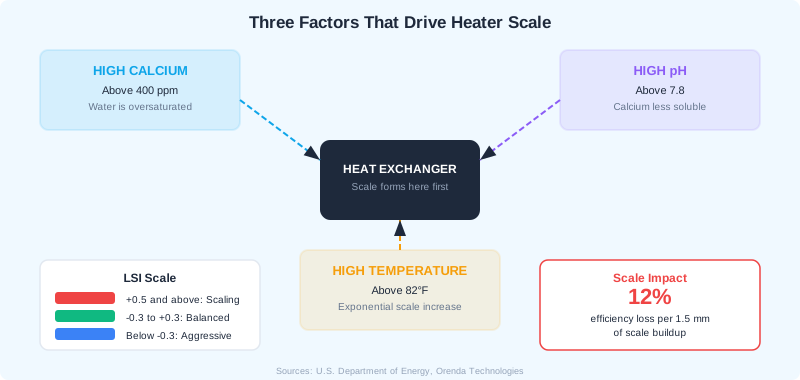
Calcium scale is the silent equipment killer in pool service. It builds up inside heat exchanger tubes where you cannot see it, gradually reducing heat transfer until the heater runs longer, costs more, and eventually fails. According to the U.S. Department of Energy, just 1/16 inch (1.5 mm) of scale on a heat exchanger surface reduces heat transfer efficiency by approximately 12%. In hard water markets like Arizona, Texas, and Florida, unmanaged scale cuts heater lifespan from the expected 5-10 years down to 3-5 years.
"Scale is the number one thing I see killing heaters in the Phoenix market," says Corey Adams, Pool Founder co-founder and 15-year pool service veteran. "Our source water comes in at 300-400 ppm calcium hardness. If you are not managing LSI and descaling every 2-3 years, you are replacing heat exchangers every 3-4 years at $800-$1,500 a pop. Preventive descaling costs a fraction of that."
Scale formation accelerates exponentially above 82 degrees F. Every degree above this threshold increases scaling rate significantly. If your customer wants the pool at 86 degrees in a hard water area, descaling frequency doubles.
What Causes Scale to Form in Pool Heaters?
Scale forms when calcium carbonate (CaCO3) precipitates out of the water and deposits on the hottest surfaces in the plumbing system, which is always the heat exchanger. This happens when the water's Langelier Saturation Index (LSI) is positive (above 0), meaning the water is oversaturated with calcium and has more than it can hold in solution. The heat exchanger creates a localized hot zone where the LSI spikes even higher, making it the first place scale forms.
Three Factors That Drive Scale Formation
- High calcium hardness (above 400 ppm) - The more calcium in the water, the less room it has to stay dissolved. Hard water markets (Phoenix, Dallas, Miami) routinely see source water at 300-500 ppm.
- High pH (above 7.8) - As pH rises, calcium becomes less soluble. A pool at pH 8.0 with 400 ppm calcium scales dramatically faster than the same pool at pH 7.4.
- High temperature - Heat reduces calcium solubility. The heat exchanger surface is the hottest point in the system, creating a concentration gradient where scale deposits form fastest. Every degree above 82 degrees F increases the scaling rate.
12%
heat transfer efficiency loss per 1.5 mm of calcium scale
Source: U.S. Department of Energy
How Do You Know If a Pool Heater Has Scale Buildup?
Scale inside a heat exchanger is not visible without disassembly, so you need to diagnose it from external symptoms. Fortunately, scaled heaters produce a clear pattern of performance degradation that an experienced technician can identify on a routine service visit.
Symptoms of a Scaled Heater
- Heater takes longer to reach set temperature. If a heater that used to heat 1 degree per hour now takes 90 minutes, scale is reducing heat transfer.
- Heater cycles on and off frequently (short-cycling). Scale restricts water flow through the exchanger, triggering the high-limit switch. The heater shuts down, cools, restarts, and repeats.
- Higher-than-normal gas or electric bills. The heater runs longer to produce the same result, consuming more fuel.
- Error codes related to high limit or flow switch. Pentair MasterTemp shows "HI" limit error. Hayward H-Series shows "HF" (high flue) error. Jandy shows "HL" code.
- Reduced flow through the heater. Scale narrows the internal passages, reducing GPM and triggering low-flow errors.
- Visible scale deposits on the header or at plumbing connections. If you see white crusty deposits where the plumbing connects to the heater, the inside is worse.
If a heater is short-cycling and the flow switch is not the issue, scale is almost always the cause. Pull the front panel and look at the header connections. White crusty buildup at the fittings confirms scale throughout the heat exchanger.
How Do You Descale a Pool Heater Heat Exchanger?
Descaling a pool heater involves circulating a diluted acid solution through the heat exchanger to dissolve the calcium carbonate deposits. This is a service that pool technicians can perform in the field with basic tools and safety equipment. The entire process takes 1-3 hours depending on scale severity. For heaters operating in hard water (280-400 ppm calcium), descaling every 2-3 years is recommended.
Descaling Procedure (Muriatic Acid Method)
- 1Safety first: Wear chemical splash goggles, acid-resistant gloves, and work in a ventilated area. Muriatic acid fumes are corrosive. Never work without PPE.
- 2Turn off the heater and allow it to cool for at least 30 minutes. Never acid-wash a hot heat exchanger.
- 3Close the isolation valves on both sides of the heater to isolate it from the pool plumbing.
- 4Disconnect the inlet and outlet plumbing connections at the heater headers.
- 5Prepare the descaling solution: 1 part muriatic acid to 10 parts water. Always add acid to water, never water to acid.
- 6Connect a small submersible pump ($30-50) to circulate the acid solution through the heat exchanger. Pump in one port, drain out the other into a bucket.
- 7Circulate for 30-60 minutes. You will see fizzing as the acid reacts with calcium. When the fizzing stops, the acid is spent and the scale is dissolved.
- 8Flush the heat exchanger thoroughly with clean water for 10 minutes to neutralize residual acid.
- 9Reconnect plumbing, open isolation valves, and test-fire the heater. Verify normal operation and no leaks.
Some manufacturers (Pentair, Raypak) sell brand-specific descaling kits with pre-measured acid and circulation fittings. These kits cost $50-80 and simplify the process. Check manufacturer recommendations before using generic acid, as some heat exchangers (especially cupro-nickel) have specific acid concentration limits.
| Descaling Method | Cost | Effectiveness | Best For |
|---|---|---|---|
| Muriatic acid (1:10 dilution) | $5-10 in acid | Excellent for heavy scale | Copper heat exchangers with thick calcium deposits |
| Commercial descaler (Scale-B-Gone, etc.) | $20-40 per treatment | Good for moderate scale | Regular maintenance descaling every 2-3 years |
| Vinegar (5% acetic acid) | $5-8 per gallon | Poor for thick scale | Not recommended for pool heaters (too weak) |
| Manufacturer descaling kit | $50-80 per kit | Good with proper fittings | Technicians who descale regularly |
How Do You Prevent Heater Scale from Forming?
Prevention costs a fraction of descaling, and descaling costs a fraction of replacement. The goal is to keep the water's LSI balanced so calcium stays in solution instead of depositing on the heat exchanger. According to Orenda Technologies, weekly sequestering agent applications reduce scale formation by 60-80% in hard water conditions, extending the time between descaling from annual to every 2-3 years.
Scale Prevention Protocol
- 1Manage LSI: Calculate LSI monthly using pH, temperature, calcium hardness, total alkalinity, and TDS. Target LSI between -0.3 and +0.3. If LSI is consistently above +0.3, lower pH and/or reduce calcium through partial drain-and-refill.
- 2Control pH: Keep pH between 7.2 and 7.6. Every tenth of a point above 7.6 increases scale risk measurably. In hard water markets, target the low end (7.2-7.4).
- 3Add sequestering agent weekly during heating season: Phosphonate-based sequestrants (Jack's Magic, Natural Chemistry) keep calcium in solution. Add at the maintenance dose weekly when the heater is running.
- 4Limit heater temperature: Set the heater to 82 degrees F or below when possible. Every degree above 82 accelerates scale formation. If the customer wants 86+ degrees, increase sequestrant dosage and descale annually.
- 5Monitor calcium hardness monthly: If CH rises above 400 ppm, consider a partial drain-and-refill to bring it down. Dilution is the most effective way to reduce calcium.
"I tell every customer with a heater in a hard water market: let me descale your heater every other year for $200, or replace the heat exchanger every 3-4 years for $1,200. Nobody picks option two." - Corey Adams
Does Scale Affect Salt Chlorine Generators Too?
Yes. Salt chlorine generators (salt cells) are just as vulnerable to scale as heaters, and for the same reason: they generate localized heat during electrolysis. The cell plates operate at elevated temperatures, which promotes calcium deposition. Most modern salt systems include a reverse-polarity feature that helps shed scale by periodically switching the electrical charge on the plates, but it does not eliminate scale in hard water.
According to Hayward and Pentair, scale buildup on salt cell plates reduces chlorine output by 25-40% before the system reports an error. At that point, the cell is working harder, wearing out faster, and producing less sanitizer. A salt cell costs $300-$900 to replace, and scale is the leading cause of premature failure.
Salt Cell Descaling
Most salt cell manufacturers recommend inspecting the cell every 3 months and cleaning with a diluted acid wash when visible scale is present. The typical procedure: remove the cell, stand it upright, fill with a 1:4 muriatic acid to water solution, wait until fizzing stops (5-15 minutes), rinse thoroughly, and reinstall. Some systems (Pentair IntelliChlor, Hayward AquaRite) have a built-in "Clean Cell" indicator that alerts when the cell needs attention.
Run a pool route?
The business side of what you just read.
Pricing, chemical costs, and the tools owners use to keep the numbers straight.
- Commercial pool service pricing2026 rate tables and the cost-plus formula
- Chemical cost per poolWhat chemicals actually cost per stop
- Chemical tracking softwareLog readings and dosing from the pool deck
- Pool service softwareRoutes, invoicing, and service reports in one app
- Free profit & rate calculatorsProfit per pool, minimum rate, break-even
Frequently Asked Questions
How often should I descale a pool heater?
In hard water areas (calcium above 300 ppm), descale every 2-3 years with a regular sequestering agent program. Without sequestrants, descale annually. In soft water areas (calcium below 200 ppm), descaling may never be needed. The best indicator is heater performance: if heating time has increased or the heater short-cycles, descale.
Can scale damage a pool heater permanently?
Yes. Thick scale insulates the heat exchanger, causing the combustion side to overheat. This thermal stress can crack copper heat exchanger tubes, warp headers, and damage internal components beyond repair. Once a heat exchanger cracks from scale-related overheating, the entire exchanger must be replaced ($800-$1,500 installed).
Does a salt pool cause more heater scaling than a chlorine pool?
Not directly. Scale is driven by calcium hardness, pH, and temperature regardless of sanitizer type. However, salt pools often have higher pH drift (salt electrolysis raises pH), which can push LSI positive and accelerate scaling if pH is not managed weekly.
Will a water softener prevent pool heater scale?
Whole-house water softeners should not be used for pool fill water. They replace calcium with sodium, which increases TDS and can damage pool surfaces and equipment. For pools, manage scale through LSI balance, pH control, and sequestering agents instead of softening the source water.
How much does professional heater descaling cost?
Professional descaling typically costs $150-$250 for a standard gas heater. The service takes 1-3 hours and includes acid circulation, flushing, and a performance test. Compare this to heat exchanger replacement at $800-$1,500. Descaling every 2-3 years is the most cost-effective approach for heater longevity.
Sources & References
- U.S. Department of Energy — Heat Pump Swimming Pool Heaters
- Orenda Technologies — How to Prevent Scale in Pool Heaters and Salt Chlorine Generators
- Executive Blue Pools — Hard Water Pool Heater Problems: Calcium Scale and Heat Exchanger Damage
- AquaDoc — How to Prevent Scale on Pool Heaters
- Trouble Free Pool — Calcium Build Up in Pool Heater Heat Exchanger
- Pentair — MasterTemp Heater Maintenance Guide