The Right Answer Depends on How Often They Swim, Not Which Is "Better."
Gas heater or heat pump is one of the most common equipment questions pool service companies get from customers. The answer is not one-size-fits-all. Gas heaters heat fast (1-2 degrees per hour) but cost $300-$500 per month to operate. Heat pumps cost $50-$100 per month but heat slowly (0.25-0.5 degrees per hour) and stop working effectively when air temperatures drop below 50 degrees F. The right choice depends entirely on usage patterns, climate, and budget.
"I used to default to gas heaters for everyone because that is what I grew up with," says Corey Adams, Pool Founder co-founder and 15-year pool service veteran. "Then I had a customer in Scottsdale who heated his pool every single day. His gas bill was $600 a month. We switched him to a heat pump and his monthly cost dropped to $80. But for the customer who only heats for weekend pool parties, gas is the right call. You have to match the equipment to the lifestyle."
How Do Gas Heaters and Heat Pumps Actually Work?
Understanding the underlying technology explains why these two systems have such different performance profiles. Gas heaters generate heat directly. Heat pumps move heat from one place to another. This fundamental difference drives every cost, speed, and efficiency comparison.
Gas Pool Heaters
Gas heaters burn natural gas or propane in a combustion chamber. Hot exhaust gases pass through a copper or cupro-nickel heat exchanger, transferring heat to pool water flowing through the exchanger tubes. Modern gas heaters operate at 89-95% thermal efficiency, meaning 89-95 cents of every dollar of gas becomes heat in the water. Most residential units are rated at 200,000-400,000 BTU, with 399,000 BTU being the most common size.
Heat Pump Pool Heaters
Heat pumps use a refrigerant cycle (the same technology as an air conditioner, but in reverse) to extract heat from the ambient air and transfer it to the pool water. A fan pulls outside air across an evaporator coil containing cold refrigerant, which absorbs heat from the air. The refrigerant is compressed (which raises its temperature), and then passes through a heat exchanger where it transfers the captured heat to the pool water. This process is measured by Coefficient of Performance (COP).
3.0-7.0
COP range for pool heat pumps (300-700% efficiency)
Source: U.S. Department of Energy
A COP of 5.0 means the heat pump delivers 5 units of heat for every 1 unit of electricity consumed. This is why heat pumps cost dramatically less to operate than gas heaters. They are not creating heat from scratch; they are moving existing heat from the air to the water.
How Do Operating Costs Compare?
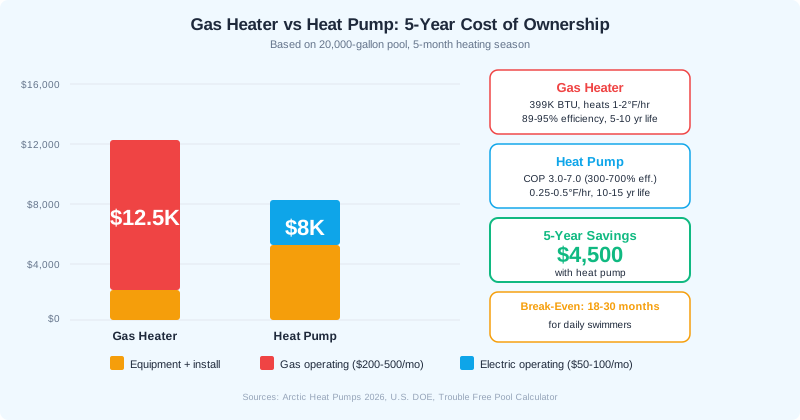
Operating cost is the deciding factor for most pool owners. The gap between gas and heat pump operating costs is substantial. According to Arctic Heat Pumps' 2026 analysis, heating a 20,000-gallon pool for a full season costs approximately $2,000 with gas and $600 with a heat pump. The monthly breakdown varies by climate and usage, but the directional math is consistent.
| Cost Category | Gas Heater | Heat Pump |
|---|---|---|
| Equipment cost | $1,500-$3,500 | $3,000-$6,000 |
| Installation cost | $500-$1,500 (gas line may be needed) | $300-$800 (electrical) |
| Monthly operating cost (heating season) | $200-$500 | $50-$100 |
| Cost per hour of operation | $3-$9 | $0.50-$1.50 |
| Annual maintenance cost | $100-$200 | $50-$100 |
| Expected lifespan | 5-10 years | 10-15 years |
| 5-year total cost (equipment + operation) | $6,500-$15,500 | $5,500-$10,000 |
| 10-year total cost | $11,500-$27,500 (may need replacement) | $8,000-$16,000 |
The break-even point where the heat pump's lower operating cost offsets its higher purchase price is typically 18-30 months for daily swimmers and 3-4 years for weekend-only users. After break-even, the heat pump saves $200-$400 per month compared to gas.
How Do Heating Speed and Performance Compare?
This is where gas heaters have a clear advantage. A 400,000 BTU gas heater raises a 20,000-gallon pool by 1-2 degrees per hour. A 140,000 BTU heat pump raises the same pool by 0.25-0.5 degrees per hour. For a pool that is 65 degrees and needs to reach 82 degrees, the gas heater gets there in 8-17 hours. The heat pump takes 34-68 hours.
| Performance Metric | Gas Heater (400K BTU) | Heat Pump (140K BTU) |
|---|---|---|
| Heating rate | 1-2°F per hour | 0.25-0.5°F per hour |
| Time to raise 20K gal by 17°F | 8-17 hours | 34-68 hours |
| Works in cold air? | Yes, any temperature | Effective above 50°F air temp |
| Heating on demand | Yes (turn on Friday, swim Saturday) | No (must run continuously) |
| BTU output | 200,000-400,000 | 50,000-140,000 |
| Efficiency in cold weather | Consistent regardless of air temp | COP drops as air temp drops below 60°F |
The Temperature Threshold Problem
Heat pumps extract heat from ambient air. When air temperature drops below 50 degrees F, the heat pump cannot extract enough heat to warm the pool efficiently. COP drops below 2.0, and in some cases the unit simply cannot maintain pool temperature. In northern climates with cool spring and fall nights, this means the heat pump extends the swim season less than a gas heater would. In warm-climate states like Florida, Arizona, and Texas, heat pumps work effectively 10-12 months per year.
Which Usage Patterns Favor Each Type?
The Trouble Free Pool community's 2026 cost calculator data shows a clear break point: if you heat your pool 15 or more days per month, the heat pump is the financial winner. Under 8 days per month, gas is typically better because you are paying for on-demand heating without the high upfront cost of a heat pump. Between 8 and 15 days, the answer depends on your local electricity and gas rates.
| Usage Pattern | Best Choice | Reasoning |
|---|---|---|
| Daily swimmer, warm climate (FL, AZ, TX) | Heat pump | Low monthly cost, runs efficiently year-round, 10-15 year lifespan |
| Weekend-only swimmer | Gas heater | On-demand heating, lower upfront cost, only pays fuel when used |
| Seasonal pool, cold climate (NE, Midwest) | Gas heater | Heat pump cannot maintain temp below 50°F air, gas works in any weather |
| Pool parties and events | Gas heater | Can raise temp 10-15°F in a few hours for events |
| Year-round swimmer, moderate climate | Heat pump | Lowest total cost over 10 years, consistent performance |
| Heated spa only (400-600 gal) | Gas heater | Small volume heats fast, on-demand matches spa usage patterns |
| Combination pool + spa | Both (dual system) | Heat pump maintains pool temp, gas for rapid spa heating |
"The most common mistake I see is a customer who swims every day buying a gas heater because the upfront price is lower. They get the first gas bill and call me in a panic. If I had the conversation upfront about usage patterns, I could have saved them the sticker shock and the equipment swap." - Corey Adams
What Are the Installation Considerations for Each Type?
Installation requirements differ significantly between gas and heat pump units. These differences affect both cost and feasibility depending on the existing equipment pad setup.
Gas Heater Installation
- Requires a natural gas or propane supply line to the equipment pad. If no gas line exists, running one costs $500-$2,000 depending on distance.
- Must be installed with proper clearance from combustible surfaces (per local code and manufacturer specs, typically 12-24 inches on sides, 36-48 inches above).
- Exhaust vents upward and must not be positioned under overhangs, awnings, or screen enclosures.
- Gas heaters are compact (approximately 24" x 24" x 28" for a standard 400K BTU unit).
- Electrical requirement is minimal: 120V for the control circuit.
Heat Pump Installation
- Requires a dedicated 240V electrical circuit (30-60 amp depending on unit size). Electrical panel upgrade may be needed in older homes.
- The unit is larger than a gas heater (approximately 42" x 42" x 36") and needs 24+ inches of clearance on all sides for airflow.
- The fan exhausts cool air. Do not position the exhaust toward the house, patio, or seating area.
- No gas line needed, which can save $500-$2,000 if no gas service exists at the property.
- Must be installed on a level concrete pad capable of supporting 300-400 lbs.
Can You Install Both a Gas Heater and Heat Pump?
Dual heating systems are increasingly common, especially in pool-and-spa combinations. The heat pump maintains the pool at comfortable temperature efficiently, while the gas heater provides rapid on-demand heating for the spa or for quick pool temperature boosts before events. Hybrid systems require a bypass valve setup so both units can operate independently without conflicting flow requirements.
The total installed cost for a dual system runs $6,000-$12,000, which is significantly more than either unit alone. However, for customers who swim daily but also want on-demand spa heating, the dual system provides the best of both worlds: low daily operating cost from the heat pump and rapid spa heating from the gas unit.
Some manufacturers now offer hybrid units (Hayward HeatPro with gas assist) that combine both technologies in one unit. These are priced at $5,000-$8,000 installed and simplify the plumbing compared to two separate units.
Ready to streamline your pool service business?
Pool Founder gives you route optimization, automated invoicing, chemical tracking, and everything else you need to run a more profitable pool business.
Frequently Asked Questions
Is a heat pump or gas heater cheaper to run?
Heat pumps are dramatically cheaper to run. Monthly operating costs are $50-$100 for a heat pump versus $200-$500 for a gas heater. The heat pump's COP of 3.0-7.0 means it delivers 3-7 times more heat energy than the electricity it consumes. Gas heaters operate at 89-95% efficiency, meaning nearly all fuel becomes heat, but the fuel itself is much more expensive per BTU.
How long does it take a heat pump to heat a pool?
A heat pump raises a 20,000-gallon pool by about 0.25-0.5 degrees per hour, so heating from 65°F to 82°F takes 34-68 hours. Heat pumps work best when run continuously to maintain temperature rather than heating on demand. Once the pool reaches the target temperature, the heat pump cycles on and off to maintain it at much lower cost.
Do heat pumps work in cold weather?
Heat pumps become less efficient as air temperature drops and are generally ineffective below 50°F air temperature. In warm-climate states (Florida, Arizona, Texas, Southern California), heat pumps work year-round. In northern states, they are useful for extending the swim season in spring and fall but cannot replace a gas heater for winter heating.
How long do pool heaters and heat pumps last?
Gas heaters typically last 5-10 years depending on water chemistry and maintenance. Heat pumps last 10-15 years because they have fewer combustion-related wear components. Scale buildup from hard water is the leading cause of premature failure for both types. Regular descaling extends lifespan significantly.
Can I switch from a gas heater to a heat pump?
Yes. The main requirements are a 240V electrical circuit (30-60 amp), adequate space on the equipment pad for the larger heat pump unit, and replumbing the heater connections. If the existing gas heater is at end of life, this is the ideal time to evaluate switching. Total cost for the heat pump plus installation runs $3,500-$7,000.
Sources & References
- U.S. Department of Energy — Heat Pump Swimming Pool Heaters
- Arctic Heat Pumps — Pool Heat Pump vs Gas Heater: Real Costs, Savings and ROI (2026)
- Trouble Free Pool — Gas and Heat Pump Cost Calculator (2026)
- Shasta Pool Supply — Heat Pump vs Gas Pool Heater: Which Saves More Money (2025)
- TURBRO — Pool Heat Pump vs Gas Heater vs Electric Resistance Heater
- Angi — How Much Does Pool Heater Repair Cost (2026)