An Undersized Filter Causes Every Other Problem on the Equipment Pad.
A filter that is too small for the pool creates a cascade of problems: high pressure, reduced flow, cloudy water, increased chemical consumption, and premature pump wear. A filter that is oversized costs more upfront but runs at lower pressure, filters more effectively, and requires less frequent cleaning. According to Leslie's Pool and INYOPools, the industry standard is to size the filter so it can handle the full output of the pump at its maximum speed while maintaining a turnover rate of 8 hours or less.
"I see undersized filters on probably 30% of the pools I take over from other companies," says Corey Adams, Pool Founder co-founder and 15-year pool service veteran. "The builder installed the cheapest filter that technically works, and the homeowner has been dealing with cloudy water and high pressure ever since. Upgrading the filter is one of the highest-impact equipment changes you can make for water quality."
How Do You Calculate the Right Filter Size?
Filter sizing starts with two numbers: your pool volume in gallons and your target turnover rate. The industry standard turnover rate is 8 hours for residential pools, meaning all the water in the pool passes through the filter once every 8 hours. This gives you the required flow rate in gallons per minute (GPM), which you then match to a filter rated for that GPM or higher.
The Filter Sizing Formula
Required GPM = Pool Volume (gallons) / (Turnover Time in hours x 60). For a 20,000-gallon pool with an 8-hour turnover: 20,000 / (8 x 60) = 41.7 GPM minimum. The filter must be rated for at least 42 GPM. In practice, you should oversize by 25-50% to account for dirty filter conditions, which means targeting a filter rated for 52-63 GPM in this example.
| Pool Volume (gal) | 8-Hour Turnover GPM | Recommended Filter Size (oversized 25%) |
|---|---|---|
| 10,000 | 21 GPM | 26+ GPM rated filter |
| 15,000 | 31 GPM | 39+ GPM rated filter |
| 20,000 | 42 GPM | 52+ GPM rated filter |
| 25,000 | 52 GPM | 65+ GPM rated filter |
| 30,000 | 63 GPM | 78+ GPM rated filter |
| 40,000 | 83 GPM | 104+ GPM rated filter |
Always oversize the filter, never the pump. An oversized pump paired with an undersized filter creates high pressure, cavitation risk, and wasted energy. The filter should be the largest component in the system.
What Are the Differences Between Sand, Cartridge, and DE Filters?
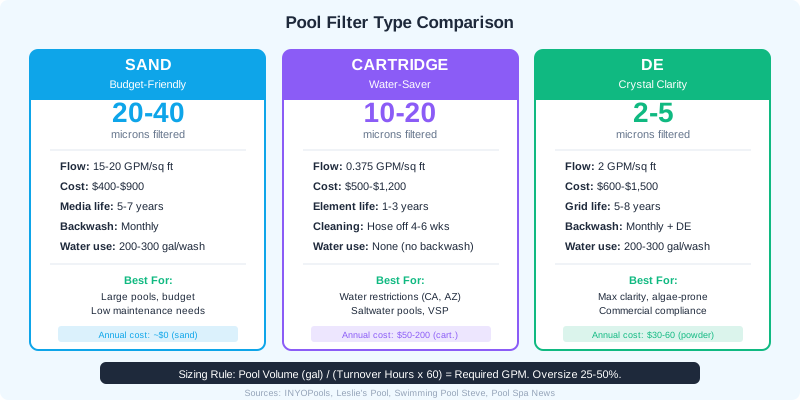
The three filter types differ in filtration fineness (micron rating), maintenance requirements, water usage, and cost. Each has specific advantages that make it the right choice in different situations. Understanding these differences helps you recommend the correct filter type for each customer's pool, budget, and maintenance expectations.
Sand Filters (20-40 Microns)
Sand filters use #20 silica sand as the filter media. Water passes through the sand bed, which traps particles 20-40 microns and larger. They are the lowest-maintenance option: backwash when pressure rises 8-10 PSI above clean pressure, and replace the sand every 5-7 years. The trade-off is lower filtration fineness. Sand filters will not produce the crystal-clear water that DE filters achieve, and they struggle to clear algae blooms quickly. Flow rate: 15-20 GPM per square foot of filter area.
Cartridge Filters (10-20 Microns)
Cartridge filters use pleated polyester cartridge elements that trap particles 10-20 microns and larger. They do not require backwashing, which saves hundreds of gallons of water per month compared to sand and DE. Maintenance involves removing the cartridge and hosing it off every 4-6 weeks, with a deep chemical soak twice per year. Cartridges last 1-3 years before replacement ($50-$200 per cartridge). The rule of thumb for sizing: 100 sq ft of cartridge surface area per 10,000 gallons of pool water.
DE Filters (2-5 Microns)
Diatomaceous earth (DE) filters provide the finest filtration at 2-5 microns, producing the clearest water of any filter type. They use a powder made from fossilized diatoms that coats internal grids. DE filters are the best choice for resolving algae blooms quickly (1-2 days versus a week or more for sand) and for pools where water clarity is the top priority. The trade-off is higher maintenance: backwashing, adding DE powder after each backwash, and periodic grid disassembly for deep cleaning. Flow rate: 2 GPM per square foot of filter area.
| Specification | Sand | Cartridge | DE |
|---|---|---|---|
| Filtration rating | 20-40 microns | 10-20 microns | 2-5 microns |
| Water clarity | Good | Very good | Excellent |
| Maintenance frequency | Backwash monthly | Clean every 4-6 weeks | Backwash + add DE monthly |
| Water waste (backwash) | 200-300 gal/backwash | None | 200-300 gal/backwash |
| Media replacement | Sand every 5-7 years ($100-200) | Cartridge every 1-3 years ($50-200) | Grids every 5-8 years ($150-300) |
| Filter cost (installed) | $400-$900 | $500-$1,200 | $600-$1,500 |
| Annual consumable cost | $0 | $50-200 for cartridges | $30-60 for DE powder |
| Best for | Budget pools, low maintenance | Water-restricted areas, ease of use | Maximum clarity, algae-prone pools |
How Do You Size a Sand Filter for a Specific Pool?
Sand filters are sized by the square footage of the filter tank's cross-sectional area. The maximum design flow rate for high-rate sand filters is 25 GPM per square foot, but optimal performance is at 15-20 GPM per square foot. Operating at the maximum rate reduces filtration quality because water passes through the sand bed too quickly for smaller particles to be trapped.
| Tank Diameter | Filter Area (sq ft) | Max GPM (at 20 GPM/sq ft) | Best For Pool Size |
|---|---|---|---|
| 16" | 1.4 sq ft | 28 GPM | Up to 13,000 gallons |
| 19" | 2.0 sq ft | 40 GPM | Up to 19,000 gallons |
| 22" | 2.6 sq ft | 53 GPM | Up to 25,000 gallons |
| 24" | 3.1 sq ft | 63 GPM | Up to 30,000 gallons |
| 26" | 3.7 sq ft | 73 GPM | Up to 35,000 gallons |
| 30" | 4.9 sq ft | 98 GPM | Up to 47,000 gallons |
Alternative sand media (zeolite, glass beads, FilterBalls) can improve sand filter performance to 10-15 microns while maintaining the same flow rates. This is an upgrade option for customers who want better clarity without changing filter types.
How Do You Size a Cartridge Filter?
Cartridge filters are sized by total cartridge surface area in square feet. The standard recommendation is 100 square feet of cartridge area per 10,000 gallons of pool water, with a maximum flow rate of 0.375 GPM per square foot of cartridge area. Oversizing a cartridge filter extends cleaning intervals and improves water clarity by running at a lower flow rate per square foot.
| Cartridge Size (sq ft) | Max GPM | Best For Pool Size | Cleaning Interval (typical) |
|---|---|---|---|
| 100 sq ft | 38 GPM | Up to 10,000 gallons | Every 2-4 weeks |
| 150 sq ft | 56 GPM | Up to 15,000 gallons | Every 3-5 weeks |
| 200 sq ft | 75 GPM | Up to 20,000 gallons | Every 4-6 weeks |
| 300 sq ft | 113 GPM | Up to 30,000 gallons | Every 6-8 weeks |
| 425 sq ft | 159 GPM | Up to 42,000 gallons | Every 8-12 weeks |
| 525 sq ft | 197 GPM | Up to 50,000+ gallons | Every 10-14 weeks |
Cartridge filters are the best choice in areas with water restrictions or drought surcharges because they do not require backwashing. In California, Arizona, and parts of Texas, water agencies actively recommend cartridge filters to reduce pool water waste.
How Do You Size a DE Filter?
DE filters are sized by grid surface area in square feet. The maximum design flow rate is 2.5 GPM per square foot, but optimal performance is at 2 GPM per square foot. DE filters are the most oversized option for their physical footprint because the grids provide enormous surface area relative to tank size.
| Filter Size (sq ft) | Max GPM (at 2 GPM/sq ft) | Best For Pool Size | DE Powder Per Charge |
|---|---|---|---|
| 24 sq ft | 48 GPM | Up to 23,000 gallons | 3 lbs |
| 36 sq ft | 72 GPM | Up to 34,000 gallons | 4.5 lbs |
| 48 sq ft | 96 GPM | Up to 46,000 gallons | 6 lbs |
| 60 sq ft | 120 GPM | Up to 57,000 gallons | 7.5 lbs |
| 72 sq ft | 144 GPM | Up to 69,000 gallons | 9 lbs |
After backwashing a DE filter, always add fresh DE powder through the skimmer with the pump running. The standard ratio is 1 pound of DE per 10 square feet of filter area. Under-charging leaves the grids exposed and reduces filtration. Over-charging bridges the grids and increases pressure.
Which Filter Type Should You Recommend for Each Situation?
Choosing the right filter type depends on the customer's priorities: budget, water clarity, maintenance tolerance, and local water restrictions. There is no single best filter type. Each excels in different conditions.
| Situation | Recommended Filter | Why |
|---|---|---|
| Budget-conscious customer | Sand | Lowest upfront cost, minimal consumable expense, longest media life |
| Water-restricted area (CA, AZ) | Cartridge | No backwashing saves 200-300 gallons per cleaning cycle |
| Premium pool, maximum clarity | DE | Best filtration at 2-5 microns, visibly clearer water |
| Frequent algae problems | DE | Clears algae blooms in 1-2 days vs a week for sand |
| Customer wants minimal maintenance | Sand or large cartridge | Sand: backwash and forget. Oversized cartridge: clean every 8-12 weeks |
| Pool/spa combo system | Cartridge (300+ sq ft) | Handles high flow from spa mode without backwash valve complications |
| Commercial pool | Sand (with glass media) or DE | Sand for ease of operation, DE for health department clarity standards |
Run a pool route?
The business side of what you just read.
Pricing, chemical costs, and the tools owners use to keep the numbers straight.
- Commercial pool service pricing2026 rate tables and the cost-plus formula
- Chemical cost per poolWhat chemicals actually cost per stop
- Chemical tracking softwareLog readings and dosing from the pool deck
- Pool service softwareRoutes, invoicing, and service reports in one app
- Free profit & rate calculatorsProfit per pool, minimum rate, break-even
Frequently Asked Questions
Can a pool filter be too big?
A filter cannot be too big for a pool. Oversized filters run at lower pressure, provide better filtration, require less frequent cleaning, and last longer. The only downside is higher upfront cost and a larger physical footprint on the equipment pad. Always oversize the filter if space and budget allow.
How do I know if my pool filter is too small?
Signs of an undersized filter include consistently high pressure (above 25 PSI), frequent need to backwash or clean (more than once per week), persistent cloudy water despite proper chemistry, and the pump cavitating or losing prime at high speed. Calculate your required GPM based on pool volume and 8-hour turnover, then compare to your filter rating.
How often should I replace pool filter media?
Sand: every 5-7 years (or when the filter can no longer achieve clean pressures after backwashing). Cartridge: every 1-3 years depending on use and water conditions. DE grids: every 5-8 years. Replace earlier if you notice declining water clarity despite proper chemical balance and cleaning.
What is the best filter for a saltwater pool?
Cartridge filters are the most popular choice for saltwater pools because they do not require backwashing (saving water) and work well with variable-speed pumps at low RPMs. However, any filter type works with salt chlorination. The salt system does not affect filter selection.
Should I match my filter size to my pump size?
The filter should always be rated for equal to or greater than the pump's maximum flow rate in GPM. An undersized filter paired with a large pump creates dangerously high pressure. Check the pump's performance curve at maximum RPM and ensure the filter can handle that flow rate comfortably.
Can I switch from one filter type to another?
Yes. Switching filter types requires a new filter unit and potentially replumbing the connections, but it is a straightforward equipment change. The most common upgrades are sand to cartridge (for water conservation) and sand to DE (for improved clarity). Budget $500-$1,500 for the swap depending on filter type and installation complexity.
Sources & References
- INYOPools — How to Size a Pool Filter
- Leslie's Pool — Pool Filter Sizing: How to Choose the Right Size
- Swimming Pool Steve — Filter Sizing for Swimming Pools
- Pool Spa News — Filter Sizing for Swimming Pools: Ultimate Tech Manual
- All Filters — Pool Filter Types Compared: Sand vs DE vs Cartridge
- Medallion Energy — Pool Filter Comparison: Sand, Cartridge, DE Filters