What Licenses Do You Need to Run a Pool Business in Florida?
Florida has one of the most structured pool contractor licensing systems in the country. The Construction Industry Licensing Board (CILB), operating under the Department of Business and Professional Regulation (DBPR), issues multiple tiers of pool licenses depending on the scope of work you plan to perform. Cleaning pools does not require a state license. But the moment you touch a pump, rewire a light, or replace a heater, you need a swimming pool contractor license or you are breaking the law.
This guide covers every license tier available to pool professionals in Florida, who needs which license, what the exams look like, how much it costs, and the step-by-step process to get licensed. We also cover CPO certification requirements for commercial operators and the county-level registrations that catch many new business owners off guard.
Florida does not require a state license for basic pool cleaning and chemical maintenance on residential pools. However, many counties require local business registration, and any equipment repair or replacement triggers the need for a DBPR-issued contractor license.
What Are the Florida Pool License Tiers?
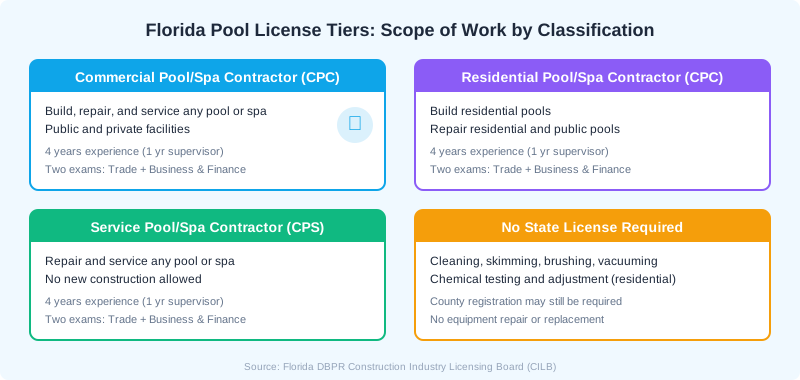
Florida offers four primary swimming pool contractor license classifications. Each tier has a different scope of work, and working outside your license classification is a violation that can result in fines, license suspension, or criminal charges. Understanding which tier you need before you apply saves you time and money on exams you may not need.
| License Classification | Scope of Work | Experience Required |
|---|---|---|
| Commercial Pool/Spa Contractor (CPC) | Build, repair, and service any pool or spa, public or private | 4 years (1 year as supervisor) |
| Residential Pool/Spa Contractor (CPC) | Build residential pools; repair both residential and public pools | 4 years (1 year as supervisor) |
| Swimming Pool/Spa Service Contractor (CPS) | Repair and service any pool or spa, no construction | 4 years (1 year as supervisor) |
| Swimming Pool/Spa Specialty Contractor | Limited specialty scope as defined by CILB | Varies by specialty |
What Work Can You Do Without a License?
Basic pool cleaning, skimming, brushing, vacuuming, and chemical testing and adjustment on residential pools does not require a state contractor license in Florida. Pool service technicians who only perform these maintenance tasks are not considered contractors under Florida law. However, the line is clear: if you replace a pool pump, install a new filter, repair plumbing, or do any electrical work, you must hold a valid DBPR swimming pool contractor license.
The most common violation DBPR investigates is unlicensed pool service companies performing equipment repairs. Replacing a pump motor, installing a salt chlorine generator, or running new plumbing all require a contractor license. Getting caught without one can result in fines up to $5,000 per incident and a misdemeanor charge.
How Do You Get a Florida Pool Contractor License?
Getting licensed in Florida is a multi-step process that typically takes 2 to 4 months from start to finish. You need to document your experience, pass two exams, submit a DBPR application, and provide proof of insurance and a financial responsibility bond. Skipping or rushing any step leads to delays.
- 1Verify your experience: You need 4 years of verifiable experience in the scope of work matching your license classification. At least 1 of those 4 years must be in a supervisory or foreman role. College credits or military experience can offset up to 3 years of the experience requirement.
- 2Register with the testing vendor: Register with Professional Testing Inc. (Florida's authorized exam provider) at a cost of approximately $135. This gives you access to schedule your exams.
- 3Pass the Trade Knowledge Exam: This is a closed-book, computer-based exam covering pool construction, repair, equipment, plumbing, electrical systems, and safety standards specific to your license classification.
- 4Pass the Business and Finance Exam: A separate closed-book exam covering Florida construction law, business management, contracts, liens, and financial practices. The administration fee is $80 paid to Pearson VUE.
- 5Submit your DBPR application: File your application with the DBPR along with the $249 application fee, proof of passing both exams, experience documentation, proof of general liability insurance, and a financial responsibility bond.
- 6Receive your license: Once DBPR approves your application (typically 4 to 6 weeks after submission), you receive your license number and can legally operate.
What Do the Exams Cover?
Both exams are closed-book and computer-based, administered at Pearson VUE testing centers throughout Florida. The Trade Knowledge exam tests your understanding of pool construction methods, equipment installation, plumbing codes, electrical codes, water chemistry, and safety regulations. The Business and Finance exam covers Florida Statute 489 (the Construction Industry Licensing Act), lien law, contract law, OSHA requirements, insurance requirements, and financial management. Most candidates find the Business and Finance exam more challenging because it tests legal concepts rather than hands-on knowledge.
| Exam Component | Details |
|---|---|
| Trade Knowledge Exam | Closed-book, computer-based, pool-specific technical content |
| Business and Finance Exam | Closed-book, computer-based, FL law and business practices |
| Testing vendor registration | $135 (Professional Testing Inc.) |
| Business exam fee | $80 (Pearson VUE) |
| Trade exam fee | Approximately $295 |
| Passing score | 70% or higher on both exams |
| Retake policy | Can retake after 30-day waiting period |
How Much Does a Florida Pool Contractor License Cost?
The total cost to get licensed runs between $1,500 and $3,000 when you factor in exam fees, application fees, insurance, and bonding. Here is a realistic breakdown of what you will spend. Many applicants underestimate the total because they only look at the DBPR application fee.
| Cost Component | Amount | Notes |
|---|---|---|
| DBPR application fee | $249 | Non-refundable |
| Testing vendor registration | $135 | Professional Testing Inc. |
| Trade Knowledge Exam | ~$295 | First attempt |
| Business and Finance Exam | $80 | Pearson VUE |
| Exam prep course (optional) | $300-$600 | Highly recommended |
| General liability insurance | $800-$2,500/year | Required minimum varies |
| Surety bond | $100-$500/year | Based on bond amount and credit |
| License renewal (biennial) | $209 | Every 2 years |
If you fail either exam, you must wait 30 days and pay the exam fee again. Investing in a quality exam prep course saves money in the long run. Providers like Gold Coast Schools, CamTech, and 1 Exam Prep offer Florida-specific pool contractor exam prep ranging from $300 to $600.
Do You Need CPO Certification in Florida?
Yes, if you service commercial pools. The Florida Department of Health requires every commercial, public, and semi-public pool to have a Certified Pool/Spa Operator (CPO) or equivalent on record. This is separate from your contractor license. A contractor license authorizes you to perform construction and repair work. CPO certification proves you can safely operate and maintain the water chemistry and safety systems at a commercial facility.
Florida has some of the strictest commercial pool regulations in the country. Health department inspectors routinely verify CPO certification during facility inspections, and operating a commercial pool without a certified operator can result in fines, failed inspections, or facility closure orders. If your pool service business handles any commercial accounts (hotels, HOAs, apartment complexes, fitness centers), you or someone on your team needs CPO certification.
27 States
Number of states that require CPO certification for commercial pool operators. Florida is among the strictest, requiring certification for every commercial facility.
Source: Pool & Hot Tub Alliance (PHTA)
CPO vs. Contractor License: What Is the Difference?
A pool contractor license (issued by DBPR/CILB) authorizes construction, repair, and equipment work on pools. CPO certification (issued by PHTA) proves competency in water chemistry, filtration operation, and regulatory compliance for operating commercial aquatic facilities. Many pool service professionals need both: the contractor license to perform equipment repairs and the CPO to manage commercial water quality. If you only clean residential pools and never touch equipment, you technically need neither at the state level, though county registration may still apply.
What About County and Local Requirements?
Florida pool licensing does not stop at the state level. Many counties require pool service businesses to register locally, even if no state license is needed for their scope of work. Miami-Dade County, for example, requires all pool service companies to obtain a Certificate of Competency from the county before operating. Broward, Palm Beach, Hillsborough, and Orange counties have similar local registration requirements.
- Miami-Dade County: Requires a County Certificate of Competency for pool service and repair work. Separate from the state license.
- Broward County: Requires local business tax receipt and may require additional certifications for commercial work.
- Palm Beach County: Requires business registration with the county and proof of insurance on file.
- Hillsborough County: Requires occupational license and county registration for pool service operators.
- Orange County: Requires a local business license and compliance with county health department regulations for commercial pools.
Always check with your county building department and health department before starting operations. Operating without proper county registration can result in local fines even if you hold a valid state license.
Common Mistakes When Applying for a Florida Pool License
After 15 years in the pool industry, Corey Adams has seen the same licensing mistakes trip up new business owners repeatedly. Here are the most common pitfalls and how to avoid them.
- Underestimating the Business and Finance exam: Most applicants focus on the trade exam because they know the technical material. The Business and Finance exam covers Florida construction law, lien statutes, and contract requirements that many experienced technicians have never studied. Budget at least 40 hours of study time for this exam.
- Incomplete experience documentation: DBPR requires detailed verification of your 4 years of experience, including employer names, dates, scope of work performed, and supervisor contact information. Vague descriptions or gaps in your timeline will delay your application.
- Forgetting county registration: Your state license does not replace county-level requirements. Contractors who skip local registration get caught during inspections or when pulling permits.
- Letting insurance lapse: DBPR requires continuous proof of general liability insurance. If your policy lapses, your license goes inactive, and reactivating requires additional fees and paperwork.
- Working outside your license scope: A Service Contractor license does not authorize new construction. A Residential license does not authorize commercial pool construction. Scope violations are the most common enforcement action DBPR takes against pool contractors.
Free starter kit
Start a pool service business with the numbers already run.
A short email series from an owner who started with $1,200 and a used truck. No software pitch, just the four things that decide whether year one works.
- Startup cost breakdownEvery line item from $2K bootstrap to fully equipped
- Pricing calculatorThe minimum you can charge per visit and still profit
- First-10-customers playbookDoor hangers, referrals, and the phone script that closes
- Licensing & insurance checklistWhat your state requires and which insurers pay claims
Already running routes? Try Pool Founder free
Frequently Asked Questions
Do I need a license to clean pools in Florida?
No. Basic pool cleaning, skimming, brushing, vacuuming, and chemical testing and adjustment on residential pools does not require a state contractor license in Florida. However, many counties require local business registration. The moment you perform any equipment repair, replacement, plumbing, or electrical work, you need a DBPR swimming pool contractor license.
How long does it take to get a pool contractor license in Florida?
The entire process typically takes 2 to 4 months. You need to register with the testing vendor, study for and pass two exams (which can be scheduled about 2 to 4 weeks apart), submit your DBPR application with all supporting documents, and wait 4 to 6 weeks for DBPR to process your application. Delays usually come from incomplete experience documentation.
How much does a Florida pool contractor license cost?
Total costs range from $1,500 to $3,000. This includes the DBPR application fee ($249), testing vendor registration ($135), trade exam (~$295), business exam ($80), exam prep courses ($300-$600), general liability insurance ($800-$2,500/year), and a surety bond ($100-$500/year). License renewal is $209 every two years.
What is the difference between a CPC and CPS license in Florida?
CPC (Certified Pool Contractor) licenses authorize both construction and repair of swimming pools. CPS (Certified Pool/Spa Servicing) licenses authorize repair and service work only, not new construction. Both require 4 years of experience and passing two exams. Choose CPC if you plan to build pools, CPS if you only plan to service and repair them.
Can I use college credits instead of work experience?
Partially. College credits or military experience can offset up to 3 of the 4 required years of experience. You still need at least 1 year of actual hands-on experience in the scope of work for your license classification, including time as a supervisor or foreman.
Is CPO certification required in Florida?
CPO certification is required for anyone operating or maintaining a commercial, public, or semi-public pool in Florida. It is not required for residential pool service. The Florida Department of Health mandates that every commercial aquatic facility have a CPO-certified operator on record. Operating without one can result in fines and facility closure.
Sources & References
- Florida Swimming Pool Association (FSPA) — Licensing
- Florida DBPR — Construction Industry Licensing Board
- CamTech School — Florida Pool Contractor License Details
- Gold Coast Schools — How to Become a Florida Pool Builder
- Pool Business Brokers — Florida Business Licensing and Regulations
- 1 Exam Prep — Florida Swimming Pool Specialty Licenses