Do You Need a Contractor License to Service Pools in Arizona?
Arizona draws a hard line between pool service and pool construction. If you only clean pools and balance chemicals, you do not need a contractor license from the Registrar of Contractors (ROC). But the moment you install a pump, replumb a return line, or repair a heater, you are performing contracting work and the ROC requires a license. Operating without one exposes you to fines up to $1,000 per offense, potential criminal misdemeanor charges, and zero legal standing to collect payment on unlicensed work.
Corey Adams, Pool Founder co-founder and 15-year pool service veteran, sees this confusion constantly. "Every year I talk to pool guys who have been swapping out pumps and motors for years without a license. They do not realize that the ROC can fine them, make them tear out the work, and the homeowner can file a complaint that goes on public record. Getting licensed is not optional if you touch equipment."
4 Years
Minimum verifiable experience required for an Arizona pool contractor license
Source: Arizona Registrar of Contractors
Service Work vs. Contractor Work: Where Arizona Draws the Line
Arizona does not require a license for routine pool maintenance. Cleaning, vacuuming, chemical testing, chemical application, filter cleaning, and backwashing are all service tasks that fall outside ROC jurisdiction. The distinction shifts when you modify, install, or repair pool infrastructure or equipment. Replacing a pool pump, installing a salt chlorine generator, replumbing filtration lines, repairing a gas heater, or installing pool fencing all require an active ROC license.
| Task | License Required? | Classification |
|---|---|---|
| Weekly cleaning and chemical balancing | No | Service work |
| Filter cartridge replacement | No | Service work |
| Pump motor replacement (same specs) | Yes | A-9 or B-5 |
| Heater repair or replacement | Yes | A-9 or B-5 |
| Replumbing return lines or skimmers | Yes | A-9 or B-5 |
| Salt system installation | Yes | A-9 or B-5 |
| Pool resurfacing or tile work | Yes | A-9 or B-5 |
| New pool construction | Yes | A-9 (commercial) or B-5 (residential) |
| Safety fence installation | Yes | A-9 or B-5 |
A common gray area: replacing a pump motor versus replacing the entire pump assembly. Swapping an identical motor within the same housing is generally considered maintenance. Installing a new pump with different specs or replumbing connections crosses into contractor territory. When in doubt, get licensed.
Arizona Pool Contractor License Classifications
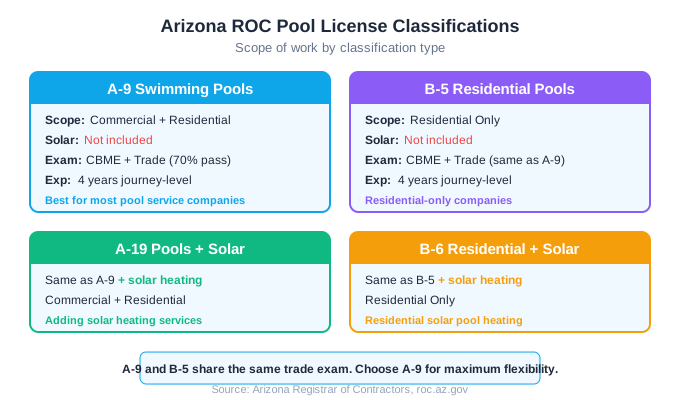
The Arizona ROC offers four license classifications that cover pool work. The two most relevant for pool service companies expanding into equipment repair and installation are A-9 (commercial swimming pools) and B-5 (residential swimming pools). Each classification defines a specific scope of work, and operating outside your classification is treated the same as operating without a license.
| Classification | Scope | Includes Solar? | Primary Use Case |
|---|---|---|---|
| A-9 | Commercial and residential pool construction, service, and repair | No | Pool companies doing commercial and residential equipment work |
| A-19 | Same as A-9 plus solar heating installation and repair | Yes | Companies adding solar pool heating to their services |
| B-5 | Residential pool construction, service, and repair only | No | Service companies doing residential equipment work only |
| B-6 | Same as B-5 plus solar heating installation and repair | Yes | Residential companies adding solar heating |
The A-9 classification allows work on both commercial and residential pools. The B-5 classification is limited to residential. If you service any commercial accounts (HOAs, hotels, apartment complexes), you need the A-9. The trade exam for A-9 and B-5 is the same, so there is no extra testing burden to go with A-9. Most pool service companies choose A-9 for the broader scope.
What A-9 and B-5 Cover
Both classifications allow construction, service, and repair of swimming pools and spas. This includes water and gas service lines from the point of service to pool equipment, wiring from pool equipment to the first readily accessible disconnect, pool piping, fittings, backflow prevention devices, waste lines, and installation of pool accessories, covers, safety devices, and fencing for protective purposes.
Application Requirements and Process
Getting an Arizona pool contractor license involves five steps: verifying your experience, passing two exams, securing a surety bond, submitting your application, and completing a background check. The entire process typically takes 4 to 8 weeks from start to finish.
Experience Requirements
The ROC requires four years of verifiable journey-level experience in the specific trade, or two years as a foreman or supervisor. Experience must be documented with employer verification, project descriptions, and timeframes. Self-employment experience counts if you can provide project records, customer references, and evidence of the work performed.
The Two Required Exams
Arizona requires passing two exams: the Contractor Business Management Exam (CBME) and the trade-specific exam. You need a 70% or higher on both. The exams are semi-open book, meaning you can bring approved reference materials with highlighted sections and permanent tabs. No loose papers, sticky notes, or electronic devices are allowed.
| Exam | Topics Covered | Format | Passing Score |
|---|---|---|---|
| CBME (Business) | Arizona contractor law, lien law, contract law, business management, financial management, safety | Semi-open book, multiple choice | 70% |
| Trade Exam (A-9/B-5) | Pool construction, plumbing, equipment installation, electrical, water chemistry, safety codes | Semi-open book, multiple choice | 70% |
The CBME and A-9/B-5 trade exams are equivalent. Once you pass the trade exam, you can apply for either classification without retesting. If you plan to do any commercial work, apply for A-9 from the start.
Surety Bond
Arizona requires a surety bond based on your anticipated annual gross volume of work. The minimum bond for most new contractors is $2,500. Bond amounts scale up with volume, reaching $100,000 for contractors doing over $750,000 annually. You pay a premium to a bonding company, typically 1-5% of the bond amount. A new contractor with a $2,500 bond might pay $100-$250 per year in premiums.
Background Check
Every person named on the license application must complete a fingerprint-based background check. Background checks expire 90 days from the completion date, so time this step carefully relative to your application submission. Felony convictions do not automatically disqualify you, but the ROC reviews each case individually.
License Fees and Ongoing Costs
The total upfront cost to get an Arizona pool contractor license ranges from $800 to $1,500 depending on your bond premium and exam prep choices. Annual renewals are significantly cheaper.
| Fee | Cost | Frequency |
|---|---|---|
| Application fee | $350-$500 | One-time |
| CBME exam fee | $75-$150 | One-time (per attempt) |
| Trade exam fee | $75-$150 | One-time (per attempt) |
| Surety bond premium | $100-$250 (on $2,500 bond) | Annual |
| Background check | $50-$75 per person | One-time |
| License renewal | $200-$350 | Every 2 years |
| Recovery fund fee | $100-$200 | One-time |
Your license must be renewed every two years. Failure to renew results in an expired license, and performing contracting work on an expired license carries the same penalties as unlicensed contracting. Set a calendar reminder 90 days before expiration.
Common Mistakes That Delay or Deny Applications
The ROC rejects or delays a significant number of applications due to preventable errors. Knowing these pitfalls saves you weeks of back-and-forth with the ROC and keeps your revenue timeline on track.
- Insufficient experience documentation: The ROC now requires detailed project descriptions, employer verification, and specific timeframes. Vague references like "worked in pool industry for 5 years" will be returned for more detail. Prepare employer contact information and project records before you apply.
- Expired background checks: Background checks expire 90 days from completion. If your application sits in the queue too long, you may need to redo them at additional cost. Submit your application promptly after completing your background check.
- Business entity not in good standing: If you are applying as an LLC or corporation, your entity must be registered with the Arizona Corporation Commission and in good standing. Verify this before submitting your ROC application.
- Wrong classification: Applying for B-5 when you need A-9 means you cannot legally work on commercial pools. Since the trade exam is identical, there is no reason to limit yourself to residential only unless you are certain you will never service a commercial account.
- Bond amount mismatch: Your bond must match your projected annual volume. Underestimating volume to get a cheaper bond can result in penalties if the ROC audits your actual revenue.
Penalties for Unlicensed Pool Contracting in Arizona
Arizona takes unlicensed contracting seriously. The penalties go beyond fines and can fundamentally damage your business and reputation.
- Financial penalties: Fines up to $1,000 per offense for performing contracting work without a license. Each project can be treated as a separate offense.
- Criminal charges: Unlicensed contracting in Arizona is a Class 1 misdemeanor, punishable by up to six months in jail and $2,500 in criminal fines.
- No legal right to collect payment: Arizona courts have ruled that unlicensed contractors cannot enforce contracts or file mechanics liens. If a customer refuses to pay for unlicensed work, you have no legal recourse.
- Public complaint record: Homeowners can file complaints with the ROC, which creates a public record searchable on the ROC website. This record follows you even after you become licensed.
- Insurance complications: General liability policies may deny claims for work you were not licensed to perform. A $20,000 equipment claim denied because you lacked a license is a devastating financial hit.
The ROC actively investigates unlicensed contracting complaints. Homeowners, competitors, and even subcontractors can file complaints. The ROC website allows anyone to verify whether a contractor is licensed, and savvy commercial clients always check before signing a contract.
Free starter kit
Start a pool service business with the numbers already run.
A short email series from an owner who started with $1,200 and a used truck. No software pitch, just the four things that decide whether year one works.
- Startup cost breakdownEvery line item from $2K bootstrap to fully equipped
- Pricing calculatorThe minimum you can charge per visit and still profit
- First-10-customers playbookDoor hangers, referrals, and the phone script that closes
- Licensing & insurance checklistWhat your state requires and which insurers pay claims
Already running routes? Try Pool Founder free
Frequently Asked Questions
Do I need an Arizona contractor license to clean pools and balance chemicals?
No. Routine pool maintenance including cleaning, vacuuming, chemical testing, chemical application, filter cartridge replacement, and backwashing does not require an ROC license. The license requirement kicks in when you install, repair, or modify pool equipment or infrastructure.
What is the difference between an A-9 and B-5 license in Arizona?
The A-9 classification covers commercial and residential pool construction, service, and repair. The B-5 classification is limited to residential pools only. The trade exam is the same for both, so most pool companies apply for A-9 to avoid limiting their scope of work.
How long does it take to get an Arizona pool contractor license?
The typical timeline is 4 to 8 weeks from application submission to license issuance, assuming your documentation is complete and you have already passed both exams. Experience verification and background checks are the most common causes of delays.
How much does an Arizona pool contractor license cost?
Total upfront costs range from $800 to $1,500, including the application fee ($350-$500), exam fees ($75-$150 each), surety bond premium ($100-$250 annually), and background check ($50-$75 per person). Biennial renewal costs $200-$350.
Can I use my pool service experience to qualify for the 4-year experience requirement?
Only if that experience includes verifiable work in construction, repair, or installation of pool equipment and infrastructure. Routine cleaning and chemical service alone does not qualify. You need documented experience with plumbing, equipment installation, or pool construction to meet the ROC requirements.
What happens if I get caught doing contracting work without a license in Arizona?
Penalties include fines up to $1,000 per offense, Class 1 misdemeanor criminal charges (up to six months in jail), loss of the legal right to collect payment for unlicensed work, and a public complaint record on the ROC website. Your insurance may also deny claims for work performed without proper licensure.