Is Your Pool Company Ready for Commercial Accounts?
Expanding into commercial pool service is the single biggest revenue upgrade most residential pool companies can make. A single commercial aquatic facility can generate the same monthly revenue as 10 to 15 residential customers, with stronger retention rates and more predictable cash flow. Commercial pool contracts run $250 to $2,000+ per month with annual values of $3,000 to $24,000+. After one year with just three to five commercial accounts, most companies see a 20% to 40% increase in total revenue with minimal additional overhead.
But commercial pool service is not residential service with bigger pools. The chemistry fundamentals are the same, but the service frequency, regulatory oversight, insurance requirements, equipment complexity, and client expectations are fundamentally different. Companies that jump into commercial work without preparation get burned by underpriced contracts, compliance violations, and equipment they do not know how to service. This guide gives you a readiness checklist, a strategy for landing your first account without commercial experience, and a realistic financial picture of what commercial expansion looks like after year one.
This guide is for pool service company owners currently doing residential work who want to add commercial accounts. If you are starting a pool service business from scratch, see our guide on starting a pool service business.
What Do You Need Before Pursuing Commercial Accounts?
Before you submit your first commercial bid, you need to close the gaps between residential and commercial operations. Your residential experience has built foundational knowledge in water chemistry, filtration, and customer service. These skills transfer directly. But commercial work adds layers of compliance, equipment, and liability that require specific preparation.
Commercial Readiness Checklist
| Requirement | What You Need | Why It Matters |
|---|---|---|
| CPO certification | At least one CPO or AFO certified person on staff | 43+ states require it for commercial pool operations |
| Insurance upgrade | $1M-$2M general liability (up from typical residential $500K) | Minimum threshold for most property managers |
| Workers compensation | Active workers comp policy if you have employees | Required by every commercial property manager |
| Commercial auto | Policy covering all service vehicles | Standard requirement in commercial contracts |
| Equipment knowledge | Familiarity with commercial pumps (5-15 HP), large sand filters, ORP/pH controllers | Commercial equipment is different from residential |
| Record-keeping system | Digital system for compliance logs, chemistry records, service reports | Health departments require 1-3 years of records |
| Emergency response capacity | Ability to respond within 2-4 hours during business hours | Most contracts specify response time requirements |
| Financial reserves | $5,000-$10,000 for initial chemical inventory and potential equipment | Commercial accounts require upfront chemical investment |
CPO Certification
The Certified Pool Operator (CPO) certification is the non-negotiable first step. At least 43 states require it for anyone responsible for commercial pool operations. The certification is administered by the Pool and Hot Tub Alliance (PHTA) and requires passing a two-day course covering water chemistry, filtration, safety regulations, and facility management. The exam pass rate is approximately 75%, and the certification is valid for five years. Cost is typically $300 to $500 for the course and exam. Even in states without a legal requirement, the CPO credential is expected by every property manager and dramatically improves your proposal credibility.
Insurance Upgrade
Most residential pool service companies carry $500,000 in general liability coverage. Commercial property managers require $1 million to $2 million minimum, with some large HOAs and corporate properties requiring $5 million aggregate. Contact your insurance agent before you start bidding. The premium increase for upgrading from $500K to $1M-$2M general liability is typically $500 to $1,500 per year, which is easily recovered from a single commercial contract. Your policy must specifically cover commercial pool service operations and you will need to issue certificates naming each client as an additional insured.
43+ states
Require CPO or equivalent certification for commercial pool operations
Source: Pool and Hot Tub Alliance (PHTA)
How Do You Get Your First Commercial Account With No Experience?
Every commercial pool service company started with zero commercial accounts. The first one is the hardest because you have no commercial references. Here are proven strategies for breaking through that barrier.
Start With Your Existing Network
Your residential customers include people who serve on HOA boards, manage apartment complexes, own fitness centers, or work in property management. Ask. You will be surprised how often a residential customer says "my HOA has been looking for a new pool company." A warm introduction from a satisfied residential client is the easiest path to your first commercial account. Include a note in your next customer communication: "We are now offering commercial pool service for HOAs, apartments, and fitness centers. If you know anyone who manages a community pool, we would appreciate the introduction."
Offer a 90-Day Trial
Property managers are understandably cautious about hiring a company with no commercial track record. Remove the risk by offering a 90-day trial at your full contract rate. Do not discount the trial. The property manager gets the ability to evaluate your service quality before committing to a full annual contract, and you get three months to prove your capabilities and build a reference. During the trial, over-deliver: provide weekly reports instead of monthly, respond to every communication within hours, and document everything with photos.
Target Properties With Visible Problems
Drive your service area and look for commercial pools that show signs of poor current maintenance: cloudy water, algae staining, broken equipment, or unkempt deck areas. Health department inspection records are public in most states. Search for facilities with recent violations or repeated issues. Approach the property manager with a free site assessment that identifies specific problems and presents your service plan. You are not selling against an abstract competitor. You are solving a visible problem that the current provider is failing to fix.
Start Small and Strategic
Your first commercial account should be manageable: a single-pool HOA or small apartment complex, not a five-pool hotel resort. A smaller account lets you build your commercial processes, train your team on compliance requirements, and develop your reporting systems without the pressure of a high-stakes facility. Choose a property that is close to your existing residential route to minimize the drive time impact. After three to six months of successful service, use that account as your reference to pursue larger properties.
Your first commercial account is your audition tape. Every interaction, report, and service visit is building the reference that will win your next five accounts. Treat it accordingly. Assign your best technician, provide exceptional communication, and document every piece of value you deliver.
What Equipment Do You Need for Commercial Pool Service?
Commercial pool equipment is larger, more powerful, and more complex than residential equipment. You do not need to purchase commercial-grade service equipment on day one, but your technicians need to know what they are walking into and have the right tools to maintain it.
Equipment You Will Encounter
Commercial pools use pumps rated at 5 to 15 horsepower (versus 1 to 2 HP residential), sand or high-rate sand filters with 36-inch to 48-inch tanks (versus 24-inch residential), commercial chemical controllers with ORP and pH probes, and often UV or ozone supplemental sanitation systems. Variable frequency drives (VFDs) on commercial pumps are increasingly common and require different troubleshooting knowledge than standard residential pump motors. Your technicians need hands-on training with these systems before they service them independently.
Tools and Supplies to Add
- Commercial-grade test kit (Taylor K-2006 or equivalent with FAS-DPD chlorine test)
- ORP/pH handheld meter for verifying controller readings ($200-$500)
- Calibration buffer solutions (pH 4.0, pH 7.0) and ORP reference solution
- Larger brushes and vacuum heads for commercial pool surfaces
- Chemical drum pump for handling 55-gallon drums of liquid chlorine and acid
- Safety equipment: chemical-resistant gloves, safety glasses, spill containment
- Spare peristaltic pump tubing for common controller brands
- Digital camera or smartphone for documenting conditions at every visit
Chemical Inventory
Commercial pools consume chemicals at two to five times the rate of residential pools. A single 20,000-gallon apartment pool may use 5 to 10 gallons of liquid chlorine and 1 to 2 gallons of muriatic acid per week. If you are servicing five commercial accounts, you need reliable chemical supply at wholesale pricing. Establish a direct account with a chemical distributor. Buying pool chemicals from a retail pool store at retail prices will destroy your margins on commercial work.
What Does the Financial Picture Look Like After One Year?
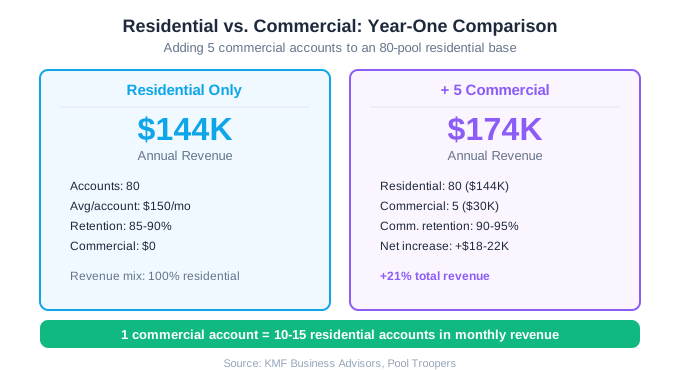
The financial case for commercial expansion is compelling when you price contracts correctly. Here is a realistic year-one scenario for a residential pool service company that adds five commercial accounts while maintaining its residential base.
Year-One Commercial Revenue Scenario
| Metric | Residential Only (Before) | With 5 Commercial Accounts | Change |
|---|---|---|---|
| Residential accounts | 80 accounts | 80 accounts | No change |
| Residential monthly revenue | $12,000 | $12,000 | No change |
| Commercial accounts | 0 | 5 accounts | +5 |
| Avg commercial monthly revenue | $0 | $2,500 ($500/account) | +$2,500/mo |
| Total monthly revenue | $12,000 | $14,500 | +21% |
| Total annual revenue | $144,000 | $174,000 | +$30,000 |
| Additional annual costs | $0 | $8,000-$12,000 | Chemicals, insurance, time |
| Net annual increase | $0 | $18,000-$22,000 | +12-15% net revenue |
Five commercial accounts averaging $500 per month add $30,000 in annual revenue. After subtracting additional chemical costs ($4,000 to $6,000), insurance premium increase ($500 to $1,500), CPO certification ($400), and additional labor time, your net revenue increase is approximately $18,000 to $22,000 in year one. That is equivalent to adding 15 to 18 residential accounts but with higher retention rates and more predictable cash flow.
Year-Two Compounding Effect
The real value shows in year two and beyond. Commercial accounts retain at 90% to 95% annually compared to 85% to 90% for residential. Your first five accounts become references that generate five more. By year two, companies that executed well typically have 8 to 12 commercial accounts generating $48,000 to $96,000 in additional annual revenue. The insurance and certification costs are already absorbed, so marginal costs per new account are lower. Chemical purchasing power improves with volume. The commercial revenue becomes a foundation that stabilizes your entire business through seasonal residential fluctuations.
90-95%
Annual retention rate for commercial pool service accounts
Source: Industry data from commercial pool service operators
What Are the Common Mistakes in Commercial Expansion?
Companies that fail at commercial expansion almost always make one of these mistakes. Knowing them in advance lets you avoid the most expensive lessons.
Underpricing to Win the First Account
The temptation to bid low on your first commercial account is strong. You want the reference, so you discount 20% to 30% below market rate. The problem: you are now locked into an underpriced contract for 12 months, your margins are thin or negative, and when you try to raise the price at renewal, the property manager balks because the increase percentage is too high. Price your first account correctly using cost-plus calculation. Offer a trial period to reduce the client risk, but do not reduce your price.
Taking Too Many Accounts Too Fast
Adding five commercial accounts in month one overwhelms your operations if you have not built the systems to handle them. Each commercial account requires three to seven visits per week, compliance documentation, monthly reporting, and emergency response capacity. Start with one or two accounts, build your processes, then add more as your team capacity allows. A poorly serviced commercial account does more damage to your reputation than having no commercial accounts at all.
Ignoring Compliance Requirements
Treating a commercial pool like a large residential pool is a recipe for health department violations, which can result in pool closure orders, fines, and contract termination. Invest the time to understand your local health department requirements for testing frequency, record-keeping, safety equipment, and operator certification. Build compliance into your standard operating procedures from day one, not after you get your first violation.
Neglecting Your Residential Base
In the excitement of commercial expansion, some companies let residential service quality slip. Residential accounts still pay the bills and generate referrals. If your best technician is now spending all week on commercial accounts and your residential customers are getting inconsistent service, you will lose the base that funds your commercial growth. Balance your route assignments so both segments receive consistent attention.
The most profitable pool service companies maintain a balanced mix of commercial and residential accounts. A common target is 20% to 30% of total revenue from commercial accounts for companies with fewer than five technicians, scaling to 40% to 50% for larger operations with dedicated commercial crews.
Ready to streamline your pool service business?
Pool Founder gives you route optimization, automated invoicing, chemical tracking, and everything else you need to run a more profitable pool business.
Frequently Asked Questions
How much more revenue does a commercial pool account generate versus residential?
A single commercial pool account typically generates $250 to $2,000+ per month compared to $80 to $200 for a residential account. In annual terms, commercial contracts run $3,000 to $24,000+ versus $960 to $2,400 for residential. A single commercial facility can generate the same monthly revenue as 10 to 15 residential customers. However, commercial accounts require more visits per week, more chemicals, and more documentation, so the revenue-per-labor-hour comparison is closer than the headline numbers suggest.
What certifications do you need for commercial pool service?
The Certified Pool Operator (CPO) certification from the Pool and Hot Tub Alliance (PHTA) is the primary requirement. At least 43 states require it for commercial pool operations, and virtually every property manager expects it regardless of state law. The CPO requires a two-day course and exam, costs $300 to $500, and is valid for five years. Some states accept the Aquatic Facility Operator (AFO) certification as an alternative. Beyond the CPO, you need the appropriate state and local business licenses, and some jurisdictions require a separate commercial pool service license or registration.
How much does it cost to start offering commercial pool service?
The main startup costs are CPO certification ($300 to $500), insurance upgrade from residential to commercial levels ($500 to $1,500 additional annual premium), a commercial-grade handheld ORP/pH meter ($200 to $500), calibration supplies ($50 to $100), and initial chemical inventory ($2,000 to $5,000 depending on the number of accounts). Total initial investment is typically $3,000 to $7,500, which is recoverable from a single commercial contract within the first few months.
How long does it take to land the first commercial pool account?
The sales cycle for commercial pool accounts ranges from two weeks to six months depending on the property type and decision-making structure. Apartment management companies make faster decisions (one to four weeks), while HOA boards operate on budget cycles that may require you to wait until the next fiscal year. Starting with your existing residential customer network for referrals is the fastest path. Offering a 90-day trial period reduces the decision risk for property managers and can shorten the sales cycle significantly.
Should you hire additional staff before getting commercial accounts?
Not necessarily for your first few accounts. Most residential companies with 60 to 100 accounts have enough schedule capacity to absorb one to three commercial accounts by optimizing their existing routes. Commercial visits take 45 to 90 minutes and occur three to seven times per week, so factor the total weekly time commitment. Once commercial accounts represent 20% or more of your total workload, consider hiring or reassigning a technician specifically for commercial routes. Having a dedicated commercial technician improves consistency and allows you to build specialized expertise.