How Do Commercial and Residential Pool Service Compare?
Every pool service business owner eventually faces the same question: should I pursue commercial accounts, stick with residential customers, or build a hybrid operation that serves both? The answer depends on your appetite for regulation, your capital reserves, and whether you prefer the steady volume of 80 residential stops per week or the concentrated revenue of a handful of commercial contracts worth ten times as much per account.
Commercial and residential pool service share the same fundamental chemistry, water balance, sanitation, and filtration, but diverge sharply on service frequency, regulatory oversight, insurance requirements, and revenue structure. A single commercial aquatic facility can generate the same monthly revenue as 10 to 15 residential customers, but it also demands daily chemical testing, CPO-certified technicians, and insurance policies with limits two to four times higher than a residential-only operation carries.
This analysis uses 2026 data from KMF Business Advisors, BusinessDojo, HomeGuide, Pool Troopers, and industry surveys to compare every dimension that matters: revenue per account, profit margins, operational complexity, certification and compliance requirements, and the practical realities of running each type of business. Whether you are a solo operator evaluating your first commercial bid or a multi-crew company deciding how to allocate growth capital, this comparison will give you the numbers you need to make a confident decision.
All financial figures in this analysis reflect 2026 industry averages for the U.S. market. Your actual results will vary by region, service scope, and operational efficiency. Commercial figures assume standard pool and spa facilities such as hotels, HOAs, and fitness centers, not water parks or large municipal aquatic complexes.
How Do the Two Service Models Compare Side by Side?
Before diving into the financial and operational details, it helps to see the full picture at a glance. The table below compares the ten factors that matter most when evaluating commercial versus residential pool service as a business model. Each of these factors is explored in depth throughout the rest of this article.
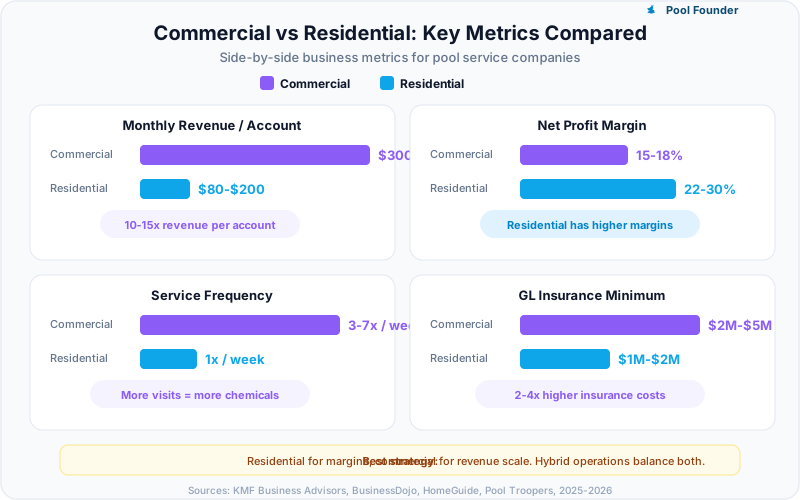
| Factor | Residential Pool Service | Commercial Pool Service |
|---|---|---|
| Typical pool size | 10,000-30,000 gallons | 10,000-100,000+ gallons |
| Service frequency | Weekly (1x per week) | Daily to 3x per week |
| Monthly revenue per account | $80-$200 | $300-$2,000+ |
| Net profit margin | 22-30% (solo operators 25-40%) | ~18% (higher absolute dollars) |
| Seasonality | Seasonal in most markets | Year-round in most cases |
| Chemical testing | Weekly during service visits | Twice daily minimum (daily logs required) |
| Insurance requirements | $1M general liability typical | $2M+ general liability often required |
| Certification needed | State license where required; CPO optional | CPO certification required in most states |
| Equipment scale | Standard truck-mounted setup | Commercial-grade pumps, controllers, bulk chemicals |
| Customer relationship | Homeowner (direct) | Property manager or facilities director |
The comparison reveals a fundamental tradeoff: residential service offers higher percentage margins and simpler operations, while commercial service delivers higher absolute revenue per account with greater complexity and regulatory burden. Neither model is inherently superior. The right choice depends on your business stage, risk tolerance, and growth objectives.
What Are the Revenue and Profitability Differences?
Revenue and profitability are the first things most operators want to compare, and the differences between commercial and residential pool service are substantial. Understanding not just the top-line revenue but also the margin structure, route density implications, and revenue per hour of labor is critical to making an informed decision about which segment to pursue.
Per-Account Revenue Comparison
A typical residential pool service account generates $80 to $200 per month, with the national average falling around $130 to $150 for weekly chemical-and-clean service. Commercial accounts start at $300 per month for a small HOA pool with weekly service and scale to $2,000 or more per month for large hotel or fitness center pools requiring daily attention. At the median, a single commercial account generates roughly $800 to $1,200 per month, making it equivalent in revenue to 6 to 10 residential customers.
10-15x
Revenue multiple: one commercial account vs one residential account at the upper end of both ranges
Source: KMF Business Advisors, Pool Troopers
Profit Margin Analysis
Residential pool service businesses typically achieve 22% to 30% net profit margins according to KMF Business Advisors and BusinessDojo, with solo operators who keep overhead minimal often reaching 25% to 40%. The simplicity of weekly residential service, lower chemical costs per stop, and the ability to build tight geographic routes all contribute to strong percentage margins.
Commercial pool service margins are narrower in percentage terms, averaging around 18% net. The compression comes from several directions: higher insurance premiums, the cost of maintaining CPO certifications, more expensive commercial-grade chemicals and equipment, the labor cost of daily or multi-weekly visits, and the administrative burden of compliance documentation. However, because the revenue base per account is so much larger, the absolute profit dollars per commercial account often exceed what you earn from several residential accounts combined.
A commercial account generating $1,200/month at 18% margin produces $216/month in net profit. To match that from residential accounts at $150/month and 28% margin, you would need roughly five accounts ($42/month each x 5 = $210). The commercial account requires more visits but involves a single location, single point of contact, and no drive time between stops.
Route Density and Revenue Per Hour
Route density is where residential service has a structural advantage. A well-optimized residential route allows a technician to complete 15 to 20 stops per day, spending 15 to 30 minutes per pool with minimal drive time between clustered accounts. At $150 per month per account and roughly 4.3 visits per month, each stop generates about $35 in revenue. A technician completing 18 stops in an 8-hour day produces approximately $630 in daily revenue, or about $79 per hour.
Commercial stops take longer, typically 45 minutes to 2 hours depending on pool size and complexity, but each visit carries more revenue weight. A technician servicing three commercial pools per day at an average of $1,000 per month each, with 12 to 20 visits per month, generates $50 to $83 per visit. Over a full day of three stops plus drive time, that translates to $150 to $250 in daily revenue allocated to those visits, which is lower per hour than a dense residential route. The economics of commercial service improve dramatically with multi-pool facilities like hotel chains or HOAs with several pools on a single property, where a single site visit covers multiple billable units.
$79/hr
Approximate revenue per technician hour on a well-optimized residential route (18 stops/day at $35/stop)
Source: HomeGuide, Industry Calculations
What Are the Operational Differences?
Beyond the financial comparison, the day-to-day operations of commercial and residential pool service differ in ways that affect staffing, scheduling, equipment investment, and the overall complexity of your business. These operational differences often determine which service model is the better fit for a given operator, regardless of the revenue potential.
Service Frequency and Scheduling
Residential pools receive weekly service as the industry standard. Each visit includes skimming, brushing, vacuuming, emptying baskets, testing and adjusting chemicals, and inspecting equipment. The weekly cadence fits neatly into route-based scheduling, where a technician runs the same route on the same day each week with predictable stop counts and drive times.
Commercial pools require far more frequent attention. Health department regulations in most jurisdictions mandate daily chemical testing at minimum, with many requiring twice-daily readings. Service visits range from daily to three times per week depending on the facility type, bather load, and local code requirements. Hotels and fitness centers with high daily usage typically need daily service, while smaller HOA pools with moderate traffic may be served three times per week. This higher frequency means that commercial accounts consume more technician hours per month but provide more predictable, year-round scheduling.
Chemical Management and Testing
Residential pool chemical management is relatively straightforward. A technician tests chlorine, pH, alkalinity, and cyanuric acid during the weekly visit, makes adjustments on the spot, and records readings in the service software. Chemical consumption for a typical 15,000-gallon residential pool runs $30 to $60 per month in materials, and dosing errors are usually correctable at the next weekly visit with no regulatory consequence.
Commercial pools operate under an entirely different chemical management paradigm. Bather loads of dozens to hundreds of swimmers per day consume sanitizer rapidly, requiring automated chemical controllers that continuously feed chlorine and acid. Daily or twice-daily manual testing is required by health departments, and those readings must be logged in permanent records that are subject to inspection. Chemical costs for a 50,000-gallon commercial pool can run $200 to $800 per month depending on usage. Any failure to maintain proper sanitizer levels can result in health code violations, forced closure of the facility, and significant liability exposure for the service provider.
Commercial pool chemical logs are legal documents. Health inspectors can and do review months of records during inspections. Incomplete or falsified logs can result in facility closure and personal liability for the CPO of record. Invest in digital logging systems that timestamp every reading automatically.
Documentation and Compliance
Residential documentation is primarily a business management function: service notes, chemical readings, customer communication records, and invoices. While thorough documentation improves customer retention and helps resolve disputes, there is no regulatory body auditing your residential service records in most jurisdictions.
Commercial documentation is a compliance function with legal weight. Required records typically include daily chemical readings with time and date stamps, equipment maintenance logs, incident and accident reports, health department inspection results, backwash and water replacement logs, and emergency contact protocols. Many commercial contracts also require monthly or quarterly written reports to the property manager documenting service performed, issues identified, and recommendations for capital repairs or upgrades.
Emergency Response Expectations
Residential customers expect responsive service when equipment fails or water turns green, but most issues can wait until the next business day. A pump failure on Saturday evening is inconvenient for the homeowner but rarely creates a health or safety emergency. Standard residential service agreements typically promise next-business-day response for non-emergency issues and same-day response for equipment failures during business hours.
Commercial facilities often require emergency response within 2 to 4 hours, regardless of the day or time. A cloudy pool at a hotel means guests cannot swim and management receives complaints. A chemical controller malfunction at a public facility means potential health code violation and forced closure until the issue is resolved. Most commercial service contracts include on-call provisions for weekends and holidays, and the expectation is that the pool remains operational 365 days per year. This emergency response requirement significantly affects staffing, as you need technicians available outside normal business hours.
Equipment Scale and Investment
Residential pool equipment is standardized and relatively affordable. Variable-speed pumps, cartridge or DE filters, salt chlorine generators, and basic automation systems are the most complex components a residential technician encounters. Replacement parts are readily available, and most repairs can be completed in a single visit with standard tools and parts inventory.
Commercial pool equipment operates at an entirely different scale. Large commercial pumps rated at 5 to 15 horsepower, sand or high-rate sand filters with 36-inch to 48-inch tanks, commercial chemical controllers with ORP and pH probes, UV or ozone supplemental sanitation systems, and sophisticated automation panels are standard in commercial facilities. Technicians need specialized training to service this equipment, and replacement parts for commercial-grade systems are more expensive and sometimes require longer lead times. A commercial equipment room is a mechanical plant, not a pool pad, and servicing it requires a different skill set than residential work.
What Additional Requirements Come with Commercial Service?
Expanding into commercial pool service is not simply a matter of bidding on larger pools. There are specific certifications, insurance requirements, regulatory compliance obligations, and record-keeping standards that create a meaningful barrier to entry. Understanding these requirements before pursuing commercial accounts prevents costly surprises and ensures you can deliver the level of service that commercial clients expect and that regulators demand.
CPO Certification
The Certified Pool Operator (CPO) certification, administered by the Pool and Hot Tub Alliance (PHTA), is required in most states for anyone responsible for the operation of a commercial or public pool. The certification covers water chemistry, filtration, circulation, health codes, safety regulations, and risk management. The course is typically a two-day classroom program followed by an open-book exam, costing $300 to $500 per person. CPO certification is valid for five years and must be renewed through continuing education and re-examination.
Some jurisdictions accept the Aquatic Facility Operator (AFO) certification from the National Recreation and Park Association as an alternative to CPO. A few states have their own state-specific operator certification programs. Before pursuing commercial work in any market, verify which certifications your local health department recognizes and requires. Having at least two CPO-certified staff members is strongly recommended so that you always have a qualified operator available for emergency response.
Insurance Requirements
Residential pool service businesses typically carry $1 million in general liability insurance, which is adequate for most homeowner-facing work and costs $800 to $2,000 per year depending on your state, revenue, and claims history. This coverage protects against property damage, slip-and-fall incidents, and chemical-related injuries at customer homes.
Commercial clients almost universally require higher insurance limits. A $2 million general liability policy is the minimum threshold for most commercial contracts, and many large property management companies, hotel chains, and municipal facilities require $5 million or more in combined coverage through umbrella or excess liability policies. Additionally, commercial work often triggers the need for professional liability (errors and omissions) coverage, which protects against claims arising from negligent chemical management or code compliance failures. Budget $3,000 to $8,000 per year for a commercial-grade insurance package, depending on your revenue volume and the number of facilities you service.
- General liability: $2M minimum for most commercial contracts, $5M+ for hotels and municipal facilities
- Professional liability (E&O): Covers claims from negligent chemical management or compliance failures
- Workers compensation: Required in most states if you have employees servicing commercial accounts
- Commercial auto: Higher limits than personal auto, typically $1M combined single limit
- Umbrella policy: Provides excess coverage above underlying limits; often required to reach $5M total
Health Department Compliance
Commercial and public pools are regulated by state and local health departments, which conduct periodic inspections and have the authority to close facilities that violate health codes. As the service provider of record, you share responsibility for maintaining the pool in compliance with applicable regulations. This includes maintaining proper sanitizer residuals (typically 1.0 to 10.0 ppm free chlorine for commercial pools), keeping pH within the required range (7.2 to 7.8), ensuring filtration and circulation systems operate within design parameters, and maintaining safety equipment in proper condition.
Health department requirements vary significantly by jurisdiction. Some states follow the Model Aquatic Health Code (MAHC), while others have their own regulations that may be more or less stringent. Before taking on commercial accounts in a new jurisdiction, obtain a copy of the applicable health code, attend a health department orientation if one is offered, and establish a working relationship with local inspectors. Being proactive about compliance protects both your client and your business.
Record Keeping and Reporting
Commercial pool service requires significantly more documentation than residential work. At minimum, you must maintain daily chemical test logs showing date, time, operator name, and all readings. Equipment maintenance records should document every repair, replacement, and preventive maintenance task with dates and descriptions. Incident reports must be filed for any accident, injury, or chemical event that occurs at the facility. Many commercial clients also require monthly service reports summarizing all work performed, chemical usage, equipment condition, and recommendations.
Retain all commercial pool service records for a minimum of three years, or longer if required by your local jurisdiction. These records are your primary defense in any liability claim and your proof of regulatory compliance during health department audits.
Can You Run Both Commercial and Residential Operations?
Many successful pool service companies operate a hybrid model that serves both commercial and residential customers. This approach combines the route density and margin advantages of residential work with the higher per-account revenue and year-round stability of commercial contracts. However, running a hybrid operation requires deliberate planning around scheduling, staffing, and equipment to avoid the common pitfall of trying to serve commercial accounts with a residential mindset.
Benefits of the Hybrid Model
A hybrid operation provides several strategic advantages that neither a pure residential nor a pure commercial business can match on its own. Revenue diversification is the most important benefit: when residential demand drops during the off-season, commercial accounts provide steady year-round income. A company with 70% residential and 30% commercial revenue typically experiences only a 15% to 25% revenue dip in winter months, compared to 40% to 60% for a residential-only operation in seasonal markets. Commercial accounts also elevate your company profile, making it easier to recruit experienced technicians and negotiate better pricing with chemical and equipment suppliers.
- Revenue diversification smooths seasonal fluctuations in residential-heavy markets
- Commercial accounts provide year-round baseline income even when residential pools are closed
- Higher monthly revenue per commercial account improves cash flow predictability
- Commercial experience and references strengthen your credibility for larger residential and estate accounts
- Bulk chemical purchasing across both segments reduces per-unit material costs
- Year-round work helps retain skilled technicians who might otherwise seek seasonal employment elsewhere
Scheduling Strategies for Hybrid Operations
The biggest operational challenge in a hybrid model is scheduling commercial and residential work efficiently without compromising service quality on either side. Commercial pools typically need early-morning service before facilities open to guests, while residential routes run best during standard business hours when homeowners are at work and gates are accessible. A proven scheduling approach is to assign commercial pools to the first stops of the day, with technicians completing commercial visits between 6:00 AM and 9:00 AM before transitioning to their residential route for the remainder of the day. This is exactly the workload that route-aware pool service dispatch and scheduling software is built to manage — mixed visit frequencies without hand-rebuilt calendars every week.
An alternative approach that works well for larger operations is to designate specific days for commercial service and other days for residential routes. For example, a technician might service commercial accounts Monday, Wednesday, and Friday, and run residential routes on Tuesday and Thursday. This reduces the context-switching overhead of moving between the two service types within a single day and ensures that commercial accounts receive the extended attention they require without compressing the residential route.
Dedicated vs Shared Technicians
Whether to use dedicated commercial technicians or cross-train your entire team depends on the scale of your commercial book of business. With fewer than five commercial accounts, cross-training two or three of your strongest residential technicians is practical and cost-effective. Ensure each cross-trained technician holds a CPO certification and is familiar with the commercial equipment at each site. This approach provides scheduling flexibility and backup coverage without the overhead of a dedicated commercial team.
Once your commercial portfolio exceeds five to eight accounts, the operational complexity justifies dedicating one or more technicians exclusively to commercial work. A dedicated commercial technician develops deeper expertise in commercial equipment, builds stronger relationships with property managers, and can respond more quickly to emergency calls without disrupting residential routes. The dedicated technician should carry a commercial-specific truck stocked with larger chemical quantities, commercial-grade replacement parts, and the specialized tools needed for commercial equipment rooms.
Start with residential service to build your operational foundation, cash reserves, and local reputation. Add your first commercial account only after you have a stable base of 40 to 60 residential customers, at least one CPO-certified technician, and commercial-grade insurance in place. Trying to pursue commercial work before these fundamentals are established stretches your resources thin and puts both segments at risk.
Building Your Commercial Pipeline
Commercial accounts are won differently than residential customers. Homeowners find you through Google, referrals, and door hangers. Property managers and facilities directors respond to professional proposals, references from other commercial clients, and demonstrated compliance expertise. To build a commercial pipeline, start by networking with local property management companies, attending HOA board meetings in communities where you already service residential pools, and joining your local chapter of the Community Associations Institute (CAI). Every residential pool you service in an HOA community is a potential foot in the door for the community pool contract.
When bidding on commercial work, present a formal proposal that includes your CPO certification credentials, proof of commercial insurance, a detailed scope of service, your chemical testing and documentation protocols, emergency response procedures, and references from other commercial clients. Commercial decision-makers are evaluating your professionalism and compliance capabilities as much as your price. A well-structured proposal that demonstrates regulatory knowledge will win over a lower bid from a competitor who presents like a residential-only operation.
Free starter kit
Start a pool service business with the numbers already run.
A short email series from an owner who started with $1,200 and a used truck. No software pitch, just the four things that decide whether year one works.
- Startup cost breakdownEvery line item from $2K bootstrap to fully equipped
- Pricing calculatorThe minimum you can charge per visit and still profit
- First-10-customers playbookDoor hangers, referrals, and the phone script that closes
- Licensing & insurance checklistWhat your state requires and which insurers pay claims
Already running routes? Try Pool Founder free
Frequently Asked Questions
Is commercial pool service more profitable than residential?
Commercial pool service generates higher absolute profit per account but lower percentage margins. A typical commercial account at $1,000 per month with an 18% net margin produces $180 in monthly profit, while a residential account at $150 per month with a 28% margin produces $42. You need roughly four to five residential accounts to match the profit of one commercial account. However, residential routes offer better revenue per technician hour due to shorter stop times and greater route density. The most profitable pool service companies typically operate a hybrid model that leverages the margin efficiency of residential work alongside the revenue concentration of commercial accounts.
What certifications do I need for commercial pool service?
Most states require a Certified Pool Operator (CPO) certification from the Pool and Hot Tub Alliance (PHTA) for anyone responsible for maintaining a commercial or public pool. The CPO course is a two-day program costing $300 to $500, covering water chemistry, health codes, filtration, and safety. Some jurisdictions accept the Aquatic Facility Operator (AFO) certification from the National Recreation and Park Association as an alternative. A few states also require a state-specific operator license in addition to or instead of CPO. Check with your local health department to confirm which certifications are required in your jurisdiction before bidding on commercial accounts.
How much more insurance do I need for commercial pools?
Commercial pool service typically requires $2 million or more in general liability coverage, compared to the $1 million policy standard for residential-only operations. Large clients such as hotel chains and municipal facilities may require $5 million or more in combined coverage through umbrella policies. You will also likely need professional liability (errors and omissions) insurance and, if you have employees, workers compensation coverage. Budget $3,000 to $8,000 per year for a commercial-grade insurance package, compared to $800 to $2,000 for a residential-only policy. Contact a broker who specializes in pool service or general contractor insurance to get the best rates.
Can I service both commercial and residential pools with the same team?
Yes, many successful companies run a hybrid model with cross-trained technicians. When you have fewer than five commercial accounts, cross-training your best residential technicians works well as long as they hold CPO certification and are trained on the specific commercial equipment at each site. Once you exceed five to eight commercial accounts, consider dedicating one or more technicians exclusively to commercial work with a separate truck stocked for commercial equipment. The key is ensuring that commercial service requirements like early-morning visits and emergency on-call do not disrupt your residential route schedules.
How do I win my first commercial pool service contract?
Start by leveraging your existing residential relationships. If you service homes in an HOA community, attend board meetings and express interest when the community pool contract comes up for bid. Network with local property management companies and join the Community Associations Institute (CAI) to connect with decision-makers. When you submit a proposal, include your CPO certification, proof of commercial insurance at $2M or higher, a detailed scope of work, your chemical testing and documentation protocols, and references. Commercial clients prioritize compliance expertise and professionalism over the lowest price. Build your credibility by starting with smaller HOA pools before pursuing hotels and large commercial facilities.