Why Should Residential Pool Companies Add Commercial Accounts?
If you run a residential pool service company and have never seriously considered commercial accounts, you are leaving the most profitable growth lever in this industry on the table. A single commercial pool contract can generate the same monthly revenue as 10 to 15 residential clients, without adding 10 to 15 new stops, invoices, and customer relationships to manage. The pool service industry has grown to between $7.2 billion and $8.8 billion in annual revenue, and commercial maintenance represents the fastest path from owner-operator to scalable business for companies that are willing to invest in the right certifications, compliance knowledge, and service capabilities.
Commercial pools are not simply bigger versions of backyard pools. They operate under stricter health department regulations, require more frequent chemical testing, demand higher insurance limits, and often involve year-round service contracts rather than seasonal arrangements. But that complexity is exactly what creates the opportunity. Most residential-only operators avoid commercial work because of the perceived difficulty, which means the pool companies willing to invest in CPO certification and compliance expertise face far less competition for accounts worth $3,000 to over $107,000 per year.
10-15x
Revenue multiplier: a single commercial account generates revenue equivalent to 10 to 15 residential clients
Source: KMF Business Advisors, Industry Benchmarks
This guide is written specifically for the residential pool service owner who is ready to take the next step. We cover the types of commercial accounts available, what certifications and equipment you actually need, how commercial maintenance differs from residential work, and a step-by-step approach to winning your first contract. Every recommendation is grounded in current cost data, regulatory requirements, and real-world pricing benchmarks from active commercial operators.
This is the hub article for our Commercial Pool Service series. For deep dives on specific topics like HOA contracts, hotel pool requirements, commercial pricing strategies, and compliance checklists, see the related articles linked throughout this guide and in the related reading section at the bottom.
Why Should Residential Pool Companies Add Commercial Accounts?
The business case for adding commercial pool maintenance to a residential pool service company comes down to four factors: higher revenue per stop, year-round contracts, predictable income, and a natural growth strategy that does not require you to add dozens of new residential customers to meaningfully increase your top line. Let us examine each of these in detail so you can make an informed decision about whether commercial expansion is right for your business.
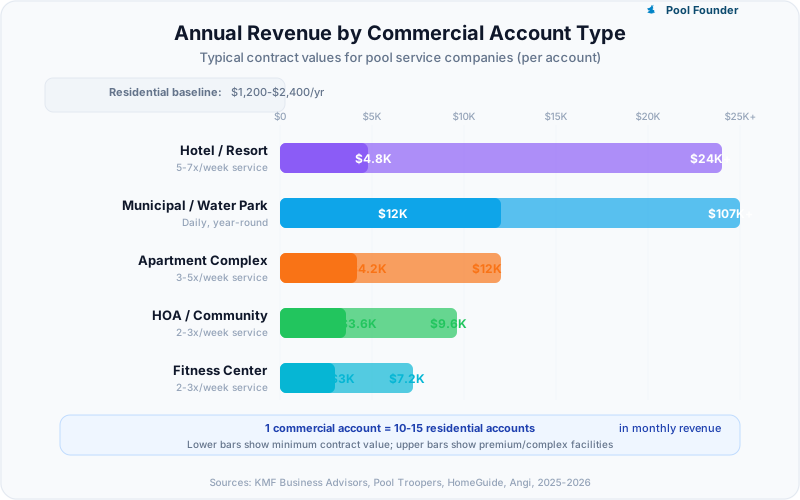
Higher Revenue Per Stop
A typical residential pool service visit generates $125 to $200 per month per customer. A commercial pool contract generates $600 to $9,000 or more per month depending on the facility type and size. A commercial pool specialist in Florida charges approximately $600 per month for hotel and resort pool clients according to KMF Business Advisors, and that represents the lower end of the commercial pricing spectrum. Large HOA communities with multiple pools and spas can exceed $5,000 per month, while water parks and large resort complexes routinely spend $50,000 to $107,600 per year on maintenance alone.
$3,000 - $107,600/yr
Annual commercial pool maintenance cost range depending on size and complexity
Source: Pool Troopers, HomeGuide
When you factor in drive time, the revenue math becomes even more compelling. A technician servicing 8 residential pools per day at $150 per month each generates $1,200 monthly from a full day of driving across town. That same technician spending a full day at a single commercial facility with three pools, two spas, and a splash pad might generate $3,500 to $5,000 per month from that one account. The revenue per labor hour is dramatically higher, and the reduced windshield time means less vehicle wear, lower fuel costs, and more productive hours in each working day.
Year-Round Contracts Eliminate Seasonality
In most markets outside of the Sun Belt, residential pool service revenue drops 40% to 60% during the off-season as customers close their pools or reduce service frequency. Commercial accounts, particularly indoor pools at fitness centers, hotels, and apartment complexes, require 12-month maintenance regardless of season. Even outdoor commercial pools in northern states often require year-round monitoring, winterization services, and pre-season preparation that generate billable work in every month of the year.
Year-round contracts solve the cash flow problem that forces many residential pool companies to either diversify into unrelated services during winter or accept months of reduced income. A portfolio of four to five commercial accounts can provide a stable revenue floor that covers your fixed costs, including truck payments, insurance, software subscriptions, and technician salaries, through the off-season while residential revenue fluctuates above it. This financial stability also makes it much easier to retain good technicians year-round instead of laying them off every fall and hoping they come back in spring.
Predictable Income and Easier Forecasting
Commercial contracts are typically structured as 12-month agreements with 30-day or 60-day cancellation clauses, compared to residential service which is often month-to-month or even per-visit with no commitment. This contractual stability means you can forecast revenue 6 to 12 months out with much higher accuracy, making it significantly easier to hire technicians, purchase equipment, and invest in growth. Banks and lenders also view contracted commercial revenue more favorably when you apply for equipment financing or business lines of credit, which can accelerate your growth timeline.
A Scalable Growth Strategy
Growing a residential pool route from 80 to 160 customers means doubling your marketing spend, doubling your intake process, and managing twice as many individual customer relationships with all the scheduling complications, payment collections, and communication overhead that entails. Growing your commercial portfolio from 0 to 5 accounts might add the same revenue while only adding 5 new client relationships. Each commercial account has a single point of contact, typically a property manager or facilities director, who makes decisions professionally without the emotional complexity of individual homeowners debating whether their pool really needs weekly service.
A proven growth path: start with 1-2 small HOA pools to build your commercial track record and compliance documentation, then leverage those references to pursue larger hotel and apartment accounts within 12 months. Your first commercial account is a credential, not just a revenue source.
Understanding the Margin Trade-Off
Commercial pool service typically operates at approximately 18% net margins compared to 22% to 30% net margins for residential service. The lower percentage reflects higher chemical costs due to larger pool volumes and heavier bather loads, more frequent service visits, additional insurance premiums required for commercial liability coverage, and the labor intensity of servicing high-traffic pools that require twice-daily chemical testing. However, it is critical to think in absolute dollars rather than percentages when evaluating the opportunity.
Consider this: 18% of a $60,000 annual commercial contract produces $10,800 in net profit. Meanwhile, 25% of $1,800 in annual residential revenue from a single customer produces just $450 in net profit. You would need 24 residential customers to match the absolute profit from one mid-range commercial account. When you factor in the reduced overhead of managing fewer client relationships, less time spent on residential marketing and customer acquisition, and the elimination of seasonal revenue gaps, the effective profitability of commercial accounts is often higher than the margin percentage suggests.
| Metric | Residential Service | Commercial Service |
|---|---|---|
| Monthly revenue per account | $125-$200 | $600-$9,000+ |
| Net profit margin | 22-30% | ~18% |
| Typical contract length | Month-to-month | 12 months |
| Seasonal revenue impact | 40-60% drop in off-season | Minimal (year-round contracts) |
| Accounts to replace 1 tech salary | 40-60 accounts | 3-5 accounts |
| Client relationship complexity | High (individual homeowners) | Low (professional property managers) |
What Types of Commercial Pool Accounts Can You Service?
Commercial pools vary enormously in size, regulatory requirements, service frequency, and revenue potential. Understanding the different account types helps you target the right opportunities for your current capabilities and growth goals. Most residential pool companies start with the lower-complexity account types and work their way up as they build experience and credentials. Here is a detailed breakdown of the six primary commercial pool categories that service companies encounter.
| Account Type | Typical Pool Size | Service Frequency | Annual Revenue Range | Complexity Level |
|---|---|---|---|---|
| HOA / Community Pool | 15,000-40,000 gal | 3-7x per week | $6,000-$36,000 | Medium |
| Hotel / Resort | 20,000-100,000+ gal | Daily | $7,200-$60,000+ | High |
| Apartment Complex | 10,000-30,000 gal | 3-5x per week | $4,800-$24,000 | Medium |
| Gym / Fitness Center | 10,000-25,000 gal | Daily | $6,000-$30,000 | Medium-High |
| Water Park | 100,000-500,000+ gal | Daily (multiple checks) | $50,000-$107,600+ | Very High |
| Country Club | 25,000-75,000 gal | Daily | $12,000-$48,000 | High |
HOA and Community Pools
HOA and community pools are the most common and most accessible entry point for residential pool companies moving into commercial work. These pools serve residential communities ranging from 25 to several hundred homes and are governed by a homeowners association board or a hired property management company. Service requirements are regulated by state and county health departments: HOAs with 25 or more units must test pool water daily, while communities with fewer than 25 units must test at least twice weekly according to state health department guidelines.
Most HOA contracts include chemical maintenance, surface cleaning, equipment inspections, filter maintenance, and seasonal opening and closing services. The advantage of HOA accounts is volume and bundling. A single HOA community might have two pools, three spas, and a splash pad, all managed under one contract with one property manager as your point of contact. Annual revenue typically ranges from $6,000 for a small single-pool community with three-times-weekly service to $36,000 or more for large communities with multiple water features and daily service requirements. HOA boards also tend to value long-term relationships, making these accounts relatively sticky once you establish a track record of reliable service.
Hotel and Resort Pools
Hotel pools are the highest-visibility commercial accounts and demand the most rigorous maintenance standards. Guest satisfaction, liability exposure, and health department scrutiny are all elevated compared to other commercial pool types. Hotels typically require daily service, sometimes twice daily during peak season, along with detailed documentation of every chemical reading and maintenance action performed. A commercial pool specialist in Florida charges approximately $600 per month per hotel or resort client at the base level, with larger resorts paying significantly more depending on the number of water features, indoor versus outdoor pools, and peak bather load.
Hotel accounts also tend to be the most demanding in terms of response time. A pool closure at a hotel during peak season can cost the property thousands of dollars per day in guest complaints, negative online reviews, and potential room refunds. Your service agreement for hotel accounts should include clearly defined emergency response provisions with guaranteed response times of 2 to 4 hours during operating hours. Hotels are willing to pay a premium for this level of service reliability, which is why hotel pool contracts often carry higher per-visit rates than other commercial account types.
Apartment Complex Pools
Apartment pools sit between HOA and hotel pools in terms of complexity and are an excellent second or third commercial account type to pursue. They serve a defined resident population, are managed by a property management company or on-site maintenance staff, and require regular health department compliance. The key advantage of apartment complex accounts is the property management relationship. Property management companies often manage multiple apartment communities across a metro area, and if you perform excellent work at one property, the property manager can award you additional pools under a single master contract without a competitive bidding process.
Apartment pools typically range from 10,000 to 30,000 gallons and require three to five service visits per week during peak season. Annual contract values range from $4,800 for a small community pool to $24,000 for larger complexes with multiple water features. The resident population creates a consistent bather load that makes chemical demand predictable, which helps with both service planning and chemical purchasing.
Gym and Fitness Center Pools
Fitness center pools and spas present unique challenges because of extremely high bather loads relative to pool size and the presence of both heated lap pools and therapeutic spas that require different chemical balancing approaches. Indoor pools at gyms also deal with air quality and ventilation concerns related to chloramine off-gassing that outdoor pools do not face, requiring careful management of combined chlorine levels. These accounts are valuable because they operate year-round regardless of climate and outdoor temperatures, providing consistent monthly revenue with zero seasonal variation.
National fitness chains like LA Fitness, Lifetime Fitness, and YMCA locations often standardize their pool maintenance vendors across multiple facilities in a region, which means winning one gym location can lead to contracts at several additional locations. Annual contract values for fitness center pools range from $6,000 to $30,000 depending on the number of water features, the facility operating hours, and whether the pool is indoor or outdoor.
Water Parks
Water parks represent the highest-revenue and highest-complexity commercial pool accounts in the industry. With pool volumes often exceeding 100,000 gallons across multiple attractions including wave pools, lazy rivers, splash pads, and individual slide pools, chemical costs alone can run $2,000 to $5,000 per month. Water parks require specialized knowledge of large-scale commercial filtration systems, automated chemical controllers managing multiple zones simultaneously, wave pool mechanics, and multi-zone water treatment protocols.
Annual maintenance costs for water parks range from $50,000 to over $107,600 per year according to Pool Troopers and HomeGuide data. Most pool service companies will not pursue water park accounts until they have several years of commercial experience, dedicated commercial technicians with advanced training, and the chemical purchasing volume to make the economics work. Water parks are a long-term growth target rather than an entry-level commercial account.
Country Clubs
Country club pools combine the high aesthetic standards of hotel pools with the community ownership dynamics of HOA pools. Members expect pristine water quality, spotless deck areas, and maintenance that is invisible to users. Country clubs typically have larger pools than HOAs, often featuring lap lanes, diving areas, wading pools for children, and attached spas or hot tubs. These accounts value long-term relationships above all else and are among the stickiest commercial clients once you earn their trust. Annual contracts typically range from $12,000 to $48,000 depending on the facility size, number of water features, and service scope.
Start with HOA and apartment complex accounts. They have the lowest barrier to entry, the most forgiving learning curve, and the highest volume of available contracts in most markets. Use those as stepping stones to hotel and country club accounts once you have 6-12 months of documented commercial compliance experience and strong references.
What Are the Requirements for Servicing Commercial Pools?
Commercial pool service carries regulatory, certification, and insurance requirements that go well beyond residential pool maintenance. Understanding these requirements before you pursue your first commercial account is essential because it prevents costly surprises, ensures you can actually deliver compliant service, and positions you as a credible provider in conversations with property managers who have been burned by unqualified service companies before.
CPO Certification Is Your Entry Ticket
The Certified Pool Operator (CPO) certification, administered by the Pool and Hot Tub Alliance (PHTA), is the industry standard credential for commercial pool operation and maintenance. In Florida, CPO certification is legally required for anyone responsible for maintaining a commercial pool. Many other states either require CPO certification outright or accept it as proof of competency for commercial pool operators. The certification covers water chemistry, filtration systems, health regulations, risk management, and facility maintenance across a two-day course (approximately 16 hours of instruction) followed by a proctored open-book exam.
Even in states where CPO certification is not legally mandated for the service provider, most property managers and commercial clients will require it as a condition of their service contract. Think of CPO as the minimum credentialing threshold for being taken seriously in the commercial pool market. The investment is modest relative to the contract values it unlocks: the course costs $300 to $500 depending on the provider and format, takes two days of your time, and the certification is valid for five years before requiring renewal. An alternative is the AFO (Aquatic Facility Operator) certification from the National Recreation and Park Association, which is accepted in some jurisdictions as equivalent to CPO.
Florida requires CPO certification for anyone responsible for a commercial pool. Even in states without this legal requirement, having at least one CPO-certified person on staff is essentially mandatory for winning commercial contracts. Get certified before you start prospecting.
Health Department Permits and Inspections
Every commercial pool in the United States requires an annual operating permit from the local or county health department. As the service company, you typically do not hold the permit yourself (the property owner does), but you need to understand exactly what the permit requires because your maintenance work directly determines whether the pool passes its annual inspection and any unannounced follow-up inspections. Health departments conduct surprise inspections throughout the year, and violations can result in immediate pool closure, fines to the property owner, and a very difficult conversation with the property manager about why their pool failed under your watch.
Common inspection points include water chemistry within mandated ranges (free chlorine typically 1 to 10 ppm with most departments preferring 2 to 4 ppm, pH between 7.2 and 7.8), proper safety signage (depth markers, no diving warnings, capacity limits, emergency contact information), functioning safety equipment (ring buoys, shepherd hooks, first aid kit), compliant drain covers meeting VGB Act requirements, operational filtration and circulation systems achieving required turnover rates, and accurate chemical testing records available on-site for review. Knowing these inspection criteria inside and out is part of your value proposition to commercial clients.
The Virginia Graeme Baker (VGB) Act
The Virginia Graeme Baker Pool and Spa Safety Act is a federal law enacted in 2007 that requires all commercial pools and spas to have anti-entrapment drain covers that meet the ASME/ANSI A112.19.8 standard. This law was passed after a child was fatally trapped by the suction of a pool drain, and it applies to every public pool, spa, and water feature in the United States regardless of state. As a commercial pool service provider, you are responsible for verifying that every pool you maintain has compliant drain covers and for reporting any non-compliance to the property owner immediately and in writing.
VGB violations carry severe liability exposure for both the property owner and the service company. Drain covers have a rated lifespan and expiration date stamped on the cover itself, and they must be replaced before that date. During every service visit, a visual inspection of all drain covers for cracks, missing screws, broken frames, or expired certification dates should be part of your standard commercial service checklist. Documenting this inspection in your service records protects both you and your client.
Insurance Requirements for Commercial Service
Commercial pool service requires significantly higher insurance limits than residential work. Most commercial clients and property management companies require a minimum of $1 million per occurrence and $2 million aggregate in general liability coverage, with many hotel chains, large HOAs, and municipal facilities requiring $5 million umbrella or excess liability policies. You will also need to add each commercial client as an additional insured party on your policy through certificates of insurance (COIs), which your insurance agent can process, typically within 24 to 48 hours of request.
Expect your insurance premiums to increase 30% to 60% when you add commercial pool service to your coverage. A residential-only pool service policy typically costs $1,500 to $3,000 per year, while a combined residential and commercial policy runs $2,500 to $5,000 per year depending on the number and type of commercial accounts. Workers compensation insurance is also required in most states once you have employees servicing commercial pools, adding another $2,000 to $6,000 annually depending on your payroll and state rates. Factor these insurance costs into your commercial pricing from day one so they do not erode your margins.
| Requirement | Residential Standard | Commercial Standard |
|---|---|---|
| CPO Certification | Optional (recommended) | Required in FL; expected everywhere else |
| General Liability Insurance | $500K-$1M typical | $1M-$2M minimum; $5M umbrella often required |
| Health Dept Permit Knowledge | Minimal exposure | Must understand all inspection requirements |
| VGB Act Compliance | Applies but rarely enforced | Strictly enforced; inspect every visit |
| Chemical Record Keeping | Basic service notes | On-site logs retained 1-3 years by jurisdiction |
| Workers Compensation | Varies by state | Required in most states with employees |
Record-Keeping and Documentation Standards
Commercial pool maintenance requires meticulous documentation that goes far beyond the service notes you keep for residential accounts. Health departments require that chemical test results, maintenance actions, equipment repairs, chemical additions (type and quantity), and incident reports be recorded at every service visit and kept on-site and accessible for 1 to 3 years depending on the jurisdiction. This means you need a systematic approach to logging every chemical reading, every adjustment made, every piece of equipment inspected, and the name of the technician who performed the work, with timestamps for each entry.
Many commercial pool service companies use pool service management software to automate this documentation, generating timestamped digital records with photo attachments that can be shared with property managers in real time and presented during health department inspections on a tablet or phone. Paper logs still work and are accepted by inspectors, but they create organizational overhead, are harder to produce quickly during surprise inspections, and cannot be shared remotely with property managers who want to review service records from their office. Whichever system you use, the absolute requirement is consistency: every visit must be documented the same way, every time, by every technician on your team.
How Is Commercial Pool Maintenance Different from Residential?
If you have been servicing residential pools for years, you already possess the foundational chemistry knowledge and equipment skills needed for commercial work. The transition is not about learning an entirely new trade. It is about adapting your existing expertise to handle higher volumes, tighter tolerances, stricter documentation requirements, and faster response expectations. Here are the key operational differences that affect how you structure your service, train your technicians, and manage your time at each commercial account.
Higher Bather Loads Change Everything
A residential pool might see 2 to 6 swimmers per day during normal use. A community HOA pool can see 50 to 200 swimmers on a busy summer Saturday. A hotel pool at full occupancy might have 30 to 80 people cycling through the water over the course of a day. These elevated bather loads introduce dramatically more contaminants including body oils, sunscreen, sweat, urine, and organic debris that consume free chlorine at a rate residential operators rarely encounter. The practical impact is that you must size your chemical dosing for peak bather load, not average daily use, and you need to deeply understand the relationship between cyanuric acid stabilization, free chlorine demand curves, and bather load calculations at a level that weekly residential service simply does not require.
High bather loads also accelerate filter pressure buildup, increase the frequency of backwashing or filter cleaning, and create more rapid pH drift due to the introduction of alkaline contaminants from swimmers. Your service schedule and chemical ordering must account for these accelerated consumption rates, particularly during peak-use periods like summer weekends, holiday weeks, and special events at the facility.
Chemical Testing Frequency and Precision
Residential pools are typically tested once per week during a scheduled service visit, and minor chemistry drift between visits is normal and generally harmless. Commercial pools require chemical testing at least twice daily in most states, with many high-traffic facilities testing three or four times per day during peak season. As the service provider, you may not be on-site for every test (facility staff often handle mid-day and evening readings), but you are directly responsible for ensuring the testing protocol is established and followed, that facility staff are properly trained on testing procedures, that test equipment is calibrated and reagents are fresh, and that all results fall within regulatory limits and are documented correctly.
2x Daily Minimum
Chemical testing frequency required for commercial pools in most states
Source: State Health Department Regulations
Your service visits will include comprehensive testing with a professional-grade digital photometer or reagent kit covering free chlorine, total chlorine, combined chlorine, pH, alkalinity, calcium hardness, and cyanuric acid. Between your visits, the facility may use simpler automated controller readings or trained staff using DPD test strips, but you are responsible for auditing those readings against your professional test results and correcting any calibration drift in automated systems.
Stricter Water Chemistry Standards and Tolerances
While residential pool chemistry is managed to general guidelines and homeowner comfort preferences, commercial pool chemistry must meet specific regulatory ranges that are actively enforced through both scheduled and unannounced inspections. Free chlorine must typically be maintained between 1 and 10 ppm, with most health departments expecting commercial pools to operate between 2 and 4 ppm. The pH must remain between 7.2 and 7.8 at all times. Combined chlorine (chloramines) must be kept below 0.4 ppm to meet air quality standards, particularly for indoor pools. Exceeding any of these ranges in either direction during an unannounced inspection can result in immediate pool closure and citation.
The practical impact is that you need to maintain much tighter chemical control with far less tolerance for drift than residential work allows. On a residential pool, if the pH creeps to 7.9 between weekly visits, the homeowner never notices and no one is harmed. On a commercial pool with twice-daily testing requirements and potential inspector visits at any time, a pH reading of 7.9 is a documented violation that goes on record. This tighter tolerance means more precise chemical dosing calculations, more frequent adjustments, and often the installation and maintenance of automated chemical controllers that continuously monitor and adjust sanitizer and pH levels between your service visits.
Emergency Response and Availability Expectations
When a residential customer calls about green water or a cloudy pool, you can typically schedule a visit within 24 to 48 hours without any significant consequence. When a commercial client calls about a water clarity issue, a chemical reading out of range, or an equipment malfunction, they expect and contractually require a response within 2 to 4 hours because a closed pool directly impacts their business operations and bottom line. Hotels lose guest satisfaction scores and face negative reviews on every travel site. Apartment complexes deal with resident complaints and lease-related liability. HOAs face angry board members and potential breach-of-contract claims from residents.
Your commercial service agreements should include clearly defined emergency response tiers: critical issues like chemical readings outside safe ranges or equipment failures affecting water circulation require 2-hour response, while non-critical issues like cosmetic concerns or minor equipment problems require same-day or next-business-day response. You need the operational capacity to actually deliver on these commitments, which means having technician availability, a stocked vehicle, and sufficient chemical inventory to handle emergency calls without disrupting your scheduled route.
Equipment Scale and Complexity
Commercial pools use equipment that most residential operators have never encountered: variable-frequency drive (VFD) pumps rated at 3 to 10 horsepower, commercial-grade sand or DE filters handling flow rates of 100 to 400 gallons per minute, UV sanitization systems, ozone generators, automated chemical feed systems with peristaltic pumps, and large commercial heaters or heat pump systems. You do not need to be an expert installer of all this equipment on day one, but you absolutely need working knowledge of how each system operates, how to diagnose common failure modes, and when to call in a specialist rather than attempting a repair yourself.
Most commercial accounts do not expect their weekly maintenance service provider to handle major equipment installations or complex repairs. They do expect you to identify developing problems early through regular equipment inspections, clearly communicate what needs attention, provide repair cost estimates, and coordinate with equipment contractors to minimize pool downtime. Your role is preventive maintenance and early detection, not heavy mechanical work. But that requires enough equipment knowledge to recognize when a pump is drawing abnormal amperage, when a filter is not achieving its rated flow, or when an automated controller sensor needs replacement before it fails entirely.
Deck, Facility, and Safety Inspections
Commercial pool service often extends beyond the water itself into the surrounding facility. Property managers expect and health departments require clean decks free of tripping hazards, properly positioned and functional safety equipment including ring buoys and shepherd hooks, compliant signage showing depth markers and capacity limits, adequate lighting in and around the pool area, and secured chemical storage areas. While deck cleaning and furniture arrangement may be outside the formal scope of your water maintenance contract, many successful commercial operators include a basic facility walkthrough and safety inspection as part of every service visit.
This facility inspection serves dual purposes. First, it differentiates your service from competitors who only test the water and adjust chemicals. Second, and more importantly, it protects you from liability by documenting safety hazards that existed before or during your service visit. If a patron slips on a broken deck tile that your technician documented and reported to the property manager three weeks ago, you have written proof that the hazard was the property owner responsibility, not yours. Always document facility conditions, report hazards in writing to the property manager, and retain copies of those communications.
What Equipment Do You Need for Commercial Pool Service?
Transitioning from residential to commercial pool service does not require a complete equipment overhaul or a massive upfront investment. It does require specific upgrades and additions to handle the increased scale, stricter regulatory demands, and professional documentation requirements of commercial accounts. Here is a practical breakdown of what you need beyond your existing residential equipment, organized by priority.
Professional-Grade Water Testing Equipment
Your residential Taylor K-2006 test kit is a solid foundation and will still be useful for backup testing, but commercial work demands more comprehensive and more precise testing capabilities. Invest in a digital photometer such as the LaMotte ColorQ Pro 11 or the Palintest Pooltest series that provides exact numerical readings rather than subjective color-matching. Digital photometers eliminate the human error inherent in comparing color swatches under different lighting conditions, which matters when your readings become legal compliance documents subject to health department review.
Your commercial testing protocol should cover free chlorine, total chlorine, combined chlorine (calculated), pH, total alkalinity, calcium hardness, cyanuric acid, and total dissolved solids at minimum. Some jurisdictions also require copper and iron testing for pools with metal-based algaecide systems or well water sources. Budget $200 to $600 for a professional digital testing setup, plus ongoing reagent costs of approximately $30 to $60 per month depending on testing volume and the number of commercial accounts you service.
Scaled Chemical Inventory and Supply Chain
A single commercial pool can consume more chemicals in one week than a residential pool uses in an entire month. You need to establish a supply chain that supports larger quantities of liquid chlorine (sodium hypochlorite), muriatic acid, calcium hypochlorite for superchlorination treatments, and specialty chemicals like non-chlorine shock, enzymatic clarifiers, and phosphate removers. Commercial chemical costs typically run $200 to $800 per month per account depending on pool volume, bather load, and whether the pool uses stabilized or unstabilized chlorine systems.
Establish a wholesale chemical supply relationship with a commercial pool chemical distributor rather than buying from retail pool supply stores. The volume discounts available on commercial quantities, particularly liquid chlorine and acid purchased in 15-gallon drums or tote quantities, can improve your chemical margins by 15% to 25% compared to retail pricing. Many distributors also offer scheduled delivery, which reduces the logistical burden of transporting large chemical volumes in your service vehicle.
Automated Chemical Controllers
While not every commercial pool currently has an automated chemical controller installed, recommending and managing these systems is a significant value-add that differentiates your service from competitors and reduces the risk of chemistry drift between your visits. Controllers like the Pentair IntelliChem, Hayward CAT series, or Stenner peristaltic pump systems continuously monitor pH and ORP (oxidation-reduction potential, which correlates with sanitizer effectiveness) and automatically dispense chemicals to maintain target ranges.
These systems cost $1,500 to $4,000 installed depending on the controller model, chemical feed pump configuration, and installation complexity. They dramatically reduce the risk of chemistry violations between visits and provide data logging that strengthens your compliance documentation. If a commercial pool already has an automated controller, you need to know how to calibrate its sensors (typically monthly), troubleshoot common error codes, verify its dosing accuracy against your manual test results, and replace probes and tubing on the recommended maintenance schedule.
Commercial Pump and Filter Knowledge
You do not need to purchase commercial-grade pumps and filters, but you need thorough working knowledge of the equipment installed at your commercial accounts to service them competently. Commercial pools typically use pumps rated at 3 to 10 horsepower compared to residential 1 to 2 HP motors, large sand filters or vertical DE filters with significantly higher flow capacity, and increasingly, variable-frequency drives (VFDs) that adjust pump speed based on demand to reduce energy costs while maintaining required turnover rates.
Understanding turnover rate calculations is essential for commercial work. A 40,000-gallon commercial pool with a health-department-mandated 6-hour turnover requirement needs a sustained flow rate of approximately 111 gallons per minute through the filtration system. You need to verify that the installed equipment achieves the required turnover rate and that filter pressure, pump amperage, and flow meter readings all indicate the system is operating within normal parameters. Tracking these readings over time allows you to identify equipment degradation before it causes a pool closure.
Record-Keeping Systems and Software
As discussed in the compliance section, commercial pool documentation must be systematic, detailed, and readily available for inspector review. At minimum, you need a structured logging system that captures the date and time of every visit, the name of the technician performing the work, all chemical test readings with the method used, all chemicals added with exact type and quantity, equipment inspections performed and their results, any issues identified and actions taken, and photo documentation of equipment conditions and facility status.
Pool service management software that generates timestamped digital logs with GPS verification, photo attachments, and automated report generation is the most efficient and defensible solution for commercial documentation. Many property managers also expect weekly or monthly summary reports showing chemistry trend data over time, all maintenance performed, recommended repairs with cost estimates, and health department inspection readiness assessments. The cost of commercial-grade pool service software ranges from $50 to $200 per month depending on features and the number of accounts, but this investment typically pays for itself through time savings and the professional impression it creates with property managers evaluating your service against competitors.
| Equipment Category | Residential Standard | Commercial Upgrade | Approximate Investment |
|---|---|---|---|
| Water Testing | Taylor K-2006 color match | Digital photometer + full reagent suite | $200-$600 |
| Chemical Inventory | $50-$100/month total | $200-$800/month per account | Varies by account size |
| Chemical Controller | Rarely used on residential | Recommended for each commercial account | $1,500-$4,000 installed |
| Documentation System | Basic handwritten notes | Timestamped digital logs with photos | $50-$200/month (software) |
| Safety Equipment Knowledge | Not typically carried or inspected | Ring buoy, shepherd hook, AED awareness | $100-$300 (reference materials) |
Vehicle and Chemical Transport Considerations
Commercial pool service often requires transporting significantly larger volumes of chemicals than residential routes. A residential technician might carry 4 to 8 gallons of liquid chlorine for a full day of stops. A commercial technician might need 20 to 50 gallons of liquid chlorine for a single large account visit, plus proportional quantities of acid, specialty chemicals, and backup supplies. Your vehicle must safely transport these larger chemical volumes with proper secondary containment for spills, adequate ventilation to prevent fume accumulation, separation of incompatible chemicals (chlorine and acid must be stored and transported separately), and compliance with DOT regulations if you exceed hazardous material transport thresholds.
A dedicated commercial service vehicle with a properly secured chemical storage area, built-in containment trays, and organized equipment storage is a worthwhile investment once you have three or more commercial accounts generating enough revenue to justify the expense. Many commercial operators use enclosed trailers or box trucks that provide weather protection for chemicals and equipment while offering more storage capacity than a standard pickup truck bed.
How to Win Your First Commercial Pool Contract
Winning commercial pool contracts is fundamentally different from acquiring residential customers. There are no Yelp reviews driving inbound leads and no neighbors noticing your truck in the driveway and calling for a quote. Commercial accounts are won through targeted outreach to property management companies, professional proposals that demonstrate compliance expertise, and relationship building with the people who make vendor decisions for multiple properties. Here is a practical, step-by-step approach to landing your first commercial contract.
Step 1: Get Your CPO Certification Before Anything Else
Before you make a single sales call or send a single email to a property manager, get your CPO certification. It is the first question every property manager and facilities director will ask when evaluating a new pool service vendor, and without it, the conversation ends immediately. The certification costs $300 to $500, takes two days of focused study, and can be completed online through PHTA-authorized providers or in person at locations throughout every state. Most participants pass on their first attempt if they engage with the course material.
Once certified, add your CPO number to your business card, email signature, company website, vehicle signage, and every proposal you prepare. It is your entry ticket to the commercial market and the single fastest way to establish credibility with property managers who have been disappointed by unqualified residential operators attempting commercial work in the past.
Step 2: Upgrade Your Insurance Before You Start Prospecting
Contact your insurance agent and add commercial pool service coverage to your policy before you begin approaching any commercial prospects. You need at least $1 million per occurrence and $2 million aggregate general liability with commercial pool service specifically listed as a covered activity, and you need the ability to issue certificates of insurance (COIs) naming commercial clients as additional insured parties within 24 to 48 hours of request. Property managers will ask for a COI before signing any contract, and waiting 2 to 3 weeks for an insurance upgrade while your prospect evaluates competing bids from prepared competitors will cost you the deal every time.
Step 3: Identify and Contact Property Management Companies
The fastest and most efficient path to commercial pool accounts is through property management companies, not individual property owners. A single property management company might oversee 10 to 50 or more properties with pools across your metro area, and winning their confidence opens the door to multiple accounts through a single business relationship. Property managers are professional vendor evaluators who make decisions based on credentials, compliance knowledge, and reliability rather than price alone, which works in your favor if you have prepared properly.
- 1Search Google for "[your city] property management companies" and "[your city] HOA management" to build an initial prospect list of 20-30 companies
- 2Check the Community Associations Institute (CAI) local chapter member directory for property management companies that specialize in community associations
- 3Search LinkedIn for property managers, community association managers, and facilities directors in your metro area and connect with a personalized note mentioning your CPO certification and commercial pool experience
- 4Drive your service area systematically and note every commercial pool you see at apartment complexes, hotels, community entrances, and fitness centers, then research who manages each property through online property records or community websites
- 5Ask your existing residential customers if they serve on HOA boards, work for property management companies, or can introduce you to property managers who might need pool service
When reaching out to property managers, lead with your CPO certification, your commercial insurance coverage limits, and your understanding of health department compliance requirements. Property managers care about three things above everything else when selecting a pool service vendor: will you keep the pool open and passing inspections (no health department closures), will you document everything thoroughly (liability protection for the property and the management company), and will you respond quickly when something goes wrong (so their phone stops ringing with complaints). Frame every conversation, email, and proposal around these three priorities.
Step 4: Offer a Free Pool Assessment to Every Prospect
Offer every serious prospect a free, no-obligation pool and facility assessment. Visit the property, test the water chemistry with your professional test kit, inspect all equipment and note its condition and age, review their current maintenance logs and documentation practices (if any exist), check for VGB drain cover compliance, and evaluate the overall facility condition. Then prepare a professional written assessment report documenting exactly what you found, including current chemistry readings compared to regulatory requirements, equipment condition ratings, any compliance gaps identified, and your recommended service plan to address the findings.
This free assessment accomplishes three critical things simultaneously. First, it demonstrates your technical expertise and compliance knowledge in a way that no sales pitch or brochure can match. Second, it builds trust and establishes a professional relationship through transparency and genuine helpfulness. Third, and most powerfully, it almost always reveals problems that the current service provider has been ignoring or missing, which creates immediate urgency for the property manager to consider switching vendors. The assessment costs you 2 to 3 hours of time but generates more qualified commercial leads than any other prospecting activity.
Step 5: Prepare a Professional, Detailed Proposal
Commercial proposals need to be significantly more detailed and more professional than residential service quotes. A one-page estimate that works for residential customers will not win commercial contracts. Your proposal should be a comprehensive document that includes a detailed scope of work with specific deliverables for each service visit, a proposed service schedule showing specific days and approximate visit times, a chemical management plan describing your testing protocol and chemical products used, an equipment inspection and preventive maintenance protocol, your documentation and reporting commitments including sample report formats, emergency response provisions with specific guaranteed response times by issue severity, your CPO certification details and any other relevant credentials, a complete insurance coverage summary with confirmation of COI availability, professional references from existing commercial clients or strong residential references if this is your first commercial account, and clear monthly and annual pricing with included services and optional add-on pricing for additional work.
Price your first commercial contract competitively but never at a loss. Research what competitors in your market charge by checking public contract records at municipal properties, asking industry contacts, and calling other pool service companies posing as a property manager requesting a competitive quote. A common and effective entry-level pricing strategy is to price 10% to 15% below the incumbent service provider while offering more comprehensive documentation, faster response times, and a stronger compliance guarantee. Once you have an established track record and three to four strong commercial references, you can price new accounts at full market rate or even at a premium based on your demonstrated quality and reliability.
Your first commercial contract is about building a credible reference and track record, not maximizing short-term profit. Price it fairly, over-deliver on service quality and documentation, and use the resulting testimonial and inspection record to win accounts two through five at full market rates within 12 months.
Step 6: Build Your Reference Portfolio Strategically
After your first 90 days of excellent commercial service, ask your client for a written testimonial and formal permission to use them as a reference for future prospects. Document your results with quantifiable data: before-and-after chemistry readings showing improvement, health department inspection pass rates under your service, response time statistics showing you met or exceeded your guaranteed times, and any specific problems you identified and resolved that the previous vendor missed. Create a one-page case study for each commercial client showing the challenge, your service approach, and measurable outcomes. This case study becomes your single most powerful sales tool for winning accounts two through ten.
The commercial pool service market is smaller and more relationship-driven than the residential market. Property managers talk to each other at industry events, share vendor recommendations in professional forums, and frequently move between management companies while bringing their trusted vendors with them. One excellent commercial reference with documented results can generate three to five warm leads through word of mouth within your first year of commercial service. Conversely, one failed commercial account, especially a health department pool closure on your watch, can close doors across your entire market for years. Treat every commercial account as a permanent public reference for your entire business.
Timing Your Outreach for Maximum Impact
Most commercial pool service contracts renew annually, and the optimal time to approach prospects is 60 to 90 days before their current contract expires, when they are actively evaluating whether to renew with their existing vendor or consider alternatives. For outdoor pools in seasonal markets, this typically means reaching out in January through March before the summer season. For indoor facilities, contracts may renew at various points throughout the year but often align with fiscal year budgets, meaning October to December outreach for January contract starts. Always ask property managers when their current pool service contract comes up for renewal, and if they are satisfied with their current vendor and not ready to switch, schedule a calendar reminder to follow up 60 days before renewal. Persistence, professionalism, and strategic timing win commercial accounts more consistently than aggressive pricing alone.
Ready to streamline your pool service business?
Pool Founder gives you route optimization, automated invoicing, chemical tracking, and everything else you need to run a more profitable pool business.
Frequently Asked Questions
How much does CPO certification cost and how long does it take?
The Certified Pool Operator (CPO) certification costs $300 to $500 depending on the training provider and format. Online courses through PHTA-authorized providers tend to be at the lower end of the range and offer maximum scheduling flexibility, while in-person courses cost slightly more but provide hands-on instruction, networking with other pool professionals, and often include study materials in the price. The course itself is approximately 16 hours of instruction typically delivered over two days, followed by an open-book proctored exam. The exam covers water chemistry, filtration systems, health regulations, and risk management. Most participants who engage with the course material pass on their first attempt. The certification is valid for five years, after which you must complete a renewal course. Many experienced operators recommend completing the course during the off-season so you are certified and ready to begin prospecting commercial accounts before the spring sales cycle when property managers are making their vendor decisions for the upcoming pool season.
What is the minimum insurance coverage needed for commercial pool service?
At minimum, you need $1 million per occurrence and $2 million aggregate general liability insurance with commercial pool service specifically listed as a covered activity in your policy. Many larger commercial clients, particularly national hotel chains, large HOA management companies, and municipal facilities, require $5 million in umbrella or excess liability coverage above your base policy. You must also have the ability to issue certificates of insurance (COIs) naming each commercial client as an additional insured party on your policy, which is a standard and non-negotiable request during the contract process. Expect to pay $2,500 to $5,000 per year for a combined residential and commercial pool service insurance policy, compared to $1,500 to $3,000 for residential-only coverage. Workers compensation insurance is required in most states once you have W-2 employees performing commercial pool service, which adds another $2,000 to $6,000 per year depending on payroll and state rates. Contact a commercial insurance broker who specializes in pool service, general contractor, or facility maintenance policies for the most competitive rates and appropriate coverage structure.
How many commercial accounts do I need to break even on a dedicated commercial technician?
A dedicated commercial pool technician costs approximately $45,000 to $65,000 per year in total compensation including base salary, payroll taxes, benefits, and workers compensation insurance. If your average commercial account generates $1,500 per month in contract revenue at an 18% net margin (approximately $270 per month in net profit per account), you need roughly 14 to 20 accounts to fully cover the technician cost from net profit alone. However, this calculation is misleading because a new commercial technician also frees your time as the owner to focus on sales, operations, and higher-value work. A more practical approach is to secure 4 to 5 commercial accounts generating combined monthly revenue of $6,000 to $10,000 before hiring a dedicated technician, as the gross margin on that revenue, typically 40% to 50% before overhead allocation, will cover the technician salary while the accounts continue to generate net profit after all overhead. A single technician can typically manage 5 to 8 commercial accounts depending on account complexity, service frequency, and geographic density. Most operators handle their first 2 to 3 commercial accounts personally or with their most experienced residential technician before making a dedicated commercial hire.
Can I service commercial pools with the same equipment I use for residential?
You can absolutely start with most of your existing residential equipment, and you should not let equipment concerns delay your entry into the commercial market. Your residential telescopic pole, brushes, leaf nets, vacuum equipment, and basic hand tools all transfer directly to commercial pool work without modification. However, you will need a few key upgrades within your first 60 to 90 days of commercial service. First, upgrade your water testing to a digital photometer ($200 to $600) that provides the precise numerical readings required for commercial compliance documentation, since color-matching test kits are too subjective for regulatory record-keeping. Second, significantly increase your chemical inventory capacity because a single commercial pool visit can consume more chlorine and acid than an entire day of residential stops. Third, while not immediately required, becoming proficient with automated chemical controllers ($1,500 to $4,000 installed) differentiates your service when bidding against competitors. The total incremental equipment investment to add commercial capability to an existing residential operation is typically $1,000 to $3,000 in testing and supplies, plus the ongoing increase in per-account chemical costs. This is a modest investment relative to the $6,000 to $60,000 or more in annual revenue that a single commercial account can generate.
How do I find HOA property managers who need pool service?
The most effective and highest-conversion channel for finding HOA property managers is the Community Associations Institute (CAI), which has local chapters in every major metro area. The CAI member directory lists property management companies that specialize in community associations and HOA management. Attend monthly CAI chapter meetings, annual trade shows, and networking events where property managers gather, as these face-to-face interactions produce more commercial leads per hour than any other prospecting method. Beyond CAI, search Google for "HOA management company [your city]" and "community association management [your county]" to build a comprehensive prospect list. LinkedIn is also a powerful tool for identifying individual property managers, community association managers (CAMs), and connecting with them using a personalized message that references your CPO certification and commercial experience. You can also prospect in the field by driving your service area and identifying commercial pools at apartment complexes, gated communities, and townhome developments, then researching property records or community websites to identify the management company. Finally, leverage your existing residential customer base by asking customers whether they serve on HOA boards, work for property management companies, or can make a personal introduction to their community property manager. A warm referral from a satisfied residential customer to their HOA board is one of the most effective paths to a first commercial contract.
Are commercial pool contracts seasonal or year-round?
The vast majority of commercial pool service contracts are structured as 12-month agreements, even for outdoor pools in seasonal markets. This year-round structure benefits both parties: you receive predictable monthly revenue throughout the year, and the client gets a committed, knowledgeable service provider who maintains continuity with their facility rather than disappearing for six months and returning cold each spring. Year-round contracts for outdoor commercial pools typically include full-service active maintenance during the swimming season, which runs May through September in most northern markets and March through November in the South and Sun Belt states. During the off-season, the contract covers winterization procedures, pool cover installation and maintenance, monthly equipment inspections and exercising of valves and mechanical systems, pre-season preparation and opening services, and water treatment during shoulder months to prevent staining and algae during the closed period. Indoor commercial pools at fitness centers, hotels, and apartment complexes obviously require 12-month active maintenance with no seasonal reduction in service frequency. Monthly pricing for year-round outdoor contracts is typically averaged across all 12 months so the client pays the same amount each month regardless of whether the pool is open or closed, smoothing your revenue and their budgeting simultaneously.
Sources & References
- Pool Troopers: Commercial Pool Maintenance Cost
- Pool Troopers: HOA & Community Pool Maintenance Guide
- SafetyCulture: Hotel Pool Maintenance Guide
- KMF Business Advisors: Pool Service Business Profitability 2026
- Florida Dept of Health: Public Swimming Pools
- Central Florida Pool & Spa: HOA Commercial Pool Service