Why Does Commercial Pool Service Pricing Require a Different Approach?
Commercial pool service is an entirely different business from residential maintenance. The pools are larger, the chemical demands are higher, the liability exposure is greater, and the compliance requirements add overhead that most residential operators have never encountered. Despite these differences, many pool service companies price commercial accounts the same way they price residential ones: they guess, match a competitor, or simply double their residential rate and hope for the best. The result is chronic underpricing that erodes margins and creates contracts no one wants to service after the first year.
Commercial pool maintenance typically costs $3,000 to $20,000 or more per year depending on pool size and complexity, translating to monthly invoices ranging from $250 for a small apartment complex pool to $2,000 or more for a hotel or resort property. These numbers represent a significant revenue opportunity, but only if you price the work correctly. A single mispriced commercial contract can consume hundreds of hours of labor and thousands of dollars in chemicals while generating less profit than a handful of residential accounts.
This guide covers verified 2026 commercial pool service pricing by property type, a cost-plus pricing framework you can use for any commercial bid, and a side-by-side comparison of commercial versus residential economics. All figures are based on industry data from Pool Troopers, HomeGuide, KMF Business Advisors, and Angi.
How Much Does Commercial Pool Service Cost?
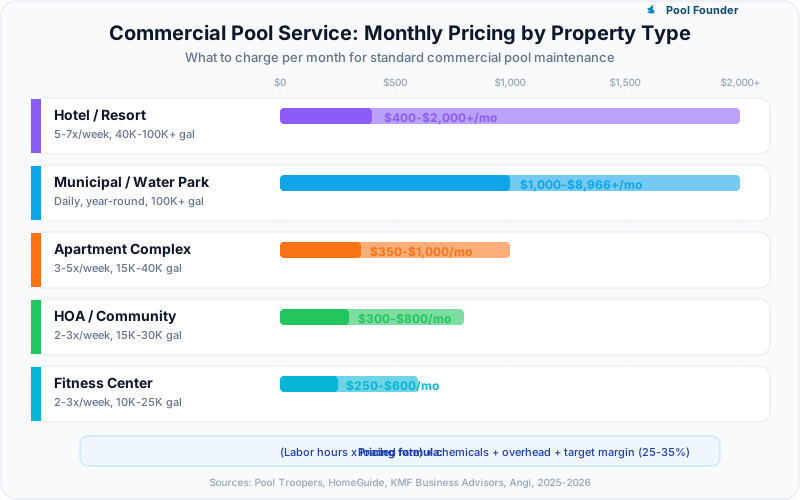
Commercial pool service pricing varies widely based on property type, pool size, bather load, and required service frequency. The table below summarizes typical monthly and annual pricing across the most common commercial property categories. These ranges assume a standard service scope that includes chemical balancing, surface skimming, vacuuming, filter maintenance, and basic equipment checks.
| Property Type | Typical Pool Size | Service Frequency | Monthly Price Range | Annual Contract Value |
|---|---|---|---|---|
| Hotel / Resort | 40,000-100,000+ gal | 5-7x per week | $400-$2,000+ | $4,800-$24,000+ |
| HOA / Community | 20,000-60,000 gal | 3-5x per week | $300-$800 | $3,600-$9,600 |
| Apartment Complex | 15,000-40,000 gal | 3-5x per week | $250-$600 | $3,000-$7,200 |
| Fitness Center / Gym | 20,000-50,000 gal | 3-5x per week | $300-$700 | $3,600-$8,400 |
| Water Park / Municipal | 100,000-500,000+ gal | Daily | $1,500-$5,000+ | $18,000-$60,000+ |
| Residential (comparison) | 10,000-20,000 gal | 1x per week | $80-$200 | $960-$2,400 |
$3,000-$20,000+
Typical annual cost range for commercial pool maintenance
Source: Pool Troopers
Hotel and resort pools sit at the top of the pricing spectrum because they combine large water volume, high daily bather loads, extended operating hours, and strict guest-experience expectations. A Florida-based commercial pool specialist reports charging approximately $600 per month per hotel client for standard maintenance, with additional fees for spa service, water features, and emergency calls. Properties with multiple pools or pool-spa combinations routinely exceed $1,500 per month.
HOA and community pools represent the most common entry point for pool service companies expanding into commercial work. These accounts are attractive because they follow a seasonal pattern in many markets, the decision-making process involves a board vote rather than a single property manager, and the pools are generally well-maintained with predictable chemical consumption. Monthly pricing of $300 to $800 reflects the range from a single community pool with three visits per week to a clubhouse facility with a pool, spa, and wading area serviced five times per week.
Apartment complex pools and fitness center pools fall in a similar price range of $250 to $700 per month. Apartment pools tend toward the lower end because they are often smaller and have less complex filtration systems, while fitness center pools with lap lanes and higher turnover rates push toward the higher end. Both property types typically require three to five service visits per week during peak season.
What Factors Determine Commercial Pool Pricing?
Pricing a commercial pool account accurately requires evaluating six primary cost drivers. Misjudging any one of them can turn a profitable contract into a money-losing obligation that ties up your schedule for an entire year. The following factors should be assessed during your initial site visit and factored into every commercial bid.
Pool Volume and Surface Area
Pool volume is the single most important variable in commercial pricing because it directly determines chemical consumption, circulation time, and the physical effort required per visit. A 50,000-gallon community pool requires roughly five times the chemicals of a 10,000-gallon residential pool, but the labor time does not scale linearly. Brushing, skimming, and vacuuming a larger pool takes more time, but chemical testing and equipment checks remain relatively fixed. Always measure or verify pool volume during your site survey rather than relying on the property manager estimate.
Bather Load
Bather load refers to the number of swimmers using the pool on a daily and weekly basis. High bather loads introduce more contaminants, including sweat, sunscreen, body oils, and organic matter, which consume sanitizer faster and demand more frequent chemical adjustments. A hotel pool with 100 daily swimmers will require significantly more chlorine and shock treatments than a fitness center pool with 20 daily lap swimmers, even if the pools are the same size. Bather load is the primary reason commercial chemical costs run two to five times higher than residential.
Service Frequency
Most commercial pools require service three to seven times per week compared to the once-weekly standard for residential pools. Service frequency is dictated by local health codes, bather load, and the property type. Hotel pools in warm climates often require daily service to maintain water clarity and compliance. HOA pools may only need three visits per week during the off-season but five during summer. Your pricing must account for the total number of annual visits, not just a weekly rate.
Chemical Costs
Chemical costs for commercial pools are substantially higher than residential due to larger volumes and heavier bather loads. A residential pool might consume $50 to $100 per month in chemicals, while a commercial pool can easily require $200 to $500 or more per month. Pools with automatic chemical feeders reduce labor time but still consume the same volume of product. When bidding a commercial account, estimate chemical costs based on pool volume and bather load rather than applying a flat markup to your residential chemical budget.
Compliance and Regulatory Requirements
Commercial pools are subject to health department inspections, water quality reporting requirements, and safety regulations that do not apply to residential pools. Many states require a Certified Pool Operator (CPO) or Aquatic Facility Operator (AFO) to oversee commercial pool maintenance. Your pricing should include the cost of maintaining these certifications, the time required for record-keeping and documentation, and the overhead of responding to health department inquiries or inspection findings.
Location and Emergency Response
Drive time to the property, regional cost-of-living differences, and emergency response expectations all factor into commercial pricing. A hotel pool that requires a two-hour response time for emergencies commands a higher price than an apartment complex with next-business-day service level agreements. Properties that are far from your existing route density add disproportionate drive time cost per visit and should be priced accordingly.
Always conduct a thorough site visit before submitting a commercial bid. Inspect the pool condition, equipment age, filtration system, chemical feeder setup, and access logistics. Ask the property manager for historical water test records and any recent health department inspection reports. These details directly affect your cost estimate and prevent surprises after the contract is signed.
How to Price Commercial Pool Service Contracts
The most reliable method for pricing commercial pool service is cost-plus pricing: calculate your total cost to service the account, then add your target profit margin. This approach ensures every contract is profitable on its own merits rather than relying on portfolio-level averages to smooth out underpriced accounts. Cost-plus pricing also gives you a defensible rationale when property managers push back on your bid.
Step 1: Calculate Your Direct Costs Per Visit
Start by estimating the direct cost of each service visit. Commercial visits typically take 45 to 90 minutes compared to 15 to 30 minutes for residential pools, so labor cost per visit is significantly higher. Include the fully loaded labor rate for your technician (wages plus payroll taxes, workers compensation, and benefits), chemical consumption per visit, and drive time to and from the property.
| Cost Component | Residential Visit | Commercial Visit | Notes |
|---|---|---|---|
| Labor (on-site) | $12-$25 | $35-$75 | Based on 15-30 min vs 45-90 min at $25-$50/hr loaded rate |
| Chemicals per visit | $8-$15 | $20-$50 | 2-5x higher for commercial due to volume and bather load |
| Drive time cost | $5-$10 | $8-$15 | Commercial sites may be farther from route clusters |
| Equipment wear | $2-$5 | $5-$10 | Heavier use of vacuum, brushes, and testing supplies |
| Total per visit | $27-$55 | $68-$150 | Direct cost before overhead and profit |
Step 2: Add Overhead Allocation
Overhead includes the costs that support your commercial operations but cannot be assigned to a single visit: commercial general liability insurance (higher limits required for commercial work), vehicle costs, office and administrative expenses, CPO or AFO certification maintenance, compliance record-keeping time, and equipment maintenance. A common approach is to calculate your total monthly overhead and allocate a proportional share to each commercial account based on the number of visits. Most commercial pool service operators find that overhead adds 20% to 30% on top of direct costs.
Step 3: Apply Your Target Margin
Industry data from KMF Business Advisors reports that pool service companies average approximately 18% net profit margin, though well-run operations can achieve 25% to 30%. For commercial accounts, target a minimum of 20% net margin after all direct costs and allocated overhead. This accounts for the additional risk, longer payment cycles, and higher liability exposure inherent in commercial work.
Use this formula for any commercial bid: Monthly Price = (Direct Cost Per Visit x Monthly Visits) x (1 + Overhead %) x (1 + Target Margin %). Example: $100/visit x 20 visits/month = $2,000 direct cost. Add 25% overhead ($2,500) then 20% margin = $3,000/month contract price.
Step 4: Structure the Contract
Annual contracts with monthly billing are the standard for commercial pool service. This structure provides revenue predictability for your business and budget predictability for the property manager. Most commercial contracts include a base monthly rate that covers routine maintenance visits, chemical supply, and basic equipment inspections. Equipment repairs, major chemical treatments (such as draining and refilling), and emergency calls outside of normal business hours are typically billed separately at agreed-upon rates specified in the contract.
Include clear terms for annual price adjustments, typically tied to chemical cost indexes or a fixed percentage increase of 3% to 5% per year. This prevents margin erosion from rising input costs. Also include a fuel surcharge clause that activates when fuel prices exceed a specified threshold, protecting your drive time costs during volatile periods.
How Does Commercial Pricing Compare to Residential?
The headline numbers for commercial pool service look impressive: contracts worth $300 to $2,000 per month compared to $80 to $200 for residential. But the real comparison that matters for your business is revenue per labor hour and net profit per account. When you factor in longer service times, higher chemical costs, and increased overhead, the economic picture is more nuanced than the monthly invoice suggests.
| Metric | Residential | Commercial | Advantage |
|---|---|---|---|
| Monthly revenue per account | $80-$200 | $250-$2,000+ | Commercial (3-10x higher) |
| Time per visit | 15-30 min | 45-90 min | Residential (faster turnover) |
| Revenue per labor hour | $65-$120 | $55-$100 | Residential (slightly higher) |
| Chemical cost per visit | $8-$15 | $20-$50 | Residential (lower input cost) |
| Visits per week | 1 | 3-7 | Residential (less time commitment) |
| Annual contract value | $960-$2,400 | $3,000-$24,000+ | Commercial (higher total value) |
| Typical net margin | 20-30% | 15-22% | Residential (lower overhead) |
| Payment reliability | Variable | High (net-30 invoicing) | Commercial (contract-backed) |
| Client retention | 85-90% annual | 90-95% annual | Commercial (switching costs higher) |
Revenue per labor hour often favors residential service, where a technician can complete four to six stops per hour on a tight route, generating $65 to $120 per hour in revenue. Commercial visits generate less revenue per hour of on-site labor, typically $55 to $100, because the service time is longer and the revenue does not scale proportionally. However, commercial accounts offer significantly higher revenue per account, more predictable payment through net-30 invoicing on annual contracts, and stronger retention rates of 90% to 95% annually compared to 85% to 90% for residential. Most operators running commercial accounts automate the net-30 cycle with pool service invoicing software so contract billing does not become a second job.
~18%
Average net profit margin for pool service companies
Source: KMF Business Advisors
The most profitable pool service companies maintain a balanced mix of both commercial and residential accounts. Residential accounts provide high revenue-per-hour efficiency and fill route density, while commercial accounts provide revenue stability, higher total contract values, and year-round income in seasonal markets where residential customers may pause service during winter months. A common target is 20% to 30% of total revenue from commercial accounts for companies with fewer than five technicians, scaling to 40% to 50% for larger operations with dedicated commercial crews. Once you are juggling both account types across multiple crews, pool service dispatch software keeps commercial visit windows from colliding with residential route days.
Commercial accounts have higher switching costs for the client, which translates to stronger retention. Once a property manager has a reliable pool service provider, the cost and disruption of switching (new vendor vetting, contract negotiation, transition period risk) makes them reluctant to change unless service quality drops significantly.
What Should Be Included in a Commercial Pool Service Quote?
A professional commercial pool service quote serves two purposes: it demonstrates your competence to the property manager and it protects your margins by clearly defining what is and is not included. Incomplete quotes lead to scope creep, where the client expects services you never intended to provide at the quoted price. Every commercial quote should address the following components.
Scope of Routine Maintenance
- Water chemistry testing and chemical balancing (specify parameters: free chlorine, pH, alkalinity, calcium hardness, CYA, TDS)
- Surface skimming and debris removal from pool and deck area
- Brushing of walls, steps, and tile line
- Vacuuming as needed (specify frequency: every visit, weekly, or as needed)
- Skimmer basket and pump basket cleaning
- Filter inspection, cleaning, and backwashing (specify frequency)
- Water level monitoring and adjustment
- Equipment function check (pumps, heaters, chemical feeders, automation systems)
Equipment Maintenance and Repairs
Commercial contracts commonly include basic equipment maintenance such as lubrication, gasket inspection, and minor adjustments as part of the monthly fee. Clearly separate routine equipment maintenance from repairs. Define a dollar threshold (for example, $250) below which repairs are included in the monthly rate and above which they require separate approval and billing. This prevents disputes and ensures you are compensated for significant repair work.
Chemical Supply
Specify whether chemicals are included in the monthly rate or billed separately. Including chemicals simplifies billing and gives the client budget certainty, but exposes you to cost fluctuations. If you include chemicals, add a contract clause that allows price adjustments if chemical costs increase more than 10% to 15% above the baseline established at contract signing. Many commercial operators prefer chemicals-included pricing because it prevents clients from purchasing inferior products that create water quality problems you must then correct.
Emergency Response and After-Hours Service
Define your emergency response commitment clearly. Specify the guaranteed response time (for example, within two hours during business hours, within four hours after hours), the hourly rate for emergency calls (typically 1.5x to 2x your standard rate), and any minimum call-out charge. Hotels and high-traffic commercial properties will often pay a premium for faster response guarantees because a closed pool directly impacts guest satisfaction and revenue.
Exclusions and Additional Services
- Major equipment replacement (pumps, heaters, filters) billed separately with prior approval
- Pool draining, acid washing, or resurfacing treated as separate projects
- Structural repairs to the pool shell, deck, or enclosure
- Lifeguard services, pool opening/closing staffing, or event support
- Damage caused by third parties, vandalism, or natural disasters
- Upgrades to automation, lighting, or filtration systems
- Health department application fees or permit renewals (may be included by agreement)
Bundled vs. Itemized Pricing
Bundled pricing presents a single monthly fee that covers all routine services and chemicals. This approach is simpler for the client, reduces billing disputes, and makes it harder for competitors to undercut you on individual line items. Itemized pricing breaks out labor, chemicals, equipment maintenance, and other components separately. While some property managers prefer the transparency of itemized pricing, it invites line-item negotiation and makes it easier for competitors to cherry-pick specific services to underbid.
For most commercial accounts, bundled pricing is the stronger strategy. It positions your service as a complete solution rather than a collection of tasks, reduces administrative overhead from itemized invoicing, and protects your margins from line-item negotiation. Reserve itemized pricing for large municipal or institutional accounts where procurement rules require it.
Every commercial quote should also include your contract terms: duration (typically 12 months with auto-renewal), payment terms (net-15 or net-30), annual escalation clause, cancellation terms (typically 30 to 60 days written notice), and your insurance coverage details. Attach a copy of your Certificate of Insurance showing commercial general liability coverage of at least $1 million per occurrence and $2 million aggregate, which is the minimum most commercial property managers require.
Ready to streamline your pool service business?
Pool Founder gives you route optimization, automated invoicing, chemical tracking, and everything else you need to run a more profitable pool business.
Frequently Asked Questions
How much more should I charge for commercial pool service compared to residential?
Commercial pool service typically costs three to ten times more than residential service on a per-account basis, with monthly rates ranging from $250 to $2,000 or more compared to $80 to $200 for residential. However, the premium is not arbitrary. It reflects the higher chemical consumption (two to five times residential), longer service visits (45 to 90 minutes versus 15 to 30 minutes), increased service frequency (three to seven visits per week instead of one), additional compliance overhead, and greater liability exposure. Rather than applying a simple multiplier to your residential rate, use cost-plus pricing to calculate the actual cost of servicing each commercial account and add your target profit margin of 20% or more.
Should I include chemicals in my commercial pool service contract price?
Including chemicals in your commercial contract price is the preferred approach for most pool service companies because it gives property managers budget predictability, prevents clients from purchasing low-quality chemicals that create water problems you must fix, and simplifies your monthly invoicing. The risk is that chemical costs can fluctuate significantly due to supply chain disruptions or demand spikes. Protect yourself by including a contract clause that permits a price adjustment if chemical costs rise more than 10% to 15% above the baseline established at contract signing. Estimate monthly chemical costs based on pool volume and bather load during your site survey, then add a 15% to 20% buffer to your chemical cost estimate to absorb normal price variations.
What profit margin should I target on commercial pool service accounts?
The pool service industry averages approximately 18% net profit margin across all account types according to KMF Business Advisors. For commercial accounts specifically, target a minimum of 20% net margin after all direct costs (labor, chemicals, drive time, equipment wear) and allocated overhead (insurance, certifications, administration, vehicle costs). Well-run commercial operations can achieve 25% to 30% net margin by optimizing route density, negotiating bulk chemical pricing, training technicians for faster service times, and including annual escalation clauses that keep pace with cost increases. If your margin on a commercial account falls below 15%, the account is likely underpriced and should be renegotiated at the next renewal.
How do I win commercial pool service contracts away from established competitors?
Winning commercial contracts requires demonstrating reliability, professionalism, and compliance expertise rather than simply undercutting on price. Start by targeting properties that show signs of poor current service: cloudy water, algae staining, unkempt deck areas, or recent health department violations (which are public record in most jurisdictions). Approach the property manager with a free site assessment that identifies specific issues and presents a clear service plan. Include your CPO or AFO certification, proof of commercial insurance coverage, and references from existing commercial clients. Offer a 90-day trial period at your full contract rate so the property manager can evaluate your service quality before committing to a 12-month contract. Avoid leading with low pricing because property managers who select the cheapest bid tend to switch again the following year, creating a cycle of unprofitable short-term contracts.