Cloudy Water Is a Symptom. Diagnosing the Cause Is the Job.
Cloudy pool water is one of the most common customer complaints and one of the most frequently misdiagnosed problems on a service route. "Cloudy water" is not a single condition. It has at least six distinct causes, and each one requires a different fix. Dumping clarifier into every cloudy pool is like giving aspirin for every headache, sometimes it works, and sometimes you miss the brain tumor. Diagnosing the specific cause first, then applying the targeted fix, is what separates a professional tech from a chemical dispenser.
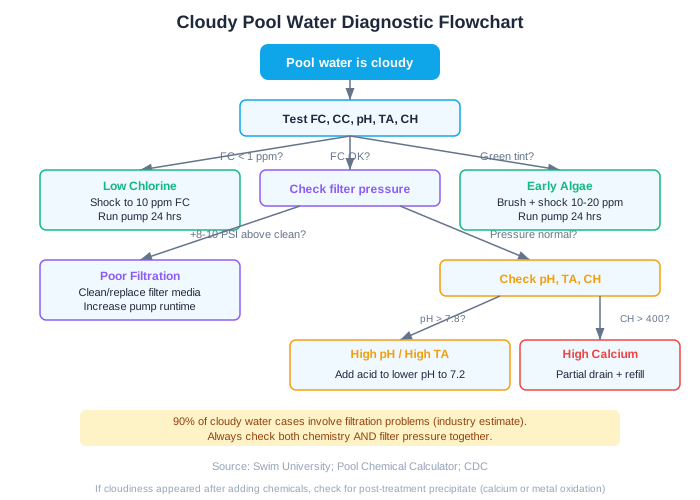
Corey Adams, Pool Founder co-founder and 15-year pool service veteran, has a diagnostic routine he runs on every cloudy pool before adding a single chemical. "I test FC, CC, pH, TA, calcium hardness, and check the filter pressure. That takes three minutes. Those six readings tell me which of the six causes I am dealing with. If I skip the tests and just throw clarifier and shock in, I get a callback 50% of the time because I treated the wrong problem."
This guide covers the six main causes of cloudy pool water, the diagnostic test for each one, and the correct treatment. Use this as a field reference when you encounter cloudiness on your route.
What Are the Six Main Causes of Cloudy Pool Water?
Every cloudy pool fits into one of these six categories. The causes overlap occasionally (a pool can have both a filtration problem and a chemistry problem), but identifying the primary driver is the first step to clearing the water efficiently.
| Cause | Key Diagnostic | Most Common Trigger |
|---|---|---|
| Low free chlorine / chloramines | FC below 1 ppm, CC above 0.5 ppm | Skipped service visit, heavy bather load, rain |
| Poor filtration | High filter pressure, short pump runtime | Dirty filter, undersized pump, insufficient runtime |
| High pH and/or high alkalinity | pH above 7.8, TA above 120 ppm | CO2 outgassing, salt cell, infrequent acid addition |
| High calcium hardness | CH above 400 ppm | Hard fill water, cal-hypo overuse, evaporation without drain |
| Early algae bloom | Slight green tint, slippery walls, FC dropping fast | FC lapse combined with warm water and sunlight |
| Post-treatment precipitate | Cloudiness appears after adding chemical | Shocking high-CH water, adding incompatible chemicals |
90%
Estimated percentage of cloudy pool cases linked to filtration problems, per industry trade publications
That 90% figure from industry publications is misleading in one way: filtration is often the amplifier rather than the root cause. A pool with marginal filtration will show cloudiness from chemistry issues that would clear on their own in a pool with excellent filtration. Always check both chemistry and filtration.
Cause 1: How Does Low Chlorine Cause Cloudy Water?
When free chlorine drops below 1 ppm, bacteria, algae spores, and organic particles are no longer being oxidized and destroyed. These particles accumulate in the water and scatter light, creating cloudiness. Chloramines (combined chlorine) make it worse. When CC rises above 0.5 ppm, the water develops a milky, dull appearance even before visible algae appears.
Diagnosis
- Free chlorine below 1 ppm
- Combined chlorine above 0.3 ppm
- Water may have a slight chemical smell (chloramines)
- Walls may feel slightly slippery but not visibly green
Fix
- 1Lower pH to 7.2.
- 2Shock to 10 ppm FC (or 10x the CC reading if combined chlorine is the primary issue).
- 3Run the pump 24 hours.
- 4Retest after 12-24 hours. If FC holds above 2 ppm and the water is clearing, the cause was confirmed.
- 5Investigate why chlorine was low: missed service, undersized chlorine delivery, high demand, or CYA issue.
If the cloudiness does not improve within 24 hours of shocking and FC is still above 2 ppm, chlorine was not the cause. Move to the next diagnostic.
Cause 2: How Does Poor Filtration Cause Cloudy Water?
The filter is the primary mechanism for removing particles from pool water. A dirty, damaged, or undersized filter cannot capture the fine particles that cause cloudiness. Insufficient pump runtime compounds the problem because the water does not pass through the filter enough times per day to stay clear. A pool needs to turn over its entire volume at least once per day, which typically requires 8 to 12 hours of pump runtime depending on flow rate.
Diagnosis
- Filter pressure is 8-10 psi above the clean baseline (needs backwash or cleaning)
- Pump runs fewer than 8 hours per day
- Chemistry is normal (FC 2-4, pH 7.2-7.6, TA 80-120, CH under 400)
- Cloudiness persists despite correct chemistry
- Water is hazy/dull rather than green-tinted
Fix
- 1Clean the filter: backwash DE or sand filters, chemically clean cartridge filters.
- 2Check the filter media. Sand older than 5 years should be replaced. DE grids with holes need replacement. Cartridge filters older than 1-2 years may need replacement.
- 3Increase pump runtime to at least 8 hours per day in summer, 10-12 hours for pools that struggle with clarity.
- 4Add a clarifier (polyDADMAC or chitosan-based) to coagulate fine particles so the filter can capture them.
- 5If the pool clears within 24-48 hours of filter cleaning, filtration was confirmed as the cause.
Before adding clarifier, check if the filter is actually clean. Adding clarifier to a pool with a dirty filter makes the problem worse. The coagulated particles cannot pass through a clogged filter and end up circulating back into the pool.
Cause 3: How Do High pH and High Alkalinity Cause Cloudy Water?
When pH rises above 7.8 and total alkalinity exceeds 120 ppm, the water becomes supersaturated with calcium carbonate. The excess calcium carbonate precipitates out of solution as microscopic white particles, creating a persistent milky cloudiness that does not respond to shocking or clarifiers. This is particularly common in hard-water areas and on salt pools where pH drifts constantly.
Diagnosis
- pH above 7.8
- TA above 120 ppm (or above 80 on salt pools)
- Calcium hardness above 300 ppm
- Water has a white/milky appearance rather than green
- No slippery walls, no chemical smell
- Free chlorine is in normal range (2-4 ppm)
Fix
- 1Add muriatic acid to lower pH to 7.2 and begin reducing TA.
- 2Run the pump for at least 4 hours after acid addition.
- 3The precipitated calcium carbonate will slowly dissolve back into solution as pH drops.
- 4If cloudiness persists after pH correction, add a clarifier to help the filter capture remaining particles.
- 5Address the root cause: lower TA to target range for the pool type, manage pH proactively.
This cause is the one most commonly missed by techs who jump straight to shocking. Shocking a pool with high pH, high TA, and high calcium can actually make the cloudiness worse because cal-hypo raises pH further and adds more calcium.
Cause 4: How Does High Calcium Hardness Cause Cloudy Water?
When calcium hardness exceeds 400 ppm, the water struggles to hold the calcium in solution. Any pH spike, temperature increase, or aeration event can trigger calcium carbonate precipitation, creating cloudiness. Unlike the pH/TA cause above, this happens even at normal pH levels when CH is simply too high. The cloudiness may come and go with temperature changes, appearing worse on warm afternoons and clearer in the cool morning.
Diagnosis
- Calcium hardness above 400 ppm
- Cloudiness persists even after pH correction
- White scale visible on tile, waterline, or equipment
- LSI calculation shows positive (scale-forming) value
Fix
There is no chemical that removes calcium from pool water. The only fix is dilution: partial drain and refill with lower-calcium water. Drain 1/3 to 1/2 of the pool and refill. Retest calcium hardness after the refill and repeat if necessary. In the meantime, add a sequestrant to keep the remaining calcium in solution and prevent further precipitation.
Stop using calcium hypochlorite shock on pools with CH above 350 ppm. Every pound of 73% cal-hypo adds approximately 7 ppm of calcium hardness to a 10,000-gallon pool. Switch to liquid chlorine for all shocking on high-calcium pools.
Cause 5: How Does Early Algae Cause Cloudy Water?
Before algae becomes visibly green, the early stages create a hazy, slightly dull appearance. The water may have a faint green or teal tint that is easy to miss if you are not looking for it. Walls and floor may feel slightly slippery. Free chlorine is typically low or dropping fast. This is the most time-sensitive diagnosis because catching algae at this stage is far cheaper and faster to treat than a full green pool.
Diagnosis
- Faint green or teal tint (hold a white bucket in the water to compare)
- Walls feel slippery when you rub them with your fingers
- FC is below 2 ppm and/or dropping faster than normal
- pH may be slightly elevated (algae consume CO2, raising pH)
- Cloudiness appeared after a period of low chlorine or heavy rain
Fix
- 1Brush all walls, floor, and steps to break up biofilm.
- 2Lower pH to 7.2.
- 3Shock to 10-20 ppm FC depending on severity.
- 4Run the pump 24 hours continuously.
- 5Clean the filter 12 hours after shocking.
- 6Retest at 24 hours. If FC holds and water is clearing, maintain elevated FC (5+ ppm) for 48 hours to ensure complete kill.
The white bucket test: fill a white 5-gallon bucket with pool water and hold it up. If the water has even a slight green tint compared to tap water in another white container, that is early algae. Do not dismiss it as "just cloudy."
Cause 6: What Causes Cloudiness After Adding Chemicals?
Post-treatment cloudiness is the cause that generates the most confused callbacks. The customer's pool was clear before you serviced it, and now it is cloudy. This is usually not your fault, it is a chemical reaction, but you need to understand what happened and how to fix it.
Common Post-Treatment Cloudiness Triggers
| Trigger | What Happened | Fix |
|---|---|---|
| Cal-hypo shock in high-CH water | Added calcium pushed CH over saturation point, causing calcium carbonate precipitation | Lower pH with acid. The precipitate will dissolve. Switch to liquid chlorine for future shocking. |
| Shocking oxidized metals | Iron or copper in the water was oxidized by chlorine, forming visible particles | Add a sequestrant immediately. Do not add more chlorine. Filter for 24-48 hours. |
| Phosphate remover treatment | Lanthanum phosphate precipitate is forming (normal). Filter will capture it. | Run the pump. Clean the filter in 24-48 hours. The cloudiness will clear. |
| Incompatible chemicals added together | Certain products react when mixed. Common example: calcium chloride + sodium bicarbonate in same area. | Run the pump for 24 hours to distribute. Test all parameters. Adjust as needed. |
| Algaecide overdose | Excess copper-based algaecide causes a blue-green tint and foaming | Partial drain and refill. Do not add more chemicals. |
The most important step when a customer calls about cloudiness after service is to check what you added, test the water, and determine which reaction occurred. Do not just add clarifier on top of an undiagnosed chemical reaction.
Log every chemical addition in your service software with the product name and amount. When a callback comes in, you can review exactly what was added and narrow down the cause immediately without a return visit for testing.
Run a pool route?
The business side of what you just read.
Pricing, chemical costs, and the tools owners use to keep the numbers straight.
- Commercial pool service pricing2026 rate tables and the cost-plus formula
- Chemical cost per poolWhat chemicals actually cost per stop
- Chemical tracking softwareLog readings and dosing from the pool deck
- Pool service softwareRoutes, invoicing, and service reports in one app
- Free profit & rate calculatorsProfit per pool, minimum rate, break-even
Frequently Asked Questions
What is the most common cause of cloudy pool water?
The most common cause is inadequate filtration, either from a dirty/clogged filter, insufficient pump runtime, or worn filter media. However, filtration problems are often amplified by chemistry issues (low chlorine, high pH, high calcium). Always test chemistry and check filter pressure together.
Why is my pool cloudy even though chlorine is high?
If free chlorine is above 2 ppm and the pool is still cloudy, the cause is not chlorine-related. Check pH and calcium hardness. High pH (above 7.8) combined with high calcium hardness (above 400 ppm) causes calcium carbonate precipitation, which creates persistent milky cloudiness. Also check the filter. A dirty filter cannot clear particles regardless of chlorine level.
Will pool shock clear cloudy water?
Shocking only clears cloudy water when the cause is low chlorine, chloramines, or early algae. If the cloudiness is caused by high calcium, high pH, poor filtration, or a post-treatment chemical reaction, shocking will not help and may make the problem worse (especially if using cal-hypo in high-calcium water). Diagnose the cause before reaching for the shock bag.
How long does it take for cloudy pool water to clear?
With the correct treatment and proper filtration, most cloudy pools clear in 24 to 48 hours. Low chlorine/early algae cases may take 24 to 72 hours depending on severity. High calcium cases may require a partial drain and take 2 to 3 days. If the water does not show improvement within 24 hours of treatment, the diagnosis may be wrong.
Does clarifier fix cloudy pool water?
Clarifier helps the filter capture fine particles by coagulating them into larger clumps. It works well as a finishing step after the root cause has been addressed. It does not fix the underlying chemistry or filtration problem. Adding clarifier to a pool with a dirty filter or out-of-balance chemistry is a waste of product.
Can high alkalinity cause cloudy water?
Yes. When total alkalinity exceeds 120 ppm and pH rises above 7.8, the water becomes supersaturated with calcium carbonate. The excess precipitates as fine white particles causing milky cloudiness. The fix is to lower pH with muriatic acid, which also brings TA down over time. Target TA in the 80-100 ppm range to prevent recurrence.
Sources & References
- Swim University: How to Clear Cloudy Pool Water in 48 Hours or Less
- Pool Chemical Calculator: Cloudy Pool Water Causes, Fixes, and Prevention
- HubPages: 7 Causes of Cloudy Swimming Pool Water and How to Clear It
- CDC: Healthy Swimming Water Quality Guidelines
- Indiana Department of Health: Chemical Adjustment in Swimming Pools