Not All Chlorine Is the Same. Here Is What Actually Matters.
Every pool chlorine product delivers the same active sanitizer: hypochlorous acid. But the carrier it arrives in changes everything about your route, your chemical costs, and what happens to the water over time. Liquid sodium hypochlorite adds no cyanuric acid or calcium. Trichlor tabs add both CYA and acid. Cal-hypo raises calcium and pH. Choosing the wrong chlorine type for a given pool costs you money and creates water balance problems that stack up over months.
"I ran trichlor on every pool for my first three years," says Corey Adams, Pool Founder co-founder and 15-year pool service veteran. "Then I started seeing CYA levels above 100 ppm on half my route by August. Once I learned the chemistry behind each chlorine type, I could match the right product to each pool and cut my callback rate in half." This guide breaks down the five major chlorine types by available chlorine content, cost per pound of actual chlorine delivered, secondary chemical effects, and best use cases.
What Is Available Chlorine and Why Does It Matter?
Available chlorine is the percentage of a product that actually becomes hypochlorous acid in the water. A product with 12% available chlorine means 88% of what you are pouring is water or inert carrier. This number is the only honest way to compare costs across chlorine types. A pound of trichlor at 90% available chlorine delivers far more sanitizer than a pound of liquid chlorine at 12.5%.
| Chlorine Type | Available Chlorine | Form | pH Effect |
|---|---|---|---|
| Sodium Hypochlorite (liquid) | 10-12.5% | Liquid | Raises pH |
| Trichlor | 90% | Tabs/sticks | Lowers pH |
| Dichlor | 56-62% | Granular | Near neutral |
| Calcium Hypochlorite | 65-73% | Granular/tabs | Raises pH |
| Lithium Hypochlorite | 29-35% | Granular | Raises pH slightly |
When comparing prices, always divide the product cost by the weight of available chlorine it delivers. A $4 gallon of 12.5% liquid chlorine contains about 1.04 lbs of available chlorine. A $5 per pound trichlor tab contains 0.9 lbs. The math changes the picture completely.
How Does Liquid Chlorine Compare to Tabs for Service Routes?
Liquid sodium hypochlorite (bleach) at 10-12.5% concentration is the workhorse of professional pool service. It adds zero cyanuric acid and zero calcium to the water. That means no CYA buildup over the season and no contribution to calcium hardness. The downside is weight and shelf life. A case of four gallons weighs about 36 pounds, and liquid chlorine loses roughly 10% of its strength per month when stored above 75 degrees Fahrenheit.
Liquid Chlorine Pros and Cons
- No CYA addition. Ideal for pools that already use trichlor tabs or have CYA above 50 ppm.
- No calcium addition. Safe for pools with hard fill water or calcium hardness above 300 ppm.
- Fast dissolving. Immediately available in the water. No dissolving time needed.
- Heavy and bulky. 128 oz per gallon, roughly 8.6 lbs per gallon. A full truck bed of liquid chlorine is a lot of weight.
- Short shelf life. Degrades in heat. Buy fresh and use within 2-4 weeks for best results.
- Raises pH. Liquid chlorine has a pH around 13. You will need muriatic acid on almost every visit.
At current retail pricing, liquid chlorine runs approximately $3.50-5.00 per gallon at pool supply stores. At 12.5% strength, that works out to roughly $3.35-4.80 per pound of available chlorine. Buying in bulk from a chemical distributor drops the cost to $2.00-3.00 per gallon, which is why most high-volume service companies use liquid chlorine as their primary sanitizer.
When Should You Use Trichlor Tablets on a Pool?
Trichlor (trichloroisocyanuric acid) is the most popular chlorine product for residential pools. At 90% available chlorine, it packs more sanitizer per pound than any other pool chlorine product. A single 8-oz tab in a chlorinator or floater can maintain chlorine levels for 5-7 days in a typical 10,000-15,000 gallon pool. That convenience is why pool owners love them and why every pool store stocks pallets of 3-inch tabs.
The CYA Problem with Trichlor
Every pound of trichlor adds approximately 6 ppm of cyanuric acid to 10,000 gallons of water. On a weekly service route using 1-2 tabs per week, CYA accumulates at roughly 3-6 ppm per month. By mid-summer, many trichlor-only pools hit 80-100+ ppm CYA, which locks up chlorine effectiveness. At CYA above 70 ppm, you need to maintain much higher free chlorine levels to get the same kill rate. The only way to lower CYA is dilution through partial drain and refill.
Trichlor also has a pH of about 2.8, making it highly acidic. While this can offset the pH rise from liquid chlorine supplementation, relying solely on trichlor tends to drive pH and alkalinity down over time. You will end up adding sodium bicarbonate or soda ash to compensate.
"I use trichlor as a supplement, not a primary sanitizer. One tab in the skimmer between visits keeps a residual going. Then I dose liquid chlorine to hit the target on service day. This keeps CYA under control while giving the customer that steady chlorine level they expect." - Corey Adams
What Is Dichlor and When Does It Make Sense?
Dichlor (sodium dichloro-s-triazinetrione) is a granular chlorine with 56-62% available chlorine. It dissolves fast, has a near-neutral pH of about 6.7, and is stabilized with cyanuric acid. It costs more per pound of available chlorine than trichlor or liquid, which is why most service companies only use it in specific situations.
Best Use Cases for Dichlor
- Spas and hot tubs. The fast-dissolving granular form is ideal for small bodies of water where a trichlor tab would overdose chlorine.
- Initial startup chlorination. When filling a new pool, dichlor adds both chlorine and a starter dose of CYA simultaneously.
- Vinyl liner pools. Dichlor dissolves completely and does not bleach liners the way undissolved cal-hypo granules can.
- Quick spot treatment. Sprinkle directly on algae spots for fast contact kill without pre-dissolving.
Like trichlor, dichlor contributes CYA to the water, roughly 9 ppm per pound per 10,000 gallons. For ongoing weekly service, this CYA accumulation makes dichlor a poor primary choice. Reserve it for spas, startups, and targeted treatment.
How Does Calcium Hypochlorite Stack Up for Commercial Pools?
Calcium hypochlorite (cal-hypo) delivers 65-73% available chlorine in granular or tablet form. It contains no cyanuric acid, making it the go-to choice for commercial pools where health departments cap CYA levels at 40-100 ppm depending on the jurisdiction. It is also the chlorine type used in most superchlorination (shock) treatments because of its high available chlorine content and zero CYA contribution.
Cal-Hypo Trade-Offs
- Adds calcium. Each pound adds roughly 7 ppm of calcium hardness to 10,000 gallons. In hard-water areas like Arizona, Texas, and Florida, this accelerates scale formation.
- Raises pH. Cal-hypo has a pH around 10.8. Budget for muriatic acid on every visit.
- Must be pre-dissolved. Tossing granules directly into a vinyl or dark-finish pool causes bleaching. Always dissolve in a bucket of water first.
- Fire and explosion hazard. Cal-hypo is a strong oxidizer. Never mix with trichlor, organics, or moisture in storage. Store separately from all other chemicals.
According to Aquatics International, when factoring in the cost of pH-adjusting chemicals needed alongside each product, the total cost per pound of available chlorine for cal-hypo averages around $3.50, while trichlor comes in around $4.25 after adding sodium bicarbonate to counteract its acidity. This makes cal-hypo the more cost-effective option for high-volume commercial applications.
Never store cal-hypo and trichlor in the same container, the same bucket, or even on the same shelf. These two chemicals react violently when mixed and can cause fire or toxic chlorine gas release. Keep them separated by at least 10 feet in your truck and storage area.
Is Lithium Hypochlorite Still Worth Considering?
Lithium hypochlorite was once the premium choice for vinyl liner and fiberglass pools because it dissolves instantly and does not cloud the water. At 29-35% available chlorine, it was always the least concentrated and most expensive option. After global lithium prices surged due to electric vehicle battery demand, pool-grade lithium hypochlorite became extremely scarce and prohibitively expensive. Most manufacturers have discontinued production for the pool market.
If you have customers asking for lithium hypo, the practical replacement is dichlor for quick-dissolve applications or pre-dissolved cal-hypo for non-stabilized needs. The only scenario where lithium hypo was genuinely irreplaceable was extremely cold water treatment, where other granular products dissolve slowly. For most service work, it is no longer a viable option.
What Is the Real Cost Per Pound of Available Chlorine for Each Type?
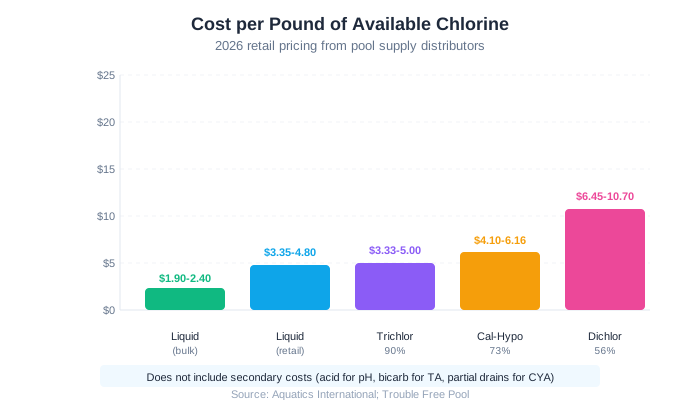
Comparing chlorine products by sticker price is misleading. A pound of trichlor costs more than a gallon of liquid, but it contains seven times more available chlorine. The only fair comparison is cost per pound of available chlorine delivered. The table below uses typical 2026 retail pricing from pool supply distributors.
| Product | Typical Cost | Available Cl | Cost per lb Available Cl |
|---|---|---|---|
| Liquid NaOCl (12.5%) | $3.50-5.00/gal | ~1.04 lbs/gal | $3.35-4.80 |
| Trichlor tabs | $3.00-4.50/lb | 0.90 lbs/lb | $3.33-5.00 |
| Dichlor granular | $4.00-6.00/lb | 0.56-0.62 lbs/lb | $6.45-10.70 |
| Cal-hypo 73% | $3.00-4.50/lb | 0.73 lbs/lb | $4.10-6.16 |
| Lithium hypo | $8.00-15.00/lb | 0.35 lbs/lb | $22.85-42.85 |
These numbers do not include secondary chemical costs. Liquid chlorine requires muriatic acid to offset pH rise. Trichlor requires sodium bicarbonate to offset pH and alkalinity drop, plus periodic partial drains to manage CYA. Cal-hypo requires muriatic acid for pH and potentially a scale inhibitor in hard water. When you factor in those secondary costs, liquid chlorine and cal-hypo tend to be the most economical for high-volume service operations.
Bulk liquid chlorine from a chemical distributor at $2.00-2.50 per gallon brings the cost per pound of available chlorine down to $1.90-2.40, making it the cheapest option for service companies running 80+ pools per week.
How Should You Choose the Right Chlorine Type for Each Pool?
The right chlorine depends on the pool, not your preference. Match the product to the water chemistry, surface type, and customer situation. Here is a decision framework that works for most residential service routes.
- CYA below 30 ppm and outdoor pool: Trichlor tabs to build stabilizer while maintaining chlorine. Switch to liquid once CYA hits 50 ppm.
- CYA above 50 ppm: Liquid chlorine only. No more stabilized products until CYA comes down through dilution.
- Hard fill water (calcium above 300 ppm): Avoid cal-hypo. Use liquid chlorine or trichlor.
- Vinyl liner or fiberglass: Avoid direct contact with undissolved cal-hypo granules. Use liquid, trichlor in a floater, or pre-dissolved cal-hypo.
- Commercial pool with CYA cap: Liquid chlorine or cal-hypo. No stabilized products.
- Spa or hot tub: Dichlor granular for quick dissolve in small volume. Drain and refill regularly to manage CYA.
Track chlorine type and dosing per pool in your service software. Over time, you will see patterns that help you standardize your truck stock. Most experienced service techs carry liquid chlorine as their primary product, keep a bucket of trichlor tabs for supplemental dosing, and stock a bag of cal-hypo for shock treatments.
Run a pool route?
The business side of what you just read.
Pricing, chemical costs, and the tools owners use to keep the numbers straight.
- Commercial pool service pricing2026 rate tables and the cost-plus formula
- Chemical cost per poolWhat chemicals actually cost per stop
- Chemical tracking softwareLog readings and dosing from the pool deck
- Pool service softwareRoutes, invoicing, and service reports in one app
- Free profit & rate calculatorsProfit per pool, minimum rate, break-even
Frequently Asked Questions
What is the cheapest type of pool chlorine for service companies?
Bulk liquid sodium hypochlorite at 12.5% from a chemical distributor is typically the cheapest option at $1.90-2.40 per pound of available chlorine. Retail pricing pushes that to $3.35-4.80, at which point trichlor tabs become competitive on a per-pound-of-available-chlorine basis.
Can you mix different types of pool chlorine?
Never mix different chlorine products directly. Trichlor and cal-hypo react violently and can cause fire or toxic gas. You can use different chlorine types in the same pool at different times, but never combine them in a bucket, feeder, or storage area.
Why do trichlor tabs raise cyanuric acid levels?
Trichlor is a stabilized chlorine, meaning cyanuric acid is chemically bonded into the tablet. When the tab dissolves, it releases both chlorine and CYA. Every pound of trichlor adds approximately 6 ppm of CYA per 10,000 gallons. Over a season, this accumulates to levels that reduce chlorine effectiveness.
Is cal-hypo or liquid chlorine better for shocking a pool?
Cal-hypo at 65-73% available chlorine is the industry standard for shock treatments because it delivers a high dose quickly without adding cyanuric acid. Liquid chlorine also works and is preferred for vinyl liner pools since it cannot leave undissolved granules that bleach the liner.
How long does liquid chlorine last in storage?
Liquid chlorine loses approximately 10% of its strength per month when stored above 75 degrees Fahrenheit. In hot climates, it can degrade even faster. Buy fresh, store in a cool shaded area, and use within 2-4 weeks for best results.
What happened to lithium hypochlorite for pools?
Global lithium prices surged due to demand for electric vehicle batteries, making pool-grade lithium hypochlorite too expensive to produce. Most manufacturers have discontinued it. Dichlor and pre-dissolved cal-hypo are the recommended replacements for applications where lithium hypo was previously used.
Sources & References
- Aquatics International - Comparing Operating Costs of Calcium Hypochlorite and Trichlor
- Trouble Free Pool - Chlorine Cost Calculator
- AutoPilot - Cost Comparison of Salt Chlorinator vs Liquid Chlorine, Trichlor, and Cal-Hypo
- Service Industry News - Liquid Chlorine Prices Rise, Trichlor Prices Fall
- Indiana Department of Health - Adjusting Chemical Levels in Swimming Pools