Why Should Your Pool Company Pursue HOA Pool Service Contracts?
HOA pool service contracts are some of the most stable revenue you can add to your business. A single community pool account generates $300 to $800 per month in recurring income, and once you land the contract, expect to keep it for years. Industry data shows that vendors who deliver consistent service often retain HOA accounts for 15 to 18 years. That kind of retention does not exist in residential pool service, where customers cancel over a $10 price increase or switch to a neighbor with a truck and a test kit.
HOA pools are classified as commercial or public pools by local health departments. That means stricter water quality standards, mandatory record-keeping, and regular inspections. For most pool service companies, the compliance requirements feel like a burden. For you, they should feel like a competitive moat. Boards and property managers strongly prefer contractors who understand the rules and can keep the association out of trouble. If you can demonstrate compliance expertise in your proposal, you will beat competitors who treat HOA pools like oversized backyard pools.
This guide covers the full lifecycle of HOA pool service: finding opportunities, building your proposal, structuring the agreement, and managing the board relationship after you win the contract. If you already service HOA pools and want deeper contract details, see our HOA Pool Maintenance Contracts guide.
Where Do You Find HOA Pool Service Opportunities?
The biggest mistake pool companies make when chasing HOA work is going directly to individual boards. That approach works, but it is slow. A single HOA board might vote on pool service once a year, and if you miss the budget cycle, you wait another twelve months. The faster path is through property management companies. A single property management firm may oversee 20 to 50 communities in your area. Win the relationship with the property manager, and you gain access to every pool in their portfolio.
Property Management Companies
Start by identifying the largest property management companies in your service area. Most states require property management firms to be licensed, so your state regulatory agency maintains a public directory. You can also find them through Community Associations Institute (CAI) chapter meetings and local HOA trade shows. Reach out with a brief introduction that focuses on three things: your CPO or AFO certification, your commercial insurance coverage, and your compliance documentation process. Property managers care about protecting the association from liability. Lead with that.
Direct Board Outreach
For self-managed HOAs without a property management company, you will need to contact the board directly. Many communities publish board member contact information in public HOA directories or on their community website. Attend annual HOA meetings (most are open to vendors) and introduce yourself to the board president or facilities committee chair. Timing matters: most HOAs set annual budgets between September and November for a January fiscal year start. Submit your proposal by early October to be included in the budget discussion.
Referrals from Existing Clients
A warm referral from an existing HOA client is the single most effective way to win a new community pool contract. Board members talk to each other at inter-community events, and property managers share vendor recommendations across their portfolios. After your first six months of service, ask your primary contact for a referral. Offer to provide a written reference that they can share with other boards or property managers in their network. One strong referral can open five or ten new opportunities without a single cold call.
Spotting Underserved Properties
Drive your service area and look for HOA pools that show signs of poor current maintenance: cloudy water visible from the fence, algae staining on the walls, unkempt deck areas, or broken gate hardware. Health department inspection records are public in most jurisdictions, so you can also search for communities with recent violations. Approach the property manager with a free site assessment that identifies specific problems and outlines how your service would resolve them. This positions you as a problem-solver, not just another vendor submitting a bid.
When reaching out to property managers, keep your initial contact brief. A one-page introduction with your certifications, insurance limits, and three client references is more effective than a multi-page brochure. Property managers receive dozens of vendor pitches every month. Respect their time.
How Do You Build a Winning HOA Pool Service Proposal?
HOA boards are required to get at least three bids for major vendor contracts, and they are not looking for the lowest price. They are looking for the best combination of competence, reliability, and risk reduction. Your proposal needs to demonstrate all three. A detailed two-to-three-page proposal that clearly explains your experience and what you will do at every service visit outperforms a one-page quote with a monthly number every time.
Site Assessment Before You Quote
Never submit a proposal without visiting the property first. During your site visit, document the pool volume, equipment age and condition, filtration system type, chemical feeder setup, deck condition, and access logistics. Ask the property manager for historical water test records and any recent health department inspection reports. Take photos of everything. This information directly affects your cost estimate and prevents surprises after the contract is signed.
Proposal Structure That Wins
- Company overview: years in business, number of commercial accounts, CPO/AFO certification, and insurance coverage details
- Site assessment findings: specific observations about the pool condition and any immediate concerns
- Scope of services: every task included in the base monthly fee, listed explicitly
- Service frequency: exact number of weekly visits, days of the week, and seasonal adjustments
- Chemical management: whether chemicals are included or billed separately, and your product quality standards
- Compliance commitment: how you handle health department testing requirements, record-keeping, and permit management
- Reporting: what the board receives monthly (service logs, water chemistry reports, equipment condition updates)
- Emergency response: guaranteed response time and after-hours availability
- Pricing: tiered options (base package plus optional add-ons) with clear annual escalation terms
- References: three to five current HOA clients with property manager contact information
Compliance Checklist Differentiator
Include a compliance checklist in your proposal that maps your services to specific health department requirements. Most board members are volunteers with no background in pool regulations. When you show them a checklist that covers daily or twice-weekly testing schedules, record retention requirements, VGB Act drain cover inspections, annual permit management, and CPO-certified technician assignments, you educate them about their obligations and demonstrate that you are the only bidder who actually understands the rules. This single element wins more HOA contracts than any pricing strategy.
3+ bids
Number of bids HOA boards typically solicit for pool service contracts
Source: Community Associations Institute
What Should the Service Agreement Look Like?
A strong HOA pool service agreement protects both your company and the association while setting clear expectations. Unlike residential agreements that can be a single page, HOA contracts need to address multiple facilities, regulatory obligations, reporting requirements, and the unique governance structure of community associations.
Contract Duration and Renewal
A one-year initial term with automatic annual renewal and 60 to 90 days written notice for termination is the most common structure. Avoid month-to-month terms. The sales cycle for HOA accounts is long, and the onboarding costs are too high to risk cancellation without adequate notice. Multi-year contracts (two to three years) provide even better stability and give you leverage to offer slightly better pricing in exchange for the commitment.
Pricing and Escalation
Include an annual price adjustment clause tied to CPI or a fixed percentage increase of 3% to 5% per year. This prevents margin erosion from rising chemical costs and labor expenses. If chemicals are included in your monthly fee, add a clause that allows a mid-term price adjustment if chemical costs increase more than 10% to 15% above the baseline established at contract signing. Without these protections, a three-year contract can become unprofitable by year two.
| Agreement Element | Recommended Terms |
|---|---|
| Initial term | 1-3 years with automatic annual renewal |
| Termination notice | 60-90 days written notice by either party |
| Price adjustment | 3-5% annual increase or CPI-linked escalation |
| Payment terms | Net 30 from invoice date, monthly billing |
| Emergency response | 4-hour response during business hours |
| Repair authorization | Board approval required above $250-$500 threshold |
| Insurance minimum | $1M-$2M general liability, HOA named as additional insured |
| Record retention | 1-3 years depending on state requirements |
Liability and Indemnification
Your contract must clearly allocate liability between your company and the HOA. You assume liability for services performed under the agreement, but you should not accept unlimited liability for pre-existing conditions, structural defects, or actions taken by residents. Include mutual indemnification clauses and require the HOA to maintain its own liability insurance. Require that the HOA notify you immediately of any incidents, injuries, or complaints related to the pool.
Exclusions
Explicitly list what is not included in the base contract: major equipment replacement, pool draining and acid washing, structural repairs, lifeguard services, and damage from vandalism or natural disasters. This prevents scope creep and billing disputes. When a board member calls and asks you to pressure wash the deck or replace the pool furniture, you can point to the contract and offer the work as a separately priced add-on.
How Do You Price HOA Pool Service Profitably?
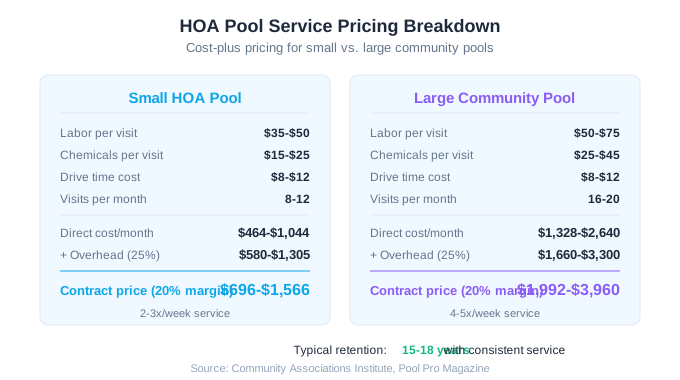
HOA pool service contracts typically range from $300 to $800 per month depending on the number of pools and spas, facility size, service frequency, and whether chemicals are included. The key to pricing profitably is cost-plus calculation, not competitive matching. If you price by copying a competitor bid, you inherit their mistakes.
Cost-Plus Pricing Formula
Calculate your direct cost per visit: labor (45 to 90 minutes at your fully loaded technician rate), chemicals consumed per visit, and drive time. Multiply by the number of monthly visits. Add your overhead allocation (insurance, certifications, administration, vehicle costs), typically 20% to 30% of direct costs. Then apply your target margin of 20% or more. This approach ensures every contract is profitable on its own merits.
| Cost Component | Small HOA Pool | Large Community Pool | Notes |
|---|---|---|---|
| Labor per visit | $35-$50 | $50-$75 | 45-90 min at $25-$50/hr loaded rate |
| Chemicals per visit | $15-$25 | $25-$45 | Based on pool volume and bather load |
| Drive time cost | $8-$12 | $8-$12 | Factor route proximity |
| Visits per month | 8-12 | 16-20 | 2-3x/week off-season, 4-5x/week peak |
| Monthly direct cost | $464-$1,044 | $1,328-$2,640 | Before overhead and profit |
| With overhead (25%) | $580-$1,305 | $1,660-$3,300 | Insurance, admin, vehicle |
| With margin (20%) | $696-$1,566 | $1,992-$3,960 | Target contract price range |
Notice that the math on larger community pools pushes monthly pricing above $800 for facilities with high visit frequency. If a large HOA pool requires daily service during summer months, your pricing must reflect that workload. Do not discount to fit within the board budget. Instead, present tiered service options that let the board choose the frequency and scope that fits their budget while keeping your margins intact.
Bundled vs. Itemized Pricing
Bundled pricing (a single monthly fee covering all routine services and chemicals) is the stronger strategy for most HOA accounts. It positions your service as a complete solution, reduces billing disputes, and makes it harder for competitors to cherry-pick individual line items to underbid. Reserve itemized pricing for large communities where the property management company procurement process requires it.
$300-$800/mo
Typical monthly range for HOA pool service contracts
Source: Industry surveys and property management estimates
How Do You Manage the Board Relationship Long-Term?
Winning the contract is the easy part. Keeping the HOA account for a decade or more requires managing a relationship that is fundamentally different from residential customer service. You are not dealing with one homeowner. You are dealing with a board of volunteers, a property manager, a facilities committee, and sometimes individual residents who think they know more about pool chemistry than your CPO-certified technician.
Monthly Reporting That Builds Trust
Deliver a monthly written report to the property manager and board president that includes all water chemistry readings, services performed at each visit, equipment condition and recommended repairs, chemical usage and inventory levels, and any compliance concerns. Include photos and timestamps. Board members rarely visit the pool during your service times. Your report is how they evaluate your work. Make it thorough, professional, and consistent. Pool service software with automated reporting, GPS verification, and photo documentation makes this effortless.
Handling Board Turnover
HOA boards typically turn over every one to three years. New board members may want to rebid every vendor contract or may have a personal connection to a competing pool company. Protect yourself by building the primary relationship with the property management company, which tends to be more stable than the board. Document your value in reports that any new board member can review. When new members join, send an introductory letter summarizing your service history, compliance record, and any improvements you have delivered.
Responding to Budget Pressure
Expect boards to push back on price increases and request competitive bids every two to three years. Counter this by showing the cost of alternatives: health department fines (often $200 to $500 per violation), pool closure orders that anger residents, emergency repairs from deferred maintenance, and the disruption cost of switching vendors. Frame your service as the lowest-cost way to maintain compliance rather than an expense that can be trimmed. When a board asks you to reduce service frequency to save money, provide a written explanation of the compliance and liability risks.
Single Point of Contact
Establish a single point of contact, usually the property manager, through whom all service requests, complaints, and approvals must flow. Document this in your contract. Without this structure, individual board members or residents will call your technicians directly with unauthorized requests, and your team will spend unpaid time fielding complaints that should be routed through the property manager. A clear communication protocol keeps everyone accountable and prevents scope creep.
Communication is the number one factor in HOA client retention. If there is no one in the office to answer calls, reply or return the call within the same business day. Property managers who cannot reach their pool service provider will start looking for a replacement, regardless of how good the water looks.
What Compliance Requirements Apply to HOA Pools?
Community pools are classified as commercial or public pools by health departments, which means they carry requirements that go well beyond what residential pools face. Understanding these requirements is not optional. Health department inspectors conduct unannounced visits, and violations can result in pool closure orders that put both the HOA board and your company in a difficult position.
Testing Frequency
Testing frequency depends on community size. HOAs with 25 or more separate interests (individual units or lots) must test pool water chemistry and temperature daily. HOAs with fewer than 25 separate interests must test at least twice weekly, with no more than four days between tests. All test results must be recorded in a log that the health department can review during inspections. Your service contract should specify which party is responsible for testing on days you are not on-site.
Certification Requirements
In Florida, Texas, and many other states, anyone responsible for the operation of a commercial pool must hold a Certified Pool Operator (CPO) certification or equivalent. The CPO certification, administered by the Pool and Hot Tub Alliance (PHTA), requires passing a two-day course and examination. Some states accept the Aquatic Facility Operator (AFO) certification as an alternative. At least 43 states require a CPO credential or equivalent state license for commercial pool operations. Even in states where it is not legally mandated, holding the CPO is a significant competitive advantage in HOA bids.
Record Retention and Safety Compliance
HOA boards are required to maintain one to three years of pool maintenance records on file, depending on the state. Florida requires three years, while Texas and Arizona require one year. These records include water chemistry test logs, equipment maintenance histories, chemical usage records, health department inspection reports, and incident reports. All community pools must also comply with the Virginia Graeme Baker Pool and Spa Safety Act (VGB Act), which requires anti-entrapment drain covers and safety systems. Include VGB compliance checks as a documented part of your regular service visits.
43+ states
Require CPO or equivalent certification for commercial pool operations
Source: Pool and Hot Tub Alliance (PHTA)
Ready to streamline your pool service business?
Pool Founder gives you route optimization, automated invoicing, chemical tracking, and everything else you need to run a more profitable pool business.
Frequently Asked Questions
How much do HOA pool service contracts pay per month?
HOA pool service contracts typically generate $300 to $800 per month in recurring revenue depending on the number of pools and spas, facility size, service frequency, and whether chemicals are included. Communities with multiple aquatic facilities (pool, spa, wading area) or daily service requirements during summer months can exceed $1,000 per month. The annual contract value ranges from $3,600 to $9,600 for a single community, with chemicals-included contracts sitting at the higher end of that range.
How do you find HOA pool service opportunities?
The fastest path is through property management companies, which may oversee 20 to 50 communities in your area. Attend Community Associations Institute (CAI) chapter meetings and local property management networking events. For self-managed HOAs, contact the board directly through public HOA directories or by attending annual meetings. Referrals from existing HOA clients are the single most effective lead source. You can also spot underserved properties by driving your service area and looking for pools with visible water quality problems or by checking public health department inspection records for communities with recent violations.
When is the best time to submit an HOA pool service proposal?
Most HOA boards set annual budgets three to six months before the start of their fiscal year. The majority operate on a calendar-year fiscal year, which means budget planning happens in September through November. Begin outreach in late summer and submit formal proposals by early October to be included in the budget discussion. If you submit in January, the board may have already allocated its pool service budget for the entire year. Mid-year proposals can work for communities that are dissatisfied with their current provider, but expect most boards to defer the decision to the next budget cycle.
What insurance do you need for HOA pool service?
Most HOA boards and property management companies require a minimum of $1 million to $2 million in general liability insurance, with some larger communities requiring up to $5 million in aggregate. You should also carry workers compensation insurance if you have employees, commercial auto coverage for service vehicles, and professional liability insurance. Your policy must specifically cover commercial pool service operations, and you will need to provide certificates of insurance that name the HOA as an additional insured party. Review your policy with your insurance agent before pursuing HOA contracts to ensure there are no coverage gaps.
How long do HOA pool service contracts typically last?
The most common structure is a one-year initial term with automatic annual renewal and 60 to 90 days written notice for termination by either party. Some larger communities offer two-to-three-year initial terms. Industry data shows that vendors who deliver consistent service and maintain good communication with the property manager often retain HOA accounts for 15 to 18 years. Board turnover every one to three years is the primary risk to retention, which is why building the relationship with the property management company matters more than relationships with individual board members.
Should you include chemicals in your HOA pool service contract?
Including chemicals in your contract simplifies billing for the HOA, gives you control over product quality, and prevents clients from purchasing inferior chemicals that create water quality problems you must then fix. The risk is that chemical costs can fluctuate significantly. Protect yourself by including a contract clause that permits a price adjustment if chemical costs rise more than 10% to 15% above the baseline at contract signing. Many successful commercial pool service companies include routine chemicals (chlorine, acid, shock) in the base fee and bill specialty chemicals (algaecides, phosphate removers, stain treatments) as separate line items.