What Does It Actually Take to Pass the CPO Exam?
The Certified Pool Operator (CPO) exam administered by the Pool and Hot Tub Alliance (PHTA) is an open-book, 60-question multiple-choice test. You need a 75% or higher to pass, which means you can miss no more than 15 questions. The exam follows a 16-hour instructional course that covers the entire PHTA Pool and Spa Operator Handbook. Most candidates walk in feeling prepared and still get tripped up by calculation-heavy chemistry questions, code interpretation problems, and trick answers that sound right but violate a specific MAHC or state code provision.
Corey Adams, Pool Founder co-founder and 15-year pool service veteran, passed his CPO on the first attempt. "The biggest misconception is that open-book means easy. It does not. If you have not tabbed and highlighted your handbook before sitting down, you will burn 20 minutes flipping through 300 pages looking for one number. The people who fail are the ones who did not prep their book. They know the material but cannot find it fast enough."
75%
Minimum passing score on the CPO exam (45 of 60 questions correct)
Source: PHTA Certification Program
CPO Exam Format and Structure
Understanding the exam format before you sit down is the first step toward passing. The CPO exam is standardized by PHTA, but the testing environment can vary depending on your instructor and location.
| Detail | Specification |
|---|---|
| Total questions | 60 multiple choice |
| Passing score | 75% (45 correct) |
| Time limit | 2 hours |
| Format | Open book (PHTA Handbook only) |
| Allowed materials | Highlighted handbook, permanent tabs, calculator |
| Not allowed | Loose notes, sticky notes, electronic devices (except calculator) |
| Prerequisite | 16-hour PHTA instructional course |
| Certification duration | 5 years |
| Cost | $300-$450 (includes course, handbook, and exam) |
The exam is open-book, but only the official PHTA Pool and Spa Operator Handbook is allowed. You cannot bring printed notes, cheat sheets, or additional reference materials. Highlighting and permanent tabs in the handbook are permitted and strongly recommended.
Topic Breakdown: What the Exam Tests
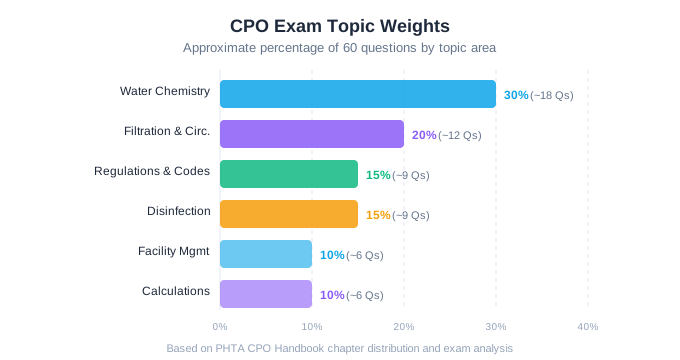
The CPO exam draws from all chapters of the PHTA Handbook, but the weighting is not equal. Water chemistry, filtration, and disinfection account for roughly 65% of the questions. Knowing where the exam concentrates lets you allocate study time efficiently.
Water Chemistry (Approximately 30% of Questions)
- pH ranges and their effects on sanitizer efficacy and bather comfort
- Free chlorine vs. combined chlorine vs. total chlorine relationships
- Breakpoint chlorination calculations and when to superchlorinate
- Cyanuric acid (CYA) and its relationship to free chlorine effectiveness
- Alkalinity, calcium hardness, and the Langelier Saturation Index (LSI)
- Water balance calculations using the LSI formula
Filtration and Circulation (Approximately 20%)
- Turnover rate calculations (pool volume divided by flow rate)
- Sand, cartridge, and DE filter operation and maintenance
- Flow rate requirements based on pool type and bather load
- Pump curves, total dynamic head, and system design basics
- Backwash procedures and filter pressure differentials
Regulations and Codes (Approximately 15%)
- Virginia Graeme Baker Act drain cover and anti-entrapment requirements
- Model Aquatic Health Code (MAHC) recommended standards
- ADA accessibility requirements for public pools
- State and local health department testing frequency mandates
- Depth markings, signage, and safety equipment requirements
Disinfection (Approximately 15%)
- Chlorine forms: liquid (sodium hypochlorite), granular (calcium hypochlorite), tablets (trichlor), gas
- Bromine use cases and spa applications
- UV and ozone as supplemental disinfection
- ORP (Oxidation Reduction Potential) readings and what they indicate
- Chemical feeder types and calibration
Open-Book Strategy: How to Prep Your Handbook
The difference between passing and failing the CPO exam often comes down to how well you prepared your handbook, not how well you know the material. In a 2-hour, 60-question test, you have exactly 2 minutes per question. If you spend 30 seconds finding the answer in your book, you have 90 seconds to read, interpret, and answer. If you spend 3 minutes flipping pages, you are already behind.
Tab System
- 1Chapter tabs: Place a permanent tab on the first page of every chapter. Label it with the chapter number and a 2-3 word description (e.g., "Ch 4 - Water Chem").
- 2Table and chart tabs: Tab every table and chart that contains numerical ranges. The exam loves questions that reference specific ranges (e.g., "What is the minimum free chlorine for a pool using CYA?"). You should be able to flip directly to the answer table in under 5 seconds.
- 3Formula tabs: Tab every page with a formula. LSI calculations, turnover rates, breakpoint chlorination ratios, and chemical dosing formulas all appear on the exam.
- 4Code reference tabs: Tab VGB Act requirements, MAHC standards, and ADA specifications. These are tested directly.
Highlighting Strategy
- Yellow: Key numerical values (minimum chlorine levels, pH ranges, turnover requirements)
- Blue/Green: Formulas and calculation steps
- Pink/Orange: Code requirements and legal mandates (VGB, MAHC, ADA)
- Do not over-highlight. If everything is highlighted, nothing stands out. Focus on numbers, formulas, and requirements.
Prepare your handbook during the 16-hour course, not the night before the exam. As each chapter is taught, tab the key tables, highlight the critical numbers, and mark the formulas. By exam day, your handbook should be a well-organized reference tool, not a textbook you are reading for the first time.
The 10 Most Common Mistakes on the CPO Exam
After years of helping pool service professionals prepare for the CPO exam, patterns emerge in where candidates lose points. These are not obscure trick questions. They are predictable, avoidable mistakes.
- 1Confusing free chlorine and total chlorine: Free chlorine is the active sanitizer. Total chlorine is free chlorine plus combined chlorine. The exam asks for specific values and expects you to know which measurement matters in each scenario.
- 2Forgetting CYA changes the minimum chlorine requirement: Without CYA, minimum free chlorine is 1.0 ppm. With CYA, it jumps to 2.0 ppm per CDC/MAHC guidance. This single fact appears in multiple questions.
- 3LSI calculation errors: The Langelier Saturation Index formula involves temperature, calcium hardness, alkalinity, TDS, and pH. Candidates transpose values or use the wrong lookup table. Practice the calculation 5 times before the exam.
- 4Mixing up turnover rate and flow rate: Turnover rate is pool volume divided by flow rate, expressed in hours. Flow rate is gallons per minute. The exam gives you two values and expects you to calculate the third.
- 5Ignoring the VGB Act drain cover requirements: The exam tests whether you know that single main drains require a secondary anti-entrapment device, not just a compliant drain cover. This is a common missed question.
- 6Not knowing the difference between superchlorination and breakpoint: Superchlorination is raising chlorine to 10x the combined chlorine level. Breakpoint is the specific ratio (10:1 FC to CC) where combined chlorine is eliminated. The exam asks about both.
- 7Miscounting filter backwash pressure differential: Backwash when the pressure gauge reads 8-10 psi above the clean starting pressure, not when it reaches a specific number. The exam tests this as a relative measurement.
- 8Forgetting that pH affects chlorine efficacy: At pH 7.2, about 63% of chlorine is in the active HOCl form. At pH 7.8, only 33% is active. This relationship is tested repeatedly.
- 9Confusing parts per million with percent: Pool chemistry uses ppm for concentration. Chemical products are labeled by active ingredient percentage. Converting between the two is tested in dosing calculation questions.
- 10Running out of time: Open-book exams create a false sense of security. Candidates look up answers for easy questions they already know, then run out of time on the calculation questions that actually require lookup. Answer questions you know from memory first, then use the book for lookups.
Study Schedule: 2-Week Plan Before the Exam
If your CPO course is two weeks away, here is a focused study plan that prioritizes the highest-weighted topics and the most commonly missed questions.
| Days | Focus | Time | Activities |
|---|---|---|---|
| Days 1-3 | Water chemistry fundamentals | 1 hour/day | Read chapters on pH, chlorine, alkalinity, calcium hardness. Highlight all numerical ranges. |
| Days 4-5 | Calculations | 1.5 hours/day | Practice LSI, turnover rate, breakpoint chlorination, and chemical dosing calculations. Do at least 5 practice problems per formula. |
| Days 6-7 | Filtration and circulation | 1 hour/day | Study filter types, backwash procedures, pump operation. Tab all flow rate tables. |
| Days 8-9 | Regulations and codes | 1 hour/day | Read VGB Act requirements, MAHC standards, ADA pool accessibility. Tab every code reference. |
| Days 10-11 | Disinfection and supplemental systems | 45 min/day | Chlorine types, bromine, UV, ozone. Focus on when each is appropriate. |
| Days 12-13 | Practice exams | 2 hours/day | Take 2-3 full practice exams. Time yourself at 2 minutes per question. Review every wrong answer. |
| Day 14 | Handbook review | 1 hour | Final tab and highlight check. Verify you can find any key table in under 10 seconds. |
Free CPO practice tests are available from multiple providers online. Take at least two full-length practice exams under timed conditions. The goal is not to memorize answers but to identify which topics you need to look up quickly and which you already know cold.
What Happens After You Pass (and If You Do Not)
Passing the CPO exam earns you a 5-year certification from PHTA. Your name is added to the PHTA certification database, which employers, health departments, and commercial clients can verify. Many states require at least one CPO-certified operator on staff for commercial pool operations.
After Passing
- You receive your CPO certificate and wallet card within 2-4 weeks
- Your certification is valid for 5 years from the exam date
- Renewal requires retaking the course and exam (no continuing education alternative)
- Some states accept CPO as partial fulfillment of their own operator licensing requirements
- Commercial accounts and municipalities often require CPO certification as a contract condition
If You Do Not Pass
If you score below 75%, you can retake the exam. Retake policies vary by instructor, but most allow a retake within 30-90 days for an additional fee (typically $50-$100). You do not need to retake the 16-hour course. Use the time between attempts to focus on the specific topics where you lost points.
Free starter kit
Start a pool service business with the numbers already run.
A short email series from an owner who started with $1,200 and a used truck. No software pitch, just the four things that decide whether year one works.
- Startup cost breakdownEvery line item from $2K bootstrap to fully equipped
- Pricing calculatorThe minimum you can charge per visit and still profit
- First-10-customers playbookDoor hangers, referrals, and the phone script that closes
- Licensing & insurance checklistWhat your state requires and which insurers pay claims
Already running routes? Try Pool Founder free
Frequently Asked Questions
Is the CPO exam open book?
Yes. You can use the official PHTA Pool and Spa Operator Handbook during the exam. Highlighting and permanent tabs are allowed. Loose notes, sticky notes, and electronic devices (except a basic calculator) are not permitted.
How many questions are on the CPO exam?
The exam has 60 multiple-choice questions. You need to answer at least 45 correctly (75%) to pass. You have 2 hours to complete the exam, which gives you 2 minutes per question.
How much does CPO certification cost?
The total cost ranges from $300 to $450 depending on the instructor and location. This typically includes the 16-hour course, the PHTA Handbook, and the exam fee. Retake fees are usually $50-$100 additional.
How long is CPO certification valid?
CPO certification is valid for 5 years from the date you pass the exam. Renewal requires retaking the full course and exam. There is no continuing education renewal option.
What math do I need for the CPO exam?
You need basic algebra for pool volume calculations, turnover rate formulas, the Langelier Saturation Index calculation, breakpoint chlorination ratios, and chemical dosing conversions. A calculator is allowed. Practice each formula type at least 5 times before the exam.
Do I need CPO certification to run a pool service company?
It depends on your state and the types of pools you service. Many states require at least one CPO-certified operator for commercial pool operations. Some commercial clients and municipalities require CPO certification as a contract condition. For residential-only service, it may not be legally required but signals professionalism to customers.