What Does It Mean to Be the Operator of Record?
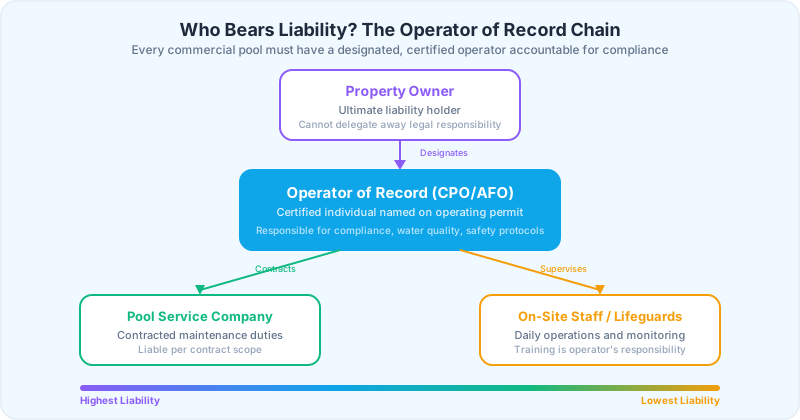
Every commercial pool operating permit has a name on it. That name belongs to the operator of record, the certified individual who the health department holds personally accountable for pool safety and regulatory compliance. In most jurisdictions, this person must hold a valid Certified Pool Operator (CPO) or Aquatic Facility Operator (AFO) certification. The role carries real legal weight. If something goes wrong at that pool, the operator of record is the first person investigators contact.
Over 35% of U.S. jurisdictions require a certified operator for every commercial pool, and that number grows every year as more states adopt CDC Model Aquatic Health Code (MAHC) recommendations. For pool service companies that manage commercial accounts, understanding the operator of record designation is not optional. It determines who carries liability, what insurance you need, and how your service contracts should be structured.
Corey Adams, Pool Founder co-founder and 15-year pool service veteran: "I have been named operator of record on commercial accounts, and I have turned it down on others. The difference comes down to control. If I cannot control the chemical feed, the maintenance schedule, and the emergency protocols, I am not putting my name on that permit. The liability follows the name, not the contract."
What Is the Legal Definition of Operator of Record?
The operator of record is the individual designated on the commercial pool operating permit as the person responsible for ensuring the pool complies with all applicable health, safety, and water quality regulations. This is a legal designation, not a job title. The operator of record may be the property manager, a pool service company owner, a maintenance director, or any other individual who holds the required certification and agrees to accept the responsibility.
Legal Responsibilities of the Operator of Record
- Ensuring water quality meets state and local health code standards at all times the pool is open
- Maintaining all required compliance documentation including chemical logs, incident reports, and equipment records
- Ensuring all safety equipment is present, functional, and properly positioned
- Responding to health department violations and completing corrective actions within required timelines
- Training and supervising any staff who perform pool maintenance or monitoring duties
- Implementing emergency action plans for chemical incidents, drownings, and weather events
- Ensuring VGB Act compliance for all drain covers and anti-entrapment systems
- Maintaining current ADA-compliant pool access equipment
What the Operator of Record Is NOT Responsible For
The operator of record is not responsible for structural defects in the pool shell that existed before their designation, bather behavior that violates posted rules, or third-party vendor failures on equipment they did not specify or install. However, the operator is responsible for identifying structural issues that affect safety and reporting them to the property owner in writing. If you know about a problem and fail to document it, the liability shifts to you.
What Certifications Are Required for Operator of Record?
The two nationally recognized certifications for commercial pool operators are the Certified Pool Operator (CPO) certification from the Pool and Hot Tub Alliance (PHTA) and the Aquatic Facility Operator (AFO) certification from the National Recreation and Park Association (NRPA). Most states accept both, though some jurisdictions specify one or the other.
| Certification | Issuing Body | Exam Format | Validity | Cost |
|---|---|---|---|---|
| CPO | Pool & Hot Tub Alliance (PHTA) | 2-day course + open-book exam | 5 years | $300-$450 |
| AFO | National Recreation & Park Assn | 2-day course + exam | 5 years | $250-$400 |
| CPO Recertification | PHTA | Online or in-person renewal | 5 years | $200-$300 |
| State-specific certs | Varies by state | Varies | Varies | Varies |
State-by-State Requirements
Requirements vary significantly by state. Florida requires a CPO or equivalent for all public pool facilities. California requires operators to complete a training course approved by the California Department of Public Health. Texas leaves operator certification requirements to county health departments, with most major counties (Harris, Dallas, Tarrant) requiring CPO or AFO certification. Arizona requires a certified operator for all public pools with a bather load exceeding 50 persons.
CPO certification expires after 5 years. If your certification lapses while you are the designated operator of record, the operating permit may become invalid. Health departments do check certification dates during inspections. Set a reminder 6 months before expiration to schedule your renewal course.
5 years
is the validity period for CPO certification before renewal is required. Letting it lapse while serving as operator of record can invalidate the pool operating permit.
Source: Pool and Hot Tub Alliance (PHTA)
What Liability Does the Operator of Record Carry?
The operator of record carries direct personal and professional liability for compliance failures at the pool. This liability exists independently of the property owner's liability. In a lawsuit resulting from a pool injury or illness, both the property owner and the operator of record will typically be named as defendants. The operator of record can be held liable for negligence if they failed to maintain proper chemical levels, did not follow testing protocols, ignored equipment defects, or failed to maintain required documentation.
Types of Liability Exposure
| Liability Type | What It Covers | Who Is Exposed | Protection |
|---|---|---|---|
| Regulatory | Health code violations, fines, permit revocation | Operator of record directly | Compliance protocols and documentation |
| Civil | Injury lawsuits, wrongful death claims | Operator, property owner, service company | General liability + professional liability insurance |
| Criminal | Gross negligence, willful disregard of safety | Individual operator | Adherence to all safety protocols and standards |
| Contractual | Breach of service contract terms | Service company | Clear contract scope and indemnification clauses |
Criminal liability is rare but real. If a drowning or serious chemical injury occurs and investigators determine that the operator of record willfully ignored known safety deficiencies, criminal charges including negligent homicide can be filed. This has happened in cases where drain cover replacements were deferred despite known VGB Act violations, or where chemical feed systems were left in a dangerous state.
Professional liability insurance (errors and omissions coverage) is separate from general liability insurance and specifically covers claims arising from your professional services and decisions as an operator. If you serve as operator of record for any commercial pool, you need both policies.
How Should Pool Service Companies Handle Operator of Record Designations?
Pool service companies face a strategic decision with every commercial account: accept the operator of record designation or decline it. Both options have business implications. Accepting it gives you more control and can command higher service fees. Declining it limits your liability but may cost you the account.
When to Accept Operator of Record Status
- You have full control over the chemical feed, maintenance schedule, and emergency protocols
- The service contract includes authority to shut down the pool for safety reasons without property owner approval
- You carry adequate professional liability insurance that covers operator of record duties
- The property owner agrees to fund all required equipment repairs and replacements within specified timelines
- Your contract includes indemnification from the property owner for issues outside your scope of control
When to Decline Operator of Record Status
- The property owner wants to maintain control over maintenance schedules or chemical purchasing
- The pool has known structural or equipment deficiencies the owner refuses to address
- Your insurance does not cover operator of record liability
- The service contract does not give you authority to close the pool for safety violations
- You cannot ensure compliance between your scheduled service visits (no on-site staff or automation)
If you decline operator of record status, make sure your service contract explicitly states that you are providing maintenance services only and that the property owner or their designated operator bears all compliance responsibility. Get this in writing before the first service visit.
What Contract Protections Do You Need as Operator of Record?
If you accept the operator of record designation, your service contract must include specific protections that standard maintenance agreements do not cover. These clauses protect you when property owners defer necessary repairs, override your recommendations, or fail to fund required compliance upgrades.
Essential Contract Clauses
- 1Authority to close the pool immediately if water quality or safety conditions warrant, without prior property owner approval
- 2Property owner obligation to fund all equipment repairs, replacements, and upgrades within specified timelines (e.g., 48 hours for safety items, 30 days for non-critical items)
- 3Indemnification clause: property owner indemnifies operator for claims arising from structural defects, bather conduct, or property owner interference with maintenance protocols
- 4Right to terminate without penalty if property owner fails to fund required safety repairs within the specified timeline
- 5Clear definition of scope: what you are responsible for versus what falls to the property owner or on-site staff
- 6Insurance requirements: property owner must maintain premises liability coverage and name the service company as additional insured
- 7Documentation access: you retain copies of all compliance records even after contract termination
Have a pool industry attorney review your operator of record contracts. Generic service agreements do not address the unique liability exposure of the operator of record designation. The legal fees for a proper contract review ($500 to $1,500) are a fraction of the cost of defending a single negligence claim.
$500-$1,500
is the typical cost for an attorney to review an operator of record service contract, a fraction of the $50,000+ average cost to defend a pool-related negligence claim
Source: PHTA industry estimates
How Do You Transfer or Terminate Operator of Record Status?
Transferring or terminating your operator of record status requires formal action with the health department, not just ending your service contract. If you stop servicing a commercial pool but remain the named operator on the permit, you may still carry liability for compliance failures that occur after you leave. The health department does not automatically update the permit when you stop showing up.
Steps to Transfer Operator of Record Status
- 1Provide written notice to the property owner of your intent to resign as operator of record with at least 30 days notice (or per your contract terms)
- 2Contact the local health department and submit a formal operator change notification
- 3Ensure the property owner designates a replacement operator before your resignation takes effect
- 4Document the condition of the pool and all equipment at the time of transfer with photographs and written notes
- 5Provide copies of all compliance records to the property owner and the replacement operator
- 6Retain your own copies of all records covering your period as operator of record
- 7Confirm in writing with the health department that your name has been removed from the operating permit
Never assume that ending your service contract ends your operator of record status. Get written confirmation from the health department that your name has been removed from the permit. Until that happens, you may still be legally liable for compliance at that pool.
Ready to streamline your pool service business?
Pool Founder gives you route optimization, automated invoicing, chemical tracking, and everything else you need to run a more profitable pool business.
Frequently Asked Questions
Can a pool service company be the operator of record?
The operator of record must be an individual, not a company. However, the individual can be the owner or a certified employee of the pool service company. The company's CPO-certified owner or manager is typically named on the permit, and the service contract defines the company's role in supporting that individual's compliance responsibilities.
What happens if the operator of record quits or is terminated?
The property owner must designate a new certified operator and update the operating permit with the health department. In most jurisdictions, there is a grace period of 30 to 90 days to name a replacement. During the transition, the pool may be required to operate under increased health department oversight or may be closed until a new operator is designated.
Is CPO certification required to be the operator of record?
In most jurisdictions that require a certified operator, CPO (from PHTA) or AFO (from NRPA) certification is required. Some states accept state-specific certifications. Check with your local health department for the accepted certifications in your area. Both CPO and AFO require a 2-day course and exam, with 5-year renewal cycles.
Can one person be the operator of record for multiple pools?
Yes, one certified individual can be the operator of record for multiple commercial pools. However, they must be able to ensure compliance at all facilities. Some jurisdictions limit the number of pools one operator can oversee based on proximity and complexity. If you are named on too many permits, inspectors may question your ability to maintain adequate oversight.
What insurance do you need as operator of record?
At minimum, you need general liability insurance and professional liability (errors and omissions) insurance. General liability covers bodily injury and property damage claims. Professional liability covers claims arising from your professional decisions and services. Many operators also carry commercial umbrella policies for additional protection above base policy limits.