Why Do Commercial Pool Records Matter More Than the Pool Itself?
A clean pool with no records is a liability waiting to happen. Every health department inspector who walks onto a commercial pool deck asks the same question first: "Show me your logs." Not your chlorine levels. Not your pump room. Your records. The documentation proves compliance. The water just proves you tested it today.
The CDC Model Aquatic Health Code (MAHC) has been adopted in whole or in part by at least 35 states, and it establishes minimum documentation standards that most jurisdictions enforce. State and county health departments then layer additional requirements on top. Missing records during an inspection can result in immediate citations, fines ranging from $100 to $1,000 per violation per day, and forced pool closure until documentation gaps are resolved.
Corey Adams, Pool Founder co-founder and 15-year pool service veteran, has managed compliance documentation for commercial accounts across multiple states. "I have seen pools shut down for a single missing log sheet. The water was perfect. The records were not. That is all the inspector needed to close it." This guide covers what you need to keep, how long to keep it, and how to survive an inspection.
What Records Must Every Commercial Pool Maintain?
Commercial pool records fall into six categories: water quality logs, chemical inventory and addition records, incident and injury reports, equipment maintenance logs, inspection documentation, and operator certification records. Every health department expects all six. The specifics vary by state, but the categories are universal.
Water Quality Logs
Water quality logs are the single most important compliance document. Most state codes require testing and recording free chlorine, pH, and water temperature at minimum twice daily when the pool is open to bathers. Many jurisdictions also require combined chlorine, alkalinity, and cyanuric acid readings on a weekly basis. The MAHC recommends that all readings be recorded with the date, time, tester name, and test method used. Digital logs are acceptable in most jurisdictions as long as they produce printable reports on demand.
| Parameter | Test Frequency | Acceptable Range | Log Requirement |
|---|---|---|---|
| Free chlorine | 2x daily minimum | 1.0-4.0 ppm | Date, time, reading, tester |
| pH | 2x daily minimum | 7.2-7.8 | Date, time, reading, tester |
| Combined chlorine | Weekly minimum | Below 0.4 ppm | Date, reading, action taken |
| Water temperature | 2x daily minimum | Below 104F (spas) | Date, time, reading |
| Alkalinity | Weekly minimum | 80-120 ppm | Date, reading |
| Cyanuric acid | Weekly (outdoor) | 30-50 ppm | Date, reading, adjustment |
Chemical Inventory and Addition Records
Beyond water quality readings, you need to track what chemicals you are adding, when, and how much. This includes every chlorine addition, acid adjustment, algaecide application, and any other chemical treatment. The record should include the product name, quantity added, date and time, and the name of the person who made the addition. Safety Data Sheets (SDS) for every chemical on site must be accessible within the pool area per OSHA requirements. Many inspectors check SDS binder completeness before they even look at the water.
Incident and Injury Reports
Every incident that occurs at a commercial pool must be documented immediately. This includes swimmer injuries, slip and fall events, chemical exposure incidents, drain entrapment near-misses, fecal contamination events, and any emergency response activation. Reports should include the date, time, location, description of the incident, names of involved parties and witnesses, actions taken, and any follow-up required. These records carry the longest retention period because personal injury statutes of limitation can extend 5 to 7 years or more depending on the state.
How Long Must You Keep Commercial Pool Records?
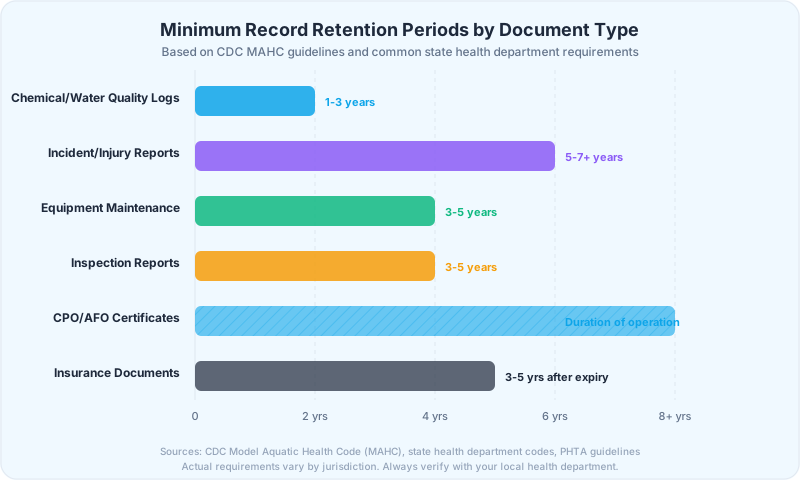
Record retention periods vary by document type and jurisdiction, but the general minimums across most states follow a predictable pattern. The safest approach is to keep everything for at least 5 years and keep incident reports indefinitely. Storage is cheap. Lawsuits are not.
| Document Type | Minimum Retention | Recommended Retention | Why |
|---|---|---|---|
| Water quality logs | 1-3 years | 5 years | Covers most inspection lookback periods and liability windows |
| Chemical addition records | 1-3 years | 5 years | Tied to water quality compliance verification |
| Incident/injury reports | 5-7 years | Indefinitely | Personal injury statute of limitations varies by state |
| Equipment maintenance | 3-5 years | Life of equipment | Proves maintenance history if equipment causes injury |
| Inspection reports | 3-5 years | 5 years | Shows compliance history and corrective actions taken |
| CPO/AFO certificates | Duration of operation | Duration of operation | Must be current and available at all times |
| Insurance documents | 3-5 years after expiry | 5 years after expiry | Proves coverage during past incidents |
| SDS sheets | As long as chemical is on site | 30 years (OSHA) | OSHA requires 30-year retention for exposure records |
35+
states have adopted CDC MAHC guidelines in whole or in part, establishing baseline documentation standards for commercial pools nationwide
Source: CDC Model Aquatic Health Code
Digital records stored in pool service software meet compliance requirements in most jurisdictions as long as the system can produce date-stamped, printable reports on demand. The MAHC does not mandate paper logs. If your software tracks chemical readings, timestamps them, and ties them to the technician who performed the test, you are covered.
State-Specific Retention Variations
Florida requires chemical logs to be maintained for at least 3 years and available at the pool site for health department review. California mandates a minimum 2-year retention window for inspection-ready records. Texas county health departments typically require 3 years of chemical logs. Arizona follows the MAHC baseline with local amendments. Always check with your specific county or city health department because municipal codes can exceed state minimums.
What Do Health Department Inspectors Actually Check?
Health department inspectors follow a standardized checklist during commercial pool inspections. The documentation review typically happens before the physical inspection. If your records fail, the inspector may not even get to the water test. Understanding what they look for lets you prepare proactively rather than scramble during the visit.
The Documentation Review
- 1Current operating permit displayed in a visible location near the pool
- 2Valid CPO or AFO certificate for the designated operator of record
- 3Water quality log book or digital log access with continuous entries (no gaps)
- 4Chemical addition records matching water quality readings (inspectors cross-reference these)
- 5Complete SDS binder for every chemical stored on site
- 6Equipment maintenance records showing regular pump, filter, and heater service
- 7Most recent health department inspection report with corrective actions completed
- 8Emergency action plan posted and current
Common Documentation Failures
The most frequent documentation failures during inspections are gaps in water quality logs (missed days or missing time entries), expired CPO certificates that were not renewed on time, SDS binders missing sheets for chemicals currently in the pump room, no incident reports on file despite pool having been open for years (inspectors know incidents happen), and equipment maintenance records that show no filter cleanings or pump inspections in the last 12 months.
- Gaps in water quality logs: even one missed day creates a compliance question
- Expired CPO certificates: must be renewed before expiration, not after
- Incomplete SDS binders: every chemical on site needs a current sheet
- No incident reports on file: zero reports looks worse than a few documented incidents
- No evidence of equipment maintenance: suggests deferred maintenance and potential safety issues
Inspectors know that zero incident reports over multiple years is not realistic for a busy commercial pool. Having well-documented incidents with proper follow-up actions demonstrates professionalism. Having no reports suggests you are not tracking them.
How Should You Organize Commercial Pool Compliance Records?
Organization determines whether your records help you or hurt you during an inspection. A binder full of loose pages with no dates is worse than no binder at all because it signals disorganization to the inspector. Whether you use paper or digital systems, the structure should allow any inspector to find any record within 60 seconds.
Paper-Based Organization
If you use paper logs, organize them in a dedicated three-ring binder with tabbed dividers for each record category. Keep the current month of water quality logs at the front. File completed months chronologically behind. Store incident reports in a separate, secured section. Keep the SDS binder physically in the pump room or chemical storage area where chemicals are handled. The operating permit and CPO certificate should be displayed, not filed. Make copies for the binder.
Digital Record Systems
Pool service software that captures chemical readings digitally with timestamps, technician identification, and GPS verification provides a stronger compliance record than any paper log. The key requirements for digital systems are: records must be printable on demand, historical data must be accessible without internet in case of outage during inspection, and the system must maintain an uneditable audit trail showing when entries were made and by whom.
- Use software that timestamps every entry automatically
- Ensure records are printable as PDF reports organized by date range
- Maintain offline access capability for inspection scenarios
- Keep backup exports of all data quarterly (do not rely solely on cloud storage)
- Verify the system logs who made each entry for accountability
60 sec
is the benchmark for locating any compliance record during an inspection. Longer search times signal poor organization to inspectors.
Source: PHTA CPO training guidelines
What Happens When Records Are Missing During an Inspection?
Missing records during a health department inspection trigger a cascade of consequences that escalate based on severity. Understanding the escalation path helps you prioritize which documentation gaps to fix first.
Violation Categories and Consequences
| Missing Record | Violation Level | Typical Consequence | Resolution Timeline |
|---|---|---|---|
| Water quality logs (gaps) | Major | Written citation, re-inspection required | 24-72 hours to provide |
| No operating permit | Critical | Immediate pool closure | Cannot reopen until permit obtained |
| Expired CPO certificate | Major | Citation, deadline to produce valid cert | 30 days typical |
| No SDS binder | Major (OSHA) | Citation, potential OSHA referral | Immediate correction required |
| No incident reports | Minor to Major | Written warning or citation | Next inspection must show system |
| No equipment maintenance records | Minor | Written warning, recommendation | Next inspection must show logs |
Fines for commercial pool violations range from $100 to $1,000 per violation per day in most jurisdictions. Repeat violations within the same inspection cycle can double or triple the fine amount. In extreme cases, chronic non-compliance can result in permit revocation, which means the pool cannot operate at all until the facility reapplies and passes a full inspection.
The financial cost of a pool closure goes far beyond the fine itself. A hotel pool closure during peak season can cost $5,000 to $20,000 per day in lost revenue, guest complaints, and reputation damage. An HOA pool closure generates immediate board complaints and potential legal action from residents. Prevention through proper documentation is always cheaper than remediation.
How Do You Build a Compliance Record System from Scratch?
If you are taking over a commercial account with no existing records, or starting compliance documentation for the first time, here is the step-by-step process to build a complete system within 30 days.
Week 1: Foundation Documents
- Obtain or verify the current operating permit and display it at the pool
- Verify CPO/AFO certification for the operator of record and file a copy
- Create or obtain SDS sheets for every chemical currently stored on site
- Set up a water quality log (paper or digital) and begin twice-daily entries
- Create a chemical addition log and begin recording every treatment
Week 2: Equipment and Maintenance Documentation
- Inventory all pool equipment (pumps, filters, heaters, controllers, safety equipment)
- Record manufacturer, model, serial number, and install date for each item
- Create a maintenance schedule based on manufacturer recommendations
- Document the current condition of all drain covers including VGB compliance dates
- Photograph equipment labels and nameplates for the equipment file
Weeks 3-4: Policy and Emergency Documentation
- Create or update the emergency action plan and post it visibly
- Develop an incident report template and train staff on when and how to use it
- Document the fecal contamination response protocol per CDC guidelines
- Set up a filing system (paper binder or digital folders) with the six core categories
- Schedule recurring reminders for CPO renewal, permit renewal, and quarterly record audits
Pool Founder tracks chemical readings, timestamps them with the technician name, stores them in the cloud, and generates printable compliance reports by date range. If you service commercial accounts, digital logging eliminates the gap risk that gets pools cited during inspections.
Ready to streamline your pool service business?
Pool Founder gives you route optimization, automated invoicing, chemical tracking, and everything else you need to run a more profitable pool business.
Frequently Asked Questions
How long do you have to keep commercial pool chemical logs?
Most states require a minimum of 1 to 3 years for chemical and water quality logs. California mandates 2 years. Florida and Texas typically require 3 years. The safest practice is to retain all chemical logs for at least 5 years to cover liability windows and extended inspection lookback periods.
Can you use digital records instead of paper logs for pool compliance?
Yes. Most jurisdictions accept digital records as long as the system produces date-stamped, printable reports on demand and maintains an audit trail showing who made each entry and when. The MAHC does not mandate paper. Digital records with automatic timestamps are often more reliable than paper because they cannot be backdated.
What happens if you fail a commercial pool inspection?
Consequences range from written citations and re-inspection fees for minor violations to immediate pool closure for critical failures like no operating permit or dangerous water chemistry. Fines typically range from $100 to $1,000 per violation per day. The pool must correct all cited violations and pass a follow-up inspection before resuming operation.
Who is responsible for maintaining commercial pool records?
The designated operator of record, typically the CPO or AFO certificate holder, is legally responsible for maintaining compliance documentation. In practice, this responsibility often falls on the pool service company under their service contract. The property owner remains ultimately liable regardless of who maintains the records.
How often do health departments inspect commercial pools?
Most health departments conduct annual inspections for permitted commercial pools. Many jurisdictions also perform random unannounced spot checks throughout the operating season. Pools with previous violations may be placed on increased inspection frequency. Some states like Florida conduct 2-3 inspections per year for public pools.
Do you need to keep records for a residential pool?
Residential pools are generally not subject to health department record-keeping requirements. However, if you operate a pool service business, maintaining service records for residential customers protects you from liability claims, supports warranty documentation, and provides proof of service if disputes arise. Professional service records benefit any pool operation.