Why Do Chemical Dosing Systems Matter for Commercial Pool Service?
Chemical dosing systems are the backbone of commercial pool water management. An ORP/pH controller continuously monitors water chemistry and automatically feeds sanitizer and acid to maintain target levels, replacing the guesswork of manual dosing. For pool service companies, understanding these systems is not optional. Every hotel, apartment complex, fitness center, and municipal facility you service will have some form of automated chemical control. If you cannot calibrate it, troubleshoot it, and explain to the property manager why the readings matter, you will lose commercial accounts to someone who can.
The technology is straightforward once you understand the principles. ORP (Oxidation Reduction Potential) measures the water sanitizing power in millivolts. pH measures acidity. The controller reads both values through sensor probes, compares them to user-defined setpoints, and activates chemical feed pumps when the readings drift outside the target range. The challenge is not the technology itself. It is knowing what setpoints to use for different applications, recognizing when probes are giving bad readings, and diagnosing the dozen common failure modes that cause dosing errors.
This guide covers ORP/pH controller operation, setpoints by application, calibration procedures, common failure modes, and troubleshooting steps. It is written for pool service technicians who maintain commercial chemical automation, not for pool builders designing new systems.
How Do ORP and pH Controllers Work?
An ORP/pH controller is a closed-loop automation system. It continuously reads sensor data, compares it to target setpoints, and activates chemical feed equipment to correct deviations. Understanding the three core components, sensors, controller logic, and feed systems, is essential for effective troubleshooting.
ORP Sensors
The ORP sensor measures the oxidation-reduction potential of the water in millivolts (mV). This value reflects the water ability to oxidize contaminants, which correlates to sanitizer effectiveness. A higher ORP reading means more active sanitizer is available. The World Health Organization and CDC have determined that a minimum of 650 mV provides virtually instantaneous inactivation of most pathogens, which is why 650 mV has become the industry standard minimum for commercial pools. ORP probes contain a platinum or gold electrode that generates a voltage proportional to the water oxidizing potential. These probes typically last 12 to 24 months before requiring replacement.
pH Sensors
The pH sensor measures hydrogen ion concentration on a 0-14 scale. For pool applications, the target range is 7.2 to 7.6, with 7.4 being optimal for both swimmer comfort and chlorine effectiveness. pH probes use a glass membrane electrode filled with a reference solution. They are more fragile than ORP probes and more susceptible to fouling from calcium buildup, oils, and biofilm. pH probes typically require calibration every 30 days and replacement every 12 to 18 months.
Controller Logic
The controller compares sensor readings to programmed setpoints and activates feed pumps accordingly. Most commercial controllers operate in one of three modes: on/off control (pump runs until setpoint is reached, then stops), proportional control (pump speed varies based on how far the reading is from setpoint), or timed feed with lockout (pump runs for a set duration, then waits before reading again to allow chemical mixing). Proportional control is the most precise and is standard on modern commercial systems. On/off control can cause chemical overshooting, especially in smaller pools.
Chemical Feed Systems
Commercial controllers feed chemicals through peristaltic pumps (squeeze tubing pumps) or diaphragm pumps. Peristaltic pumps are preferred for commercial applications because they provide accurate dosing, handle corrosive chemicals safely, and the tubing is the only wear part. Liquid chlorine (sodium hypochlorite, 12.5%) is the most common sanitizer for controller-fed commercial pools, while muriatic acid (31.45% hydrochloric acid) is the standard pH reducer. Some facilities use calcium hypochlorite or erosion feeders for sanitizer, but liquid feed systems provide the most precise control.
650 mV
Minimum ORP required for pathogen inactivation per WHO/CDC standards
Source: World Health Organization and CDC
What Setpoints Should You Use for Different Applications?
Setpoints are not universal. The correct ORP and pH targets depend on the facility type, bather load, local health codes, and the specific sanitizer being used. The following table provides starting-point setpoints for common commercial applications. Always verify against your local health department requirements, which may be more restrictive.
| Application | ORP Setpoint | pH Setpoint | Notes |
|---|---|---|---|
| Hotel/resort pool | 700-750 mV | 7.4-7.6 | High bather load demands higher ORP |
| HOA/community pool | 680-720 mV | 7.4-7.6 | Standard commercial target |
| Apartment pool | 680-720 mV | 7.4-7.6 | Adjust up for high-occupancy complexes |
| Fitness center/lap pool | 700-740 mV | 7.2-7.4 | Lower pH improves chlorine efficiency |
| Spa/hot tub | 650-700 mV | 7.2-7.4 | High temp accelerates chlorine loss |
| Splash pad/water feature | 720-760 mV | 7.2-7.6 | Zero-depth features need higher ORP |
| Municipal/water park | 720-760 mV | 7.2-7.6 | Highest bather load, strictest codes |
Why ORP Setpoints Vary
ORP readings are affected by pH, temperature, CYA (cyanuric acid) levels, and dissolved solids. A pool with pH 7.2 and 2 ppm free chlorine will read a higher ORP than the same pool at pH 7.8 with the same chlorine level, because lower pH means more hypochlorous acid (the active form of chlorine) is present. CYA suppresses ORP readings even when adequate free chlorine is present. This is why pools using stabilized chlorine or with high CYA from trichlor tablets often show low ORP readings despite having 3+ ppm free chlorine. For pools with CYA above 30 ppm, you may need to set ORP targets 20 to 50 mV higher than standard to compensate.
Overfeed and Underfeed Limits
Every commercial controller should have overfeed and underfeed alarms configured. Set the overfeed alarm 50 to 100 mV above your ORP setpoint and 0.3 to 0.5 pH units below your pH setpoint (acid overfeed drives pH down). Set underfeed alarms the same increments in the opposite direction. These alarms should trigger an audible alert and, on modern systems, a push notification to your phone. Overfeed alarms prevent dangerous chemical concentrations. Underfeed alarms catch probe failures before the pool becomes unsanitary.
At least eight states (Arizona, Colorado, Iowa, Idaho, Ohio, Maine, Montana, and Wyoming) include ORP requirements in their state pool codes, requiring a minimum of 650 mV. Even in states without specific ORP codes, maintaining 650 mV minimum is the industry standard and your baseline for any commercial pool.
How Do You Calibrate ORP and pH Probes?
Calibration is the single most important maintenance task for chemical dosing systems. An uncalibrated probe feeds bad data to the controller, which then doses the wrong amount of chemical. The result is either underchlorinated water that fails health inspections or overchlorinated water that irritates swimmers and wastes chemicals. Calibrate pH probes monthly and ORP probes quarterly, or immediately whenever readings seem inconsistent with manual test kit results.
pH Probe Calibration
- 1Remove the pH probe from the flow cell and rinse with distilled water.
- 2Immerse the probe in fresh pH 7.0 buffer solution. Wait 60 seconds for the reading to stabilize.
- 3Adjust the controller to read 7.0. This is your midpoint calibration.
- 4Rinse with distilled water again.
- 5Immerse in pH 4.0 buffer solution. Wait 60 seconds.
- 6Adjust the controller to read 4.0. This is your slope calibration.
- 7Rinse and reinstall the probe in the flow cell.
- 8Compare the controller pH reading to a fresh manual test kit reading after 10 minutes. They should agree within 0.2 pH units.
ORP Probe Calibration
ORP probes are calibrated using a known ORP reference solution, typically a 200 mV or 475 mV standard. Rinse the probe with distilled water, immerse it in the reference solution for 60 seconds, and adjust the controller to match the standard value. After reinstalling, verify the ORP reading against a handheld ORP meter or by cross-referencing free chlorine and pH levels against expected ORP values. If the probe cannot be calibrated within 10% of the reference standard, it needs replacement.
Probe Maintenance Between Calibrations
Between calibrations, keep probes clean and functional. Check the flow cell weekly for debris, calcium buildup, or biofilm that can coat the probe surfaces and cause inaccurate readings. Clean probes with a soft brush and mild acid solution (10% muriatic acid) when calcium deposits are visible. Ensure the flow cell has adequate water flow. Low flow past the sensors causes sluggish readings and delayed chemical response. Replace probe O-rings annually and check the reference solution level in pH probes quarterly.
| Maintenance Task | Frequency | Time Required |
|---|---|---|
| pH probe calibration | Monthly | 15-20 minutes |
| ORP probe calibration | Quarterly | 10-15 minutes |
| Flow cell inspection/cleaning | Weekly | 5-10 minutes |
| Pump tubing inspection | Monthly | 5 minutes per pump |
| Pump tubing replacement | Every 6-12 months | 15-20 minutes per pump |
| Probe replacement (pH) | Every 12-18 months | 10 minutes plus calibration |
| Probe replacement (ORP) | Every 18-24 months | 10 minutes plus calibration |
What Are the Most Common Controller Failure Modes?
Chemical controller problems fall into three categories: sensor failures, feed system failures, and configuration errors. Knowing which category you are dealing with cuts your diagnostic time in half. The following are the most common failure modes Corey Adams encountered over 15 years of commercial pool service, roughly in order of how often they occur.
Probe Fouling
The most common controller issue. Calcium deposits, biofilm, and oils coat the probe surfaces and cause readings to drift. Symptoms: ORP reading is low despite adequate free chlorine on a manual test, or pH reading drifts steadily in one direction over weeks. Fix: clean the probes, check the flow cell, and recalibrate. If cleaning does not restore accurate readings, the probe needs replacement.
Exhausted Probes
All probes have a finite lifespan. pH probes last 12 to 18 months, ORP probes last 18 to 24 months. As probes age, they respond more slowly and cannot be calibrated accurately. Symptoms: the probe takes more than 90 seconds to stabilize in buffer solution, or the reading will not calibrate within 10% of the reference standard. An ORP probe older than 18 months that is giving inconsistent readings should be replaced rather than repeatedly recalibrated.
Low or No Flow Through Flow Cell
Probes require continuous water flow to provide accurate real-time readings. A clogged flow cell, closed valve, or failed circulation pump will cause the controller to read stale water. Symptoms: readings are stable but do not change even after manual chemical addition, or readings fluctuate wildly when the circulation pump cycles on and off. Modern controllers have flow switches that disable chemical feed when flow stops. If the flow switch is bypassed or faulty, the controller may feed chemicals into stagnant water.
Pump Tubing Failure
Peristaltic pump tubing wears out from the continuous squeezing action. When it cracks or loses elasticity, the pump delivers less chemical per stroke or leaks. Symptoms: the controller shows the pump running but ORP or pH readings do not respond, or you find chemical puddles under the pump head. Replace tubing every 6 to 12 months as preventive maintenance. Carry spare tubing on your truck for every pump brand you service.
Check Valve and Injection Point Blockage
The injection point where chemical enters the plumbing can become blocked by crystallized chemical residue, especially with liquid chlorine. Check valves can also stick closed. Symptoms: pump runs but chemical never reaches the pool. Verify by disconnecting the injection line and running the pump into a bucket to confirm output. Clean or replace the injection fitting and check valve. This is a common issue on systems that sit idle during winter shutdowns.
Configuration Errors
Incorrect setpoints, wrong feed mode selection, disabled alarms, or bypassed flow switches. These are human errors, often introduced by well-meaning on-site maintenance staff who adjust settings without understanding the consequences. After any unexplained chemistry incident, check the controller configuration first. Document your settings with a photo at every calibration visit so you can detect unauthorized changes.
How Do You Troubleshoot Dosing Problems?
When a commercial pool has a dosing problem, follow a systematic approach rather than replacing parts at random. This diagnostic sequence covers 95% of controller issues.
- 1Manual test first: test free chlorine and pH with a fresh DPD test kit. If manual readings match controller readings, the sensors are fine and the problem is in the feed system. If they do not match, the problem is a sensor issue.
- 2Check flow cell: verify water is flowing through the flow cell. Look for debris, closed valves, or a failed circulation pump. No flow means no accurate readings.
- 3Inspect probes: remove probes and check for fouling (calcium, biofilm, oil coating). Clean and recalibrate. If probes are older than 18 months (ORP) or 12 months (pH), replace them.
- 4Verify chemical supply: check that chemical drums or tanks are not empty. Inspect suction lines for air leaks. Confirm that the drum lid vent is open so the pump can draw chemical.
- 5Test pump output: disconnect the injection line and run the pump into a graduated container for 60 seconds. Compare output to the pump rated volume. If output is low, replace tubing. If zero, check electrical connections and pump motor.
- 6Inspect injection point: check the injection fitting and check valve for blockage. Chemical crystallization is common after winter shutdowns or extended idle periods.
- 7Review controller settings: check setpoints, feed mode, alarm configuration, and flow switch status. Compare to your documented settings from the last calibration visit.
- 8Check for interference: high CYA, metals in the water, or recently added algaecide can all affect ORP readings without changing free chlorine. Consider water chemistry context when evaluating sensor data.
Keep a troubleshooting log for every commercial controller you maintain. Record the date, symptoms, root cause, and fix. Over time, patterns emerge: a specific controller model that eats tubing, a property where calcium fouling is chronic, a management company that keeps adjusting settings. These patterns save you hours of future diagnostic time.
What Does a Chemical Dosing System Cost?
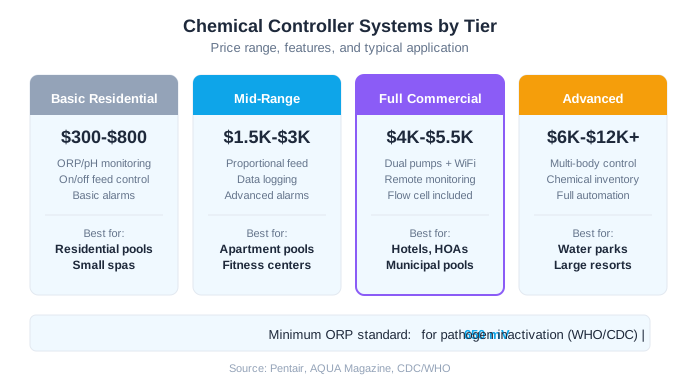
Pool service companies do not usually purchase and install chemical controllers (that is the builder or facility manager job), but you need to understand equipment costs to advise property managers on upgrades and to price your service accordingly. A controller that costs $5,000 to install requires more skilled maintenance than a $500 residential unit, and your service pricing should reflect that.
| System Tier | Price Range | Features | Typical Application |
|---|---|---|---|
| Basic residential | $300-$800 | ORP/pH monitoring, on/off feed | Residential pools, small spas |
| Mid-range commercial | $1,500-$3,000 | Proportional feed, alarms, data logging | Apartment pools, fitness centers |
| Full commercial | $4,000-$5,500 | Dual pumps, WiFi, flow cell, remote monitoring | Hotels, HOAs, municipal pools |
| Advanced/multi-body | $6,000-$12,000+ | Multiple pool bodies, chemical inventory tracking | Water parks, large resorts |
The Pentair IntelliChem commercial system with dual peristaltic pumps runs approximately $4,400 to $5,200 depending on configuration. Hayward CAT controllers fall in a similar range. These systems come pre-mounted on a backboard with the controller, flow cell, sensors, and feed pumps ready for installation. Probe replacement costs $80 to $200 per sensor, and peristaltic pump tubing runs $15 to $40 per replacement. Factor these consumable costs into your annual service pricing for commercial controller maintenance.
$4,400-$5,200
Typical cost for a commercial ORP/pH controller with dual feed pumps
Source: Pentair IntelliChem commercial pricing
Run a pool route?
The business side of what you just read.
Pricing, chemical costs, and the tools owners use to keep the numbers straight.
- Commercial pool service pricing2026 rate tables and the cost-plus formula
- Chemical cost per poolWhat chemicals actually cost per stop
- Chemical tracking softwareLog readings and dosing from the pool deck
- Pool service softwareRoutes, invoicing, and service reports in one app
- Free profit & rate calculatorsProfit per pool, minimum rate, break-even
Frequently Asked Questions
What ORP level should a commercial pool maintain?
The minimum ORP for commercial pools is 650 mV, which the World Health Organization and CDC have determined provides virtually instantaneous inactivation of most pathogens. In practice, most commercial pools target 680 to 750 mV depending on the application. Hotels and high-bather-load facilities should target 700 to 750 mV. HOA and apartment pools typically run 680 to 720 mV. At least eight states include ORP requirements in their pool codes. Even in states without specific ORP codes, 650 mV minimum is the industry standard baseline.
How often should ORP and pH probes be calibrated?
Calibrate pH probes monthly and ORP probes quarterly, using fresh buffer solutions (pH 4.0 and 7.0 for pH probes) and a known ORP reference standard. Calibrate immediately if controller readings differ from manual test kit results by more than 0.2 pH units or 30 mV ORP. After calibration, verify readings against a manual test within 10 minutes. If a probe cannot be calibrated within 10% of the reference standard, it needs replacement regardless of age.
Why does ORP read low even when free chlorine is adequate?
The most common cause is high cyanuric acid (CYA). CYA binds with chlorine to form chloroisocyanurates, which are less oxidizing than free hypochlorous acid. A pool with 80 ppm CYA and 3 ppm free chlorine will show a lower ORP than the same pool with 30 ppm CYA and 3 ppm free chlorine. Other causes include probe fouling (calcium, biofilm, or oil on the sensor surface), exhausted probes older than 18 months, low flow through the flow cell, and high pH reducing the percentage of active hypochlorous acid.
How long do chemical controller probes last?
pH probes typically last 12 to 18 months, while ORP probes last 18 to 24 months. Actual lifespan depends on water conditions (high calcium or TDS shortens life), maintenance quality (regular cleaning extends life), and operating environment. Signs that a probe is reaching end of life include slow response time (more than 90 seconds to stabilize in buffer), inability to calibrate within range, and erratic readings that do not correlate with manual testing. Replace probes proactively rather than waiting for complete failure, which can lead to dangerous over- or under-dosing.
What is the most common cause of chemical dosing system failure?
Probe fouling is the single most common cause of dosing system problems. Calcium deposits, biofilm, and oils coat the sensor surfaces over time, causing readings to drift. The controller then doses based on inaccurate data. Weekly flow cell inspections and monthly probe cleaning prevent most fouling-related issues. The second most common cause is worn peristaltic pump tubing, which reduces chemical output without triggering an alarm. Replace tubing every 6 to 12 months as preventive maintenance.