When a Pool Eats Chlorine, a Demand Test Tells You Why
Chlorine demand is the amount of chlorine consumed by contaminants in pool water before a stable free chlorine residual can form. When you add chlorine and it disappears within hours, the pool has a demand problem. Iron, manganese, algae, ammonia, nitrogen compounds, and organic debris all consume chlorine before it can do its sanitizing job. A chlorine demand test measures exactly how much chlorine the water needs to satisfy that demand and establish a lasting residual.
Corey Adams, Pool Founder co-founder and 15-year pool service veteran, runs demand tests on every green pool recovery and any pool that cannot hold chlorine between weekly visits. "If you just keep dumping shock in without knowing the actual demand, you are guessing. A demand test takes the guesswork out. You know exactly how much product you need, and you can price the job accurately before you start."
This guide covers the chlorine demand test procedure, the math behind dosing, common causes of high demand, and how to bill for demand-related service calls.
What Is Chlorine Demand and Why Does It Matter?
Chlorine demand is calculated with a simple formula: Chlorine Dose minus Chlorine Residual equals Chlorine Demand. If you add 10 ppm of chlorine and measure only 2 ppm of free chlorine three hours later, the demand was 8 ppm. That 8 ppm was consumed by oxidizable contaminants in the water. Until the demand is fully satisfied, no stable free chlorine residual will form, and the pool remains unsanitized.
Dose - Residual = Demand
The core chlorine demand formula
Demand is time-dependent. The demand measured after 30 minutes will be lower than the demand measured after 4 hours, because chlorine continues reacting with contaminants over time. For pool service purposes, the standard practice is to measure demand after a 3 to 4 hour contact period with the pump running.
Why Can a Pool Not Hold Chlorine Between Visits?
A pool that loses all its chlorine within 24 to 48 hours has an unsatisfied demand. Common causes include metals in the fill water (iron and manganese consume chlorine rapidly), algae growth (even invisible early-stage algae creates demand), high bather load with inadequate shocking, organic debris accumulation, and chloraminated source water that introduces combined chlorine directly. High cyanuric acid does not create demand, but it slows the kill rate of the available chlorine, which can look like a demand problem.
When Should You Run a Chlorine Demand Test?
Run a chlorine demand test any time a pool cannot maintain a free chlorine residual of at least 1 ppm for 24 hours after treatment. This is the clearest indicator that something in the water is consuming chlorine faster than you are adding it. Do not keep shocking blindly. Test first, then dose based on data.
What Are the Specific Triggers for a Demand Test?
- Green pool recovery where you need to know total chemical cost before quoting the job
- Pool that consistently reads 0 ppm FC on the next weekly visit despite proper dosing
- After a drain and refill with well water or water from an unknown source
- Post-storm when debris, runoff, and contaminants have entered the pool
- Any pool where combined chlorine exceeds 0.5 ppm and breakpoint shocking has failed twice
- New customer onboarding where the previous service company neglected the pool
"I run a demand test on every new customer pool during the first visit," Corey says. "It tells me exactly what I am inheriting. If the demand is 15 ppm, I know this pool has been neglected and I can set expectations with the customer on day one."
How Do You Perform a Chlorine Demand Test?
The field procedure for a chlorine demand test is straightforward but requires patience. You are adding a known dose of chlorine, waiting for a contact period, measuring the residual, and calculating the difference. The Indiana Department of Health recommends shocking with a measured dose and retesting every 3 to 4 hours until a stable residual holds.
Step-by-Step Chlorine Demand Test Procedure
- 1Test current free chlorine (FC), combined chlorine (CC), pH, and CYA using a FAS-DPD kit.
- 2Lower pH to 7.2 if it is above 7.6. Chlorine is significantly more effective at lower pH.
- 3Add a measured dose of chlorine. Use liquid sodium hypochlorite (12.5%) for accuracy. Record the exact amount added and convert to ppm for your pool volume.
- 4Run the pump continuously. Circulate for the entire test period.
- 5Test free chlorine after 3 to 4 hours. Record the residual.
- 6Calculate demand: Chlorine Added (ppm) minus FC Residual (ppm) equals Demand Satisfied.
- 7If FC is below 1 ppm, add another measured dose and repeat. Continue in 3 to 4 hour intervals until FC holds above 1 ppm for a full cycle.
- 8Sum all chlorine added across all doses. Subtract the final FC reading. That total is the pool total chlorine demand.
| Step | Time | Chlorine Added | FC Reading | Demand This Round |
|---|---|---|---|---|
| Initial test | 0 hrs | 0 ppm | 0 ppm | N/A |
| First dose | 0 hrs | 10 ppm | N/A | N/A |
| First retest | 4 hrs | 0 ppm | 2 ppm | 8 ppm |
| Second dose | 4 hrs | 10 ppm | N/A | N/A |
| Second retest | 8 hrs | 0 ppm | 6 ppm | 4 ppm |
| Total demand | 8 hrs | 20 ppm total | 6 ppm final | 14 ppm total |
Use liquid chlorine (sodium hypochlorite 12.5%) for demand tests, not granular cal-hypo. Liquid is easier to measure precisely and does not add calcium to the water. One gallon of 12.5% sodium hypochlorite raises approximately 10,000 gallons by 10 ppm.
How Do You Calculate the Chlorine Dose from Demand Results?
Once you know the total demand, you can calculate the exact amount of product needed to satisfy it and establish a target residual. The formula is: Total Chlorine Needed (ppm) = Demand (ppm) + Target FC Residual (ppm). If demand is 14 ppm and you want a 4 ppm residual, you need 18 ppm total.
How Do You Convert ppm to Product Weight or Volume?
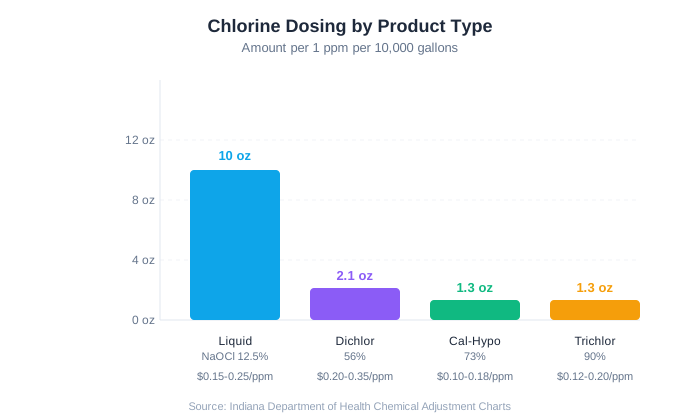
Converting ppm to actual product amounts depends on the chlorine source and pool volume. For a 15,000-gallon pool with 18 ppm needed: using 12.5% liquid chlorine, you need approximately 2.7 gallons. Using 73% calcium hypochlorite, you need approximately 2.3 pounds. These conversions assume the standard dosing rates published by the Indiana Department of Health chemical adjustment charts.
| Chlorine Source | Available Chlorine | Amount per 1 ppm per 10,000 gal | Cost per ppm (approx) |
|---|---|---|---|
| Sodium hypochlorite 12.5% | 12.5% | 10 fl oz | $0.15-0.25 |
| Calcium hypochlorite 73% | 73% | 1.3 oz by weight | $0.10-0.18 |
| Dichlor 56% | 56% | 2.1 oz by weight | $0.20-0.35 |
| Trichlor 90% | 90% | 1.3 oz by weight | $0.12-0.20 |
How Do You Price a High-Demand Pool Recovery?
Once you know the demand, you can calculate your chemical cost and quote accurately. A pool with 20 ppm demand in 20,000 gallons needs roughly 4 gallons of liquid chlorine just to satisfy the demand. Add another gallon for residual. At current prices, that is $25 to $40 in chemical cost alone, plus your labor for multiple visits. Corey prices green pool recoveries at 3x chemical cost plus a flat labor fee, and the demand test is what makes that pricing possible.
What Causes High Chlorine Demand in Pools?
High chlorine demand always points to something in the water that is consuming chlorine. Identifying the root cause is critical, because if you satisfy the demand without fixing the source, the demand will return. Here are the six most common causes, in order of frequency.
| Cause | How It Creates Demand | Diagnostic Clue | Fix |
|---|---|---|---|
| Algae (visible or invisible) | Algae cells consume chlorine as they are oxidized | Green tint, slippery walls, chlorine drops to 0 overnight | Satisfy demand, brush, filter, maintain FC above algae kill threshold |
| Metals (iron, manganese, copper) | Oxidation of dissolved metals consumes chlorine | Brown/rust staining after shocking, well water source | Sequestrant before shocking, consider pre-filter on fill line |
| Organic debris | Leaves, pollen, body oils, and yard waste consume chlorine | Visible debris in skimmer, cloudy water, high combined chlorine | Net, vacuum, clean filter, then satisfy demand |
| Ammonia/nitrogen compounds | Creates chloramines that consume FC | High combined chlorine, strong chemical smell | Breakpoint chlorination at 10x CC |
| Chloraminated fill water | Municipal water adds 1-4 ppm CC directly | Demand appears after every top-off or refill | Breakpoint shock after each fill, or pre-treat fill water |
| Insufficient CYA protection | UV destroys unprotected chlorine in 2-3 hours | FC drops fast on sunny days, CYA below 30 ppm | Raise CYA to 30-50 ppm, retest demand |
Always test metals before shocking a pool with suspected high demand. If iron or copper is present, add a sequestrant and wait 24 hours before adding chlorine. Shocking a pool with dissolved metals causes instant staining that is expensive to remove.
How Do You Handle Chronic Chlorine Demand on a Route?
Some pools on your route will have recurring chlorine demand problems. These are the pools that eat chlorine every week, require extra product on every visit, and generate callbacks between services. Chronic demand pools need a systematic approach rather than just adding more chlorine each week.
What Is the Protocol for Chronic Demand Pools?
- 1Run a full demand test to establish baseline demand.
- 2Test source water for metals and chloramines. If the fill water has iron above 0.3 ppm or chloramines above 0.5 ppm, that is your root cause.
- 3Check CYA level. If CYA is below 30 ppm, UV destruction may be mimicking demand. Raise CYA to 30-50 ppm and retest.
- 4Inspect and clean the filter. A dirty or undersized filter allows organic particles to accumulate, creating ongoing demand.
- 5Verify pump runtime. Pools running less than 8 hours per day in summer do not circulate enough to distribute chlorine and filter contaminants.
- 6If demand is satisfied but returns within 48 hours, look for an ongoing contamination source: fertilizer runoff, septic seepage, heavy tree debris, or an underground spring.
Log every demand test result in your service software. Over time, the data reveals patterns. You might find that a pool has high demand every spring after pollen season, or every time the homeowner fertilizes the lawn. Those patterns let you schedule proactive treatments instead of reacting to callbacks.
Pool Founder logs chlorine readings on every visit and flags pools where FC drops below 1 ppm between services. That flag triggers a demand investigation rather than just adding more shock. Tracking the data across your route turns reactive troubleshooting into predictable maintenance.
Run a pool route?
The business side of what you just read.
Pricing, chemical costs, and the tools owners use to keep the numbers straight.
- Commercial pool service pricing2026 rate tables and the cost-plus formula
- Chemical cost per poolWhat chemicals actually cost per stop
- Chemical tracking softwareLog readings and dosing from the pool deck
- Pool service softwareRoutes, invoicing, and service reports in one app
- Free profit & rate calculatorsProfit per pool, minimum rate, break-even
Frequently Asked Questions
What is a chlorine demand test?
A chlorine demand test measures how much chlorine pool water consumes before a stable free chlorine residual can form. You add a known dose of chlorine, wait 3 to 4 hours with the pump running, then measure the remaining free chlorine. The difference between what you added and what remains is the demand. This tells you exactly how much chlorine the pool needs.
How long does a chlorine demand test take?
A single round takes 3 to 4 hours. Many high-demand pools require 2 to 3 rounds, bringing the total to 8 to 12 hours. Plan to start the test in the morning and check back throughout the day. The test is complete when the pool holds at least 1 ppm free chlorine for a full 3 to 4 hour cycle.
Why does my pool lose all its chlorine overnight?
Rapid chlorine loss usually means unsatisfied demand from algae, metals, ammonia, or organic debris in the water. If CYA is below 30 ppm, UV destruction from sunlight can also consume chlorine quickly during the day. Run a chlorine demand test to measure the actual demand, then check CYA, metals, and combined chlorine to identify the root cause.
Can high CYA cause chlorine demand?
High CYA does not create chlorine demand directly. However, CYA above 70 ppm slows the kill rate of free chlorine so much that contaminants like algae can outpace the sanitizer. This looks like a demand problem because the pool cannot stay clear, but the real issue is that the chlorine is too slow to work. The fix is to drain and dilute to lower CYA below 50 ppm.
How much does it cost to satisfy chlorine demand on a green pool?
It depends on pool volume and demand level. A typical 15,000-gallon green pool with 20 ppm of demand needs about 3 gallons of 12.5% liquid chlorine just to satisfy the demand, costing $20 to $35 in chemicals. Add another gallon for residual and you are at $25 to $45 total. Most service companies charge 2 to 4 times their chemical cost plus a labor fee for green pool recoveries.
Should I use liquid chlorine or cal-hypo for a demand test?
Use liquid sodium hypochlorite (12.5%) for demand tests. It is easier to measure precisely, dissolves instantly, and does not add calcium to the water. One gallon of 12.5% liquid chlorine raises approximately 10,000 gallons by 10 ppm. Cal-hypo works but adds calcium hardness, which can push already-high CH over the limit on pools that need large doses.