Every Algae Type Requires a Different Kill Protocol
Algae is the most visible failure in pool service. When a customer sees green, yellow, or black growth in their pool, they lose confidence immediately. For service professionals, the key is fast identification followed by the correct treatment protocol. Treating mustard algae like green algae wastes product and time. Treating black algae without brushing first guarantees a callback. Each algae type has a specific chemistry, a specific chlorine resistance level, and a specific kill protocol.
Corey Adams, Pool Founder co-founder and 15-year pool service veteran, has treated thousands of algae outbreaks across every pool type. "Green algae is easy if you hit it hard and fast. Mustard algae is stubborn and comes back if you miss a single surface. Black algae will beat you if you do not brush through the protective layer first. And pink slime is not algae at all, it is bacteria, and it needs a completely different approach."
This guide covers identification, chemistry, and step-by-step treatment for each algae type. Includes dosing tables, brushing requirements, and prevention strategies.
How Do You Identify the Four Types of Pool Algae?
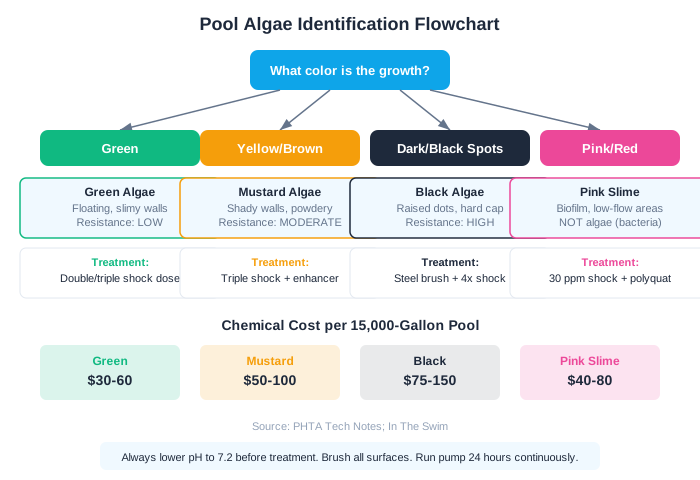
Correct identification is the first step to effective treatment. Each algae type looks different, grows in different locations, and responds to different chlorine levels. Misidentification leads to wasted chemicals and repeat visits.
| Type | Color | Location | Texture | Chlorine Resistance |
|---|---|---|---|---|
| Green algae | Bright green to dark green | Floating in water, walls, floor | Slimy, slippery surfaces | Low (easiest to kill) |
| Yellow/mustard algae | Yellow-green to brown | Shady walls, steps, corners | Powdery, brushes off easily but returns | Moderate (chlorine resistant) |
| Black algae | Dark blue-green to black spots | Plaster, grout, concrete surfaces | Raised dots with hard protective cap | High (very chlorine resistant) |
| Pink slime | Pink to reddish-orange | Skimmer, PVC fittings, light niches | Slimy biofilm coating | Moderate (bacteria, not algae) |
How Do You Tell Yellow Algae from Pollen or Sand?
Yellow algae is commonly mistaken for pollen, dirt, or sand on the pool floor. The test is simple: brush the affected area. If the material clouds up and disperses into the water rather than sinking back down, it is algae. Pollen floats on the surface and filters out. Sand settles immediately to the bottom and does not cloud. Yellow algae clings to walls and returns to the same spot within 24-48 hours after brushing.
How Do You Treat Green Algae?
Green algae is the most common pool algae and the easiest to kill. It is a free-floating algae that turns the water green and makes surfaces slippery. Green algae responds to standard chlorine shocking. The severity determines the dose: light green needs a double dose, dark green needs a triple dose, and a pool that looks like a swamp may need four times the standard shock dose.
Green Algae Treatment Protocol
- 1Test and record FC, CC, pH, CYA, and TA before treatment.
- 2Lower pH to 7.2 using muriatic acid. Chlorine is significantly more effective at lower pH.
- 3Brush all walls, floor, steps, and behind ladders. This breaks up biofilm and exposes algae to chlorine.
- 4Shock to the appropriate FC level based on severity (see table below).
- 5Run the pump 24 hours continuously. Do not turn it off until the water clears.
- 6Clean or backwash the filter every 8-12 hours during recovery. Dead algae clogs filters fast.
- 7Retest FC after 12-24 hours. If FC has dropped to 0, add another shock dose. The pool has unsatisfied demand.
- 8Once the water is clear and FC holds above 2 ppm for 24 hours, vacuum dead algae to waste if possible.
| Severity | Water Appearance | Target FC | Shock Dose (cal-hypo 73% per 10,000 gal) |
|---|---|---|---|
| Light | Teal/light green tint | 10 ppm | 13 oz (double dose) |
| Moderate | Solid green, cannot see bottom | 20 ppm | 26 oz (triple dose) |
| Severe | Dark green/black-green | 30 ppm | 39 oz (quadruple dose) |
If CYA is above 50 ppm, you need higher FC targets to achieve the same kill rate. The general rule: multiply the target FC by the CYA factor. At CYA 70, you may need 50% more chlorine to achieve the same effect as at CYA 30.
How Do You Treat Yellow (Mustard) Algae?
Yellow algae, also called mustard algae, is chlorine-resistant and persistent. It prefers shaded areas and low-circulation zones like steps, behind ladders, and the shady side of the pool. It brushes off walls easily but returns within 24-48 hours if not treated aggressively. Standard shocking rarely eliminates mustard algae. You need a triple-shock dose at minimum, and you must decontaminate every item that has contacted the pool water.
Yellow Algae Treatment Protocol
- 1Remove all pool accessories: floats, toys, ladders, skimmer baskets, vacuum heads, brushes. Soak everything in a chlorine solution (1 gallon liquid chlorine per 5 gallons water) for 30 minutes.
- 2Lower pH to 7.2.
- 3Brush every surface in the pool thoroughly, including inside the skimmer, behind light niches, and under step treads.
- 4Apply a chlorine enhancer product (sodium bromide based, sold as Yellow Out or Yellow Treat) following the manufacturer instructions. This converts to bromine in the presence of chlorine and kills algae chlorine alone cannot.
- 5Immediately follow with a triple shock dose: 3 lbs of cal-hypo 73% per 10,000 gallons, or 2.3 gallons of liquid chlorine per 10,000 gallons.
- 6Run the pump 24-48 hours continuously.
- 7Clean the filter 12 hours after treatment and again at 24 hours.
- 8Retest at 48 hours. If any yellow residue remains, repeat brushing and re-shock.
- 9Wash all swimsuits and towels in hot water with bleach. Mustard algae spores survive on fabric.
"Mustard algae is the one that makes guys look bad," Corey says. "You treat it, the pool looks perfect, and three days later the customer calls because it is back. The spores live on everything that touched the water. If you do not soak the brushes, the nets, and the vacuum hose, you are reintroducing it every time you service the pool."
How Do You Treat Black Algae?
Black algae is the most difficult pool algae to eliminate. It is actually a cyanobacterium that forms a hard protective cap over its root structure. This cap shields the organism from chlorine, which is why standard shocking rarely works. Black algae roots penetrate into porous surfaces like plaster, grout, and concrete. It appears as dark blue-green or black raised dots, usually smaller than a dime, most commonly on plaster walls and floors.
Black Algae Treatment Protocol
- 1Lower pH to 7.2.
- 2Use a stainless steel algae brush (not nylon) to aggressively scrub every black algae spot. The goal is to break through the protective cap and expose the living algae underneath.
- 3Apply granular trichlor directly to each black algae spot on the walls and floor. The granules sink and sit on the spots, delivering concentrated chlorine. Only do this on plaster or concrete surfaces, not on vinyl or fiberglass.
- 4Shock the pool with a quadruple dose: at least 4 lbs of cal-hypo 73% per 10,000 gallons.
- 5Add an algaecide rated for black algae (copper-based or polyquat 60) following the label rate.
- 6Brush the spots again 24 hours after shocking.
- 7Run the pump 24-48 hours continuously.
- 8Retest and re-brush at 48 and 72 hours. Black algae often requires 2-3 treatment cycles.
- 9If spots persist after three full cycles, the roots have penetrated too deeply. The pool may need to be drained and the plaster acid-washed or replastered.
Never use a stainless steel brush on vinyl, fiberglass, or painted surfaces. It will scratch and damage the finish. For black algae on non-plaster surfaces, use a stiff nylon brush and rely on higher chlorine concentrations and longer contact time.
What Is Pink Slime and How Do You Treat It?
Pink slime is not algae. It is a bacterial biofilm caused by Methylobacterium or similar organisms. It appears as a pink or reddish-orange slimy coating, most commonly in low-flow areas: inside the skimmer, around PVC fittings, in light niches, and along the waterline. Pink slime thrives in pools with low sanitizer levels and poor circulation.
Pink Slime Treatment Protocol
- 1Remove and clean all affected accessories. Scrub light niches, skimmer throats, and return fittings with a chlorine solution.
- 2Lower pH to 7.2.
- 3Shock to 30 ppm FC using liquid chlorine.
- 4Add a polyquat 60 algaecide at double the label rate. Polyquat is more effective against bacterial biofilm than copper-based products.
- 5Run the pump 24 hours continuously with all valves open to circulate through every line.
- 6Clean the filter 12 hours after treatment.
- 7Maintain FC above 5 ppm for 72 hours after treatment to ensure complete kill.
- 8Check and improve circulation in dead spots where pink slime was found. Aim return jets at those areas.
Pink slime typically indicates a systemic circulation or sanitizer problem. If it keeps returning, check pump runtime (should be 8+ hours daily in summer), verify the chlorine delivery method is functioning, and inspect for dead legs in the plumbing where water sits stagnant.
How Do You Prevent Algae on a Pool Service Route?
Prevention is cheaper than treatment. A single algae callback costs you the chemical product, the extra drive time, and the customer confidence hit. A consistent prevention program across your route eliminates most algae calls before they happen.
What Are the Key Prevention Practices?
- Maintain FC at 2-4 ppm on every visit. Algae starts growing when FC drops below 1 ppm.
- Keep CYA between 30-50 ppm. Below 30, chlorine burns off too fast. Above 70, chlorine loses kill power.
- Brush walls, steps, and corners on a rotating schedule. Biofilm starts before visible algae appears.
- Run the pump at least 8 hours per day in summer, 6 hours in winter. Stagnant water breeds algae.
- Clean the filter on a regular schedule. A clogged filter reduces flow and creates dead zones.
- Apply a maintenance dose of algaecide (polyquat 30 or 60) every 2-4 weeks during swim season as a backup to chlorine.
- Check phosphate levels quarterly. While phosphates alone do not cause algae, levels above 500 ppb provide a food source that makes outbreaks more likely when chlorine drops.
Pool Founder tracks chlorine levels across every stop on your route. When FC drops below your threshold on consecutive visits, the system flags the pool for investigation before algae has a chance to take hold. Catching the trend early prevents the callback.
Run a pool route?
The business side of what you just read.
Pricing, chemical costs, and the tools owners use to keep the numbers straight.
- Commercial pool service pricing2026 rate tables and the cost-plus formula
- Chemical cost per poolWhat chemicals actually cost per stop
- Chemical tracking softwareLog readings and dosing from the pool deck
- Pool service softwareRoutes, invoicing, and service reports in one app
- Free profit & rate calculatorsProfit per pool, minimum rate, break-even
Frequently Asked Questions
What is the most common type of pool algae?
Green algae is the most common type found in swimming pools. It is a free-floating algae that turns the water green and makes surfaces slippery. Green algae is also the easiest to treat with standard chlorine shocking. A double dose of shock (raising FC to 10 ppm) handles light cases, while severe cases require a triple or quadruple dose.
Why does mustard algae keep coming back?
Mustard algae spores survive on any surface that has contacted the pool water: brushes, vacuum hoses, nets, floats, swimsuits, and towels. If you treat the pool without decontaminating every accessory, you reintroduce the spores on the next service visit. Soak all equipment in a chlorine solution, wash swimsuits in hot water with bleach, and triple-shock the pool to prevent recurrence.
Can you treat black algae without draining the pool?
Yes, in most cases. The key is breaking the protective cap with a stainless steel brush before shocking. Apply granular trichlor directly to each spot (on plaster surfaces only), then quadruple-shock the pool. Most cases require 2-3 treatment cycles over a week. However, if roots have penetrated deeply into the plaster after months of untreated growth, draining and acid washing may be the only permanent solution.
Is pink slime in a pool dangerous?
Pink slime (Methylobacterium) is generally not dangerous to healthy swimmers but indicates inadequate sanitizer levels and poor circulation. It can harbor other bacteria in its biofilm. The bigger concern is that if sanitizer is low enough for pink slime to grow, the pool is also vulnerable to harmful pathogens. Treat it promptly and fix the underlying circulation or chlorine issue.
How much does algae treatment cost a pool service company?
Chemical cost depends on pool volume, algae type, and severity. A standard green pool recovery on a 15,000-gallon pool costs $30 to $60 in chemicals. Mustard algae treatment runs $50 to $100 including the chlorine enhancer product. Black algae can cost $75 to $150 in chemicals over multiple treatments. Most service companies charge 2 to 4 times chemical cost plus labor.
Do algaecides replace chlorine for algae prevention?
No. Algaecides are a backup to proper chlorine management, not a replacement. Chlorine is the primary sanitizer that kills and prevents algae. Algaecides (polyquat 30 or 60) provide a secondary layer of protection for the period between service visits when FC may drop. Never rely on algaecide alone.