Algae Does Not Show Up Randomly. It Follows a Calendar.
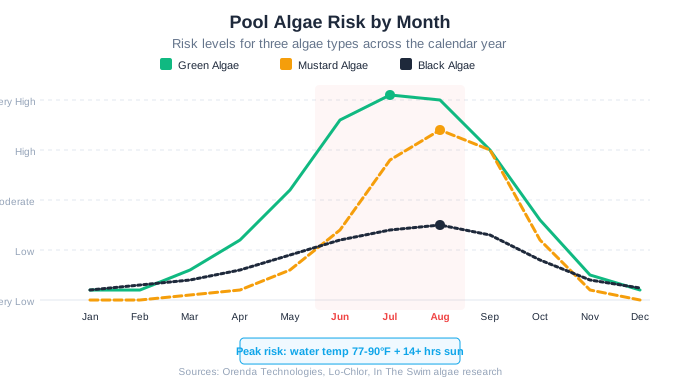
Pool algae blooms look sudden, but they are predictable. Algae growth is driven by temperature, sunlight, nutrient availability (primarily phosphates and nitrates), and sanitizer levels. These factors follow seasonal patterns. Water temperature above 60 degrees F allows algae to grow. Above 77 degrees F, green algae can replicate every 3-6 hours under ideal conditions. Combine warm water with long summer daylight, phosphate accumulation from landscaping runoff, and increased bather loads that consume chlorine, and you have the recipe for a bloom.
Corey Adams, Pool Founder co-founder and 15-year pool service veteran, manages algae proactively, not reactively. "Every year I see the same pattern. March and April, pools are fine. May, a few green tints start showing up. June through August, it is all-out war. September it calms down. The pool guys who get blindsided are the ones running the same chemical program in July that they ran in February. Algae is seasonal. Your chemical program should be too."
77-88°F
Water temperature range where algae growth rate peaks
Source: Orenda Technologies, pool chemistry research
The Three Algae Types and When They Peak
Not all pool algae behaves the same way or peaks at the same time. Understanding the three primary types helps you recognize early signs and target your treatment.
| Algae Type | Appearance | Growth Speed | Peak Season | Difficulty to Treat |
|---|---|---|---|---|
| Green algae (Chlorophyta) | Green water, green slime on walls and floor | Fast (replicates every 3-6 hours in ideal conditions) | June through August | Easiest. Responds to superchlorination and brushing. |
| Mustard/Yellow algae (Phaeophyta) | Yellow-brown powder on walls and floor, often mistaken for pollen or dirt | Slow but persistent | Late July through September | Moderate. Chlorine-resistant. Requires specialized algaecide (sodium bromide) and aggressive brushing. |
| Black algae (Cyanobacteria) | Dark blue-green or black spots embedded in plaster, grout, or rough surfaces | Very slow | Year-round in warm climates, peaks in summer | Hardest. Has a protective outer layer. Requires repeated brushing with stainless steel brush, concentrated chlorine, and often algaecide. |
Black algae is not technically algae. It is cyanobacteria. It forms roots (rhizoids) that penetrate plaster and grout, making it nearly impossible to fully eliminate with surface treatment alone. If you see black algae on a pool you service, address it immediately. It does not go away on its own and spreads over time.
The Four Trigger Conditions for Algae Blooms
Algae needs four conditions to bloom. Remove any one of them and growth stalls. Your chemical program should systematically suppress as many of these conditions as possible.
1. Water Temperature Above 60 degrees F
Algae growth is minimal below 60 degrees F. Between 60-77 degrees F, growth accelerates. Above 77 degrees F, growth rate peaks. At 85 degrees F, green algae can double its population every 3-6 hours with adequate sunlight and nutrients. You cannot control water temperature on outdoor pools, so temperature is the one factor you must compensate for with chemistry and maintenance.
2. Sunlight (UV Radiation)
Algae are photosynthetic organisms. They need sunlight to grow. Longer summer days with 14-15 hours of sunlight provide more energy for algae growth than winter days with 9-10 hours. Pools in full sun are at higher risk than shaded pools. UV also degrades free chlorine, compounding the problem by reducing your sanitizer while simultaneously fueling algae growth.
3. Nutrients (Phosphates and Nitrates)
Phosphates are the primary nutrient that fuels algae growth in pools. Sources include landscaping fertilizer runoff, decomposing leaves and debris, bather waste (sweat, sunscreen), and fill water. Phosphate levels above 500 ppb create a persistent food source for algae. Levels above 1,500 ppb make algae control extremely difficult even with aggressive chlorination.
4. Insufficient Sanitizer (Low Free Chlorine)
Free chlorine kills algae. But chlorine demand increases in summer due to higher bather loads, UV degradation, and warmer water temperatures that accelerate chlorine consumption. A chlorine level that works in March may be completely inadequate in July. If free chlorine drops below the effective threshold for even 12-24 hours during peak season, algae can establish a foothold that takes days to eliminate.
Monthly Chemical Adjustment Guide: Staying Ahead of Algae
A static chemical program fails during summer. The pool service companies that prevent algae, rather than treat it, adjust their chemical program by month based on the seasonal conditions. Here is the monthly framework for sun belt and seasonal markets.
| Month | Risk Level | Key Adjustment | Notes |
|---|---|---|---|
| January-February | Very Low | Maintain baseline FC at 2-3 ppm | Water temp below 60 F in most markets. Minimal chlorine demand. Standard program. |
| March | Low | Begin phosphate monitoring | Spring pollen and landscaping fertilizer introduce phosphates. Test phosphate levels. Treat if above 500 ppb. |
| April | Moderate | Increase FC target to 3-4 ppm. Verify CYA. | Water temps approaching 70 F. Ensure CYA is 30-50 ppm to protect chlorine from UV degradation. Begin preventive algaecide if pool has history of blooms. |
| May | Moderate-High | Increase FC to 4-5 ppm. First phosphate removal treatment. | Bather loads increasing. Sunlight hours peak. This is the transition month where underdosing chlorine creates June algae problems. |
| June | High | FC at 5-6 ppm. Weekly brushing. Phosphate maintenance dose. | Peak algae season begins. Green algae can bloom in 24-48 hours at these temps. Check FC twice per visit if possible. |
| July | Very High | FC at 5-7 ppm. Consider supplemental oxidation. Watch for mustard algae. | Highest risk month. Water temps 82-90 F. Heavy bather loads. Maximum chlorine demand. Mustard algae starts appearing. |
| August | Very High | Maintain July protocol. Aggressive phosphate management. | Cumulative phosphate buildup from the entire summer. Even well-maintained pools can bloom if phosphates have accumulated unchecked. |
| September | High | Begin tapering FC back to 4-5 ppm. | Water temps starting to drop. Bather loads decreasing. Mustard algae is still active. Do not drop your guard too early. |
| October | Moderate | Taper to 3-4 ppm. Final phosphate treatment. | Falling leaves introduce phosphates and organic debris. Clean filters. Remove debris promptly to limit nutrient introduction. |
| November-December | Low | Return to baseline 2-3 ppm | Water temps below 65 F in most markets. Reduced chlorine demand. Standard program resumes. |
These FC targets assume CYA levels of 30-50 ppm. If CYA is higher, your effective FC is lower because CYA binds free chlorine. At 80 ppm CYA, you need roughly double the FC to achieve the same sanitizing power as at 30 ppm CYA. The FC/CYA ratio matters more than the absolute FC number.
Phosphate Management: The Overlooked Factor
Phosphates do not directly harm swimmers or damage equipment. But they are the primary nutrient that fuels algae growth. A pool with zero phosphates and marginal chlorine may never bloom. A pool with 2,000 ppb phosphates and adequate chlorine is one missed service visit away from a green pool. Managing phosphates is insurance against the inevitable chlorine lapse.
Where Phosphates Come From
- Landscaping fertilizer: Irrigation overspray and rainwater runoff carry phosphorus-based fertilizers directly into the pool. This is the largest source in most residential pools.
- Decomposing organic matter: Leaves, insects, pollen, and grass clippings break down and release phosphates into the water.
- Bather waste: Sweat, sunscreen, cosmetics, and body oils contain phosphates. Heavy bather loads during summer increase introduction.
- Fill water: Municipal water supplies contain varying levels of phosphates (often 100-500 ppb). Every time you add water, you add phosphates.
- Some pool chemicals: Certain sequestering agents and stain preventers contain phosphoric acid or phosphonate compounds.
Phosphate Treatment Protocol
- 1Test phosphate levels monthly from March through October. Use a phosphate-specific test (not included in standard pool test kits). Target: below 500 ppb.
- 2Apply a lanthanum-based phosphate remover when levels exceed 500 ppb. Dose according to manufacturer instructions. Common brands include Natural Chemistry PHOSfree, Orenda PR-10000, and SeaKlear.
- 3Run the filter for 24-48 hours after treatment. Phosphate removers work by binding phosphates into a filterable precipitate. The filter captures it. Clean or backwash the filter after the treatment cycle.
- 4Apply preventive maintenance doses every 1-3 months during peak season to keep levels from spiking between tests.
- 5Address the source: If landscaping runoff is the primary phosphate source, recommend that the customer redirect irrigation overspray away from the pool or adjust fertilizer application timing.
Chlorine Demand Shifts: Why the Same Dose Fails in Summer
Chlorine demand is the amount of chlorine consumed by contaminants in the water before a measurable residual remains. In winter, a pool might consume 1-2 ppm of chlorine per day. In July, the same pool can consume 4-8 ppm per day. If your chemical program adds the same amount of chlorine in July as it does in January, free chlorine will drop to zero during peak demand periods, and algae will exploit that gap.
What Increases Summer Chlorine Demand
| Factor | Summer Impact | Chlorine Demand Increase |
|---|---|---|
| UV degradation | 14-15 hours of sun vs. 9-10 hours in winter | Without CYA, UV can destroy 90% of FC in 2 hours. With CYA at 30-50 ppm, degradation slows to 5-10% per hour. |
| Water temperature | 82-90 F vs. 55-65 F in winter | Higher temps accelerate all chemical reactions, including chlorine consumption and organic decay |
| Bather load | Daily swimming vs. minimal or no use | Each swimmer introduces sweat, oils, sunscreen, and urine that consume chlorine. A pool party with 10 swimmers can consume 2-4 ppm FC in hours. |
| Organic debris | More insects, pollen, leaves during summer | Each piece of organic matter consumes chlorine as it oxidizes |
| Phosphate accumulation | Peak fertilizer season + runoff | More phosphates = more algae growth potential = more chlorine consumed fighting algae spores |
If you use a salt chlorine generator, verify the output percentage is increased for summer. Many pool owners set their SCG to 50% in spring and forget about it. By July, 50% output is not keeping up with demand. Increase to 70-80% during peak season and consider supplemental tablet or liquid chlorine during high-use periods.
What to Do When You Find Algae on a Customer Pool
Despite your best preventive efforts, you will occasionally arrive at a pool to find green water or algae on the walls. Speed and correct treatment matter. A green tint treated on Tuesday becomes crystal clear by Thursday. A green tint ignored until next week becomes a full bloom that takes 3-5 days and multiple visits to resolve.
Green Algae Treatment Protocol
- 1Brush all surfaces. Break up the algae colonies so chlorine can reach them. Algae forms a biofilm that partially protects it from chlorine.
- 2Shock to 30 ppm FC (breakpoint superchlorination). Use liquid chlorine (sodium hypochlorite) for fastest results. Calculate the dose based on current FC and pool volume.
- 3Run the pump 24 hours continuously until the water clears. Stagnant water lets dead algae settle and can cause secondary problems.
- 4Vacuum dead algae to waste (not through the filter). Filtering large amounts of dead algae clogs the filter and reduces flow.
- 5Retest FC in 24 hours. If FC has dropped back below 5 ppm, the pool has high chlorine demand and may need a second shock.
- 6Clean or backwash the filter after the water clears. Dead algae captured by the filter reduces filtration efficiency until removed.
For mustard algae, add a sodium bromide algaecide before the chlorine shock. For black algae, scrub each spot with a stainless steel brush, apply granular calcium hypochlorite directly to the spots, and follow with a full-pool shock. Black algae treatment may require 3-5 visits over 2 weeks.
Run a pool route?
The business side of what you just read.
Pricing, chemical costs, and the tools owners use to keep the numbers straight.
- Commercial pool service pricing2026 rate tables and the cost-plus formula
- Chemical cost per poolWhat chemicals actually cost per stop
- Chemical tracking softwareLog readings and dosing from the pool deck
- Pool service softwareRoutes, invoicing, and service reports in one app
- Free profit & rate calculatorsProfit per pool, minimum rate, break-even
Frequently Asked Questions
What month is algae worst in pools?
July and August are the highest-risk months for pool algae in most U.S. markets. Water temperatures peak at 82-90 degrees F, sunlight hours are at maximum, bather loads are highest, and cumulative phosphate buildup from the entire summer reaches its peak. Green algae can bloom within 24-48 hours during these months if free chlorine drops below effective levels.
What temperature does pool algae start growing?
Algae can begin growing when water temperature exceeds 60 degrees F. Growth accelerates above 77 degrees F and peaks between 77-88 degrees F. Some species, like black algae (cyanobacteria), can tolerate temperatures as low as 60 degrees F. In sun belt states, pool water may stay above 60 degrees F year-round, meaning algae risk never fully disappears.
Do phosphates cause algae in pools?
Phosphates do not directly cause algae, but they fuel its growth. Phosphates are a primary nutrient that algae need to reproduce. High phosphate levels (above 500 ppb) give algae a persistent food source, making blooms more likely when other conditions (temperature, sunlight, low chlorine) align. Managing phosphates below 500 ppb reduces algae risk significantly.
Why does my pool get algae even with good chlorine levels?
Several reasons: high phosphate levels providing nutrients, CYA levels above 50 ppm reducing chlorine effectiveness, poor circulation leaving dead spots where algae can establish, or brief chlorine lapses during peak demand periods (after a pool party or heavy rain). Even "good" chlorine at 3 ppm may be insufficient during July if CYA is high and phosphates are elevated.
Should I use algaecide as a preventive measure?
In high-risk situations, yes. Pools with a history of recurring algae, pools in full sun with limited circulation, and commercial pools with heavy bather loads all benefit from preventive algaecide. A quarterly maintenance dose of a polymer-based algaecide provides supplemental protection. However, algaecide is a supplement, not a replacement for adequate free chlorine and phosphate management.
How do I increase chlorine in summer without increasing CYA?
Use liquid chlorine (sodium hypochlorite) or calcium hypochlorite instead of trichlor tablets. Trichlor adds approximately 0.6 ppm of CYA for every 1 ppm of chlorine it provides, which causes CYA to accumulate over the season. Liquid chlorine and cal-hypo add chlorine without adding CYA. If you use an SCG, increase the output percentage rather than adding supplemental trichlor.