Salt Pools Are Not Cheaper to Maintain. They Are Different.
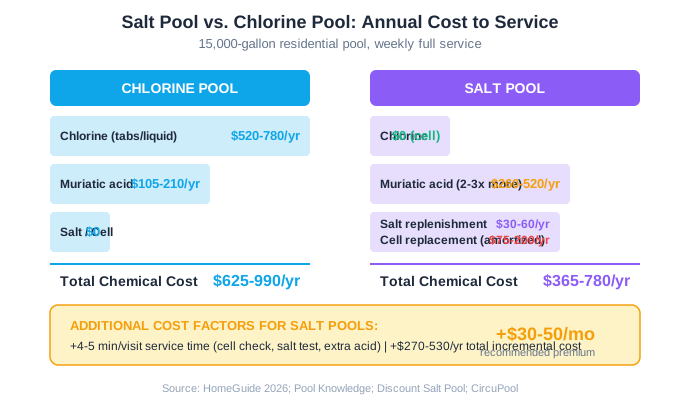
Homeowners buy salt pools because they heard they are "low maintenance" and "cheaper than chlorine." Neither statement is accurate. Salt pools generate their own chlorine through electrolysis, which eliminates the cost of buying chlorine tablets or liquid. But that savings is offset by higher acid consumption, periodic salt cell replacement ($300 to $700 every 3 to 5 years), and the specialized knowledge required to prevent cell scaling, manage persistent pH rise, and maintain the correct CYA balance.
According to HomeGuide 2026 data, saltwater pool maintenance costs are comparable to traditional chlorine pools when factoring in all expenses. Monthly chemical costs run $40 to $80 for salt pools versus $50 to $100 for chlorine pools, but the amortized salt cell replacement adds $75 to $200 per year. Total annual maintenance for a professionally serviced salt pool runs $1,970 to $4,050. You need to price your service to reflect this reality, and you need to explain it clearly so customers understand why they are paying a premium.
This guide covers the true cost of salt pool service, how to calculate and justify your premium, and how to communicate the value to homeowners who think their salt pool should cost less than their neighbor's chlorine pool.
What Does Salt Pool Service Actually Cost You?
Before you can set a price, you need to understand your actual cost per salt pool stop compared to a traditional chlorine pool stop. The differences are not dramatic on any single line item, but they add up across four weekly visits per month and 12 months per year.
| Cost Category | Chlorine Pool | Salt Pool | Difference |
|---|---|---|---|
| Chlorine (liquid/tabs) | $8-15/visit | $0 (cell generates) | -$8-15/visit |
| Muriatic acid | $2-4/visit | $5-10/visit | +$3-6/visit |
| Salt replenishment | $0 | $1-3/visit (amortized) | +$1-3/visit |
| Cell replacement (amortized) | $0 | $1.50-4/visit | +$1.50-4/visit |
| Cell inspection time | 0 min | 3-5 min/visit | +3-5 min |
| Total chemical cost/visit | $10-19 | $7.50-17 | Similar |
| Total service time/visit | 18-25 min | 22-30 min | +4-5 min |
The net chemical cost per visit is actually similar between salt and chlorine pools. The savings from not buying chlorine is largely consumed by increased acid use and amortized cell replacement. But the service time is consistently longer because salt pools require cell inspection, salt level testing with a digital meter, and more careful pH management. Those extra 4 to 5 minutes per visit add up to 16 to 20 extra minutes per month, which is real labor cost.
$270-530/yr
Additional annual cost for salt pool maintenance vs. traditional chlorine (15K gal pool)
Source: Pool Founder analysis; Discount Salt Pool; HomeGuide
How Much More Should You Charge for Salt Pool Service?
The data supports a $30 to $50 per month premium for salt pool service over your standard chlorine pool rate. At the low end, $30 per month ($360/year) barely covers the incremental costs. At $50 per month ($600/year), you are building in a reasonable margin above the $270 to $530 in additional annual costs. Your premium should scale with pool size because larger pools require more acid, more salt, and more expensive cells.
| Pool Size | Base Rate (Chlorine) | Salt Premium | Salt Pool Rate | Annual Salt Premium |
|---|---|---|---|---|
| Small (under 12K gal) | $100-130/mo | +$25-35/mo | $125-165/mo | $300-420/yr |
| Medium (12-20K gal) | $125-165/mo | +$35-45/mo | $160-210/mo | $420-540/yr |
| Large (20-30K gal) | $150-200/mo | +$40-55/mo | $190-255/mo | $480-660/yr |
| Very large (30K+ gal) | $175-230/mo | +$50-65/mo | $225-295/mo | $600-780/yr |
Corey Adams, Pool Founder co-founder and 15-year pool service veteran, prices salt pools with a flat $40 premium on most residential accounts. "I tried matching chlorine pool pricing on salt pools early in my career and it ate my margins. The acid alone costs more, the cell inspection adds time, and when the cell fails, the customer expects you to handle it. If you are not charging a premium, you are subsidizing the customer's salt system out of your profit."
How Do You Explain the Premium to Customers?
The number one pushback from salt pool owners is "But I thought salt pools were supposed to be cheaper." They are not wrong about the marketing. Salt system manufacturers and pool builders promote lower ongoing costs as a key selling point. Your job is to reframe the conversation from "cheaper" to "different" without making the customer feel like they were misled into buying the salt system.
Three Talking Points That Work
- 1The chlorine savings are real, but they are offset by other costs. "Your salt cell generates free chlorine, which saves you $40 to $60 per month on chlorine products. But the cell itself costs $300 to $700 and lasts three to five years, so that is $75 to $200 per year in amortized replacement cost. And your pool uses twice as much acid as a chlorine pool because the electrolysis process pushes pH up constantly."
- 2Salt pools need more specialized knowledge. "Managing pH rise, protecting the cell from calcium scaling, keeping CYA in the right range, and knowing when the cell needs cleaning or replacement are specialized skills. Not every pool company knows how to do this correctly. We do, and our premium reflects that expertise."
- 3Under-servicing a salt pool costs more in the long run. "If pH runs high for months because the tech is not adding enough acid, calcium scales on the cell plates. That shortens the cell lifespan from five years to two years. Replacing a $500 cell two years early costs far more than the $40 per month service premium."
Put the cost comparison in writing. When quoting a new salt pool customer, include a one-page breakdown showing chlorine savings, acid costs, cell amortization, and the net difference. Transparency builds trust and prevents the "why is this more expensive" conversation six months in.
What Should Salt Pool Service Scope Include?
Your salt pool service scope needs to explicitly include items that do not exist on a chlorine pool service. Customers should know exactly what they are getting for the premium. Document this in your service agreement so there is no ambiguity about what is included and what constitutes extra work.
Standard Salt Pool Service Scope
- Weekly chemical testing and balancing (FC, pH, TA, salt level)
- Weekly muriatic acid addition to manage pH rise from electrolysis
- Monthly CYA and calcium hardness testing
- Quarterly salt cell inspection and cleaning (acid wash as needed)
- Annual salt level calibration and replenishment
- Salt cell performance monitoring (output percentage, error codes)
- All standard pool service items (skim, brush, baskets, filter pressure check)
Items NOT Included in Standard Service
- Salt cell replacement (quoted separately when needed, $300-700 parts + labor)
- Salt system control board repair or replacement
- Bulk salt addition after a drain and refill (customer provides salt or charged per bag)
- Cell cleaning beyond quarterly schedule (if excessive scaling from poor chemistry by previous provider)
Being explicit about what is included prevents scope creep. The most common source of margin erosion on salt pool accounts is the tech spending 10 extra minutes per visit troubleshooting cell issues, cleaning the cell off-schedule, or dealing with salt level problems without the customer being charged for the additional work.
How Do You Handle Salt Cell Replacement Sales?
Salt cells last 3 to 7 years with proper maintenance, with most lasting 3 to 5 years in practice according to CircuPool and River Pools. Cell lifespan is measured in operating hours (5,000 to 10,000 hours), and cells running at high output percentages in warm climates burn through their lifespan faster. When a cell fails, the customer needs a replacement, and you should be the one selling and installing it.
$300-700
Salt cell replacement cost (parts only)
Source: CircuPool, Salt and Umber, River Pools
| Cell Brand/Size | Replacement Cost | Rated Hours | Typical Lifespan |
|---|---|---|---|
| Hayward T-Cell-15 | $400-550 | ~10,000 hrs | 3-5 years |
| Pentair IntelliChlor IC40 | $450-600 | ~10,000 hrs | 3-5 years |
| CircuPool RJ-45+ | $350-500 | ~12,000 hrs | 4-7 years |
| Jandy AquaPure Ei | $300-450 | ~8,000 hrs | 3-4 years |
Quote cell replacement as parts plus one hour of labor. Most replacements take 30 to 45 minutes, so one hour gives you comfortable margin. Markup the cell 15 to 25% over your wholesale cost. The customer could buy the cell online for less, but they are paying for your knowledge of which cell fits their system, correct installation, and the post-installation calibration and testing. Position the cell replacement as a scheduled maintenance event, not a surprise expense, by tracking cell age and output in your service notes.
Ready to streamline your pool service business?
Pool Founder gives you route optimization, automated invoicing, chemical tracking, and everything else you need to run a more profitable pool business.
Frequently Asked Questions
How much more does salt pool service cost than chlorine pool service?
Salt pool service typically costs $30 to $50 per month more than equivalent chlorine pool service, reflecting higher acid consumption, amortized salt cell replacement costs, and longer service time per visit. The total additional annual cost of maintaining a salt pool versus a traditional chlorine pool is $270 to $530 for a 15,000-gallon pool. Your rate should cover these costs plus a reasonable margin.
Why do salt pools need more acid than chlorine pools?
The electrolysis process that generates chlorine in a salt pool also produces sodium hydroxide (NaOH) as a byproduct, which has a pH above 13. This causes persistent pH rise that requires weekly acid addition to counteract. A 15,000-gallon salt pool typically needs 12 to 24 ounces of muriatic acid per week versus 4 to 8 ounces for a chlorine pool of the same size.
How long does a salt cell last?
Salt cells last 3 to 7 years depending on usage, water chemistry, and maintenance. Most cells are rated for 5,000 to 10,000 operating hours. Proper water chemistry (especially calcium hardness below 400 ppm) and regular cell cleaning every three months extend lifespan. Cells running at high output in warm climates burn through their rated hours faster.
How do I explain salt pool pricing to customers?
Frame the conversation around total cost of ownership, not just chlorine savings. Acknowledge that the salt cell generates free chlorine but explain the offsetting costs: higher acid consumption, cell replacement every 3 to 5 years, and specialized expertise. Provide a written cost comparison showing that salt pools cost $270 to $530 more per year to maintain than chlorine pools of the same size.
Should salt cell replacement be included in the service plan?
No. Salt cell replacement should be quoted separately as a parts-plus-labor service call. Cells cost $300 to $700 for parts alone, and bundling this into monthly service would require charging an additional $8 to $20 per month to amortize the cost. Most customers prefer the one-time expense when the cell fails rather than a higher monthly rate. Track cell age and proactively notify customers when replacement is approaching.