Your Training Program Determines Your Service Quality
Every callback, every green pool, every angry customer phone call traces back to one root cause: training. Most pool service companies hire a new tech, hand them a truck key, and hope for the best. The result is predictable. Chemistry mistakes, equipment damage, and customer churn that costs you five to ten times what a proper training program would have cost upfront.
The PHTA Pool Maintenance and Service Technician Apprenticeship Program recommends 2,000 hours of on-the-job training plus 144 hours of classroom instruction. That is the gold standard, but you do not need to replicate a formal apprenticeship to get results. What you need is a structured 30-day program that covers chemistry first, equipment second, customer interaction third, and solo readiness last.
2,000 hrs
of on-the-job training recommended by the PHTA apprenticeship program
Source: Pool & Hot Tub Alliance
Corey Adams puts it this way: "I have never regretted spending too much time training someone. I have regretted every shortcut I have ever taken. The tech who ruins a $40,000 plaster job because nobody taught them proper acid wash technique costs you more than six months of training wages."
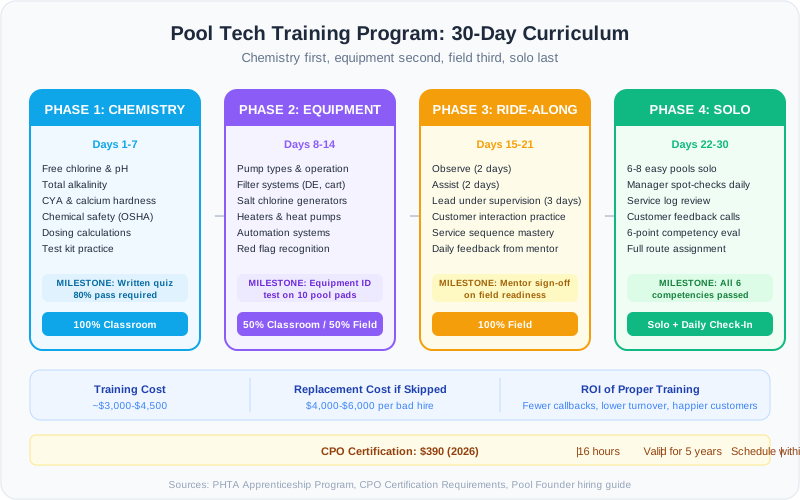
Phase 1: Water Chemistry Foundations (Days 1-7)
Chemistry comes first because every other skill depends on it. A tech who cannot read water test results will make wrong decisions at every stop. Start with the five core parameters every residential pool tech must understand before they touch a chemical.
| Parameter | Ideal Range | Why It Matters | Test Method |
|---|---|---|---|
| Free Chlorine | 2-4 ppm | Primary sanitizer, kills bacteria and algae | DPD test kit or FAS-DPD titration |
| pH | 7.4-7.6 | Controls chlorine effectiveness and bather comfort | Phenol red reagent |
| Total Alkalinity | 80-120 ppm | Buffers pH against rapid swings | Acid demand titration |
| Cyanuric Acid | 30-50 ppm | Protects chlorine from UV degradation | Turbidity test (melamine) |
| Calcium Hardness | 200-400 ppm | Prevents plaster etching or scale formation | EDTA titration |
Spend the first three days in a classroom or office setting. Use the Pool & Spa Operator Handbook as your textbook. Cover chemical safety (OSHA 29 CFR 1910.1200), proper handling and storage, and the relationship between pH and chlorine effectiveness. On days four through seven, move to live pools for hands-on testing under supervision.
Require every new tech to pass a 25-question written chemistry quiz before moving to Phase 2. Set the passing score at 80%. This is not optional. A tech who cannot calculate a chlorine dose from test results is not ready for the field.
The CPO certification exam requires 37 out of 50 correct answers to pass. While full CPO certification takes 16 hours and costs $390 as of 2026, your internal chemistry quiz should cover the same foundational concepts. Schedule CPO certification within the first six months of employment.
Phase 2: Equipment Identification and Basics (Days 8-14)
Week two shifts focus to equipment. Your tech needs to identify every major component on a pool pad, understand what it does, recognize when something looks or sounds wrong, and know when to call for help versus when to attempt a fix.
| Equipment | What to Teach | Common Issues to Recognize |
|---|---|---|
| Variable-speed pump | Programming, priming, seal inspection | Air leaks, unusual noise, error codes |
| Single-speed pump | Motor replacement basics, impeller clearing | Humming without running, overheating |
| DE filter | Backwash procedure, DE recharge amounts | High pressure, DE in pool, cracked grids |
| Cartridge filter | Removal, cleaning, replacement schedule | Pressure above clean baseline, collapsed pleats |
| Salt chlorine generator | Cell inspection, cleaning, salt level calibration | Low salt warnings, scale buildup on cell |
| Gas heater | Ignition sequence, error code lookup | Failure to ignite, rusted heat exchanger |
| Heat pump | Airflow requirements, defrost cycle | Icing, fan not running, low output |
| Automation system | Basic programming, relay identification | Communication errors, relay failures |
Build a photo library of every equipment configuration your company services. New techs study it before field visits. When they arrive at a pool pad for the first time, nothing should be completely unfamiliar. This library becomes your most valuable training asset over time.
Create a "red flag" list: equipment conditions where the tech must stop and call the office before proceeding. Examples include gas leaks, exposed wiring, cracked pump housings, and main drain cover damage. This prevents costly mistakes during the learning period.
Phase 3: Field Procedures and Ride-Alongs (Days 15-21)
Week three is where classroom knowledge meets reality. Your new tech rides along with your most experienced technician. Not your fastest tech. Not your highest-revenue tech. Your most methodical, process-oriented tech. Speed comes later. Right now you are building habits.
The Standard Service Sequence
- 1Arrive, check gate and access. Note any property changes.
- 2Test water chemistry before touching anything. Log results in the app.
- 3Skim surface, brush walls and tile line, vacuum if needed.
- 4Empty pump and skimmer baskets.
- 5Check filter pressure and compare to clean baseline.
- 6Inspect equipment pad: look, listen, feel for abnormalities.
- 7Add chemicals based on test results and dosing charts.
- 8Take a completion photo of the pool surface.
- 9Log service notes, flag any issues for follow-up.
During the ride-along phase, the new tech observes for two days, assists for two days, then leads the service while the mentor observes for three days. The mentor provides real-time feedback after each stop. Written notes go into a shared document that the manager reviews daily.
Customer interaction training happens naturally during ride-alongs, but address it explicitly. Teach the tech to greet the customer by name if they are home, explain what they are doing in plain language, and report any issues before leaving the property. "Mrs. Johnson, your pool looked great today. I noticed your filter pressure is getting high, so we may want to schedule a filter clean in the next couple of weeks."
Phase 4: Solo Readiness Evaluation (Days 22-30)
The final week is a supervised solo phase. Your new tech runs a short route of 6 to 8 easy pools independently. The manager checks their work at 2 to 3 random stops each day, reviews all service logs, and debriefs at the end of each day.
Solo Readiness Checklist
| Competency | Evaluation Method | Pass/Fail Criteria |
|---|---|---|
| Water chemistry accuracy | Manager retests 3 pools, compares results | All readings within 10% of manager results |
| Chemical dosing accuracy | Review logged doses vs. calculator outputs | No overdoses, all doses within recommended range |
| Equipment inspection | Tech identifies 5 planted issues on test route | Must catch at least 4 of 5 |
| Service time management | Track stop times across full route | Within 15% of target time per pool type |
| Customer communication | Manager calls 3 customers for feedback | No complaints, all customers satisfied |
| Documentation quality | Review 5 consecutive service logs | All fields complete, photos attached, issues flagged |
If the tech fails any competency, extend training by one week in that specific area. Do not push someone to a full solo route before they are ready. The cost of one angry customer or one green pool wipes out whatever you saved by rushing.
$4,000-$6,000
average cost to replace a pool technician who quits or is fired within the first 90 days
Source: PHTA Workforce Surveys
Building SOPs That New Techs Can Actually Follow
Your Standard Operating Procedures document is only useful if it is short, visual, and accessible from a phone. Nobody reads a 40-page binder in a truck. Build your SOPs as checklists with photos, accessible through your service app.
What Every SOP Should Include
- A numbered step-by-step process (10 steps maximum)
- Photos showing the correct result at each step
- Decision points: "If X, do Y. If not, call the office."
- Chemical dosing charts for the three most common pool sizes on your routes
- Emergency procedures: chemical spill, electrical issue, injury
Create separate SOPs for each service type: weekly maintenance, filter cleaning, green pool recovery, equipment startup, and winterization. Each SOP should take less than two minutes to read. If it takes longer, break it into two SOPs.
Update SOPs every quarter based on mistakes from the field. When a tech makes an error, add a specific step to the SOP that prevents that error. Your SOPs should be living documents that get better over time.
Ongoing Development After the First 30 Days
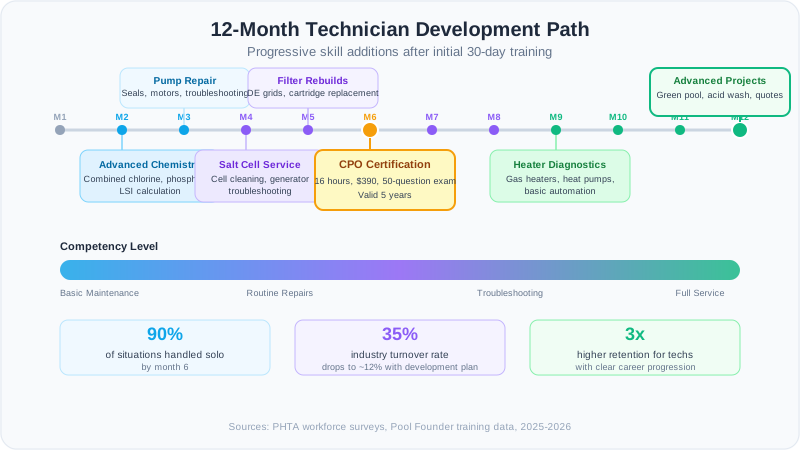
Training does not end at day 30. Build a 12-month development plan that progressively adds skills. Month two: advanced chemistry troubleshooting. Month three: pump repair basics. Month four: salt cell maintenance. By month six, the tech should be comfortable handling 90% of situations independently.
| Timeline | Skill Addition | How to Train |
|---|---|---|
| Month 2 | Advanced chemistry (combined chlorine, phosphates) | Classroom session + field practice |
| Month 3 | Pump seal replacement, motor troubleshooting | Ride-along with repair tech |
| Month 4 | Salt cell cleaning, generator troubleshooting | Hands-on with mentor |
| Month 5 | Filter rebuilds (DE grids, cartridge replacement) | Shop training + field practice |
| Month 6 | CPO certification | 16-hour PHTA course ($390 in 2026) |
| Month 9 | Heater diagnostics, basic automation programming | Manufacturer training videos + field practice |
| Month 12 | Green pool recovery, acid wash, equipment quotes | Lead on supervised projects |
Schedule a monthly one-on-one with each tech to review their development. Ask what they are struggling with. Check their service logs for patterns. A tech who consistently overdoses chlorine needs more chemistry review. A tech whose stop times are climbing may be encountering equipment they do not recognize.
Common Training Mistakes to Avoid
After 15 years of building pool service teams, Corey Adams has seen every training shortcut fail in predictable ways. Here are the mistakes that cost pool companies the most money and the most technicians.
- Skipping chemistry and going straight to field work. This creates techs who add chemicals by habit instead of by test results.
- Using your fastest tech as the trainer. Fast techs cut corners that new techs will copy. Use your most methodical tech.
- No written evaluation. If you cannot measure competency, you cannot manage it. Gut feelings are not a training program.
- Sending new techs to the hardest pools first. Start with simple, well-maintained residential pools and gradually increase complexity.
- No ongoing development plan. Techs who stop learning start looking for other jobs. The industry turnover rate of 35% is largely a training problem.
The pool service companies with the lowest turnover rates are the ones that invest the most in ongoing training. It is not a coincidence. Technicians stay where they feel competent and where they see a path to growing their skills and income.
Ready to streamline your pool service business?
Pool Founder gives you route optimization, automated invoicing, chemical tracking, and everything else you need to run a more profitable pool business.
Frequently Asked Questions
How long does it take to fully train a pool technician?
A structured 30-day program produces a tech who can handle routine residential maintenance independently. Full competency across all service types, including equipment repair, green pool recovery, and commercial pools, takes 9 to 12 months of progressive development. The PHTA recommends 2,000 hours of on-the-job training for their apprenticeship program.
Should I require CPO certification for all technicians?
CPO certification is strongly recommended but not legally required in most states for residential pool service. Schedule it within the first six months of employment. The 16-hour course costs $390 in 2026 and covers water chemistry, equipment, and safety. It pays for itself in reduced chemical waste and fewer callbacks.
How do I train techs when I am too busy running routes myself?
If you are a solo operator, dedicate the first week to classroom chemistry training before or after your route. During weeks two and three, bring the new tech on your route as a ride-along. By week four, give them your easiest pools while you handle the rest. You will be slower for a month, but you will gain a competent tech who frees up your time permanently.
What is the biggest mistake pool companies make when training new technicians?
Skipping chemistry and jumping straight to field work. When a tech does not understand why they are adding chemicals, they add by habit instead of by test results. This leads to overdosing, underdosing, green pools, and callbacks. Chemistry is the foundation that makes every other skill work correctly.
How do I know when a new tech is ready to go solo?
Use a formal evaluation checklist covering water chemistry accuracy, chemical dosing, equipment inspection, time management, customer communication, and documentation quality. The tech must pass all six competencies. If they fail any area, extend training in that specific skill for one additional week before re-evaluating.