Why Is Hiring Pool Technicians the Biggest Challenge in the Industry?
Pool service companies face persistent labor shortages that drain recruiting budgets, disrupt route consistency, and directly cap how fast owners can grow their businesses. According to the Skimmer 2025 State of Pool Service Report, labor shortages and inflation are the leading concerns for pool professionals, with hiring described as the primary scaling constraint for most businesses. SHRM reports the average time-to-fill for an open position is 44 days nationally, and in competitive trades markets like Phoenix and South Florida that number stretches further during peak season.
The technician shortage is structural, not seasonal. The pool service industry competes for the same labor pool as HVAC, landscaping, pest control, and plumbing. All of these trades offer similar pay ranges, and many offer indoor work or year-round stability that pool service cannot always match. Winning this competition requires a systematic approach to compensation, recruiting channels, training speed, and long-term retention.
This guide covers recruiting, interviewing, compensation, training, and retention strategies based on data from pool service companies across the U.S. Whether you are hiring your first technician or building a team of ten, each section includes specific numbers, timelines, and tactics you can implement this week.
How Much Should You Pay Pool Service Technicians in 2026?
Experienced pool service technicians command $18-25 per hour nationally in 2026, entry-level hires start at $14-17 per hour depending on market, and total compensation including benefits adds 20-30% on top of base pay. These numbers have increased 8-12% since 2023, driven by trade labor shortages, minimum wage increases in key pool states, and aggressive hiring by larger operators consolidating the market.
Underpaying by even $2 per hour relative to your local market creates a revolving door. A technician earning $16/hr who can get $18/hr across town will leave within 90 days, and the $4,000-6,000 replacement cost (approximately 16-20% of annual salary per the Center for American Progress) dwarfs the $4,160 annual difference in wages. Pay at or slightly above market rate from day one.
What Are Pool Technician Salary Benchmarks by State?
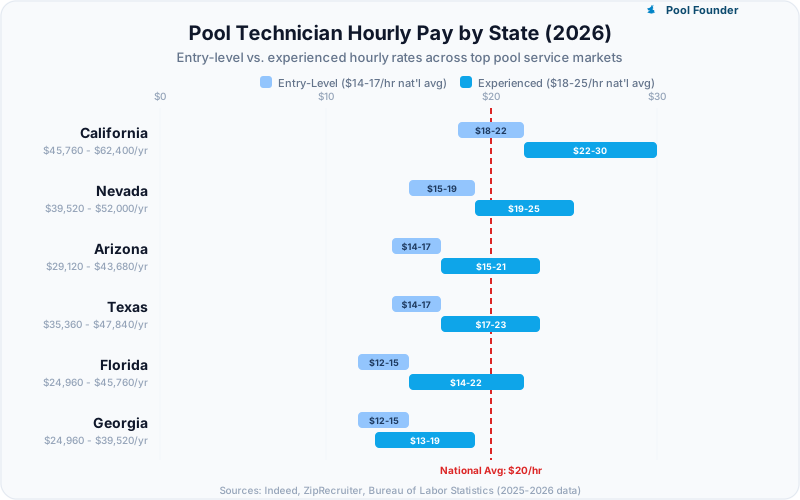
California leads the nation at $22-30 per hour for experienced techs according to Indeed and Glassdoor data, driven by high cost of living, strict licensing requirements, and intense competition from construction trades paying $35+ per hour. Sun Belt states with lower costs of living cluster in the $14-22 range per ZipRecruiter, but local variation within a state can be significant. A technician in Tampa earns 10-15% more than one in Ocala, even though both are in Florida.
| State | Entry-Level ($/hr) | Experienced ($/hr) | Annual Salary Range |
|---|---|---|---|
| California | $18-22 | $22-30 | $37,440 - $62,400 |
| Nevada | $15-19 | $19-25 | $31,200 - $52,000 |
| Arizona | $14-17 | $15-21 | $29,120 - $43,680 |
| Texas | $14-17 | $17-23 | $29,120 - $47,840 |
| Florida | $12-15 | $14-22 | $24,960 - $45,760 |
| Georgia | $12-15 | $13-19 | $24,960 - $39,520 |
These figures represent base hourly wages before overtime, bonuses, and benefits. Many experienced technicians earn an additional $3,000-8,000 per year through performance bonuses and overtime during peak season (April through September).
Should You Pay Hourly, Salary, or Per-Route-Stop?
Hourly pay remains the industry standard for 80% of pool service companies because it simplifies overtime compliance, aligns with state labor laws, and keeps payroll predictable during slow weeks. Salary and per-stop models each have legitimate use cases, but both carry risks that hourly avoids.
| Pay Model | Best For | Pros | Cons |
|---|---|---|---|
| Hourly ($14-30/hr) | Most companies | Simple overtime compliance, predictable costs, easy to adjust | No built-in incentive to work efficiently |
| Salary ($35K-55K/yr) | Senior techs, route managers | Retention signal, simplifies payroll, attracts career-minded hires | Must still track hours for overtime eligibility, risk of overwork |
| Per-Stop ($5-8/stop) | High-volume residential routes | Aligns incentives with output, top earners make more | Needs minimum daily guarantee, quality can suffer if rushed |
Per-stop pay at $5-8 per stop aligns technician incentives with productivity and can result in top performers earning $25-32 per hour equivalent. The critical requirement is a daily minimum guarantee, typically $120-160 per day, so technicians are not penalized for weather cancellations or light route days. Without that floor, per-stop pay creates resentment during slow periods.
Salary works best for senior technicians and route managers who you want to retain long-term. Converting a top hourly tech to a $48,000-55,000 salary signals commitment and simplifies their financial planning. Pair it with a quarterly performance bonus to maintain the productivity incentive that salary alone removes.
What Benefits Matter Most to Pool Technicians?
Two-thirds (66%) of blue-collar workers rank paid time off as the most attractive benefit and 65% cite flexible scheduling according to HR.com research, while company vehicles are the highest-impact practical perk for pool technicians because they eliminate $400-700 per month in personal fuel, vehicle wear, and commercial insurance costs.
- Health insurance: Required for companies with 50+ full-time employees under the ACA; smaller companies offering it gain a major recruiting edge. Budget $300-600/month per employee for employer contribution.
- Company vehicle: Eliminates technician fuel and wear costs. Estimated value to the tech: $400-700/month. Costs the company $500-800/month including payment, insurance, and maintenance.
- Gas card: If no company vehicle, a gas card covering $150-300/month in fuel costs is the minimum expected perk for route technicians.
- Paid time off: Start at 5 days in year one, increase to 10 days by year three. Pool technicians who never get a break burn out faster.
- Performance bonuses: $150-300/month potential tied to route completion rate, customer satisfaction scores, and upsell revenue. Pays for itself through reduced callbacks and higher retention.
- Tool and certification reimbursement: Cover CPO certification ($350-390 per PHTA 2026 pricing) and basic tool replacement. Small cost, large loyalty signal.
A benefits package that includes health insurance, a company vehicle, and performance bonuses adds $12,000-18,000 per year to your cost per technician. However, companies offering this package report 40-50% lower turnover than those offering hourly pay alone, saving $8,000-12,000 per year in avoided replacement costs.
Where Should You Recruit Pool Service Technicians?
Referred employees are retained at 46% after one year compared to just 33% from job board hires per ClearCompany data, 82% of employers rate referrals as generating the best hiring ROI, and the best pool technicians rarely apply through public listings because the talent pool skews toward word-of-mouth connections and direct outreach from competing companies.
A diversified recruiting strategy uses three to four channels simultaneously: one high-volume platform for lead generation, one industry-specific source for experienced candidates, one referral program for quality, and one unconventional channel for cross-trade recruits. Running all four gives you pipeline coverage that no single channel provides.
Which Job Platforms Work Best for Pool Service Hiring?
Indeed generates the highest applicant volume at 15-30 applicants per 30 days for pool technician roles, but only 10-15% of those applicants have relevant trade experience. ZipRecruiter offers better targeting with skill-based matching, while Facebook Jobs reaches passive candidates who are not actively searching but might switch for the right offer.
| Platform | Cost | Avg. Applicants / 30 Days | Quality Rating | Best For |
|---|---|---|---|---|
| Indeed | Free tier + $5-15/day sponsored | 15-30 | Medium | High volume, entry-level |
| ZipRecruiter | $16-36/day | 10-20 | Medium-High | Skill-matched candidates |
| Facebook Jobs | Free to post | 8-15 | Medium | Passive candidates, local reach |
| Craigslist | $10-75 per post | 5-12 | Low-Medium | Blue collar, immediate availability |
| PHTA Job Board | Member access | 2-5 | High | Experienced, certified techs |
| Trade schools | Free relationship | 1-3 | High | Trainable entry-level with aptitude |
Write job ads that lead with compensation, not responsibilities. "Pool Technician - $18-24/hr + Company Truck + Benefits" outperforms "Seeking Hardworking Pool Technician" by 3x in click-through rate. Include the pay range, list the top three benefits in the first two lines, and keep the job description under 400 words. Long, requirement-heavy posts filter out good candidates who do not want to read a novel.
How Do You Recruit Technicians from Other Trades?
HVAC installers, landscaping crew members, pest control technicians, and auto mechanics all possess the mechanical aptitude, outdoor work tolerance, and route-based work habits that transfer directly to pool service. Cross-trade recruits typically reach full productivity 25-30% faster than candidates with no trade background because they already understand tool handling, customer property etiquette, and working independently.
Target cross-trade recruits by highlighting what pool service offers that their current trade does not. HVAC techs spend hours in attics and crawlspaces. Landscapers work in direct sun doing heavy physical labor. Pest control involves chemicals in enclosed spaces. Pool service happens outdoors with water, involves moderate physical effort, and offers route autonomy that most trades lack.
- Outdoor work in a pool environment, not attics, crawlspaces, or rooftops
- Route independence: no supervisor standing over you all day
- Moderate physical demands compared to landscaping or construction
- Year-round work in Sun Belt states, seasonal but predictable elsewhere
- Clear career path from technician to route manager to operations
Post in trade-specific Facebook groups, attend local home service networking events, and ask your HVAC and plumbing vendor reps if they know any technicians looking for a change. Vendor reps interact with dozens of trade businesses weekly and often know who is unhappy.
How Can Employee Referrals Build Your Team?
Referred employees are retained after one year at a rate of 46% compared to 33% for job board hires (ClearCompany), and ERIN reports that 45% of referred hires stay four or more years versus just 25% of job board hires who stay two years. A structured referral bonus program paying $500-1,000 per successful hire after 90 days is the single highest-ROI recruiting investment for pool service companies under 20 employees.
Structure your referral program with clear rules: the referring employee gets $500 when the new hire completes 90 days, with an optional additional $500 at the six-month mark. The average employee referral bonus across trades is $1,000-$3,000 per Sprad research, so $500-$1,000 for pool service is competitive without breaking the bank. Pay the bonus in a separate check so it feels like a reward, not just part of a regular paycheck. Announce successful referral bonuses to the team so everyone sees the program is real.
A pool service company in Tampa implemented a $1,000 referral bonus (split $500 at 90 days, $500 at 6 months) and filled 4 of their 6 open positions through referrals within two months. Total recruiting cost: $4,000. Equivalent job board spend for the same hires would have been $6,000-9,000.
What Should Your Pool Technician Interview Process Look Like?
A structured two-stage interview with a paid ride-along is among the strongest predictors of job performance according to Staffing Advisors research on work sample tests, and companies using skills-based assessments report filtering out the majority of unqualified candidates before making a hiring decision. The ride-along costs only $75-100 per candidate yet cuts 90-day turnover dramatically. Most pool companies skip this step and rely on gut feeling during a 20-minute interview, which is why 46% of new hires fail within 18 months according to Leadership IQ.
Stage one is a 30-45 minute structured interview covering technical knowledge, work ethic indicators, and cultural fit. Stage two is a half-day paid ride-along with an experienced technician. Both stages use standardized scoring so you compare candidates objectively rather than going with whoever seemed friendliest.
What Questions Should You Ask Pool Technician Candidates?
Ten interview questions covering technical knowledge, behavioral patterns, and situational judgment predict on-the-job performance far better than open-ended conversation. Score each answer 1-5 and set a minimum threshold of 30 out of 50 to advance to the ride-along stage.
- 1"What experience do you have working outdoors in heat for extended periods?" Good answer: specific examples of outdoor work, strategies for staying hydrated, no complaints about weather.
- 2"Describe a time you had to figure out how to fix something you had never seen before." Good answer: systematic troubleshooting approach, willingness to research or ask, persistence.
- 3"How do you feel about working alone for most of the day?" Good answer: preference for independence, self-motivated, comfortable making decisions without a supervisor.
- 4"What do you know about pool chemistry or water treatment?" Good answer: any relevant knowledge shows initiative. No knowledge is fine for entry-level if they show eagerness to learn.
- 5"Tell me about a time you had a difficult interaction with a customer. How did you handle it?" Good answer: stayed calm, listened, found a resolution, did not argue.
- 6"What does your ideal daily work schedule look like?" Good answer: early starts are fine, flexible on end time, understands routes run until the work is done.
- 7"Why are you leaving your current job?" Red flags: blaming everyone else, short tenures at multiple jobs, vague answers about "looking for something different."
- 8"How do you handle being behind schedule when you have 15 stops to complete?" Good answer: prioritizes, communicates proactively, does not cut corners on quality.
- 9"Are you comfortable driving a large vehicle (truck/van) and maintaining it?" Good answer: clean driving record, experience with work vehicles, basic maintenance awareness.
- 10"Where do you see yourself in two years?" Good answer: growth within the company, interest in senior tech or management roles, stability-oriented.
Print a standardized scorecard with these 10 questions and a 1-5 rating scale for each. Every interviewer uses the same scorecard. This eliminates the bias of "I just had a good feeling about them" and lets you compare candidates numerically.
Why Should You Include a Paid Ride-Along in Your Hiring Process?
A half-day paid ride-along at $75-100 reveals work ethic, mechanical aptitude, and customer interaction skills that no interview question can reliably assess. You see how candidates react to physical work in real conditions, whether they ask questions or stand idle, and how they interact with homeowners at the door.
Pair the candidate with your best technician, not your newest one. Brief the tech beforehand on what to observe: Does the candidate show initiative? Do they ask questions about what they are seeing? Are they comfortable around equipment? Do they seem physically able to handle the work? How do they interact when a customer walks out?
- Red flag: Candidate checks phone repeatedly during stops
- Red flag: Candidate does not ask a single question in four hours
- Red flag: Candidate complains about the heat, the walking, or the pace
- Red flag: Candidate is rude or dismissive to a customer
- Green flag: Candidate offers to carry equipment without being asked
- Green flag: Candidate asks about chemical names, equipment types, and process
- Green flag: Candidate interacts positively with homeowners
- Green flag: Candidate asks about training timeline and advancement
Pay every ride-along candidate regardless of whether you hire them. This is non-negotiable for legal compliance in most states and builds your reputation as a fair employer. The $75-100 cost per candidate is trivial compared to the $4,000-6,000 cost of a bad hire who quits or gets fired at week six.
How Do You Train a New Pool Technician in 30 Days?
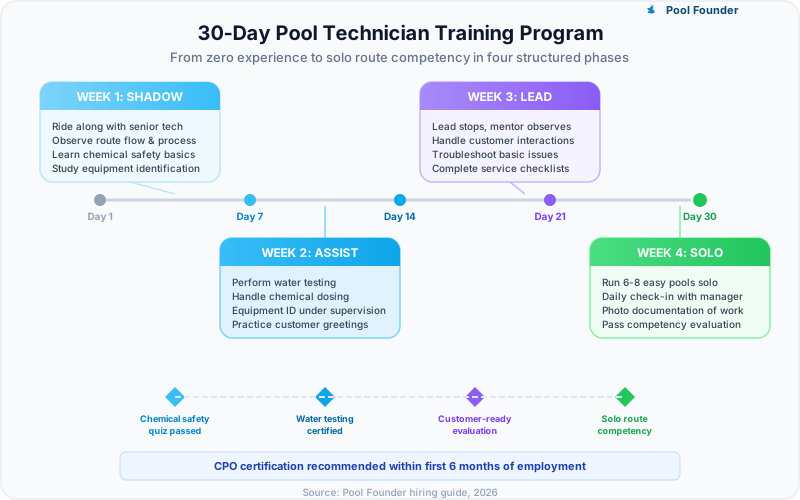
The industry-standard 30-day training program moves new hires from zero experience to solo route competency through a structured four-phase progression of shadow, assist, lead, and solo that reduces training-related callbacks by 70% compared to the old method of throwing new techs on routes after three days. Companies that invest in structured training report 50% lower 90-day turnover because new hires feel prepared rather than overwhelmed.
Each phase builds on the previous one, with a clear competency gate at the end of each week. A technician who is not ready to advance stays in the current phase until they pass. Rushing the timeline to fill a route gap creates callbacks, customer complaints, and a technician who feels set up to fail.
What Does a Week-by-Week Pool Technician Training Schedule Look Like?
Week one focuses exclusively on observation and safety because chemical mishandling sends 2,800 pool workers to emergency rooms annually, making it the single most important training priority before a new hire touches any equipment or product.
| Week | Phase | Focus Areas | Competency Gate |
|---|---|---|---|
| Week 1 | Shadow | Ride with senior tech, observe route flow, chemical safety, equipment identification, company procedures | Pass chemical safety quiz (90%+ score) |
| Week 2 | Assist | Perform water testing, handle chemical dosing under supervision, identify equipment types and common issues, practice customer greetings | Correctly test and dose 10 pools with zero errors |
| Week 3 | Lead | Lead service stops with mentor present, handle customer interactions, troubleshoot basic equipment issues, complete full service checklists | Lead 8 stops independently with mentor observing (rated satisfactory or above) |
| Week 4 | Solo | Run 6-8 easy pools independently, daily check-in call with manager, photo documentation of all work, flag anything unusual for senior tech review | Complete solo week with zero customer complaints and manager sign-off |
Week one: shadow phase. The new hire rides along with your most experienced and patient technician for five full days. They carry equipment, observe every step, learn chemical names and safety data sheets, and complete a chemical safety quiz on Friday. No exceptions: nobody touches chemicals without passing the safety quiz.
Week two: assist phase. The new hire performs water testing and chemical dosing under direct supervision. The mentor watches every test, corrects technique in real time, and has the new hire identify equipment at each stop. By Friday, the new hire should be able to test water, calculate chemical doses, and identify pumps, filters, heaters, chlorinators, and automated systems.
Week three: lead phase. The new hire runs each stop while the mentor observes and intervenes only when necessary. This is where customer interaction skills get tested. The new hire handles homeowner questions, documents service in the app, and troubleshoots minor issues like a cloudy pool or a tripped breaker. The mentor provides feedback after each stop, not during.
Week four: solo phase. The new hire runs a shortened route of 6-8 straightforward residential pools independently. They call the manager for a daily 10-minute check-in, send photos of completed work, and flag anything unusual. The route intentionally includes only easy pools: no green pools, no equipment repairs, no difficult customers. Success in week four earns full route assignment starting week five.
What Pool Industry Certifications Should Technicians Get?
The Certified Pool Operator (CPO) certification is the most impactful credential in the pool service industry, costs $350-390 for the two-day course (with the 2026 PHTA-mandated price at $390), and is increasingly required by commercial clients, HOAs, and municipal contracts. New technicians should target CPO certification within their first six months, not during initial training when they need to focus on hands-on skills.
| Certification | Provider | Cost | Duration | Timeline |
|---|---|---|---|---|
| CPO (Certified Pool Operator) | Pool & Hot Tub Alliance | $350-390 | 2-day course + open book exam | Within first 6 months |
| AFO (Aquatic Facility Operator) | National Recreation & Park Assoc. | $300-400 | 2-day course + exam | Alternative to CPO, within 6 months |
| PHTA Service Tech Certification | Pool & Hot Tub Alliance | $200-350 | Online + exam | Within first year |
| State Contractor License | Varies by state | $100-500 | Application + exam (some states) | When required for repair/construction work |
Cover the full cost of CPO certification for any technician who has been with you for 90 days. This $350-390 investment signals career commitment, opens commercial contract eligibility, and creates a retention incentive since the technician knows they got the cert through your company. The certification is valid for five years. Require a one-year commitment post-certification with a prorated repayment clause if they leave early.
The AFO (Aquatic Facility Operator) certification is a viable alternative to CPO and is accepted by many commercial facilities. However, CPO has broader name recognition in the pool service industry and is specifically mentioned in more RFPs and contract requirements. When in doubt, get CPO first.
How Do You Retain Pool Technicians and Reduce Turnover?
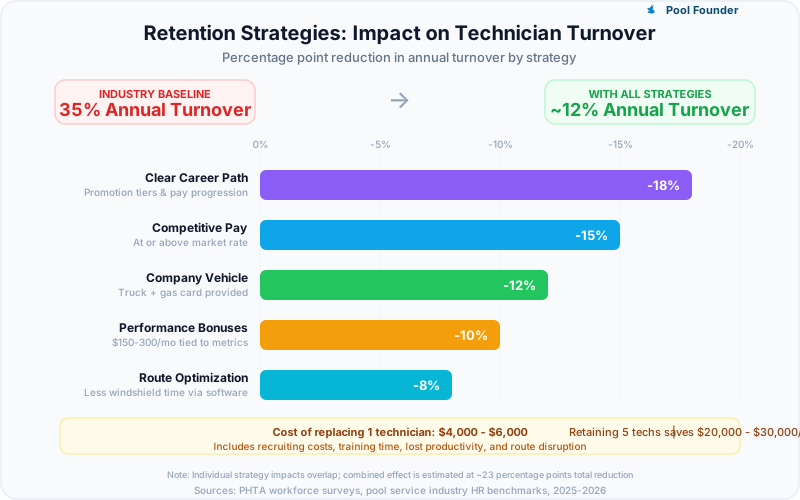
Replacing a pool technician costs $4,000-6,000 in recruiting fees, training time, and lost route productivity, making retention the single highest-ROI investment for any pool service company running more than two routes. A company with 8 technicians and 35% turnover replaces roughly 3 techs per year at a total cost of $12,000-18,000. Dropping that turnover to 12% through systematic retention strategies saves $8,000-14,000 annually while improving route consistency and customer satisfaction.
$4,000-$6,000
Average cost to replace one pool service technician
Source: Center for American Progress (16-20% of annual salary), SHRM
What Causes Pool Technicians to Quit?
According to Pew Research Center, 63% of workers who quit cite low pay and 63% cite no advancement opportunities, while 57% cite feeling disrespected. Among blue-collar workers specifically, 78% cite non-wage factors including lack of engagement, poor management relationships, and limited career growth (Orca Lean). Fixing pay alone does not solve the problem.
| Reason for Leaving | Workers Citing This Reason | Primary Fix |
|---|---|---|
| Low pay relative to market | 63% (Pew Research) | Annual market rate audit, adjust within 30 days |
| No advancement opportunities | 63% (Pew Research) | Documented promotion tiers with pay increases |
| Feeling disrespected / poor management | 57% (Pew Research) | Weekly one-on-ones, quarterly reviews |
| Lack of flexibility / burnout | 45% (Pew Research) | Route optimization, balanced stop counts, PTO |
| Not having good benefits | 43% (Pew Research) | Competitive total compensation, company vehicle, health insurance |
Most technicians do not quit over a single issue. Pew Research found workers typically cite multiple overlapping reasons for leaving. Turnover is cumulative: a tech tolerates below-market pay if the route is easy and the manager is good. Remove one of those supports and the pay gap suddenly becomes intolerable. Address all factors simultaneously rather than fixing them one at a time.
What Retention Strategies Actually Work?
A clear career path with documented promotion tiers reduces turnover by 18 percentage points, the largest single-strategy impact, because it answers the question every technician eventually asks: what is next for me here? Companies without a visible advancement track lose their best people to competitors who offer one.
Build a five-tier career ladder with compensation attached to each level:
- 1Helper / Trainee ($14-17/hr): First 30 days, in training program, paired with mentor
- 2Pool Technician ($17-22/hr): Solo route capability, handles standard residential service
- 3Senior Technician ($22-27/hr): Handles complex repairs, mentors new hires, trusted with commercial accounts
- 4Route Manager ($27-32/hr or salary $56K-66K): Oversees 2-3 routes, conducts quality checks, handles escalations
- 5Operations Manager (salary $65K-85K): Manages all field operations, hiring, scheduling, fleet
Performance bonuses tied to measurable route metrics give technicians control over their earnings and reduce the "working for someone else" feeling that drives people to start their own operations. Structure bonuses around three metrics: route completion rate (did you finish all stops?), customer satisfaction (measured by complaint rate or app ratings), and upsell revenue (chemical sales, repair referrals).
- Route completion bonus: $50-100/month for maintaining 98%+ completion rate
- Customer satisfaction bonus: $50-100/month for zero complaints and positive feedback
- Upsell bonus: 5-10% commission on chemical sales and repair referrals generated
- Quarterly retention bonus: $200-500 for each quarter of continuous employment
- Annual performance review: documented pay increase of $0.50-2.00/hr based on performance tier
Route ownership builds pride and customer relationships that make technicians reluctant to leave. Assign the same technician to the same pools every week. Customers learn their name, trust their judgment, and specifically request them. A technician who feels ownership over "their" 20 pools is far harder to lose than one who gets shuffled across random routes weekly.
How Does Technology Help With Technician Retention?
Route optimization software reduces daily windshield time by 20-35%, which translates directly into technicians finishing routes earlier, driving fewer miles, and experiencing less physical and mental fatigue. A technician who finishes at 3:30 PM instead of 5:15 PM every day is measurably happier and less likely to look for other work.
Mobile apps that eliminate paperwork remove one of the most common daily frustrations for field technicians. Instead of filling out paper service tickets, photographing them, and dropping them off at the office, a technician taps a few buttons on their phone and the service record is complete. Pool Founder's mobile app is built specifically for this workflow, letting technicians complete service documentation in under 30 seconds per stop with offline capability for areas with poor cell signal.
- Route optimization: 20-35% less drive time, earlier finish times, less fuel expense
- Mobile service documentation: eliminates paper tickets, reduces admin to 30 seconds per stop
- Offline capability: works in basements, rural areas, and dead zones without losing data
- Chemical tracking: automatic dosage logging reduces callbacks from incorrect treatments
- Customer communication: automated appointment reminders reduce gate-locked and no-access stops by 40%
Technology does not replace good management, fair pay, or career paths. It amplifies them. A well-paid technician with a clear promotion track AND a great mobile app is the hardest employee for a competitor to poach.
What Legal Requirements Apply to Hiring Pool Technicians?
Pool service employers must navigate state-specific licensing mandates, DOT vehicle regulations for trucks over 10,001 lbs GVWR, and chemical handling certifications that vary dramatically between the top 10 pool states. Getting compliance wrong exposes you to fines ranging from $500 for a paperwork violation to $50,000+ for an uninsured worker injury.
Before you post your first job ad, verify three things with your state licensing board and insurance agent: what licenses your technicians need, what insurance coverages change when you add employees, and what vehicle requirements apply to your fleet.
Do Pool Technicians Need a License?
Licensing requirements range from almost nothing in Texas, where routine pool cleaning requires no state license, to California's C-61/D-35 contractor license for any repair work exceeding $500, creating a compliance patchwork that multi-state operators must track individually.
| State | Cleaning/Maintenance | Repair/Equipment Work | Key Requirement |
|---|---|---|---|
| Florida | No state license for basic cleaning | Swimming Pool Contractor license for structural/plumbing repairs | CPO required for at least one supervisor per company for commercial work |
| California | No license for cleaning only | C-61/D-35 specialty license for repairs over $500 | Contractor license bond ($15,000), workers comp required for any employees |
| Texas | No state license required | No specific pool license, but general contractor rules apply for large repairs | Minimal state regulation; local permits may apply in some municipalities |
| Arizona | No state license for cleaning | ROC license required for repairs over $1,000 | ROC (Registrar of Contractors) license includes bonding and insurance requirements |
| Georgia | No state license required | Contractor license for plumbing/electrical pool work | County-level business licenses required in most jurisdictions |
| Nevada | Business license required | NV contractor license for repairs | State business license plus local licensing in Clark County/Las Vegas |
Even in states with minimal licensing, your business needs a general business license, and your employees need to be properly classified as W-2 employees (not 1099 contractors) if you control when, where, and how they perform their work. Misclassifying employees as contractors is the most common legal violation in pool service and carries penalties of $50 per misclassified W-2 plus back taxes and interest.
What Insurance Do You Need When Hiring Employees?
Adding your first employee triggers three mandatory insurance changes: workers compensation coverage (required in 48 states for companies with one or more employees), increased general liability limits, and commercial auto insurance for any vehicle the employee drives for work. According to Insureon, total added insurance cost for pool service companies runs $3,500-7,000 per employee per year, with workers comp averaging $136/month, general liability at $67/month, and commercial auto at $173/month per vehicle.
| Insurance Type | Required? | Estimated Annual Cost Per Employee | Notes |
|---|---|---|---|
| Workers Compensation | Yes (48 states) | $1,200-3,000 | Based on payroll amount and classification code. Pool service is moderate risk. |
| General Liability (increase) | Strongly recommended | $500-1,200 additional | Most policies need limit increase when adding employees. $1M/$2M minimum. |
| Commercial Auto | Yes, if company vehicle | $1,800-3,500 per vehicle | Covers employee-driven vehicles. Personal auto policies do NOT cover commercial use. |
| Employment Practices Liability (EPLI) | Recommended | $400-800 | Covers wrongful termination, discrimination, harassment claims. Critical with employees. |
Workers compensation rates for pool service typically fall under NCCI classification code 9014 (cleaning) or 5183 (plumbing), with rates ranging from $2.50 to $8.00 per $100 of payroll depending on state. Florida and California tend to have higher rates due to claims frequency. Shop workers comp quotes from at least three carriers because rates vary significantly.
Commercial auto insurance is the cost most new employers underestimate. A single work truck with comprehensive coverage runs $1,800-3,500 per year per vehicle, and you need a policy for every vehicle that touches a customer property. If technicians drive personal vehicles, you need hired and non-owned auto coverage on your business policy, which adds $300-600 per year but provides essential liability protection.
Talk to a commercial insurance broker who specializes in service businesses before hiring your first employee. A generalist agent will likely miss pool-service-specific exposures like chemical liability, pool equipment property damage, and the higher commercial auto limits that HOA contracts require.
Ready to streamline your pool service business?
Pool Founder gives you route optimization, automated invoicing, chemical tracking, and everything else you need to run a more profitable pool business.
Frequently Asked Questions
How much does it cost to hire a pool technician?
The total cost to hire one pool technician ranges from $2,500 to $6,000, including job advertising ($200-500), interview time (4-6 hours of manager time), paid ride-along ($75-100), background check ($30-50), uniforms and equipment ($300-500), and four weeks of training at reduced productivity ($1,500-3,000 in trainer time and slower output). Referral hires cost 40-60% less than job board hires because they skip most advertising spend and have faster ramp-up times.
What is the average pool technician salary in 2026?
The national average for experienced pool technicians is $18-25 per hour according to ZipRecruiter and Indeed, or $37,440-52,000 per year based on full-time hours. Entry-level technicians start at $12-17 per hour ($24,960-35,360/year) depending on state. California is the highest-paying state at $22-30/hr for experienced techs (Indeed, Glassdoor), while Georgia and Florida are at the lower end at $13-22/hr (ZipRecruiter). Total compensation including benefits, bonuses, and vehicle adds 20-30% above base pay.
Do pool technicians need certification?
For basic residential pool cleaning, most states do not require certification. However, the Certified Pool Operator (CPO) certification is increasingly expected by commercial clients, HOAs, and municipal contracts. CPO costs $350-390 for a two-day course (2026 PHTA pricing) and is the most widely recognized credential in the industry. Florida requires at least one CPO-certified supervisor for companies servicing commercial pools. California requires a C-61/D-35 contractor license for repair work exceeding $500.
How long does it take to train a new pool tech?
A structured training program takes 30 days to bring a new hire from zero experience to solo route competency. Week one is shadowing, week two is assisted work under supervision, week three is leading stops with a mentor present, and week four is solo work on an easy route with daily check-ins. Technicians with trade experience (HVAC, landscaping, plumbing) typically progress 25-30% faster through the program. Full expertise including equipment repair and troubleshooting takes 6-12 months.
What is the turnover rate in the pool service industry?
The broader field service and construction trades experience annual turnover rates ranging from 20% to over 60% depending on role and measurement methodology, according to BLS JOLTS data. Pew Research Center found the top reasons workers quit are low pay (63%), no advancement opportunities (63%), and feeling disrespected (57%). Companies implementing comprehensive retention programs including competitive pay, career ladders, and performance bonuses report turnover rates of 10-15%.
Should I hire employees or use subcontractors for pool service?
Hire W-2 employees if you control when, where, and how the work is performed. The IRS uses a behavioral control test, and most pool service arrangements where you assign routes, set schedules, and provide equipment clearly qualify as employment. Misclassifying employees as 1099 contractors carries penalties of $50 per W-2 plus back taxes and interest. True subcontracting works only when the contractor uses their own equipment, sets their own schedule, and serves multiple clients independently.
How many pools can one technician service per day?
An experienced pool technician services 15-25 residential pools per day depending on route density, drive time between stops, and service scope. The national average is 18-20 stops per day for basic weekly maintenance (skim, vacuum, test, dose). New technicians in their first month average 10-14 stops per day. Route optimization software increases daily capacity by 15-20% by reducing windshield time between stops.
What's the best time of year to hire pool technicians?
Start recruiting in January and February for peak season (April through September). This gives you 6-8 weeks for interviewing, ride-alongs, and the 30-day training program before routes hit full capacity in April. Hiring in March is possible but leaves almost no training buffer. Off-season hiring (October through December) offers the advantage of lower competition for candidates and a relaxed training pace, but finding candidates willing to start during the slow season is harder in seasonal markets.
Sources & References
- BLS Grounds Maintenance Workers Occupational Outlook
- Indeed Pool Technician Salary Data
- ZipRecruiter Pool Technician Salary Data
- Glassdoor Pool Technician Salary Data
- Center for American Progress Employee Replacement Cost Study
- SHRM Retaining Talent & Managing Employee Turnover
- Pew Research Center: Why Workers Quit in 2021
- BLS Job Openings and Labor Turnover Survey (JOLTS)
- OSHA Training Requirements